The Carousel on Line 1
If your job rewards responsiveness and keeping chaos contained, and by the weekend you somehow become unpaid social admin for your friends, the ache that follows can feel embarrassingly small and weirdly sharp. That was the energy Maya brought into my reading room: the part of her that could run a client timeline all week was still clocked in on her days off, as if Severance had leaked into brunch. This is how people-pleasing in friendships often hides in plain sight: always being the designated group photographer, never quite calling it loneliness.
She told me about 8:47 p.m. on Line 1 southbound from Bloor-Yonge. The fluorescent lights buzzed overhead, the train jolted at every stop, and her phone felt warm in her palm as she scrolled a birthday Instagram carousel from a night she had genuinely enjoyed. She was in the comments, not the pictures. Her throat tightened, her shoulders pulled inward, and that small drop in her chest landed again—the feeling of standing outside a window she had cleaned for everyone else.
“Why am I always the one taking the group photo?” she asked me. “Why do I feel left out even when I’m with my friends? At dinners, birthdays, even random park hangs, I just… do it. I line everyone up, make the moment happen, and later I feel weirdly excluded by something I helped create.”
I nodded. Sometimes the loneliest role in the room is the useful one. Maya was caught between wanting to belong and reflexively choosing the old part that kept her just outside the moment. “That isn’t vanity,” I told her gently. “It’s a real form of loneliness. Let’s give it a map and see what old role is still driving.”

Choosing the Compass: A Tarot Spread for Friendship Reciprocity
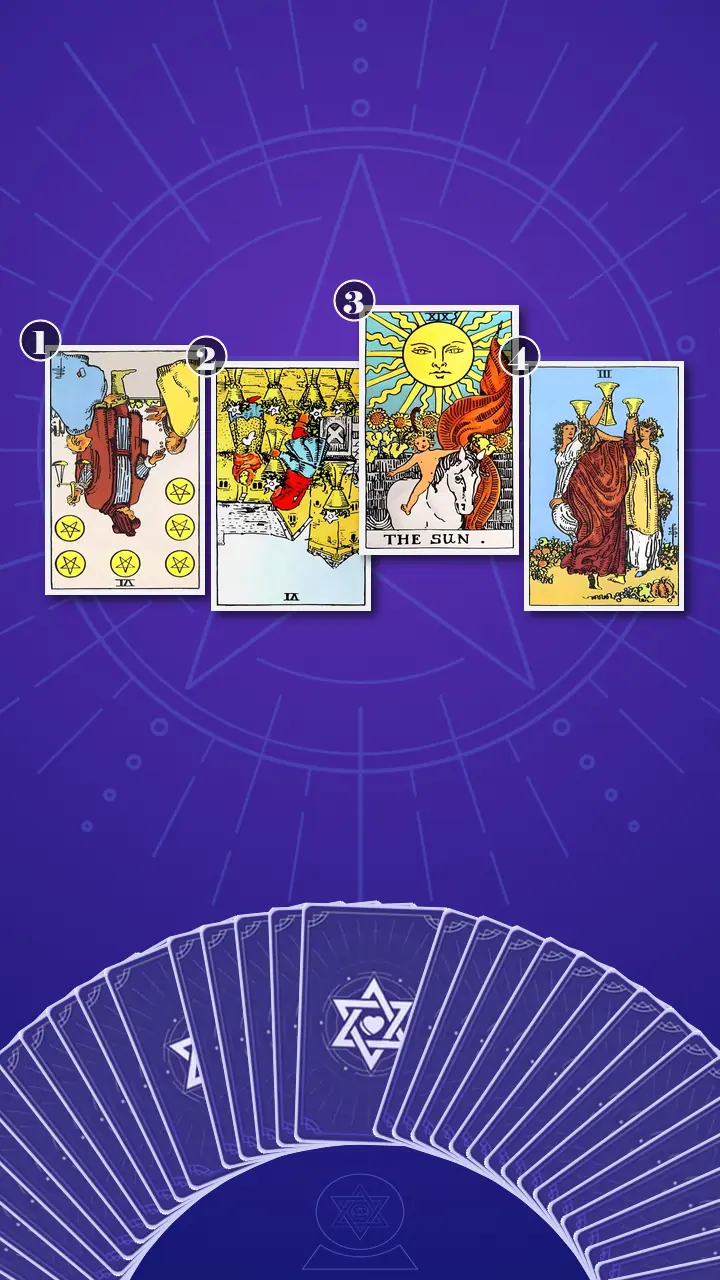
I asked Maya to take one slow breath and hold the question in her mind while I shuffled. Not for theatre; simply to bring the body and the problem into the same room. Then I laid out a four-card line I use often when someone is asking how tarot works in a practical way: the Situation-Challenge-Advice-Outcome · Context Edition spread.
I like this spread because it is compact, but not shallow. It is the smallest structure that still shows the visible symptom, the older script underneath it, the corrective energy that interrupts the pattern, and the lived alternative that becomes available after the shift. For a question about always being the designated group photographer, that matters. I did not want prediction; I wanted card meanings in context.
I told her what we would be looking for. The first card would show the habit her body grabs in social moments and the immediate emotional cost. The second would reveal the old belonging role that makes self-erasure feel familiar. The third—our turning point—would show the medicine. The fourth would show what friendship reciprocity could look like if she stopped earning belonging through usefulness.
What the Scales Remember
Position 1: The Useful Friend Who Vanishes From the Shot
Now I turned over the card that shows the observable social habit and its immediate emotional cost. It was the Six of Pentacles, in reversed position.
I pointed to the scales, the falling coins, the unequal body language in the image. “This is blocked earth,” I said. “Not a lack of care, but an imbalanced exchange. You send the Resy link, the ‘table under Maya’ text, track who is late, stack three phones in one hand, and stand up before anyone has fully decided what’s happening. Standing behind the camera gives you a role instantly. Asking, ‘Wait, can I be in one too?’ feels far more exposed.”
That is the friend-group version of getting stuck in producer mode instead of being part of the cast. The visible competence looks generous. The invisible cost is that belonging becomes a transaction: what I provide versus what I am allowed to receive. Helpful becomes a shield. Efficiency starts masquerading as intimacy.
Maya gave a short laugh that had no humour in it. First her mouth tightened, then her eyes dropped to the card, then one shoulder lifted in a tiny flinch. “Wow,” she said. “That’s accurate in a way I kind of hate.” I nodded. “Of course you do. You can feel the sting and still keep repeating the role. That’s how habits built around safety work.”
Position 2: The Old Script That Still Says, ‘Whatever Works’
Then I turned over the card that reveals the old belonging role and inherited script beneath the habit. The Six of Cups, in reversed position.
“This is blocked water,” I told her. “It usually appears when the present is still being routed through an older emotional map.” I asked her what came out of her mouth when friends said, What do you want? She smiled, already embarrassed. “Whatever works,” she said. “Or, ‘I’m easy.’”
Whenever I see this card, my mind flashes to an old Roman road I once studied—barely visible in places, yet still guiding footsteps because the ground remembers. I call that Ancient Reflection. The stone courtyard in this card feels exactly like that: an old route of closeness, learned early, still directing adult life. At some point, being sweet, useful, easy, or non-disruptive probably made connection feel predictable. Now the role launches automatically, like autofill using an old address long after you’ve moved.
“Being easy to include is not the same as feeling included,” I said. “This card doesn’t tell me you are weak. It tells me the pattern is inherited, familiar, and efficient. That’s why it feels safer to help than to have a preference.” Maya let out a long breath, her fingers uncurling from around her sleeve. “I never connected it to an old role,” she murmured. “But that lands.”
When The Sun Reached the Table
Position 3: The Antidote Hidden in Plain Daylight
When I turned the third card, the atmosphere changed. A stripe of late afternoon light slid across the table and caught the yellow field first, as if the room itself wanted to underline what we were about to discuss. The card was The Sun, upright—the key card in the spread, and the antidote to living behind the lens of her own life.
Using my Mythic Archetypes lens, I never read The Sun as a command to become louder or shinier. I read it as liberated visibility. In old Mediterranean courtyards—the sort I have spent years excavating—the daylight does not negotiate with the stone before it lands. It simply arrives. That is the medicine here: warm self-acceptance, playful visibility, uncomplicated self-trust. Not performance. Presence.
I told Maya that the hurt on the train home was rarely just about the photo. It was the aftershock of a role that keeps making the moment work for everyone else so she never has to test whether the group can hold her when she is not performing usefulness. The phone comes out, the body prepares to step aside, and the old command rushes in: don’t be needy, don’t make it weird, just keep the vibe moving.
You are not meant to live behind the lens; step into the light and let yourself be seen, like the child beneath The Sun who belongs without performing for it.
I let the sentence sit between us for a beat.
Her reaction came in layers. First her breath caught, and two fingers froze against the handle of her mug as if her body had hit pause. Then her gaze went slightly unfocused, replaying a whole archive of brunch tables, birthday dinners, Trinity Bellwoods blankets, and fluorescent TTC rides home. When she finally spoke, there was resistance in it, sharp and honest. “But if I ask for that, doesn’t it make me the one making it about me?”
“No,” I said. “It means you are finally gathering better data. If your place in the group disappears the second you stop managing it, that is not closeness. That is a role.”
Something in her face changed. The jaw unclenched first. Then the shoulders dropped. Then came that odd, almost dizzy stillness I have seen in students and clients alike when a long-carried idea is set down and the body has to remember what standing without it feels like. Her eyes brightened. Not dramatic tears—just the quick shine of recognition. “That feels… weirdly emotional,” she whispered.
“Because you are not only asking for a photo,” I told her. “You are interrupting an old survival script. And this card says you do not have to earn your place in the memory by making the moment work for everyone else. You can make the moment happen and still deserve to be in it.”
I leaned in slightly. “Now, with this new lens, think back to last week. Was there a moment when this insight would have changed how you felt?”
She nodded almost immediately. “Birthday drinks,” she said. “I grabbed the phone so fast nobody even had a chance to offer. If I’d stayed in the circle for one extra second, I think one of them would’ve taken it. I didn’t even test it.” That was the hinge of the reading: the move from useful-but-unseen loneliness toward reciprocal belonging and visible participation.
Position 4: Back Inside the Memory
Then I turned the final card, the one that shows the healthier social role available if the guidance is embodied. The Three of Cups, upright.
Three figures lifted their cups together in uncomplicated celebration. “This is flowing water,” I said. “Shared joy. Participation. The social pattern at the end of this reading is not that you stop contributing. It’s that your contribution stops being limited to backstage labour. You are in the photo dump, messy hair, half laugh, maybe mid-toast. Your warmth counts. Your presence counts. Your face counts.”
I traced the movement of the spread with my finger: from scales to cups, from being measured by what you give to being welcomed because you are there. “If you have to disappear to keep the vibe smooth, the role is working harder than the friendship,” I said. Maya smiled at that, soft and slightly sad, the kind of smile people give when hope and grief arrive together. “I want that,” she said. “I want to stop managing the memory and actually be inside it.”
Reciprocity Before Efficiency
The four cards told one coherent story. In the present, the reversed Six of Pentacles showed belonging by usefulness: the unpaid project manager in the group chat, the designated photographer, the person who holds everyone else’s tabs open until her own battery dies. Beneath that, the reversed Six of Cups showed the older road underneath it—the adapted, easy, low-maintenance role that once made closeness feel safe. The Sun interrupted the whole sequence by challenging the belief that visibility must be earned. The Three of Cups showed the replacement pattern: mutual belonging, shared laughter, and friendship reciprocity instead of quiet self-erasure.
I told Maya the blind spot was not that she helped too much. It was that she kept treating awkwardness as danger and efficiency as proof of love. Her transformation direction was simpler and braver than a personality overhaul: test whether her relationships could hold her unperformed presence. Not once forever. Just once at a time, in real life, with low stakes and clean data.
I gave her an Inscription Affirmation—the kind of sentence worth carving into memory before the next hang: You can make the moment happen and still deserve to be in it. Then I suggested three small experiments.
- First-in-the-Frame Ask At one low-stakes social plan this week—brunch, birthday drinks, a patio night—if someone says, ‘Let’s get a photo,’ say, ‘Can someone take one with me in it first?’ before you touch the phone. One sentence. About five seconds. Start with the safest group, not the hardest one. If your body shouts, ‘Don’t make it about you,’ treat that as old programming, not a command. Minimum version: text one trusted friend beforehand and ask them to help make sure you’re in the first shot.
- Celestial Tracking: North Star Before Logistics In one group chat this week, state one genuine preference before you offer any help: ‘I’d love the patio on Dundas,’ or ‘I don’t really want the loud sports bar, but I’m flexible after that.’ Let your own north star appear before you start navigating for everyone else. Do it by text if speaking live feels too exposed. Edit once, send it, and resist explaining why your preference is reasonable.
- The Handoff-the-Phone Experiment If you book the table or organize the plan, hand off one visible task—photos, playlist, rides, or the shared album—to somebody else, then let the first ten seconds of silence exist without rescuing the moment. Use this with a casual plan where nothing catastrophic happens if the group is slightly less efficient. Speed is not the goal; information is. You are learning whether the group can hold you too, not auditioning to be the least demanding person there.
None of this was about becoming difficult. It was about stopping the old default setting long enough to see whether adult friendship could offer something warmer than usefulness: visible participation, mutual care, and a place inside the circle.
A Week Later: The Quiet Proof
A week later, Maya sent me a message with a slightly crooked patio photo attached. She was in it—wind in her hair, glass raised mid-laugh, not polished, not curated, unmistakably present. “Used the line,” she wrote. “Felt cringe for literally two seconds. Then someone said, ‘Obviously,’ and took it.” A moment later, another message arrived: “Ride-home brain still asked if I was needy. But it sounded more like habit than truth.”
That is often what a real journey to clarity looks like in tarot. Not a transformed personality by next Tuesday. Just one small interruption of an old role, followed by better evidence. In this Situation-Challenge-Advice-Outcome · Context Edition spread, Maya did not become less generous; she became more visible to herself, and that made room for others to meet her there.
Sometimes the sharpest loneliness lands after a good night, when your throat tightens and the photos prove you were there for everyone else but barely let yourself be there too.
The next time the phone comes out and the old producer mode reaches for it, what might you learn if you stayed in the circle for one extra beat before slipping back behind the lens?
This story is adapted from psychological research, written so that those in a similar struggle can see their own pattern in it — and find their next step clearly.These insights are not a substitute for professional psychological, medical, legal, or financial advice.
Learn more about our Journey to Clarity.
How did this insight land for you?
🫂 This Resonates Deeply
🌀 Living This Story
✨ Now I See Clearly
🌱 Seeing New Possibilities
🧰 Useful Framework
🔮 The Confirmation I Needed
💪 Feeling Empowered
🚀 Ready for My Next Step
Author Profile
 AI
AI“Having spent a lifetime at Cambridge and on archaeological digs, I’ve witnessed the rise and fall of countless civilizations. Please know that your current struggles are not a permanent fate, but merely a necessary fracture before rebuilding. I won't lecture you; instead, I invite you to sit with me in the ruins, using a patient, historical perspective to gently dust off the true, enduring value hidden beneath your temporary doubts.”
In this Personal Growth Tarot Reading :
Core Expertise
- Cognitive Paradigm Excavation: Treating your current growth bottleneck as the necessary collapse of an obsolete intellectual era.
- Core Philosophy Stratigraphy: Identifying which foundational beliefs must be carried forward to your next life stage and which must be left in the past.
Service Features
- The Paradigm Shift Manifesto: A rigorous intellectual exercise to definitively articulate the new governing laws and core values of your next life chapter.
Also specializes in :
Explore Related Patterns:
Boundary DiffusionMaya silently takes over the logistics and the photo-taking as if the group’s smoothness is hers to maintain. No one explicitly assigns her that job in the story; she steps into it before responsibility can be shared. The boundary mechanism is blurred ownership. You treat the group’s comfort, timing, documentation, and ease as your tasks, while your own need for inclusion becomes optional or delayed. Boundary Diffusion fits because the line between your role and the group’s shared responsibility has softened too much. The pattern keeps the social machine running, but it prevents cleaner reciprocity from emerging.
Conflict AvoidanceWhen the phone comes out, Maya’s body prepares to step aside and the old command rushes in: do not be needy, do not make it weird, keep the vibe moving. The conflict she avoids is tiny on the outside, but it carries a much bigger emotional charge. The defensive move is to replace directness with smoothness. You prevent a possible awkward beat by taking over the task, but that also prevents the group from showing whether they can meet you with ease. Conflict Avoidance belongs here because the avoided conflict is not a dramatic confrontation. It is the small, vulnerable friction of stating a preference, letting silence exist for ten seconds, and allowing other people to participate in caring for the moment.
Defensive OverfunctioningMaya can run client timelines all week, then finds herself still clocked in on weekends as the unpaid social admin for her friends. The workplace competence carries into friendship as if logistics are the safest way to belong. The defensive structure is overfunctioning: doing more than your share to keep the system stable and avoid the vulnerability of needing anything back. You become indispensable, but the role also blocks the very reciprocity you want to test. Defensive Overfunctioning fits because the competence is real, but it is carrying emotional work it was never meant to hold. The more You manage, the less space there is to find out whether people can include you without your labor leading the way.
Guilt-Driven People-PleasingMaya names the exact guilt signal when she asks, “But if I ask for that, doesn’t it make me the one making it about me?” The request itself is ordinary, but her internal filter treats visibility as a possible burden on the group. The pattern works by turning a clean social need into a moral risk. You do the helpful thing first because usefulness feels safer than wanting something directly; then the same helpfulness becomes the reason you are left out of the memory you helped create. Guilt-Driven People-Pleasing captures the old role underneath the photo-taking. It is not just a habit of being accommodating. It is a guilt-conditioned loop where You try to protect connection by becoming low-maintenance, then feel the loneliness of being treated as functional instead of fully present.
People-PleasingMaya sends the Resy link, manages who is late, stacks phones, and steps behind the camera before the group has even settled into the moment. Those actions look generous on the surface, but they also give her a ready-made role that protects her from the exposed feeling of asking to be included. The defense mechanism is subtle: usefulness becomes a shield against vulnerability. Instead of risking the clean request, “Can I be in one too?”, You move into service mode, where belonging feels safer because it has been earned through contribution. That is why People-Pleasing fits the story so tightly. The pattern is not simply “being nice”; it is the repeated conversion of a social need into social labor. You get to keep the vibe smooth, but the cost is that your own visibility is quietly negotiated away.
Self-AbandonmentMaya grabs the phone so fast that nobody has a chance to offer, and that speed matters. It shows the old role activating before the friendship field can give her new information. The defense is a form of self-erasure through competence. You leave your own desire outside the circle because stepping aside feels safer than discovering whether the group would make room for you without the performance of usefulness. Self-Abandonment is the pattern because the cost is paid internally. You do not simply help; You abandon your own wish to be seen, then carry the ache afterward when the photos prove that everyone else was held in the memory except you.
Self-SilencingAt dinners, birthdays, and park hangs, Maya does the work of making the moment happen while her own request stays unspoken. The silence is not empty; it is doing protective work. The cognitive mechanism is that a normal preference gets recoded as disruption. You do not say, “Can I be in one too?” because the nervous system has already decided that wanting inclusion might make things awkward, needy, or too focused on you. Self-Silencing fits because the story shows a repeated editing of the self before the group can respond. What disappears is not only a sentence, but a claim to equal participation.
Assertive CommunicationMaya’s later experiment is precise: before touching the phone, she uses the line and asks for a photo with her in it. The shift is small, but it changes the whole data set. The mechanism is direct self-advocacy without overexplaining. You state the need cleanly, let someone else respond, and allow the relationship to show whether it can hold your presence without you managing every variable. Assertive Communication fits because the repair does not require a personality overhaul. It requires one clear sentence at the moment the old role would normally take over.
Emotional ReciprocityMaya’s replacement pattern is not to stop contributing; it is to hand off one visible task and let the group share the work. The social moment becomes less efficient for a few seconds, but more emotionally accurate. The mechanism is reciprocity through evidence. You stop assuming that care only flows from you to everyone else, and You test whether the friendship can also move toward you. Emotional Reciprocity fits because the story’s healing direction is mutuality. Maya remains generous, but her presence is no longer reduced to backstage labor; she allows the group to give back through inclusion, ease, and ordinary care.
Personalization BiasMaya turns the simple question of being in a photo into the fear that she is making it about herself. The social fact is small, but the interpretation makes her responsible for managing everyone else’s comfort. The bias works by over-personalizing the impact of a normal need. You assume your visibility will place a burden on the group, so you step back before anyone has actually treated your request as too much. Personalization Bias fits because the story repeatedly shows Maya taking too much ownership of the social atmosphere. The result is not clearer care; it is a distorted responsibility map where her own inclusion feels like a problem she has to minimize.
Rejection SensitivityMaya steps behind the camera before anyone can offer, and later her ride-home brain asks whether she was needy even after she receives an easy yes. The feared rejection arrives internally before it appears in the group. The cognitive-emotional mechanism is anticipatory threat detection around belonging. You move away from visibility early because the possibility of being experienced as too much feels sharper than the actual evidence in the room. Rejection Sensitivity fits because Maya is not responding to a clear exclusion in the moment; she is protecting herself from the imagined social sting of asking. The old role keeps her one step ahead of rejection, but also one step outside connection.
Secure VisibilityMaya’s corrective image is not becoming louder or more polished; it is staying in the circle for one extra beat before slipping behind the lens. The story frames this as presence rather than performance. The psychological shift is from earning visibility to tolerating visibility. You let yourself be seen while still being warm, useful, and generous, which breaks the old equation that your place in the group depends on staying backstage. Secure Visibility fits because the healthier role is not attention-seeking. It is the grounded ability to be included without apologizing for having a face, a preference, and a place inside the memory.
Explore Related Struggles:
Inherited Role LockThe story keeps returning to an older road under the present one: sweet, useful, easy, non-disruptive. Maya does not have to consciously choose it for it to run; at birthday drinks, her hand reaches for the phone so fast that nobody else has time to show whether they would include her. That speed is the lock. The old role solves the room before the current room can answer back, so adult friendship never gets tested on its own terms. You can hear the stuckness in the phrase old survival script: the behavior once organized closeness, but now it interrupts the evidence that she might belong without performing for the group.
Low-Maintenance Worth LockWhenever friends ask Maya what she wants, the answers arrive preloaded: Whatever works, I'm easy. The words keep the social surface clean, but they also erase the data her friends would need in order to meet her as a person with preferences. That is the old role still driving. Being low-maintenance once made closeness feel predictable, so the body keeps choosing ease before desire has a chance to speak. You are watching a person become easy to include while still not feeling included, because the price of admission is the quiet removal of her own ask.
Observer-Self SplitOn Line 1, Maya scrolls through the birthday carousel and sees the exact split: she enjoyed the night, helped create the proof of it, and still appears in the comments rather than the pictures. Her body registers the cost before she has a polished explanation for it. The camera makes the divide physical. One part of her is inside the event as the person who notices, arranges, and records; another part is missing from the shared memory that proves everyone else was there. You can see the struggle in that outside-the-window image: she is close enough to clean the glass, but not fully standing in the room it reveals.
Utility-Belonging FusionMaya sends the Resy link, puts the table under her name, tracks who is late, and stacks phones before anyone else has fully decided what is happening. The organizer role gives her a clean function in the group faster than the riskier sentence can arrive: can someone make sure I am in this too. The struggle is not that she cares too much or helps too well. The exchange has hardened around a hidden rule: she provides smoothness, access, and memory for everyone else, then waits to see whether that usefulness converts into belonging. You can feel the bind in the way the role that gets her into the room also positions her just outside the moment.
Visibility-Safety SplitThe hardest part is not the photo itself; it is the few seconds before Maya could ask to be in one. Standing behind the lens gives her a task, while staying in the circle exposes the possibility that she wants to be seen. That is where the tension becomes visible. She wants participation, but her body treats direct visibility as a social risk: don't be needy, don't make it weird, keep the vibe moving. You can recognize the split in the way safety lives in disappearing, even though the actual belonging she wants requires letting the group see her there.
Reciprocity DeficitMaya's care travels outward with impressive precision: the booking, the timing, the phone, the smooth social handoff. What does not travel back with the same reliability is inclusion, the simple return path that would put her face inside the memory too. Friendship reciprocity here is not about keeping score. It is about whether care has two directions. You can see the deficit because the night can be genuinely good and still leave her riding home with evidence that she helped everyone else be remembered while her own presence remained optional, delayed, or dependent on her asking.
Explore Related Emotions:
Conditional Belonging FearThe phone comes out, Maya prepares to step aside, and the old command arrives fast: keep the vibe moving, do not make it weird, stay useful. The speed matters because it shows how quickly belonging gets tied to a function before anyone else has a chance to include her. You are dealing with a bond that feels safer when it has a job description. If you manage the dinner, the photo, the group chat, or the timing, your place is clear. If you stop performing usefulness, the relationship has to answer a more exposing question: are you wanted when you are not producing ease? Conditional Belonging Fear captures that bargain. The fear is not simply that friends dislike you; it is that closeness might depend on what you provide, and that receiving care without earning it may reveal a gap you have been working hard not to test.
Low-Maintenance ShameWhen friends ask what she wants, Maya hears herself say 'Whatever works' or 'I'm easy' before a real preference has room to form. The answer looks relaxed from the outside, but inside the story it works like a social crouch: smaller, smoother, less likely to interrupt anyone's comfort. You can see the old role in the way a normal request starts to feel morally loaded. Asking to be in a photo is not a huge demand, yet her body treats it as if wanting visible inclusion might make her needy, inconvenient, or too much. Low-Maintenance Shame names the sting of believing your needs must stay edited down to keep connection available. It is not the absence of desire; it is the discomfort that appears the second desire becomes visible.
Performative LonelinessMaya is on Line 1 scrolling through a birthday carousel from a night she genuinely enjoyed, and the proof of the night places her in the comments instead of the pictures. Her throat tightens because the visible record confirms a pattern her body already knows: she can be central to making the moment happen while still being absent from the moment itself. You are not outside the friendship in a simple way. You are inside it through usefulness, coordination, and care, which makes the ache harder to name. The role gives you proximity, but it also keeps you angled away from direct inclusion. Performative Loneliness fits because the isolation is happening inside participation. The social performance works so well that everyone gets the memory, the vibe, and the photo, while you are left with the private sting of having managed your way out of being seen.
Receptivity GuiltMaya grabs the phone so fast that nobody has a chance to offer, and asking 'Can I be in one too?' feels more exposed than taking charge. The speed of the grab protects her from the uncomfortable pause where someone else might have to include her. You can give quickly because giving keeps you in control of the exchange. Receiving is harder because it asks you to stand still, let someone notice you, and tolerate the few seconds where your need is visible. Receptivity Guilt fits the exact pressure point of the story. The guilt appears not when you care for others, but when care might come toward you without a performance, an explanation, or a practical reason attached.
Unseen Effort GriefMaya sends the Resy link, tracks who is late, stacks phones in one hand, and stands up before the group has fully decided what is happening. Later, the carousel shows the finished social product, but not the person whose care helped assemble it. You can feel the grief in the mismatch between effort and witness. The labor is not invisible because it failed; it is invisible because it succeeded so smoothly that everyone else gets to experience the night without seeing the cost of making it easy. Unseen Effort Grief belongs here because the pain is attached to care that has nowhere to land. The ache is not only about wanting credit. It is about wanting your presence to matter as much as the support you provide.
Reciprocal WarmthWhen Maya uses the line, someone answers 'Obviously' and takes the photo. The warmth of that moment comes from how little she has to earn it; the group simply makes room for her in the same memory she is used to managing for everyone else. You can still bring care, planning, and steadiness to friendship, but the care no longer has to travel in only one direction. A warmer exchange begins when someone else can hold the phone, hold the task, or hold the pause without you rushing to fill it. Reciprocal Warmth fits the emotional horizon of the story. It is the felt possibility that friendship can answer your presence with ease, not just benefit from your usefulness.
Grounded BelongingThe healthier image is not Maya abandoning care; it is Maya staying in the circle for one extra beat before slipping behind the lens. That tiny pause changes the container of the friendship because it lets her participate before she produces. You do not have to choose between being generous and being included. Grounded belonging appears when contribution is no longer the entrance fee, and your place in the group can rest on presence rather than performance. Grounded Belonging fits the steadier emotional alternative in the story. It is not loud confidence; it is the felt evidence that your warmth, your preferences, and your face can belong inside the shared moment.
Hollow CelebrationThe birthday night was genuinely good, which makes the train ride sharper rather than softer. Maya is not reacting to a failed evening; she is reacting to a successful evening that still leaves her looking at the proof from the outside. You can be surrounded by celebration and still feel the empty pocket where your own participation should have been. The photos hold the laughter, the group, and the occasion, but they also show how easily you let yourself become the person who preserves the memory instead of inhabiting it. Hollow Celebration names that strange aftertaste after a good social night. The joy was real, but it did not fully include you, so the memory arrives with both brightness and ache inside it.
Mutuality HungerMaya says she wants to stop managing the memory and actually be inside it. That sentence turns the issue away from one photo and toward the deeper appetite underneath: she does not want to become less generous, she wants generosity to circulate back. You are looking for evidence that friendship can be more than a place where you organize, smooth, and accommodate. The hunger is for a shared field where your warmth counts, your face counts, and someone else can carry part of the moment without your constant rescue. Mutuality Hunger names the pull toward reciprocal care before it has fully become familiar. It is the part of you that can still want the circle, but no longer wants a version of the circle that requires quiet self-erasure.
Visibility ReliefA week later, Maya sends a slightly crooked patio photo where she is present, wind in her hair, glass raised mid-laugh. The relief is not polished or cinematic; it is ordinary, almost anticlimactic, because someone simply says 'Obviously' and takes the picture. You get new information through the body first. The cringe lasts for two seconds, then the feared social rupture does not arrive. Visibility becomes something your nervous system can test in real time rather than something your old role gets to veto in advance. Visibility Relief captures the release that comes when being seen does not require a performance. The frame holds you, the group keeps moving, and the old alarm starts sounding more like habit than truth.
Explore Related Contexts:
Care Reciprocity TestMaya's experiment is specific: before touching the phone, she asks whether someone can take one with her in it first. A week later, she uses the line at a patio plan, and someone answers 'Obviously' before taking the photo. Care Reciprocity Test names the external shift from assuming she must manage belonging to gathering real evidence about whether care can move both ways. The test is not a demand for constant reassurance; it is a small social handoff that lets the group show what it can carry. For You, this context matters because the answer to the old role cannot be solved only inside Maya's head. The friendship field has to be tested in real time, through low-stakes requests that reveal whether visibility, help, and inclusion are available from other people too.
Emotional Labor ImbalanceMaya keeps dinners, birthdays, and park hangs moving by organizing the plan, tracking the timing, managing the photo moment, and stepping in before anyone else has to. The group benefits from her competence, but the exchange becomes uneven when the work of care flows outward while visible inclusion does not automatically flow back. That is the structure of Emotional Labor Imbalance in a friendship setting. The labor is not only practical; it includes reading the room, preventing awkwardness, smoothing the vibe, and making sure everyone else gets a clean social moment. You are not looking at a lack of kindness from Maya. You are looking at a friendship pattern where care has become over-concentrated in one person's role, and the route back toward reciprocity requires the group to carry more of the shared social weight.
Low-Maintenance Friendship PressureWhen friends ask Maya what she wants, her automatic answer is 'Whatever works' or 'I'm easy.' In the photo moments, the same logic appears physically: she steps aside, grabs the phone, and avoids the exposed ask of being included. The social pressure in this context is the quiet expectation that being easy to include means having fewer visible needs. You can participate, but only through a version of yourself that keeps the plan smooth, the vibe uninterrupted, and the group free from having to notice what you want. Low-Maintenance Friendship Pressure fits because the old role is not simple generosity. It is a friendship setup where your preferences, visibility, and requests have to pass through a filter of not being too much before they are allowed into the room.
Safe Visibility TrialMaya realizes that at birthday drinks she grabbed the phone so fast nobody had a chance to offer. The alternative is small but concrete: stay in the circle for one extra second and ask for one photo with her in it before she becomes the person managing the shot. Safe Visibility Trial captures the healthier social stage because the story does not ask her to become louder, more performative, or less generous. It asks her to practice being visibly present in a setting where the risk is low enough to collect better evidence. You can see the result in the later patio photo: wind in her hair, glass raised mid-laugh, not polished, not curated, unmistakably there. The trial turns visibility from a threat into a normal part of friendship participation.
Soft ExclusionOn the Line 1 ride home, Maya scrolls through a birthday carousel from a night she genuinely enjoyed and finds herself in the comments instead of the pictures. The sharpness comes from the mismatch between being present at the event and being absent from the public memory of it. Soft Exclusion is the right frame because the story does not show a dramatic rejection or an open group conflict. It shows a repeated social arrangement where Maya's labor is visible in the finished moment, while her face and place inside that moment are not. For You, the key reality is that exclusion can be produced without anyone formally pushing someone out. A role can place you at the edge of the circle so consistently that the evidence later looks like you were never fully inside it.