The 11:43 p.m. Text and the Feeling of Being Needed
If you’re a late-20s city professional who can ignore your own low battery but bolts upright for an 11:43 p.m. “can you talk?” text, I want to say this gently: the question underneath that reflex is often, “Why do I feel useful only when needed?” In my experience, that is rarely just about kindness. More often, it is emotional labor quietly becoming your place in the friendship.
When Maya described the moment to me, I could see it as clearly as if I were standing in the doorway of her small Toronto bedroom: Netflix still asking whether she was watching, the duvet dragging over her knees as she sat straight up, blue phone light touching the ceiling, restless hands already moving before her mind had caught up. Her chest went tight. Her shoulders lifted. The text was short, but the meaning her body gave it was huge.
At 27, she was a project coordinator, praised all day for fast replies, smooth handling, and keeping things moving. It made perfect sense that her friendships had started running on the same system. “I know how to show up,” she told me. “I just don’t know how to be around when nothing is wrong. Sometimes I can’t tell if I’m being caring or just scared of being forgettable.”
There it was—the whole contradiction in one breath: wanting to be there for a friend, and fearing she had no place unless someone needed something from her. The feeling in her was not vague. It was like her ribs had become a push-notification bar: every hint of somebody else’s distress lit her up, while her own needs sat in dark mode.
I nodded. “That makes sense to me,” I said. “It doesn’t make you dramatic, and it doesn’t make you manipulative. It means your nervous system has learned to treat usefulness as proof of belonging. Let’s draw a map through that fog and see if we can find some clarity.”

Choosing the Stairwell: Why I Used The Shadow Spread
I asked her to place her phone face down on the table, breathe once slowly into the back of her ribs, and shuffle until the cards stopped feeling sharp in her hands. I never treat this part as theatre. It is simply a threshold—the moment the mind stops refreshing the chat and starts listening.
For a question like this, I did not want a predictive spread about what her friends might do next. I wanted a structure that could show how tarot works when the real issue is an inner loop: the visible pattern, the hidden wound, the medicine, and the next embodied practice. That is why I chose The Shadow Spread. For overfunctioning in friendships, therapist-friend burnout, and usefulness-based closeness, it is one of the cleanest tools I know.
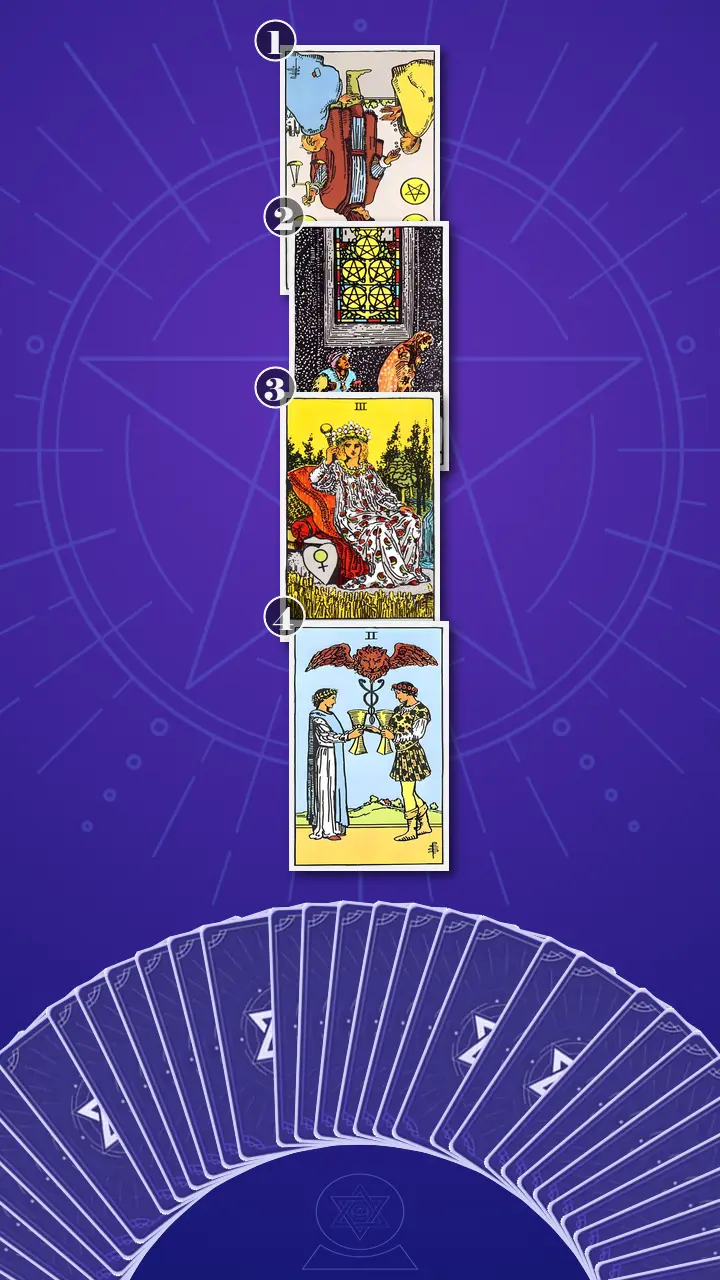
I laid the four cards in a vertical line, like a narrow stairwell opening into a warmer room. I told her the first position would show the caretaking reflex that takes over when a distressed text lands. The second would uncover the deeper belonging wound underneath it. The third—our key card—would reveal the antidote, the truth capable of interrupting the loop. And the fourth would ground everything in real relationship behavior: reciprocity, receiving, and the next step toward mutual connection.
Reading the Cards Beneath the Reflex
The Scales Above the Hand
The first card I turned over was the one representing her visible caretaking reflex—the conscious pattern of becoming instantly available and emotionally useful when someone reaches out in distress. The card was Six of Pentacles, reversed.
In modern life, this card looked exactly like the split-screen reality she already knew: a deadline open at work, Slack still buzzing, and the second a friend texts “can you talk?” she mentally clears the whole room for them. She drafts the most grounded possible response, keeps their notifications on, and stays half-available for the rest of the hour because fast helpfulness feels like the price of staying emotionally central.
Reversed, the Six of Pentacles shows giving in excess and balance in deficit. The raised scales mirrored the invisible measurement happening in Maya’s body: How fast can I answer? How calm can I sound? How useful do I need to be to keep my place? Care begins as generosity and quietly turns into relationship currency. Not because she is cold or calculating, but because her body is trying to pay for security with availability. It is the difference between kindness and running customer support for the group chat.
“So I’m basically an emotional first responder with excellent response times,” Maya said, and then she gave a quick laugh that landed with more bitterness than humor. Her breath caught first. Then one hand rose to her chest. Then her eyes dropped to the card. “I really thought I was just being supportive.”
“You are supportive,” I told her. “And support can still get tangled with fear. Being the first responder is not the same thing as being fully known.”
The Window in the Cold
The next card I turned over was the one representing the deeper shadow driving the pattern—the belonging wound, the fear of becoming forgettable when she is not needed. The card was Five of Pentacles, upright.
This is the quieter, colder scene that usually arrives after the helping. A reply takes too long. The group chat stays still. Friends post park hangs, birthday dinners, or patio photos, and suddenly the phone in her palm feels like evidence. Nobody has said she is outside the friendship, yet her body acts like it has heard a door close. That is the Five of Pentacles exactly: the lit window of warmth nearby, the snow underfoot, the long walk already braced for exclusion.
Upright, this card brings deficiency and survival logic fully online. Neutral silence becomes rejection. A delayed reply feels personal. This is why a friend’s “can you talk?” text can make someone anxious and important at the same time. If somebody needs you, you do not have to sit in the uncertainty of where you fit. You get a role. You get a job. You get a temporary seat.
I felt one of my oldest family teachings rise in me then. In the Highlands, my grandmother used to say that winter fields are deceptive; just because the ground looks bare does not mean life has left it. I still use that wisdom in what I call my Nature Empathy Technique. People, like landscapes, are often misread when fear is doing the observing. “A quiet chat is not automatic proof you’ve been replaced,” I told Maya.
She went very still. First, her fingers stopped worrying the cardboard cup. Then her gaze blurred for a second, as if she were replaying half a dozen unread messages at once. Finally, a long breath left her, slow and shaky. “That line,” she said softly, “nobody said I was outside, but my body heard a door close. That’s exactly it.”
When The Empress Opened the Warmer Room
When I turned the third card—the one representing the medicine, the lesson, the transformative truth that challenges the shadow—the room itself seemed to change. A stripe of late-afternoon light slid across my table and caught the card first, gold touching gold. It was The Empress, upright.
Her posture mattered to me at once. Across the spread we had moved from kneeling, to struggling through cold, to a woman who simply sits and occupies her space. That shift is never accidental. In my work, I read posture the way I read weather. It is part of that same Nature Empathy Technique: before you chase the clouds, you feel the wind on your own skin. Maya’s nervous system had been forecasting social winter from every small silence. The Empress was the first true sign of a different season.
I could see the old equation still gripping her: phone lights up, body snaps to attention, answer quickly, stay calm, stay valuable. She had spent so long asking, “What do I need to do so this bond doesn’t disappear?” that she had barely let herself ask the more honest question: “What if the bond should be able to hold my ordinary self too?”
You are not the kneeling figure trying to matter through service; step into The Empress’s wheat field and let belonging grow from presence, not performance.
I let the sentence stay in the room. The real shift was not learning to care less. It was learning that closeness had to be able to survive her slower reply, her ordinary presence, and the version of her that was not performing usefulness. Maya froze first—mid-inhale, shoulders slightly raised, one thumb caught against the edge of her sleeve. Then I watched the thought move through her. Her eyes lost focus, not blank but busy, as if she were scrolling backward through every night she had answered from bed, from the office, from the TTC, giving steadiness before she had checked whether she had any to spare. Her jaw softened. Her shoulders dropped a full inch. Then came the exhale, trembling a little, and with it that very human second after relief when a person looks almost dizzy, because the burden has shifted and now there is new space to stand in. Her eyes shone. “So I don’t have to prove I’m safe to keep?” she asked.
“Exactly,” I said. “You are allowed to be in the friendship before you are useful to it. Nothing has to be burning for you to count.”
Then I asked her, gently, “Now, using this new perspective, can you think of a moment from last week when this insight would have made you feel different?”
She gave a small, stunned laugh. “Last Thursday,” she said. “My friend texted during dinner and I answered before the pasta water boiled. I thought if I waited, I’d become less important.”
Before we moved on, I asked her to open Notes and write one line: “What am I feeling before I help?” I told her that if the next text spike came, she would have only three choices to consider—wait ten minutes, ask one clarifying question, or send one boundary sentence. And if even that felt too large, she could simply name three sensations and stop there. An experiment, not a test.
This was the hinge of the whole reading: not from caring to coldness, but from alert usefulness and belonging anxiety toward steady self-worth and mutual connection. The Empress brings receptivity, self-nourishment, and worth that exists before the helping begins. That is why she is such a powerful card meaning in context here: she turns usefulness-based closeness into something softer, steadier, and far more true.
Two Cups at Eye Level
The final card I turned over was the one representing integration—the next embodied practice of reciprocity, receiving, and testing mutual connection in real life. The card was Two of Cups, upright.
After The Empress, this card felt almost disarmingly simple. In modern life, it looks like post-work coffee where both people talk, a two-way voice-note thread instead of a one-way crisis hotline, or a friend who still asks, “How are you actually?” when nothing is on fire. Both figures hold a cup. Both stand at the same height. No one is kneeling. No one is doing beverage service for the whole room.
Upright, the Two of Cups is balanced emotional exchange. The next step for Maya was not to care less; it was to notice which friendships still felt warm when she answered a little slower, shared one honest sentence, or let someone care for her without instantly redirecting the focus. The real test was not whether she could rescue the bond. It was whether the bond could hold two real people.
Maya looked at that card longer than the others. Her shoulders stayed down now. “I honestly don’t know who can meet me like that,” she said.
“That isn’t failure,” I told her. “That is information. And information is kinder than fantasy.”
The Seat-at-the-Table Test
When I laid the spread back out from top to bottom, the story became clear. Six of Pentacles reversed showed the visible loop: helping had become relationship currency. Five of Pentacles revealed the wound beneath it: silence was getting translated into exclusion, so ordinary closeness never felt stable enough to trust. The Empress changed the ground itself—worth before performance, battery before output, presence before performance. Only then could Two of Cups become real rather than theoretical: eye-level connection, honest needs, reciprocity.
Even the elemental flow made sense to me. The reading began in heavy Earth—security, usefulness, scarcity, survival—and only ended in Water once worth was grounded differently. That is often the hidden logic in friendship anxiety. The body tries to solve belonging like logistics before it lets feeling move naturally.
The blind spot was this: Maya had been reading urgency as intimacy. But urgency can create contact without creating mutuality. The transformation direction was the one at the heart of the whole reading: shift from proving you deserve closeness by solving distress to testing whether connection can survive slower replies, honest needs, and simple presence.
I said it to her as plainly as I could. “Do not keep paying for closeness with your nervous system. Try presence before performance.”
Then I gave her three practices—small on purpose. When people ask me how to stop overfunctioning when friends vent, I almost never start with grand boundaries. I start with tiny evidence that the bond can survive reality.
- The 10-Minute Presence-First ReplyThe next time one close friend sends a distressed message, do not answer instantly unless it is a genuine emergency. Put your phone face down for 10 minutes, or 3 if 10 feels more workable. Before replying, ask one clarifying question such as, ‘Do you want to vent, be distracted, or think through options?’ If needed, add one warm boundary sentence like, ‘I can talk after 8,’ or ‘I have ten minutes right now and I can listen.’When the guilt voice says this makes you a bad friend, treat that as the old pattern speaking. Warm and brief works better than over-explaining.
- My 3-Minute Bedtime Energy ReviewTonight, and for the next seven nights, spend three minutes before sleep writing one line about a conversation that day: did you feel warm, drained, resentful, purposeful, or oddly flat afterward? Then add three words about your own state before you helped—for example, ‘wired, lonely, annoyed,’ or simply ‘tight chest, buzzing hands, tired eyes.’If naming feelings feels too intense, start with body sensations. You are not grading yourself; you are gathering evidence about whether your care felt spacious or urgent.
- The Reciprocity Check-InPick one friend who feels safer than average and send one non-crisis, low-drama text this week: ‘Small check-in from my side: I’ve had a weird week and could use a little company.’ If your body spikes before sending it, use my walking meditation with environmental sounds first—one block outside, or one slow lap of your apartment, while you notice three sounds such as the crosswalk chirp, the fridge hum, or your own footsteps before you press send.Keep the ask small, specific, and time-bound. You are not testing whether everyone responds perfectly; you are finding out where mutual friendship already has roots.

A Week Later, the Phone Stayed Facedown
A week later, Maya sent me a message just before nine. Not a crisis screenshot. Not an essay. Just this: she had been making dinner when a friend texted “can you talk?” and, for the first time in months, she finished eating first. Then she replied, “I can call in 20—do you want to vent or problem-solve?” Her friend said vent. After the call, the friend asked how she was, and Maya said she actually answered.
She told me the strangest part was not disaster, but the absence of it. The friendship did not collapse. The panic rose, hovered, and passed like weather. She slept a full night afterward, though she admitted the old thought still visited at breakfast—what if I’m being selfish? This time, she noticed it and smiled before it could run the day.
I sat with that message for a while, grateful in the quiet way I always am when a reading becomes something lived. This is what finding clarity often looks like in friendships: not a brand-new personality, not certainty, but the first honest proof that you can move from emergency role to equal presence, from feeling valuable only when needed to being fully known in ordinary life too.
If tonight you are caught in that silent tug-of-war between “I should answer perfectly” and “I wish I could just be here,” remember this: when being useful is the only time your body fully wakes up inside a friendship, even love can start to feel like a seat you have to keep earning.
So when the next screen lights up and your shoulders rise, what would one slightly more honest, slightly less useful reply sound like if you answered from the seat at the table instead of the help desk at the edge of the room?
This story is adapted from psychological research, written so that those in a similar struggle can see their own pattern in it — and find their next step clearly.These insights are not a substitute for professional psychological, medical, legal, or financial advice.
Learn more about our Journey to Clarity.
How did this insight land for you?
🫂 This Resonates Deeply
🌀 Living This Story
✨ Now I See Clearly
🌱 Seeing New Possibilities
🧰 Useful Framework
🔮 The Confirmation I Needed
💪 Feeling Empowered
🚀 Ready for My Next Step
Author Profile
 AI
AI“As the seventh generation of a Highland healing family, I see modern anxieties as a simple, temporary disconnection from nature's rhythm. I bring 67 years of lived seasons not to instruct you, but to hold space for you. Using tarot as a mirror, I want to gently guide you out of the chaos, helping you breathe deeply and rediscover the organic, steady heartbeat of your own life.”
In this Personal Growth Tarot Reading :
Core Expertise
Service Features
Also specializes in :
Explore Related Patterns:
Boundary DiscernmentMaya's practice is small on purpose: wait a few minutes, ask one clarifying question, or send one warm boundary sentence like 'I can talk after 8' or 'I have ten minutes right now and I can listen.' These are not grand exits from friendship. They are precise tests of whether care can include timing, capacity, and consent. Boundary Discernment fits because the story is not asking her to build a wall. It is asking her to tell the difference between genuine care, automatic overextension, and guilt-driven urgency. By noticing what she feels before helping, she brings her own body back into the decision. The pattern becomes visible when You stop treating every distressed message as a command. A boundary sentence lets You stay warm without becoming endlessly available. In this case, that distinction is the practical bridge between feeling useful only when needed and discovering whether the relationship can meet You as a whole person.
Defensive OverfunctioningMaya's body moves before her mind does: the phone lights up at 11:43 p.m., her chest tightens, her shoulders lift, and she starts preparing to become calm, useful, and immediately available. The story makes the behavior concrete through repeated scenes of answering from bed, the office, the TTC, and even during dinner, where the first impulse is to clear space for someone else's distress before checking whether she has any steadiness to spare. That reflex functions as a defense against uncertainty in the friendship. Fast helpfulness gives her a role, and the role temporarily settles the fear that she might be forgettable when nobody needs anything. This is why the pattern is not simply kindness; it is emotional labor operating as a belonging strategy. Defensive Overfunctioning fits because Maya does more than respond with care. She organizes, soothes, clarifies, monitors, and stays half-available as if the relationship depends on her capacity to keep the emotional system moving. You can see the mechanism clearly when she later tests a slower reply and discovers that the friendship does not collapse. The shift is not from caring to coldness; it is from emergency usefulness to a more mutual form of presence.
Emotional ReciprocityThe story's final movement is not about Maya caring less. It is about testing whether friendship can hold two real people. The examples are deliberately ordinary: post-work coffee where both people talk, a two-way voice-note thread, a friend asking how she is when nothing is on fire, and a small non-crisis text where she lets someone meet her too. Emotional Reciprocity fits because the repair is a shift from one-way emotional labor to mutual exchange. Maya does not abandon warmth; she adds receiving, honest needs, and clearer availability. That turns support from a performance into a relationship. This pattern belongs in the upright position because it captures the adaptive alternative already emerging in the case. You can see it when Maya finishes dinner, replies with a clear time frame, asks whether her friend wants to vent or problem-solve, and then actually answers when the friend asks how she is. The friendship does not collapse when she becomes less useful; it becomes more real.
Rejection SensitivityMaya does not only react to the late-night text; she also reacts to the spaces around it. A delayed reply, a still group chat, or friends posting park hangs and birthday dinners can make the phone in her palm feel like evidence that she has been pushed outside the circle, even when nobody has said that. This is the cognitive loop behind Rejection Sensitivity. Ambiguous friendship data gets filtered through a threat lens, so neutral silence starts to feel personal and social distance becomes a story about being replaced. The body then treats the distressed 'can you talk?' text as relief because it gives her a role that temporarily cancels the uncertainty. The pattern matters because it explains why being needed can feel both stressful and stabilizing. When You are scanning for proof of exclusion, usefulness becomes a fast way to feel included again. The repair begins when the story separates signal from assumption: a quiet chat is not automatic proof that the door has closed.
Relational HypervigilanceThe 11:43 p.m. text is short, but Maya's body gives it huge meaning. Her chest tightens, her shoulders lift, and her hands start moving before reflective thought has time to enter the room. The story keeps returning to that same cue-react cycle: somebody else's distress lights her up while her own needs go dim. Relational Hypervigilance fits because her nervous system is scanning friendship signals for urgency, exclusion, and proof that she still matters. The message is not processed only as a request; it is processed as a relational alarm. That alarm pushes her toward immediate availability before she can ask what the situation actually requires. This pattern helps explain why the phone feels so powerful. You are not just deciding whether to answer; You are regulating the fear that connection may disappear if You do not respond quickly enough. The later practice of waiting, naming sensations, and asking one clarifying question interrupts the vigilance loop without making care vanish.
Self-AbandonmentMaya repeatedly gives steadiness before checking whether she has any to spare. The story shows her answering from bed, the office, the TTC, and the middle of dinner, while her own low battery, hunger, tiredness, and emotional state are pushed out of frame the moment someone else needs support. The psychological mechanism is a boundary collapse around care: her attention fuses with the friend's distress, and her own needs become secondary before she has consciously chosen that trade. The line about her own needs sitting in dark mode captures the pattern with precision. She is present for others by leaving herself. Self-Abandonment fits because the core move is not just helping too much; it is disappearing from her side of the relationship in order to stay valued. You can feel the correction when she asks, 'What am I feeling before I help?' and later finishes dinner before replying. That tiny pause matters because it puts You back into the friendship as a person, not only as the support function.
Transactional IntimacyMaya describes a friendship system where fast helpfulness feels like the price of staying emotionally central. When the text arrives, she clears the room, prepares the grounded response, and stays half-available because the exchange offers a temporary seat in the relationship. Transactional Intimacy fits because closeness has become organized around an invisible bargain: if she is useful enough, available enough, and steady enough, then she gets to feel secure for a while. The story names the blind spot directly when it says she has been reading urgency as intimacy. Urgency creates contact, but it does not automatically create mutuality. The pattern is especially relevant to the question because feeling useful only when needed is the emotional logic of a transaction. You are not asking for cold detachment; You are asking whether belonging can exist without payment in the form of nervous-system labor. The corrective movement is presence before performance: seeing whether the bond can survive slower replies, honest needs, and ordinary selfhood.
Explore Related Struggles:
Availability-Worth FusionThe phone lights up and Maya's body snaps into position before her mind has caught up. She clears space, drafts the grounded reply, keeps notifications on, and stays half-available because response speed has started to feel like proof that she still matters. Availability-Worth Fusion names the point where access becomes identity. The story does not show simple generosity; it shows a body measuring closeness through timing, usefulness, and readiness. You are watching care become a scoreboard, where every delayed reply or slower answer threatens to lower someone's sense of relational value. This struggle becomes especially costly because urgency can create contact without creating mutuality. Maya can be reachable, calming, and needed while still not being fully known. The friendship stays active, but her worth is routed through the help desk instead of the seat at the table.
Belonging-Authenticity SplitMaya's sentence holds the whole split: she knows how to show up, but she does not know how to be around when nothing is wrong. The friendship feels navigable when there is a task, a crisis, or a distressed text; it becomes harder to locate herself when the relationship asks only for presence. Belonging-Authenticity Split names that friction between being included through performance and being included as an ordinary self. You can feel it when she freezes at the idea that the bond might hold her slower reply, her tired body, and the version of her that is not producing emotional steadiness on demand. The struggle is that the safest role is not the most honest one. Maya wants connection, but the connection she trusts most requires her to become useful first. That leaves her authentic needs standing just outside the room, waiting to see whether they will be allowed in too.
Utility-Belonging FusionMaya bolts upright for the late-night text while her own low battery stays easy to ignore. The message is short, but her body treats it like a doorway back into belonging: answer fast, sound calm, become useful, keep the connection lit. That is why Utility-Belonging Fusion sits at the center of the story. Her care is real, but the friendship role has become fused with function, so being needed feels more stable than simply being wanted. You can see the bind in her own words: she knows how to show up, but she does not know how to be around when nothing is wrong. The struggle is not that she cares too much. It is that ordinary presence has not yet become convincing evidence of belonging. When usefulness becomes the clearest way to feel securely included, every distressed text starts to feel like both a request and a temporary seat at the table.
Competence-Connection SplitMaya is praised all day for fast replies, smooth handling, and keeping things moving, and the same system has slipped into her friendships. When distress appears, she knows exactly how to operate; when nothing is wrong, she does not know how to simply be there. Competence-Connection Split names the gap between managing a bond and inhabiting it. Her skills are real, but they are built for coordination, containment, and response. Friendship asks for something less measurable: being known, receiving care, and letting closeness exist without a problem to solve. The pain of this split is subtle because competence can look like intimacy from the outside. You can be the most reliable person in the chat and still feel unseen in the room. Maya's story exposes the moment where being good at handling people stops being the same as being connected to them.
Relational Pacing StrainMaya answers before the pasta water boils because waiting feels like becoming less important. A week later, she finishes eating first, replies with a clear time, and discovers that the friendship does not collapse under a slower rhythm. Relational Pacing Strain lives in that small interval between impulse and reply. The struggle is not about abandoning care; it is about whether care can move at a human pace without triggering the fear that the bond will disappear. Her body has been trained for emergency timing, while her life asks for ordinary timing too. That is why the pause matters so much. Ten minutes, twenty minutes, or one dinner finished before responding becomes evidence that connection can survive a little reality. You are not measuring whether you can be perfectly available; you are testing whether the relationship has room for your pace.
Scarcity Compass LockA delayed reply, a quiet group chat, or a photo from a hangout becomes evidence in Maya's hand. Nobody has said she is outside the friendship, but her body behaves as if a door has closed and the warm room is no longer guaranteed. Scarcity Compass Lock captures the way her relational map keeps pointing toward lack. Silence is not allowed to remain neutral; it gets translated into exclusion, replacement, or a shrinking place in the group. Once that compass takes over, usefulness becomes the quickest route back to orientation. This makes the late-night 'can you talk?' text powerful because need removes ambiguity. If someone needs you, you do not have to sit with the open question of where you fit. You get a role, and for a while the cold space outside the window feels less real.
Systemic DepletionMaya gives steadiness from bed, from work, from dinner, and from the middle of her own unfinished life. The story keeps returning to the same physical sequence: the phone lights up, her shoulders rise, and support moves outward before she checks whether she has anything left to give. Systemic Depletion appears when care stops being a mutual current and becomes an extraction pattern disguised as reliability. Her emotional labor is not a single kind act; it is a repeated system where her energy becomes the friendship's emergency resource while her own needs remain barely named. The depletion is structural because the output channel is trained and celebrated while the receiving channel stays underused. You can still be loving inside that system, but love starts to feel like permanent availability, and the body eventually learns that connection costs more than it restores.
Explore Related Emotions:
Conditional Belonging FearMaya says she knows how to show up, but she does not know how to be around when nothing is wrong. You can hear the condition forming in that sentence: distress gives her a role, while ordinary presence leaves her unsure whether there is a seat for her. Conditional Belonging Fear names the inner weather behind that condition. The bond feels temporarily safer when You are useful, because usefulness gives You a job to do; the fear arrives when the job disappears and You have to find out whether You are still wanted without performing care.
Fear of Being ForgottenMaya names the fear almost directly when she wonders whether she is caring or just scared of being forgettable. Later, delayed replies, quiet group chats, and friends' photos start to feel like evidence, even when no one has actually pushed her out. Fear of Being Forgotten is the quieter dread beneath the fast response. You are not simply trying to be helpful; part of You is trying to stay visible in the room, as if slower availability could make Your outline fade.
Grounded BelongingThe turning point arrives when Maya hears that she is allowed to be in the friendship before she is useful to it. Then the proof comes in a small domestic scene: she finishes eating, replies in twenty minutes, and the friendship does not collapse. Grounded Belonging names the steadier feeling that begins when You test presence before performance. Your place in the bond starts to feel less like a seat You earn through speed and more like ground that can hold Your ordinary self.
Relational UrgencyThe screen lights up, Maya's shoulders rise, and her hands are already moving before her mind has caught up. Last Thursday, she answered before the pasta water boiled because waiting felt like becoming less important. Relational Urgency fits because closeness has become something that must be seized before it disappears. You are not just replying; You are racing to keep the bond emotionally central, as if a slower response would lower Your value.
Standby Mode AnxietyNetflix is still asking whether Maya is watching, the duvet is across her knees, and the 11:43 p.m. text pulls her upright before her mind has caught up. You can feel the body entering a waiting room where the phone gets priority over rest, dinner, deadlines, and the small private rhythm of the night. Standby Mode Anxiety fits because availability has stopped being a simple choice and started acting like a proof-of-belonging signal. The unease is not only about answering a message; it is the tense, always-on feeling that if You miss the emotional call, Your place in the friendship might flicker.
Boundary GuiltA week later, Maya finishes dinner before replying, then still notices the old thought at breakfast: what if she is being selfish. The boundary is tiny and warm, yet her body treats the delay as if care itself has been reduced. Boundary Guilt names the moral sting that appears when You stop paying for closeness with instant access. You are still offering care, but now it has edges, and those edges make the old relationship math protest.
Compassion FatigueMaya can ignore her own low battery but move instantly when someone else needs support. The story shows her giving steadiness from bed, from work, from dinner, and from transit before she has checked whether she has any steadiness left. Compassion Fatigue fits not because she lacks care, but because care has been running without a recovery channel. You keep becoming the calm room for other people while Your own body is still waiting to be checked.
Mutuality HungerThe Two of Cups scene is deliberately ordinary: post-work coffee where both people talk, a two-way voice-note thread, a friend who asks how she actually is when nothing is on fire. Maya looks at that image and admits she does not know who can meet her there. Mutuality Hunger is the clean longing under the whole reading. You do not want to care less; You want contact where Your needs do not have to arrive disguised as a crisis before they are allowed into the room.
Quiet Self-RespectMaya turns the phone facedown, finishes dinner, and replies with a clear, bounded offer: she can call in twenty and asks whether her friend wants to vent or problem-solve. Nothing about that is cold, but it does include her body, time, and capacity in the equation. Quiet Self-Respect fits because the change is practical without being merely logistical. You are choosing to include Yourself in the relationship before You start helping, which turns care from a reflexive payment into a paced, honest offer.
Self-Betrayal AcheThe story says her ribs feel like a push-notification bar, while her own needs sit in dark mode. That image matters because it shows the exact trade: someone else's distress becomes bright and urgent, while her own signal gets dimmed before she has even named it. Self-Betrayal Ache is the soreness of abandoning Your own timing, hunger, tiredness, or honesty to keep another person emotionally held. It is not the absence of love; it is the private aftertaste of repeatedly leaving Yourself out of the care You are giving.
Social Exclusion DreadThe still group chat, the delayed reply, and the photos of park hangs or birthday dinners do not contain a direct rejection. Still, Maya's body acts as if it has heard a door close, turning neutral distance into a scene of being left outside. Social Exclusion Dread fits because the story keeps placing You at the edge of maybe. Nothing has been officially taken away, but the social atmosphere feels cold enough that You start bracing for loss before anyone has named it.
Explore Related Contexts:
Conditional Belonging PressureMaya names the contradiction directly when she says she wants to be there for a friend but fears she has no place unless someone needs something from her. The delayed reply, the still group chat, and the friends' patio photos become social signals she uses to locate herself, even though nobody has explicitly pushed her out. The friendship offers a temporary role when distress appears, yet ordinary silence leaves the seat at the table feeling unconfirmed. You can see why the 11:43 p.m. text lands with so much force; it gives her a job, a reason to matter, and a way to bypass the uncertainty of simply being present. The pressure is not that she cares too much in a vacuum. The pressure is that access, reply speed, and emotional usefulness have become the visible proof points of membership, so the work of reclaiming agency begins with separating closeness from performance.
Emotional Labor ImbalanceMaya clears the room the second a distressed text lands, drafts the most grounded response, keeps notifications on, and stays half-available even while her own battery is low. The story repeatedly shows her care becoming the infrastructure that keeps the connection moving. In that setup, support is no longer a mutual exchange. One person is managing urgency, tone, availability, and repair while her own needs remain in the background, which turns friendship into a quiet ledger of who absorbs the pressure. For you, this label points to the outside shape of the problem rather than a flaw in generosity. The question is not whether caring is real; it is whether the relationship has enough reciprocal structure for care to move both ways.
Fixer Friend DynamicMaya jokingly calls herself an emotional first responder with excellent response times after the reading names how quickly she moves into service. The pattern is concrete: a friend reaches out in distress, she becomes calm, useful, available, and oriented toward solving or holding the moment. The fixer position gives her a recognizable place in the friendship, but it also narrows the range of roles she is allowed to occupy. You can be wanted for steadiness without being fully known, and the story makes that gap visible every time usefulness replaces ordinary presence. This context matters because the external demand is not just a text message. It is a social role that keeps pulling her to the edge of the room as the helper, while the deeper need is to test whether the bond can meet her at eye level.
Response Time PressureMaya is praised at work for fast replies and smooth handling, then she carries that same response system into friendship when an 11:43 p.m. text makes her sit upright before her mind catches up. Last Thursday, she answers during dinner before the pasta water boils because waiting feels like becoming less important. The pressure sits in the response window itself. Reply time becomes a social scorecard, and every pause risks being read as a loss of place rather than a normal delay inside a real life. You do not have to treat that pressure as a personal defect to map it clearly. The story shows an external attention economy moving through Slack, group chats, notifications, and late-night access, turning speed into a proxy for care.