Victoria Line Drafts, One Kitchen Question, and Then the Right Witness

Finding Clarity in the 8:47 Victoria Line Scroll
If your commute home regularly includes toggling between a LinkedIn draft and a Notes app plan, then closing both before your stop, you already know what drafts-folder paralysis feels like. That was the exact flavour of career pivot anxiety Jordan (name changed for privacy) brought into my reading space: the fear of sharing a new plan before it felt solid, and the equally exhausting fear of keeping it private so long that it never met real life.
As Jordan spoke, I could see the scene almost frame by frame. It was 8:47 p.m. on a Tuesday on the Victoria line heading south after work. The carriage light was too bright. Their phone felt warm in one hand. The air carried that faint metallic dampness London trains get when everyone steps on with wet coats. On the screen, a half-written LinkedIn post sat open beside a Notes folder that might as well have been called ‘next move v7.’ Their thumb moved between the two, edit, pause, backspace, close. By the time the train reached their stop, both had gone back into hiding.
‘I don’t want to talk about it too soon and make it feel flimsy,’ Jordan told me. A moment later, they added the real crux: ‘I want support, but I don’t want the pressure that comes with being known.’ There it was, clean and human at once: share my new plan yet versus let it grow quietly first.
What I felt from Jordan was not simple hesitation. It was vulnerability shaped like carrying a glass seedling through rush-hour—alive, hopeful, and impossible to protect from every accidental elbow. Their throat kept tightening when they imagined saying the plan out loud. Their stomach fluttered. Their hands never really settled.
I leaned in a little and kept my voice soft. ‘That makes sense to me,’ I said. ‘Not everything private is hidden. Sometimes it’s still rooting. Let’s see whether your silence is serving fear, or serving wisdom. We’re not here to force a reveal. We’re here to draw a map and find some clarity.’
Choosing the Compass: How the Decision Cross Spread Works
I asked Jordan to take one slow breath and hold the question in plain language: not ‘What is the perfect move?’ but ‘What kind of sharing actually helps this plan grow?’ Then I shuffled slowly. I never treat that part as theatre. It is simply a way of helping the nervous system stop performing for a minute and tell the truth.
For this reading, I used a classic 5-card Decision Cross spread. For anyone wondering how tarot works in a situation like this, this is exactly the kind of spread I trust: it is small enough to stay clear, but structured enough not to flatten a nuanced dilemma into a yes-or-no answer. Jordan didn’t need fortune-cookie certainty. They needed a tarot spread for timing, boundaries, and selective disclosure.
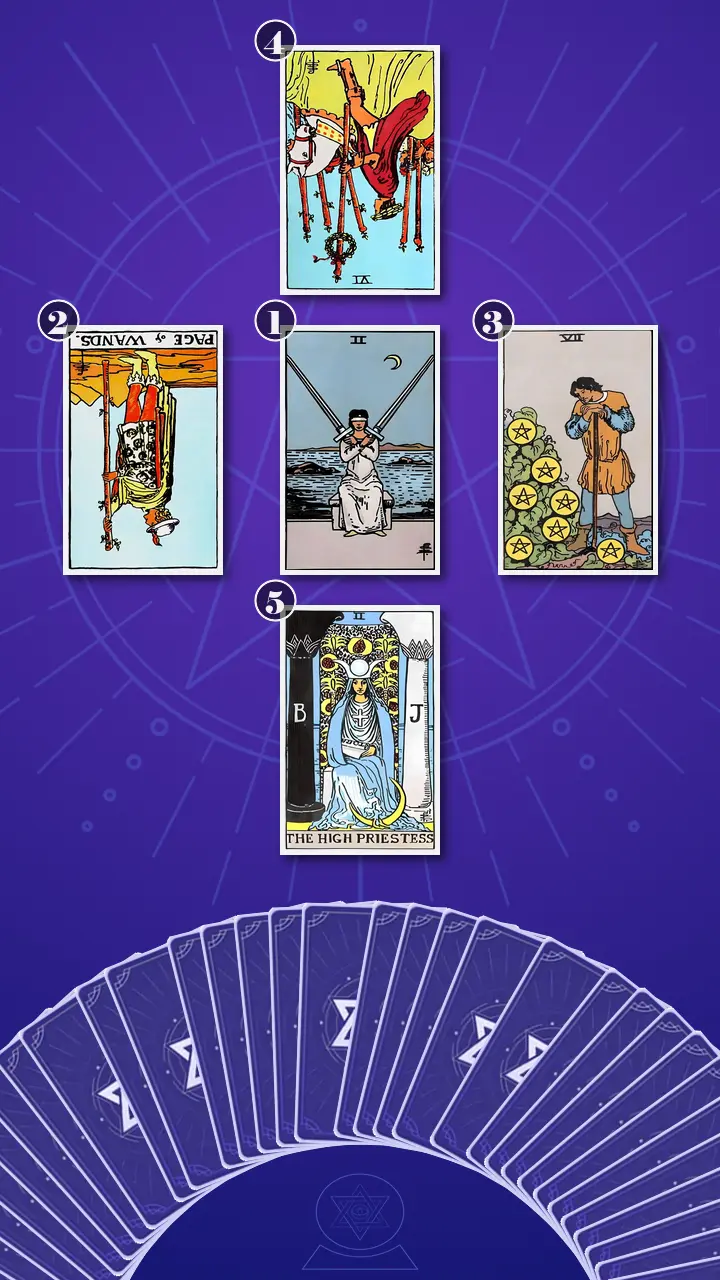
The layout gave me a clean professional sequence. The center card would show the current knot itself: the stall between speaking and protecting. One side card would show what sharing now might activate; the other would show what quiet growth could support when it is used well. The card above would reveal the hidden emotional driver steering the whole thing. The final card below would offer grounded guidance: not just whether to share, but how to handle timing, audience, and boundaries without turning visibility into a verdict on competence.
I like this spread because it works like a crossroads sign. Your eye thinks the answer lives in the left-or-right choice, but often the real answer is lower down, in the rooted path beneath the noise.
Reading the Crossroads Sign
Position 1: The Drafts Folder Deadlock
Now I turned the card representing the current knot: the visible stall between wanting to speak about the new plan and wanting to keep it protected. The card was the Two of Swords, upright.
I told Jordan exactly what I saw. ‘This looks like sitting on the commute with both the announcement draft and the private plan open, telling yourself the pause is strategic when the real stalemate is emotional. Nothing important is missing here except permission to admit that the discomfort is about being seen, not about needing fifteen more versions.’
The energy of this card was pure blockage. Not lack of intelligence. Not lack of options. Blockage. The blindfold told me Jordan was trying not to feel the full charge of the decision, and the crossed swords over the chest showed how defensively they were holding the question. In my mind, the split screen was immediate: LinkedIn draft on one side, Notes folder on the other. Maybe not yet. Maybe soon. Maybe not like that. When indecision starts sounding like research, the pause feels safe, but it quietly becomes expensive.
Jordan gave a short laugh that had a wince inside it. ‘That’s brutally accurate,’ they said. ‘I keep calling it thinking.’ Their fingers tapped once against the mug and then stopped.
‘Yes,’ I said. ‘And the card isn’t shaming you for that. It’s just showing that the non-decision has become its own decision.’
Position 2: When Sharing Too Early Becomes a Scoreboard
Next I turned the card for what sharing now would activate, especially around expression, exposure, and outside reaction. It was the Page of Wands, reversed.
I said, ‘This is the late-night voice-note card. The burst of excitement, the sudden urge to soft launch the career move, the feeling that saying it out loud will finally make it real—followed by waking up and rereading every reply like it’s a performance review.’
The energy here was excess fire with nowhere stable to land. The idea itself was real; the card didn’t question that. What it questioned was the container. Reversed, the Page of Wands often shows expression that is alive but too exposed, too audience-sensitive, too dependent on reaction. Like posting the teaser before you know what the first real episode actually needs. If Jordan shared too widely right now, other people’s responses could become the scoreboard for whether the plan was valid in the first place.
Jordan rubbed the sleeve of their jumper between two fingers. ‘That’s the bit I hate admitting,’ they said. ‘Sometimes I want to say it just so it will feel official.’
‘Exactly,’ I replied. ‘And this card is gently telling you that sharing is not supposed to manufacture certainty. It is only supposed to communicate a beginning.’
Position 3: The Difference Between Incubation and Delay
Then I turned the card for what letting the plan grow quietly would support when it was used for cultivation rather than delay. It was the Seven of Pentacles, upright.
I felt the whole reading slow down. ‘This,’ I told Jordan, ‘is the version of quiet that actually helps. One measurable root. One sample deck. One outreach email. One pilot conversation. Think beta, not launch.’
The energy here was balanced earth. Not glamorous, but stabilising. This card did not romanticise hiding. It made a much cleaner distinction: quiet can be wise if it is feeding the roots. Quiet becomes avoidance when it is just polished private planning with no touchpoint in reality. The image was simple and honest—something tended, something reviewed, something allowed to grow before it is asked to survive the weather.
I watched Jordan’s shoulders drop a fraction. Their exhale was visible this time. ‘So I don’t have to announce it,’ they said slowly, ‘I can test it.’
‘Yes,’ I said. ‘That’s the first believable movement in this spread. Build one proof point before you build the caption.’
Position 4: The Crowd in the Office Kitchen
Above the center, I turned the card revealing the hidden driver beneath the choice: the fear or motive quietly steering the whole decision. It was the Six of Wands, reversed.
I knew immediately where this lived in Jordan’s daily life. ‘This is the office-kitchen card,’ I said. ‘Someone near Liverpool Street asks, “So what are you working on next?” You’re holding an oat flat white, the microwave beeps behind you, the fridge hums, and suddenly one ordinary question feels like a tiny public referendum on whether you’re serious.’
The energy here was blocked recognition. The problem was not visibility itself. The problem was that visibility had fused with worth. Broad visibility is not proof. It’s just exposure. Reversed Six of Wands often appears when someone is treating LinkedIn like a live performance review instead of a platform, or reading one group chat reaction as if it were market research on their competence.
In my head, I did what I call a Systemic Friction Audit. The friction wasn’t that Jordan lacked commitment. It was structural. They were asking one conversation to do four jobs at once: offer encouragement, confirm strategy, protect identity, and prove they were in control. No wonder their throat tightened. No human exchange can carry that much weight without warping.
Jordan went very still. First their breathing paused, as if the body had briefly forgotten the next step. Then their eyes lost focus and slid somewhere past my shoulder, replaying a memory I didn’t need named yet. Only after that did the feeling land. Their mouth tightened, and then they said quietly, ‘Yes. This is exactly the part I hate.’
‘Since when,’ I asked, ‘did one neutral reaction become evidence that the plan itself is weak?’
That question stayed in the room between us for a beat. Outside my window, rain ticked once against the glass, light but unmistakable, as if the weather wanted in on the truth.
When the High Priestess Chose the Right Witness
By the time I reached the final card, the room had gone quieter. Even the city noise felt farther away. I turned the card offering the key integration: the wiser way to handle timing, boundaries, and disclosure in a way that supported the plan’s growth. It was The High Priestess, upright.
‘This,’ I said, ‘is not full reveal or full secrecy. This is Close Friends, not main feed. Password-protected doc, not homepage. Same truth, different container.’
Whenever I meet The High Priestess after the Seven of Pentacles, my mind goes straight to cycles. One of my signature lenses is Macro-Cycle Phase Identification: I ask whether life is in a broadcasting phase, a building phase, or a rooting phase. This spread was unusually clear. Jordan was not in a launch orbit. Jordan was in a rooting orbit, trying to use launch-phase tools. That mismatch was creating most of the strain. The resistance was not proof they were doing life badly; it was proof they were trying to force exposure before the plan had the right structure around it.
And there was another contrast I couldn’t ignore. The Two of Swords had shown me a blindfold: concealment used to block engagement. The High Priestess showed me a veil: concealment used to protect depth and timing. One was fear. The other was discernment.
On the ride home, with the post draft open in one tab and the private plan in another, it can feel like the whole decision is whether to speak or stay silent. But that is not quite the real crossroads.
Your plan does not need broad visibility to become real; it needs the right container and the right witness.
Stop treating exposure as proof and choose selective revelation instead, letting the High Priestess’s veil protect what is still taking shape.
Jordan’s inhale stopped halfway. Their fingers hovered above the mug. For a second, their expression didn’t soften at all—it sharpened. ‘But doesn’t that mean I’ve been hiding behind all this planning?’ they asked, and there was a flash of frustration in it, almost anger, the kind that shows up when relief arrives wearing the face of accountability.
I kept my tone steady. ‘Some of it has been protection,’ I said. ‘Some of it has been fear. You do not need to shame yourself to separate the two. You only need to become more honest about which one is driving the choice in each moment.’
I saw the reaction move through them in layers. First the freeze. Then the mental replay: the deleted voice note, the vague kitchen answer, the draft left unsent because neutral reactions had already been preloaded as rejection. Then the release. Their shoulders lowered. The tightness around their eyes softened. When they finally breathed out, it sounded less like defeat and more like setting down a bag they had been carrying with one shoulder for too long.
I asked, ‘Now, with this new lens, think about last week. Was there a moment when this would have changed how you felt?’
Jordan looked down at the spread. ‘Yes,’ they said. ‘I didn’t need to tell everyone. I could have said one honest sentence to one person who actually gets nuance.’
‘Exactly,’ I said. ‘A witness is different from an audience.’
That was the real shift of the reading. Not from silence to noise, but from guarded excitement and audience-conscious hesitation toward grounded self-trust about timing and disclosure. Not louder confidence. Wiser authorship.
From Insight to Action: Your Next 72 Hours
When I stitched the spread together for Jordan, the story was precise. The Two of Swords showed a freeze response wearing the outfit of strategy. The reversed Page of Wands showed the temptation to share in order to feel certain, which would only hand too much power to outside reaction. The Seven of Pentacles showed that quiet could help—but only if it produced one real root instead of another private masterpiece. The reversed Six of Wands named the real choke point: visibility had started to mean judgment, and judgment had started to mean self-worth. The High Priestess resolved the whole pattern by offering boundary-led selective disclosure with one trusted witness and one real proof point.
I told Jordan the blind spot was simple, but not easy: they had been mistaking perfect phrasing for readiness, and public visibility for proof. The transformation direction was cleaner than that. Share the next step, not the whole identity. Choose the right witness, not the widest audience. You can share the next step without turning it into a promise.
Then I gave them my Orbital Sync Protocol: seventy-two hours with no forced public action, no late-night reveal energy, and no pressure to perform certainty. The goal was not to stall again. The goal was to bring their expectations back into sync with the phase they were actually in.
- Choose the container Tonight, open Notes and write three bullets: what the plan is, what is still uncertain, and what you are not ready to discuss yet. Then finish this sentence before any post, coffee chat, or DM: ‘The response I actually want from this share is…’ Tip: If your body tightens, stop after the sentence. Clarity beats overexplaining.
- Name one trusted witness Within 24 hours, text one grounded person: ‘Can I share something early-stage? I don’t need a big reaction, just a sounding board for the next step.’ End with one boundary sentence: ‘I’m keeping this off my wider feed for now, so I’d love for this to stay between us.’ Tip: If a live conversation feels too exposed, send a short voice note or draft the text and sit with it for ten minutes before sending.
- Build the root before the caption Before any broader announcement, choose one proof point to complete within the next seven days: one sample deck, one outreach email, one pilot conversation, or one mini case study. Keep a phone note titled ‘evidence, not performance’ and log only three things: what I tried, what happened, what I learned. Tip: Define ‘done’ before you begin. Twenty-five honest minutes counts. The point is reality-testing, not self-proving.
That was my practical bottom line for Jordan: root-then-reveal. Privacy is wisdom when you choose it on purpose.
Ownership, Not Exposure
A few days later, Jordan sent me a message. They had texted one trusted person instead of posting the big update. They had named the plan as early-stage, asked for grounded feedback rather than applause, and kept it off LinkedIn. The conversation had not turned into a referendum. It had turned into exactly what it should have been: a useful human exchange. By the end of the week, they had also completed one small proof point that made the plan feel less like a fantasy and more like a living draft.
The plan was clearer. Jordan slept through the night, then woke with the old thought—what if I change my mind? This time, they smiled, opened the note marked ‘evidence, not performance,’ and sent the email before the coffee went cold.
That is what I mean by a Journey to Clarity. Tarot did not hand Jordan a command. It gave them a better distinction: hiding is not the same as incubating, and being seen is not the same as being supported. Once that difference became visible, the power went back where it belonged—with them.
A lot of us know that throat-tightening moment when a new direction feels alive in private and strangely fragile the second another person might see it. If you treated sharing less like a reveal and more like choosing the right witness, who in your life feels more like Close Friends than main feed—the person or space that would make this plan easier to say in one honest sentence?