Language App Streak Anxiety: Choosing Real Contact Over Count
The 11:52 p.m. Streak Panic
When Maya (name changed for privacy) sat across from me, I recognized the pattern before I touched the cards. She was twenty-eight, a communications coordinator in Toronto, hybrid-office, productivity-app fluent, the kind of person whose weekdays already ran on dashboards, deadlines, Slack pings, and subway timing. I remember thinking, with immediate tenderness, that if someone is doing a one-minute lesson in bed after the whole commute-home-eat-reply-to-Slack loop, only to feel weirdly empty once the animation ends, they are rarely dealing with a simple study question.
She gave me the exact timestamp. 11:52 p.m. West-end condo bedroom. Under the duvet. Streetcar brakes hissing faintly outside. Blue-white phone light on her face. The phone warm in her palm. One eye half-closed, thumb tapping through the easiest possible lesson as if she were just clearing one last notification before sleep. Then the streak animation flashed, her chest loosened for two seconds, and her jaw tightened again because, as she admitted, if I had asked her right then for one new phrase, she would not have had one.
"I know one minute is not real studying," she said, staring into her coffee. "But at least I did not break it." The unease in her voice felt like a phone left vibrating on a wooden table - small, constant, impossible to ignore. Pride and guilt in the same breath. Fatigue with a tiny pulse of urgency still running underneath it.
I nodded. "Of course the number feels solid; numbers are easier to trust than half-felt progress. But that does not make you fake. It makes you human." I rested my hands on the deck between us. "We are not going to turn this into a referendum on your discipline. We are going to make a map. And from there, we can find out whether this is healthy consistency, language app streak anxiety, or a habit that has quietly started acting like a judge."

Choosing the Compass: A Decision Cross for Language App Streak Anxiety
I asked her to place her phone face down, take one slow breath, and hold a single honest question in mind: am I learning, or am I only maintaining? Then I shuffled slowly. Not for drama. Just to give the nervous system a beat to stop sprinting.
For this reading, I chose the Decision Cross · Context Edition. When someone asks me a question that sounds like a yes-or-no dilemma - keep the streak, or admit I am just feeding the number - this is one of the cleanest tarot spreads I know. It lets me separate the issue into what is actually happening in the present, what continuing genuinely supports, what the metric attachment is costing, what fear is shaping the whole thing, and what the healthiest integrated next step looks like. That is how tarot works best for habit-versus-obsession questions: not as a mystical verdict, but as card meanings in context.
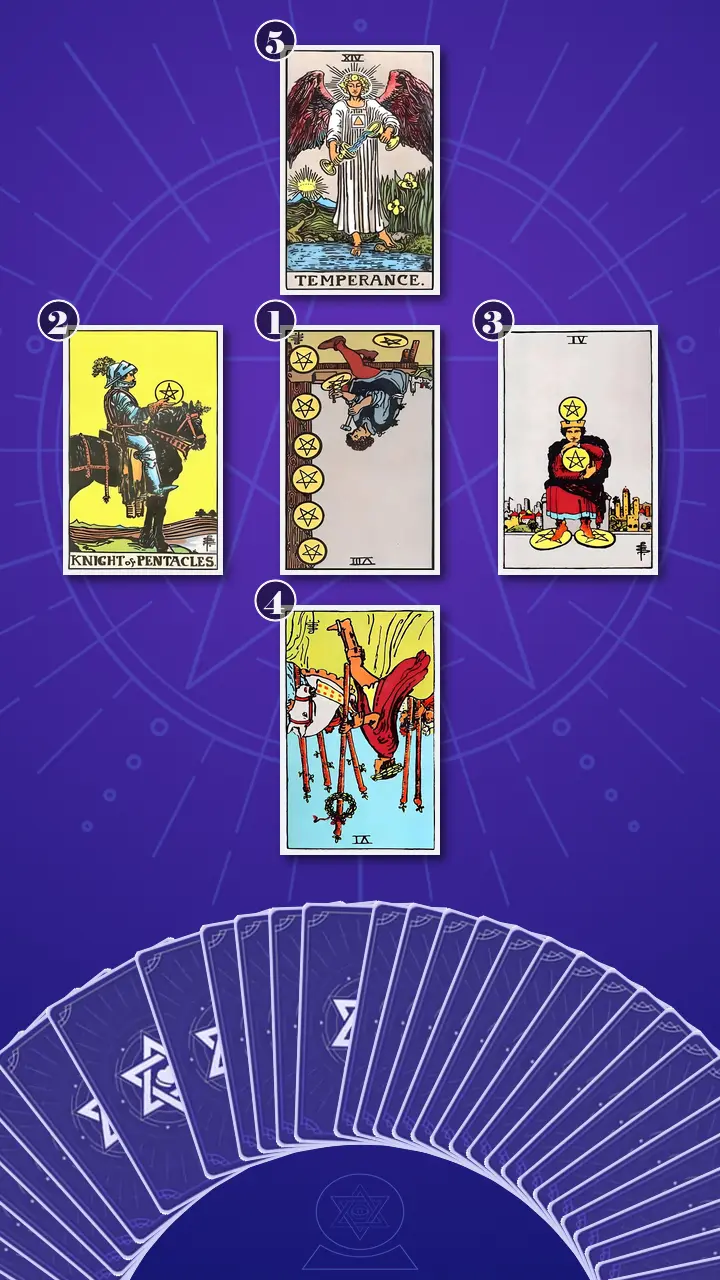
I laid the cards in a cross like a signpost. The center card would show the living issue exactly as it appeared in her body and calendar. The left card would show what "keep going" still offered her. The right card would reveal what got squeezed out when the number became the priority. The card beneath the center would expose the emotional driver. The top card - the bridge - would show the path toward finding clarity.
Reading the Cards Beneath the Number
Position 1: The Loop That Feels Like Studying
I turned over the center card first, the one showing the observable pattern in the diagnosis: doing the smallest possible lesson to preserve the count while quietly doubting the learning. The card was Eight of Pentacles, reversed.
I felt the fit immediately. In modern life, this card is the 11:52 p.m. lesson done half-asleep, the one that feels less like practice and more like clearing an app badge. The old workbench in the card became her phone screen in my mind. The line of pentacles became the unbroken line of days. The lowered gaze of the artisan mirrored that autopilot state where the app registers effort but memory barely does. It had the same energy as clearing your inbox to feel productive while the actual hard project still sits untouched in another tab.
"This is blocked craft," I told her. "Not no effort. Blocked effort. The energy here is not absent; it is mechanical. Maintenance is still an action. It is just not the same action as learning."
She did not nod right away. Instead, she let out a short laugh that had a little sting in it. "Okay," she said, rubbing her thumb against the side of her mug, "that is so accurate it feels a bit rude."
I smiled. "Accurate is useful. It means we can stop arguing with the fog."
Position 2: The Part of Continuing That Is Actually Real
The next card sat in the position revealing what "keep going" genuinely supports here: consistency, repetition, and the part of the routine that is still serving learning. I turned over Knight of Pentacles, upright.
This card was important because it stopped the reading from becoming self-attack. The value of continuing was not imaginary. The quiet version of Maya who returns to the language day after day is real. This is the steady horse, the pentacle held carefully at chest height, the tilled field behind him - no spectacle, no montage, just compound interest for attention. The modern version is not some dramatic main-character reinvention. It is the boring, reliable recurring calendar block that actually builds trust over time.
"So no," I said, "the whole habit is not fake. This card shows balance in the part of you that knows repetition matters in language learning. A streak can track repetition. It cannot certify devotion. But the repetition itself still has value."
Her shoulders eased back a fraction. "So there is a real reason I keep coming back to it."
"Absolutely," I said. "The good instinct is there. It has just gotten tangled with something else."
Position 3: When the Streak Starts Acting Like Property
I turned over the card in the position showing what "feeding the number" looks like in practice and what gets squeezed out when the metric becomes the priority. The card was Four of Pentacles, upright.
This is where the habit stops behaving like a tool and starts behaving like emergency savings you are afraid to touch even when the system clearly needs to change. The coin pressed to the chest became the protected streak. The feet pinned to the other pentacles became that frozen feeling: do not experiment, do not skip, do not admit the session did almost nothing, do not risk movement. In plain life, it looks like choosing the safest lesson because it guarantees completion, avoiding messier speaking or listening practice, and thinking, I know this is not helping, but I cannot drop it now.
After twenty years of listening to people tell me the truth over cooling coffee, I have learned something simple: the cleanest number in a messy week can start to feel like rent money. Not because it is actually priceless, but because your nervous system has decided it is protecting something bigger. That is what I saw here. The same daily habit can come from care or from fear. In this position, fear had started driving.
"This card is excess holding," I said. "Control replacing curiosity. The app becomes something you guard like property, and the moment that happens, growth gets crowded out by safety."
Maya gave me the exact reaction that told me the card had landed. A sharp nod. One tight exhale through her nose. Then that embarrassed little laugh people make when they feel very accurately seen. "Yeah," she said. "It feels stupid, but it also feels... expensive. Like I cannot afford to lose it."
"That makes sense," I said gently. "It does not mean the pattern is healthy. It means the pattern is emotionally loaded."
Position 4: The Private Gold Star Underneath It All
I moved to the card beneath the center, the one exposing the core fear and validation need making the streak emotionally charged rather than neutral. I turned over Six of Wands, reversed.
This was the real hinge underneath the whole spread. In ordinary life, this is the card of vague work feedback, unread effort, messy weeks, and then the sudden hunger for one visible proof that says, See? I still showed up. The laurel wreath, the raised wand, the implied crowd - reversed, all of that victory energy curls inward and turns into self-evaluation through stats, badges, recap screens, and totals. It is Spotify Wrapped brain applied to self-improvement. It is wanting a tiny blue check for your effort.
"When this card shows up reversed," I said, "I start asking a different question. Not 'Is the app helping?' but 'What identity is the number protecting?' Because if the streak disappeared tonight, what is the first self-judging sentence you are afraid would show up tomorrow morning?"
She went very still. First came the freeze: her breath paused high in her chest. Then the cognitive drop; her eyes lost focus for a second as if she were replaying a Thursday meeting, a vague 'looks good, tighten the messaging,' the ride home, the buzz of the reminder. Then the release came out in a smaller, softer voice. "It would feel like proof that I am only serious when it is easy."
I nodded. "There it is. The streak has been doing emotional work, not just tracking behavior. It has been trying to stand in for self-trust."
When Temperance Poured Between Two Cups
Position 5: The Habit That Can Breathe
When I turned over the final card, even the room changed. The radiator clicked once. Outside the window, a streetcar bell thinned into the wet Toronto evening. At the top of the spread - the position pointing to the key shift and the healthiest next-step relationship between consistency and real language contact - lay Temperance, upright.
This was the bridge card, and it was beautiful in its practicality. The image gave me exactly what her situation needed: water moving between two cups, one foot on land and one in water, a path stretching toward light. In modern terms, it looked like one app lesson, one phrase spoken while making tea, one short podcast clip on the TTC, one skipped day without drama, one deliberate return. Not the app as the whole operating system. The app as one useful tab in a bigger life.
By this point, Maya was stuck in the split-screen that exhausts so many thoughtful people: if she kept the streak, she feared she was feeding something hollow; if she broke it, she feared the whole effort would be exposed as fake.
You are not here to guard a sacred number; you are here to pour your effort between the cups until routine becomes real learning.
I let the sentence sit between us for a moment.
Then I reached for the lens I use whenever someone's mind is sprinting circles around a decision - what I privately call Analysis Paralysis Deconstruction. I stripped the whole debate down to grounded reality. Not "Should I quit?" Not "What does this say about my character?" Just this cleaner binary: after a session, is there any real contact with the language - one word recalled, one phrase spoken, one sentence understood - or is there only evidence that the app was opened? That was the hinge. Temperance was not asking her to become less disciplined. It was asking her to calibrate discipline honestly, so the streak could support the practice instead of defining it.
Her reaction came in three waves. First, the physical freeze: her hand stopped halfway to the mug and her breath caught. Then the thought fully entered; her gaze went slightly unfixed, and I could almost see her replaying those warm-phone, blue-light, end-of-day sessions in fast cuts. Then came the emotional release: her shoulders dropped, her jaw unclenched, and a rough little half-laugh left her chest. It was relief, but not pure relief. There was a flicker of annoyance in it too. "But that means I've been making the number the whole relationship," she said. "That is... kind of maddening."
"It means the number got promoted above its pay grade," I said. "That is different." I touched the edge of Temperance. "Maybe small and real is better than perfect and hollow. Maybe a good session is one remembered word, not an unbroken chain. Maybe structure and flexibility are not enemies. You are allowed to build a habit that can breathe."
I asked her, "With this new angle, can you think of a moment from last week when this would have changed how the session felt?"
She nodded slowly. "Tuesday," she said. "I could have called it maintenance, closed the app, and gone to sleep. I did not need the whole courtroom scene in my head."
That was the breakthrough. Not a grand reinvention, but the first real move from gamified self-worth and bedtime streak panic to flexible discipline, honest calibration, and steadier self-trust.
From Scoreboard to Skill: Actionable Advice for the Next 7 Days
When I stepped back from the full spread, the story was clean. The first card showed maintenance dressed up as practice. The second protected the truth that consistency really does matter. The third revealed where that consistency had hardened into control. The fourth named the deeper wound: in a life already full of metrics, outputs, reminders, and comparison fatigue, the streak had become visible proof of discipline. The blind spot was not laziness. It was assuming that a clean metric must also be an honest one. She had been watering the label on the plant instead of the roots.
I told her the transformation direction was straightforward, even if it would take a little practice: stop asking the streak to certify you, and start asking each session whether it creates real contact with the language. That is the scoreboard-to-skill shift. That is how the app becomes a tool, not a judge.
To make it usable, I gave her three grounded next steps, including the sorting exercise I call the Coffee Bean Filter Protocol. No grand theory. Just clearer feedback.
- The Real Contact Minute For your next three app sessions, add sixty seconds after the lesson. In bed, on the couch, or at your desk, say one word, phrase, or sentence out loud from memory before you close the app. If nothing comes, open Notes and type one word only: "maintenance." One remembered word counts. Whisper, mouth it silently, or type it if roommates, thin walls, or commuting make it awkward. Stop after a minute; this is feedback, not a test.
- Move It Out of Panic Hour Pick two days this week and do the app before 10 p.m. - after dinner, right after you get off the TTC, or when you close your laptop. Set a five-minute timer before you open it so the session has a container instead of borrowing urgency from bedtime. If the earlier window fails once, treat that as data, not a moral failure. Your backup version can be a 90-second lesson before bed plus one recalled word afterward.
- The Coffee Bean Filter Protocol Once this week, do one session without looking at the streak count until the end. Then make two quick columns in Notes: "Absolute Must-Haves" and "Emotional Noise." Put things like one calm study window, one recalled word, or one non-app touchpoint - a 2-minute clip on your commute, five kitchen objects labeled aloud, one phrase texted to yourself - in the first column. Put badge screens, recap stats, screenshot temptation, and the thought that one missed day means something final about your character in the second. Give this filter only 24 hours. You are not rebuilding your life in one sitting. You are sorting signal from reassurance.
A Week Later, the Quiet Proof
A week later, I got a message from Maya while I was rinsing out a coffee cup. "Did the app before dinner twice," she wrote. "Covered the count once. Wrote 'maintenance' on Wednesday. Said three phrases while the kettle boiled tonight. Weirdly, I feel less dramatic about it." I smiled at that last sentence because it was exactly the right kind of progress.
Her proof was light but real. She slept a full night after one imperfect session, and when the old thought surfaced in the morning - what if I am slacking? - she laughed, made coffee, and answered it with a phrase instead of a panic spiral.
I do not believe tarot's job is to run anyone's life. My job is to help tidy the clutter until the next honest choice becomes visible. In this reading, clarity was not "keep the streak" or "kill the streak." It was remembering that consistency feels healthier when it belongs to the learner, not to the counter.
When a tiny bedtime reminder can make your jaw lock, it usually is not about one missed lesson; it is about how fast a broken streak can start to feel like broken self-trust. If this story felt a little too familiar, and the count became just one small data point instead of the judge, what kind of five-minute contact with your language would actually feel real to you this week?