When Speed Replaces Learning

A grounded look at deadline-driven shortcut pressure, related tarot cards, and reading insights from students under academic compression.

Academic Shortcut Pressure
What is this situation?

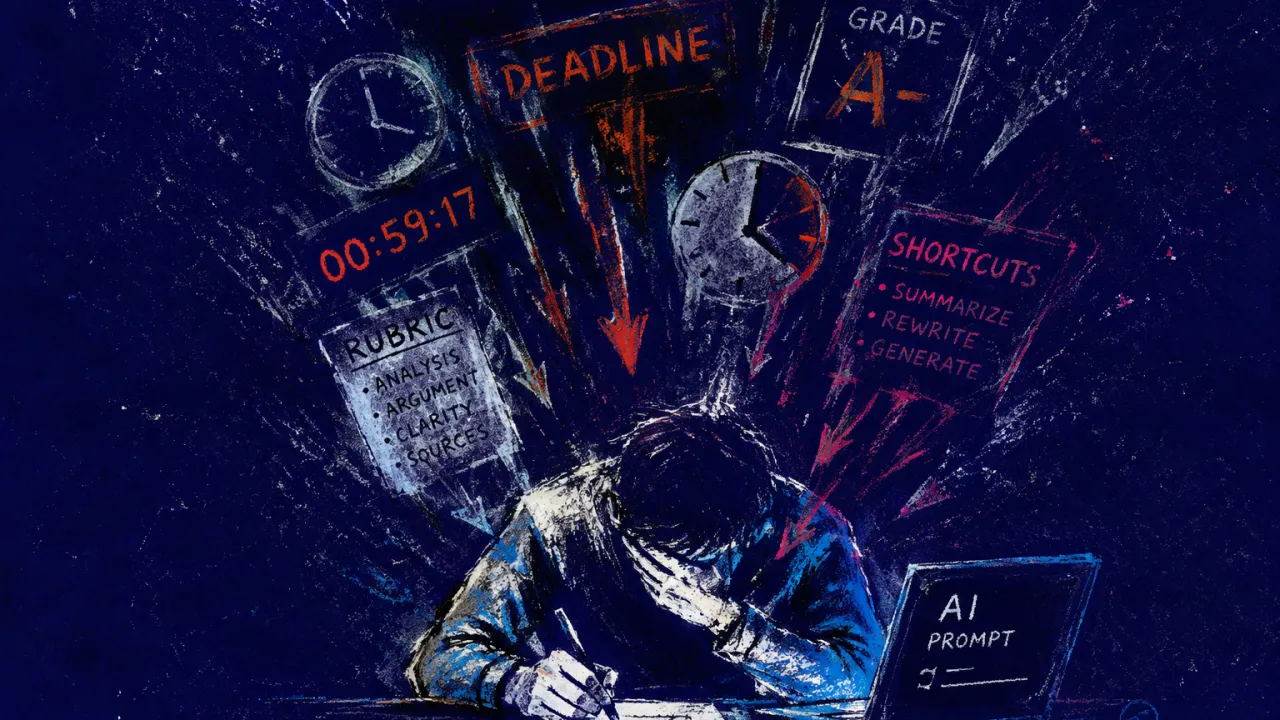
Academic Shortcut Pressure — you feel it the moment the syllabus, the grade portal, and the assignment deadline start speaking louder than the material itself. You sit in a lecture, seminar, library cubicle, or bedroom desk setup with the learning platform open, the rubric in another tab, group chat messages lighting up, and people quietly trading which class is easiest, which professor is lenient, which old outline still works, which AI prompt can make a draft look finished by midnight. The official path says read, think, cite, revise, ask questions, build command; the schedule says submit by 11:59, protect the GPA, stay competitive for the next course, internship, scholarship, program, or application. Around you, the academic culture rewards clean-looking output before it can always see the process behind it. A vague prompt becomes a guessing game. A harsh grading curve turns classmates into comparison points. A pile of overlapping deadlines makes cramming look less like a bad habit and more like the only route left with time on the clock. Even the tools meant to help can become pressure points: summary apps, answer banks, borrowed structures, AI drafts, recorded lectures at double speed, notes you barely had time to absorb. Your shoulders tighten, your hand keeps moving, your eyes skim paragraphs without taking them in, and the question stops being “How do I understand this?” and becomes “What is the fastest version of this that will pass?” By the end, the pressure is not just academic work; it is a whole system narrowing the space between performance and learning, much like The Lovers, where the serpent coils near fruit close enough to reach while the mountain still waits as the harder climb in the background.

Why it's not you?

This is not about being lazy, weak, or somehow less serious than everyone else. Compressed grading, vague expectations, stacked deadlines, AI availability, and comparison culture can create a shortcut economy around the student. When the system rewards visible output faster than it protects learning time, the pressure belongs to the setup, not to your character.

Academic Shortcut Pressure in Tarot Cards

In Academic Shortcut Pressure, the tight shoulders you get while the deadline clock sits open beside the learning portal are part of the scene, not a private flaw. This is an environmental and structural dynamic: the system keeps measuring visible output faster than slow understanding can form. The cards below do not judge the shortcut; they reflect the pressure field around it. Here are the Tarot Cards that often mirror this kind of academic compression.

The Lovers Reversed
The serpent coils around the fruit tree and brings a side-channel of influence into an otherwise ordered garden. The fruit is close, vivid, and easier to imagine consuming than the mountain is to climb. In study life, that image fits the pressure to choose the easy class, grade hack, cram loop, or optics-friendly route over a learning path that can actually hold. The issue is not desire itself; the structure shows how a tempting shortcut becomes stronger when the official path feels slow, unclear, or over-policed. The angel above keeps the scene public. Whatever route is chosen will be measured against standards, so the card exposes the friction between immediate academic payoff and longer-range intellectual integrity.
Strength Reversed
The red lion presses raw force into the foreground, while the woman's light hands slow the release. The image is not anti-force; it shows force being held long enough to become usable instead of breaking out through the quickest opening. Academic shortcut pressure appears when grades, deadlines, AI tools, cram culture, or peer comparison make speed look like the only survivable strategy. The learning process gets squeezed until bypassing the material starts to feel more rational than building real command of it. The card connects this context to restrained output under compression. You are being shown where speed is masquerading as strategy, and where the academic system has narrowed the gap between urgent completion and actual mastery.
Temperance Reversed
The sunlit crown sits at the end of a long road, while the angel's present task requires slow, exact transfer between cups. Reversed, that visual tension can turn into pressure to skip the middle process and reach the visible academic result faster than integration allows. You may be facing exams, essays, AI tools, cram plans, or borrowed outlines that promise speed when your actual learning system needs sequencing. Temperance does not moralize the pressure; it maps the structure that creates it, where deadlines reward output before knowledge has had time to settle.
The Devil Upright
The loose chains around the two figures are not locked around their hands; they sit at the neck, where permission, voice, and self-direction are negotiated. Above them, the downturned torch concentrates heat toward the body rather than illuminating a path, turning urgency into a cue for immediate relief. In an academic setting, that configuration mirrors a system where grades, deadlines, and unclear evaluation compress learning into survival tactics. You are not just choosing between effort and laziness; you are standing in a structure that makes the shortcut look like the only available lever when the real path has become too narrow.
Seven of Cups Reversed
The cups offer glittering outcomes without showing the route that would earn them. The wreath promises recognition, yet the skull hidden beneath it turns that promise into a warning about success that carries an unseen cost. That is the visual logic of Academic Shortcut Pressure. Under deadlines, grades, and comparison, the attractive option is the one that seems to bypass the slow process of reading, drafting, citing, revising, and understanding. The Seven of Cups does not moralize the pressure. It exposes the structure that makes shortcuts seductive: high reward is visible, hidden cost is minimized, and the student is left staring at an option that looks efficient before its consequences are fully legible.
Five of Swords Upright
The figure in front gathers more swords than one person can naturally use, holding advantage close to the chest while the others withdraw. The scene has the texture of a win secured through tactics rather than a clean exchange of skill. In school, that visual pressure appears when the grade, deadline, ranking, or comparison culture becomes stronger than the learning process. Notes, AI drafts, answer banks, borrowed phrasing, selective contribution, and strategic silence can start to look less like choices and more like the surrounding system's reward logic. The card does not flatten the situation into blame. It shows the academic environment that makes shortcuts tempting: a field where visible success is scarce, trust is low, and every tool can be turned into leverage if the structure rewards outcome over comprehension.
Seven of Swords Upright
The figure slipping away with five swords turns academic effort into a covert extraction rather than an open learning process. The blades are useful tools, but they are being carried in a way that makes speed, secrecy, and incomplete control more important than mastery. In a study context, that image maps onto the pressure to find a shortcut when the formal path feels too slow for the deadline or too exposed for the grading stakes. You may still be trying to solve a real academic problem, but the surrounding system has made efficiency feel sharper than integrity, and partial success can start to look like survival. The two swords left behind matter because the shortcut does not remove the whole problem. It leaves traces, gaps, and unfinished requirements that can later become the real pressure point, especially when the work has to be explained, defended, or built on.
Knight of Swords Reversed
The sword is raised for a fast strike, but the scene offers no visible checkpoint where the rider can slow down, review, or change method. The weapon is precise, yet the whole image is moving too quickly for careful integration. That visual tension fits academic shortcut pressure: cramming without retention, copying surface structure, overusing tools without understanding, or choosing speed hacks because the timeline has become louder than the learning goal. The problem is created by an environment that rewards immediate output while leaving little room for process integrity. You are facing a setup where speed has started to impersonate competence. The card brings the pressure into view so the real question becomes whether the method is still serving learning, or whether it has become a blade pointed only at the deadline.
Ace of Wands Reversed
The wand is a living tool, but the grip is tight enough to make the leaves shake loose. Its authority comes from being held up as a sign of action, even though the branch still needs contact with living ground to keep growing. In an academic setting, that becomes the pressure to produce the sign of learning before learning has actually integrated. You may be pushed by exams, grading stakes, deadlines, or peer comparison toward cramming and cutting corners. The card exposes how compressed evaluation can turn a growth tool into a shortcut machine.
Eight of Wands Reversed
The eight wands move quickly without a visible hand, and their uniform alignment turns action into throughput. The image has force, but it lacks the human pacing that would show reflection, authorship, or careful sequencing. For You, this becomes the academic environment where speed starts to pressure the method. The card maps the external pull to cut corners, outsource thinking, or over-rely on automated help as a structural response to velocity, not as a simple character flaw, which makes the real boundary easier to inspect.
Knight of Wands Reversed
The knight's ornate display sits on top of very lean equipment for a harsh crossing. Armor, plume, and wand announce capability, while the desert quietly exposes how little practical margin supports the ride. In academic work, that image maps onto the pressure to use shortcuts when the assignment, deadline, or course culture demands speed over integration. You are not looking at a simple willpower problem; the card exposes a mismatch between public performance demands and the resources actually available for learning.

Academic Shortcut Pressure in Tarot Card Reading Insights

When Academic Shortcut Pressure makes the clean route feel too slow for the deadline, other students have brought the same squeeze into readings. The pieces below move from the card list into what came up around grades, AI tools, cram plans, and compressed coursework. Tarot Reading Insights from sessions shaped by this kind of academic pressure.

Psychological contexts related to Academic Shortcut Pressure