Finding Clarity in the Sunday Scaries Three-Tab Spiral
If you refresh Slack/email at 10 p.m. Sunday “just to be prepared,” then open your banking app, then reread a text thread for hidden meaning, you already know the three-tab spiral.
Jordan told me it hits like clockwork: 9:34 p.m., Toronto condo bedroom, the city glow leaking through the blinds like a dim aquarium light. Their phone was warm from being in their hand too long; the charger brick gave off that faint, annoying buzz you only notice when you’re trying to be still. Calendar. Bank balance. A half-written text. Their chest tightened first—then the stomach-knot, sharp and specific, like a hand squeezing the center of their body just to see what would pop out.
“Sunday nights feel like a performance review for my whole life,” they said, not quite laughing. “Work, money, dating—it’s like if I make one wrong move, it proves I’m not in control. Like I’m not… enough.”
I watched their fingers keep reaching for the phone even while they were talking, like muscle memory had its own agenda. In my family, we’ve always paid attention to that—what the body does before the mind can explain it. “Sunday night isn’t a verdict—it’s a trigger,” I said gently. “And you’re not broken for having a trigger. Let’s make a map of the pattern so you can find the next step without having to fix your entire life tonight.”

Choosing the Compass: The Energy Diagnostic Map (7)
I asked Jordan to take one slow breath with me—not as a ritual, just as a clean handoff from spiraling into observing. While I shuffled, I kept my voice plain. Tarot works best, in my experience, when we use it like a mirror: not to predict a grand outcome, but to name what’s happening and what to do next.
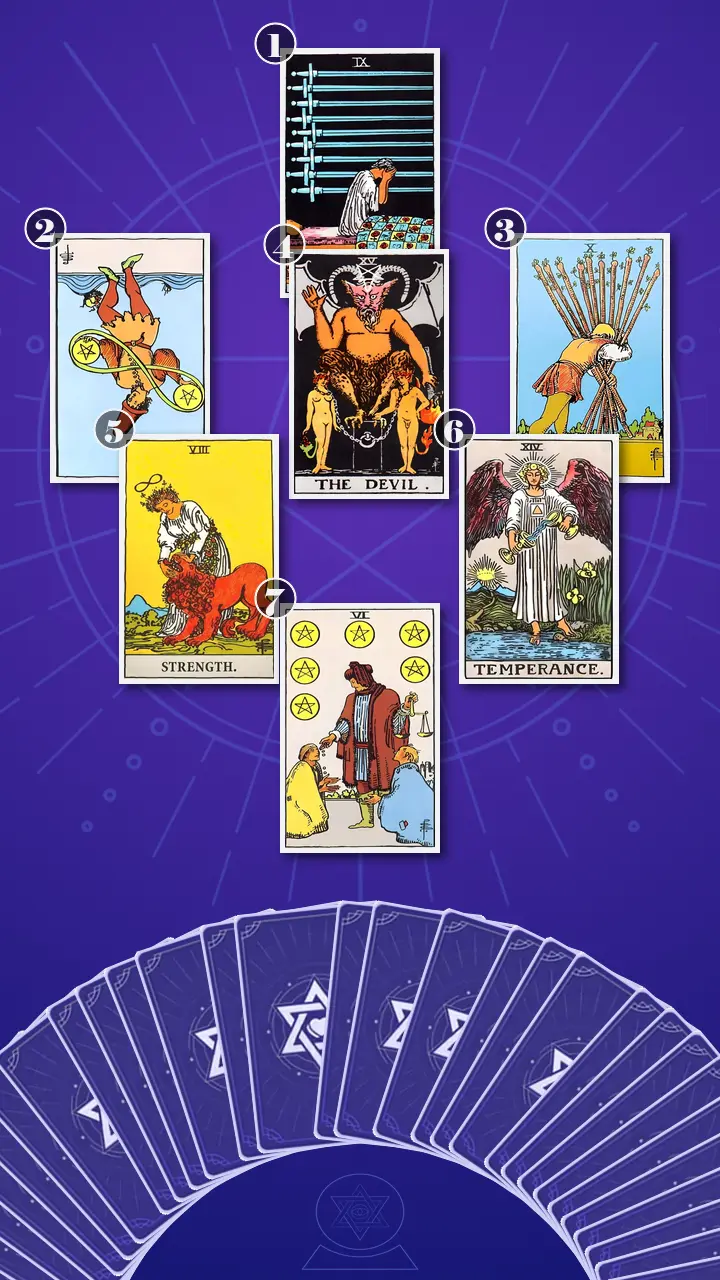
“We’ll use a spread called Energy Diagnostic Map (7) · Context Edition,” I told them. For a question that spans work, money, and love, it’s one of the most practical layouts I know. It separates what you’re feeling on the surface from what’s fueling it underneath—then it turns that insight into a resource, a key shift, and a grounded next step.
I previewed the structure so Jordan—and you—could track the logic: the first card shows the Sunday-night symptoms you fixate on first; the center card reveals the core blockage (the belief that keeps repeating); and the final card points to a concrete boundary or action you can try this week.
Reading the Map: From Pinned Thoughts to Heavy Bundles
Position 1: Surface energy — what Sunday-night dread grabs first
Now turning over is the card that represents Surface energy: the observable Sunday-night dread symptoms and what they fixate on first.
Nine of Swords, upright.
This is the bedroom-at-night card. The image always feels too familiar: thoughts lined up like weapons you can’t unsee. And it translates cleanly into modern life—It’s 11:07 p.m. Sunday and you’re in bed with Slack/email open. You reread a neutral message like it’s a warning, then jump to your bank app, then to a text thread—your mind narrating one story: “If I’m not on top of all of it, I’m failing.” You’re exhausted, but you can’t stop refreshing because the checking feels like the only way to prevent Monday from going badly.
That’s Air energy in excess—mind speed without traction. Information-gathering that isn’t actually planning. I said it the way I’d want someone to say it to me: “One more check” becomes “one more check” becomes “one more check,” and suddenly you’ve spent an hour trying to buy certainty with your nervous system.
Jordan let out a short, bitter little laugh. “That’s… brutal. But yeah. I keep calling it ‘being responsible.’” Their eyes flicked to the phone again, almost embarrassed by how automatic it was.
“You’re not irresponsible,” I replied. “You’re trying to feel safe. We’re just going to be honest about the method you’re using—and whether it’s working.”
Position 2: Inner tug-of-war — the bargain that fuses work, money, and love
Now turning over is the card that represents Inner tug-of-war: the internal push/pull that links work, money, and love into one tension system.
Two of Pentacles, reversed.
Reversed, the juggler’s smooth rhythm turns into frantic toggling. In real life: You sit on the couch Sunday night with three ‘important’ tasks open: plan your week, review spending, decide what to do about someone you’re seeing. Instead of finishing one, you keep switching—calendar to bank to texts—because choosing one feels like admitting the others might stay messy. The more you juggle, the less stable you feel.
This is Earth energy out of balance—trying to create stability through constant adjustment. It’s that Notion-dashboard impulse: build twelve trackers, update them obsessively, and still feel like nothing has shipped. The reversed energy isn’t “you can’t manage life.” It’s “your system is overloaded, so your adaptability turns into being permanently on call.”
Jordan nodded, slow. “If I pick one thing,” they said, “it feels like the other two are going to collapse and I’ll be exposed for not having it together.”
Position 3: External pressure — what the world is asking you to carry
Now turning over is the card that represents External pressure: what the environment (work demands, cost of living, social comparison) is asking you to carry.
Ten of Wands, upright.
This one is blunt: overload carried alone. And it’s painfully literal in Toronto—high rent, shifting work priorities, and the quiet pressure of LinkedIn humblebrag season. The modern translation lands like a backpack you can’t set down: Monday arrives and you’re carrying deadlines, rent math, and emotional uncertainty like one private backpack. You say yes to one more thing at work, tell yourself you’ll “be disciplined” with spending, and act chill in dating—even though you’re stretched thin. By midweek, you’re tired enough that even simple choices feel like lifting something.
Fire energy here is in excess—not passion, but strain. The bundle blocks the figure’s view, and that’s the point: when you’re carrying too much, you can’t see the simple path right in front of you.
I heard myself think, briefly, of winter in the Highlands—how people used to ration their energy the way they rationed fuel. Not because they lacked ambition, but because the season demanded a different pace. I brought my attention back to Jordan. “This card doesn’t shame you for carrying,” I said. “It tells the truth: there’s not much spare capacity, so of course the smallest decision feels heavy.”
Position 4: Core blockage — the invisible rule that keeps the loop repeating
Now turning over is the card that represents Core blockage: the central belief or attachment that keeps the pattern repeating across domains.
The Devil, upright.
Here’s the engine under the hood. The real trap isn’t your inbox, your balance, or your dating life—it’s the rule underneath: “I’m only safe if I’m proving I’m enough.” So you keep monitoring: working harder for approval, tightening money control like a punishment, and chasing clarity in love through overreading signals. The chains feel real, but they’re mostly made of fear and habits.
Monitoring feels like control, but it steals your next step.
I named the invisible rule out loud, the way you name a raccoon in your backyard so you stop pretending it’s just “a noise”: “Control equals safety. Proof equals worth.” Then I asked the question the card demands: “Who are you trying to prove ‘enough’ to at 11:48 p.m.?”
Jordan’s face tightened—wince first, then a stillness, then a small nod as if the words had landed too accurately. “No one,” they said, and then corrected themselves. “Me. I’m trying to prove it to me.”
“Exactly,” I said. “And that means we can work with it—without blaming you.”
Position 5: Usable resource — what you can access mid-spiral
Now turning over is the card that represents Usable resource: a strength you can access in real time when the spiral starts.
Strength, upright.
This is power without force. The modern version is simple and real: You feel the surge to check Slack one more time, and you notice it in your body first—tight chest, tense jaw. Instead of obeying, you do one tiny regulating move (feet on the floor, slow exhale), then choose one courageous action: send one clarifying message, close one tab, or set one boundary. You don’t need to feel fearless—you just need to stay in charge for 90 seconds.
This is where my Body Signal Interpretation comes in. I told Jordan, “Your chest tightening is information, not a command. It’s your body saying, ‘Threat scan activated.’ Strength is the skill of hearing that message and still choosing.”
They tried it right there: shoulders dropped a fraction; jaw unclenched like they’d been holding a secret. A tiny shift, but believable—the kind that says, shift is possible.
When Temperance Poured Between Two Cups
Position 6: Key transformation — the lever that integrates work, money, and love
When I turned the next card, the room felt quieter—not spooky, just focused, like the moment a friend finally tells the truth instead of the story.
Now turning over is the card that represents Key transformation: the most important shift that integrates work, money, and love into a sustainable rhythm.
Temperance, upright.
Setup. I reflected their loop back to them in plain, exact detail: it’s 9:30 p.m., you’re in bed in Toronto with your calendar open, your banking app open, and a half-written text—your thumb keeps switching tabs like Monday is a verdict. The thought behind it is relentless: if you only fix one thing, the other two will collapse.
Delivery.
Not another round of frantic juggling—choose Temperance’s measured pour, and let small, consistent recalibration replace Sunday-night crisis mode.
I let the sentence sit for a beat. Even the buzz from the charger in Jordan’s story felt louder in the pause.
Reinforcement. Jordan’s reaction came in layers. First: a brief freeze—their breath caught, and their hands stopped mid-fidget, hovering as if they’d been caught doing something private. Second: the mind recalibrating—their eyes unfocused for a second, like they were replaying every Sunday night where they tried to solve work, money, and love in one hour and then hated themselves for failing. Third: the release—a long exhale they didn’t plan, shoulders softening downward, and a quiet, almost stunned, “Oh… I don’t have to solve all three tonight.” And right behind that relief was something more tender: the vulnerability of realizing they’d been treating every week like a final exam.
“You don’t need a perfect plan tonight,” I added, calm and steady. “You need a repeatable process.” Then I gave them an experiment, not a promise: set a 7-minute timer. In Notes, draw three tiny boxes: Work / Money / Love. Write exactly one ‘next 15 minutes’ action for each—no life goals. Choose only one box to do tonight, and schedule the other two for specific times. If your chest tightens and you start bargaining—‘but I should also…’—take three slow breaths. You can stop anytime. This is an experiment, not a test.
“Now,” I asked, “with this new lens—measured pour, not frantic juggling—can you think of one moment last week when this would have changed how you felt?”
Jordan swallowed, then gave a small, honest shrug. “Thursday,” they said. “I lost an hour ‘researching’—finance app, LinkedIn, old texts. If I’d done one small action and stopped… I would’ve actually rested.”
That was the bridge: from Sunday-night dread and compulsive monitoring to calm, integrated focus driven by a repeatable process. In elemental terms, Temperance is the return to balance—Air stops whipping itself into stories, Earth stops trying to micromanage stability, Fire stops carrying everything, and the whole system learns a pace it can trust.
Position 7: Next step — the grounded boundary you can try this week
Now turning over is the card that represents Next step: a grounded action or boundary you can implement this week to start changing the loop.
Six of Pentacles, upright.
The scales. Measurable reciprocity. In real life: This week you do a fairness check in each domain. At work, you stop over-giving without clarity and ask for support or scope. With money, you choose a ‘fair’ plan you can live with all week. In love, you notice whether effort is mutual—who initiates, who follows through—and you adjust your boundaries so you’re not paying for connection with anxiety.
Jordan gave a half-smile. “Fair,” they repeated. “Not impressive.”
“Exactly,” I said. “Fair beats impressive.”
Fair Beats Impressive: Actionable Advice for Your Next 48 Hours
I tied the whole map together for them: the Nine of Swords shows the symptom—late-night mental pressure that demands proof. The Two of Pentacles reversed shows the internal bargain—juggle all three domains so none can ‘prove’ failure. The Ten of Wands shows the outer reality—too much weight, too little slack. The Devil is the root: an internal terms-of-service that says you can relax only after you’ve earned it through constant proof. Strength is the lever in the moment, and Temperance is the method: a repeatable mixing process. The Six of Pentacles is how you ground it: fairness and reciprocity, measurable and non-dramatic.
The cognitive blind spot was simple: Jordan had been treating monitoring as preparation. But monitoring keeps everything “open,” which creates more ambiguity—at work, in money, and in love. The transformation direction was the exact opposite of their Sunday habit: one small, bounded experiment that separates signals from stories.
- The 3-Box Monday Landing Note (Sunday night)Write a 3-line note: (1) one work priority for Monday, (2) one money check-in, (3) one relationship intention. Then close the note and put your phone on the charger across the room—one-domain-per-night, no stacking.If your brain says “too small,” that’s the old Devil-rule talking. Keep it tiny on purpose.
- The 90-Second Strength Reset (anytime the urge spikes)When you feel the urge to check Slack/banking/texts: feet on the floor, drop your shoulders, exhale longer than you inhale. Then choose one action: open one app for one purpose—or choose to stop.If you get flooded, use my simplest nervous-system reset: a shower water-flow meditation—feel the water move, name the urge (“Sunday Scaries wave”), and come back only if you want to.
- The Six of Pentacles Fairness Check (pick one domain first)Work: list what you gave last week (hours, favors, emotional labor) and pick one adjustment (clarify scope, ask for support, push back on a deadline). Money: choose one fair weekly number you can live with. Love: notice reciprocity in one thread—did they initiate, confirm, follow up? If not, ask one direct question or step back 10%.Treat reactions as data, not a verdict. Fair isn’t harsh—it’s sustainable.

A Week Later: The Quiet Proof
A week later, Jordan messaged me a screenshot: a simple email to their manager—one clarifying question about priority, sent at 4:30 p.m. instead of drafted and deleted five times. They’d also set one bill to autopay at lunch and stopped at 15 minutes, even though the optimizing itch was loud. The most tender part: they’d asked someone they were seeing a direct, calm question about plans for the week. No dramatic confrontation—just clean information.
They added, “I still felt the spiral on Sunday. But I did the 90-second reset, wrote the 3-box note, and then I sat on my balcony for five minutes like you said. It was… quiet. Not perfect. But quieter.”
That’s the Journey to Clarity I trust the most: not certainty, but ownership—moving from compulsive monitoring into a repeatable process you can actually live inside.
When Sunday night turns into a performance review for your whole life, it makes sense that you keep checking work, money, and love for proof—because the scariest part isn’t Monday, it’s the fear that one imperfect choice will expose you as not in control.
If you treated this week like one small experiment instead of a verdict, what’s the tiniest “fairness check” you’d want to try first—at work, with money, or in love?
This story is adapted from psychological research, written so that those in a similar struggle can see their own pattern in it — and find their next step clearly.These insights are not a substitute for professional psychological, medical, legal, or financial advice.
Learn more about our Journey to Clarity.
How did this insight land for you?
🫂 This Resonates Deeply
🌀 Living This Story
✨ Now I See Clearly
🌱 Seeing New Possibilities
🧰 Useful Framework
🔮 The Confirmation I Needed
💪 Feeling Empowered
🚀 Ready for My Next Step
Author Profile
 AI
AI“As the seventh generation of a Highland healing family, I see modern anxieties as a simple, temporary disconnection from nature's rhythm. I bring 67 years of lived seasons not to instruct you, but to hold space for you. Using tarot as a mirror, I want to gently guide you out of the chaos, helping you breathe deeply and rediscover the organic, steady heartbeat of your own life.”
In this Introspection Tarot Reading :
Core Expertise
- Somatic Shadow Sensing: Identifying where chronic mental fatigue and unexpressed emotions are physically trapped within your body's architecture.
- Ecosystem Bandwidth Restoration: Using the metaphor of nature's self-cleansing cycles to diagnose and clear the 'mental static' of an overstimulated nervous system.
Service Features
- The Grounding Transmutation Ritual: A sensory, physical practice designed to literally discharge excessive mental rumination into the earth, instantly restoring bodily presence.
Also specializes in :
Explore Related Patterns:
Achievement FusionJordan does not just worry about Monday tasks; they experience Sunday night as a verdict on whether they are in control and enough. The story makes the fusion explicit when work, money, and dating all become proof points in one private evaluation system. This is the psychological move that makes the dread feel so total. A delayed email is not just an email, a bank balance is not just a number, and an unclear text is not just an unclear text. Each one starts carrying identity-level meaning, as if a normal imperfect choice could expose something defective about You. The way out is not to become more impressive. The story's strongest corrective is 'fair beats impressive' because fairness breaks the fusion between worth and performance. You can ask for scope, choose a livable money plan, or ask a direct dating question without making any of those actions a referendum on who You are.
Certainty SeekingJordan rereads a neutral message as if it might contain a warning, checks the bank balance as if the number can settle the body, and returns to the calendar as if Monday can be made safe in advance. Each move is an attempt to turn ambiguity into certainty before the week begins. The trap is that certainty is being asked to do emotional regulation work. Instead of helping You choose a next step, the search for proof makes every unclear signal feel urgent: an email could expose failure, a spending choice could expose instability, and a text could expose rejection. This pattern ties the three domains together because work, money, and love are all being processed through the same mental rule: if I know enough, I can finally relax. The shift is to stop treating certainty as the entry fee for action and use limited, reality-based signals to make one small move.
Compulsive CheckingJordan's thumb keeps moving between Slack, email, the banking app, and text threads even when the body is already showing overload. The behavior is not random scrolling; it is a repeated safety scan where each app becomes a different doorway into the same question: can I prove nothing is about to go wrong? That is why the checking feels responsible in the moment. It offers the illusion of preparation while quietly keeping every domain open, unfinished, and emotionally active. The more You check, the more the system teaches your brain that uncertainty is dangerous unless it is monitored. The pattern becomes costly because the relief never lands. One more refresh does not close the loop; it creates the need for another. The next step is not to shame the urge, but to separate information from compulsion: one app, one purpose, one bounded action, then stop before the checking becomes the problem it was trying to solve.
Productivity as SafetyJordan describes Sunday night as a performance review for their whole life, then tries to manage that feeling by preparing harder, monitoring harder, and proving harder. Work, money, and dating are different domains, but they are all being pulled into one safety strategy: if I perform well enough, I can stop feeling exposed. Calling the loop 'being responsible' shows how convincing this defense can feel. Preparation is not the issue; the issue is that preparation has become the condition for feeling allowed to rest. You are not simply planning Monday, reviewing spending, or reading a text thread; You are trying to earn enough internal safety to put the phone down. The useful insight is that this pattern has a logic, even if it is exhausting. It once tries to create stability through competence. The next step is to make responsibility smaller and fairer: one bounded action, one clear priority, one relationship question, instead of turning the whole week into a test of worth.
Analysis ParalysisJordan has three important tasks open at once: plan the week, review spending, and decide what to do about someone they are seeing. Instead of completing one, they keep switching because choosing one box makes the other two feel dangerously unresolved. The paralysis is not caused by a lack of intelligence or effort. It comes from the threat attached to prioritizing. When every domain feels like it could collapse if unattended, analysis becomes a way to avoid the vulnerability of making one limited choice. That is why the later email to the manager matters: one clarifying question sent at 4:30 p.m. interrupts the draft-delete loop. The pattern shifts when You stop asking one decision to solve the whole life system and let one small action be enough for this specific moment.
Defensive OverfunctioningJordan says yes to one more thing at work, tightens discipline around money, and acts chill in dating while already stretched thin. The same move appears in different forms: carry more, ask for less, and make the strain look manageable. This is overfunctioning with a protective purpose. Extra effort becomes a shield against exposure, especially when the internal rule says worth has to be proven. You carry the bundle alone because receiving help, asking for clarity, or needing reciprocity can feel like evidence that You do not have it together. The Six of Pentacles advice targets this directly. A fairness check is not withdrawal; it is a boundary audit. Asking for scope at work, choosing a livable money plan, or noticing mutual effort in love gives You a way to stop paying for safety with constant overextension.
CatastrophizingJordan reads a neutral message like a warning and feels that choosing one task could let the other two collapse. The mind is not merely noticing risk; it is escalating ordinary ambiguity into a full-system threat. This pattern works by compressing the future into a worst-case verdict. A single email, balance check, or dating text becomes loaded with the fear that one wrong move will prove You are not in control. Once that logic takes over, every signal feels bigger than it is. The practical correction is reality testing at a smaller scale. Instead of arguing with the whole fear, You name one concrete signal, one realistic consequence, and one next action. That turns catastrophic prediction back into usable information.
Explore Related Struggles:
Monitoring-Safety FusionJordan keeps moving from Slack/email to the banking app to a half-written text, and the loop is framed as being prepared. The body is already showing the cost through the tight chest, the stomach knot, and the phone held too long, yet the thumb keeps reaching because checking has become the closest available stand-in for safety. The struggle is not that you care too much about work, money, or love. It is that all three have been routed through the same control circuit, so every unclear signal asks for another scan. Monitoring promises relief, then keeps every tab emotionally open, which leaves you with more ambiguity to manage. When this fusion hardens, the next step gets stolen by the need to feel certain first. You regain leverage when you separate signal from story and let one bounded action count as enough for now.
Performance-Worth FusionSunday night turns into a performance review for Jordan's whole life, not just a planning window before Monday. Work, money, and dating are no longer separate areas with separate next steps; they become evidence in one private trial about whether Jordan is in control and enough. That is the pressure you feel when a neutral email, a bank balance, or an unclear text stops being information and starts feeling like a verdict. The friction is not between ambition and laziness, but between wanting a sustainable life and using constant proof as the entry fee for rest. Performance-Worth Fusion names the bind because the story keeps showing ordinary actions carrying identity-level stakes. You begin to loosen it when a small action is allowed to be useful without becoming a final exam on your value.
Resource Integration StrainJordan sits with the calendar, bank balance, and relationship thread open at the same time, and none of them can become the clear first move. Each tab carries a real need, but together they create a system where choosing one feels like leaving the others exposed. You can feel this struggle when your attention becomes a triage desk for your whole life. Work asks for readiness, money asks for control, love asks for clarity, and the nervous system tries to answer all three in one sitting. The switching looks productive from the outside, but inside it keeps resetting the decision point. Resource Integration Strain fits because the problem is not a lack of effort. The issue is that separate life domains have been fused into one overloaded balancing act, so progress requires a measured sequence rather than another round of frantic juggling.
Fairness-Agency SplitJordan's practical shift is small but revealing: one clarifying email to a manager, one bill handled without endless optimizing, and one calm question to the person they are seeing. Each action replaces the pressure to look impressive with a cleaner standard of what is fair. The struggle here is about agency getting trapped inside overextension. At work, you may keep giving without scope. With money, you may punish yourself with control. In love, you may pay for connection with anxiety instead of asking whether effort is mutual. Fairness-Agency Split names the point where your next move becomes possible. You are not withdrawing care or ambition; you are choosing a standard that lets support, reciprocity, and limits become part of the system instead of treating them as failures of effort.
Systemic DepletionBy Monday, Jordan is carrying deadlines, rent math, and emotional uncertainty like one private backpack. They say yes to more work, tighten spending as if discipline can solve the strain, and act chill in dating even while the load is already too much. Systemic Depletion shows up when capacity is spent before the actual choice begins. You are not just tired from one domain; your work self, money self, and dating self are all drawing from the same reserve, while each area still expects you to look composed. The story gives this struggle weight because even simple choices start to feel heavy by midweek. Seeing the depletion clearly matters because the next step cannot be another demand for more willpower; it has to reduce the load that makes every decision feel oversized.
Explore Related Emotions:
Not-Enough PanicJordan says the quiet part directly: if they make one wrong move, it proves they are not in control and not enough. Later, when asked who they are trying to prove enoughness to, the answer lands inward: themselves. Not-Enough Panic is the rush that turns normal uncertainty into a self-worth emergency. You are not only afraid of a messy inbox, a tight budget, or an unclear dating thread; you are afraid those things will become proof that something about you is fundamentally lacking.
Choice Integration OverwhelmJordan sits with three important tasks open at once: plan the week, review spending, and decide what to do about someone they are seeing. Instead of completing one, they keep switching because choosing a lane feels like abandoning the other two. Choice Integration Overwhelm names the specific pressure of trying to make work, money, and love resolve in one mental space. You are not overwhelmed by choice because you lack priorities; you are overwhelmed because every priority feels attached to the safety of the whole life structure.
Control FatigueOne more check becomes one more check, and Jordan calls it being responsible even as the loop keeps work, money, and dating open. The monitoring promises control, but the body tells a different story through the chest, stomach, jaw, and restless hand. Control Fatigue names the exhaustion of trying to stabilize life by keeping every variable under surveillance. You are using control as a substitute for safety, but the effort of maintaining that control starts draining the very steadiness you were trying to create.
Grounded AgencyA week later, the change is ordinary on purpose: one clarifying email to a manager, one bill set to autopay, and one direct question to the person Jordan is seeing. None of it looks dramatic, but each action gives one life domain a clean edge. Grounded Agency names the feeling of getting a handle back without pretending the whole pattern is gone. You are not forcing yourself into perfect confidence; you are choosing one bounded move, watching what happens, and letting that small ownership interrupt the spiral.
Hypervigilant AnxietyJordan's fingers keep reaching for the phone even while they are talking, and the motion is described as automatic, like the body has started scanning before the mind has agreed. Slack, bank balance, and text thread become three places to search for the one signal that would make the night feel settled. Hypervigilant Anxiety fits because the checking is not neutral information-gathering anymore. You are trying to prevent Monday from going badly by staying alert to every possible warning sign, but that alertness keeps the whole system lit up when it needs a boundary.
Sunday ScariesJordan is in bed at 9:34 p.m. with Slack/email, banking, and a half-written text moving across the same small screen; the phone is warm, the charger buzzes, and the body tightens before any real Monday problem has arrived. That is why Sunday Scaries fits here: not as a cute meme, but as a weekly inner weather system where the end of the weekend becomes a full-life audit. You are not just preparing for work; you are trying to settle money, love, and self-worth before sleep, which makes the night feel like it has more authority than it actually does.
Verdict DreadJordan calls Sunday night a performance review for their whole life, then describes one wrong move as proof that they are not in control. The physical details make the inner court feel immediate: tight chest, stomach knot, phone in hand, tabs open like evidence. Verdict Dread names the pressure of living as if every ordinary choice is being graded. You are not simply deciding what to do next; you are bracing for the feeling that work, money, or love could deliver a ruling on your worth before the week has even begun.
Clarity ReliefJordan's breath catches, then drops into a long exhale when the sentence lands: they do not have to solve work, money, and love tonight. The same three domains are still there, but they no longer have to be handled as one giant proof of competence. Clarity Relief is the release that comes when the loop finally has a shape. You can see that the problem was not a personal failure to try hard enough; it was the impossible demand to fix three emotionally loaded systems in one late-night hour.
Rest GuiltJordan realizes they have been treating every week like a final exam, then remembers losing an hour to finance apps, LinkedIn, and old texts when one small action would have let them actually rest. The issue is not laziness; it is the rule that stopping has to be justified. Rest Guilt fits because rest has become something you feel you must earn through proof, optimization, or one more check. You can technically put the phone down, but the inner contract says you are not allowed to soften until work, money, and love have all been handled.
Quiet Self-TrustJordan still feels the spiral the next Sunday, but they use the 90-second reset, write the three-box note, and sit on the balcony for five minutes instead of reopening the tabs. The outcome is not perfect; it is quieter. Quiet Self-Trust names that believable middle state where you do not need total certainty to follow through on one small boundary. You are learning that the urge to check can be present without being in charge, and that creates a softer kind of confidence than force ever did.
Explore Related Contexts:
Adulting Performance PressureJordan names Sunday night as a performance review for their whole life, then immediately lists work, money, and dating as the areas being evaluated. The pressure is social as much as personal: high rent, shifting priorities, and LinkedIn comparison turn ordinary adult responsibilities into a public scoreboard. You are not just dealing with three separate tasks. The story shows a young urban life structure where competence has to be proved across income, productivity, and desirability at the same time. That is why one imperfect choice feels oversized: it is being treated as evidence about whether the whole adult life setup is under control.
Overcommitment SpiralBy Monday, Jordan is carrying deadlines, rent math, and emotional uncertainty like one private backpack, then still says yes to one more thing at work and tries to stay low-maintenance in dating. The overload is not confined to a single calendar item; it is a stacked role demand across several parts of life. You are watching capacity get treated as if it can expand on command. The story's turning point is not a bigger plan, but the admission that there is little spare slack. Once the load is named, the next move becomes choosing one bounded action instead of continuing to carry every open loop at once.
Sunday Scaries LoopJordan's pattern starts at 9:34 p.m. in a Toronto bedroom, with calendar, bank balance, and a half-written text all competing for the same attention. The loop is not just a late-night habit: work, money, and dating are loaded into one Sunday checkpoint, so the transition into Monday becomes a whole-life audit. You are looking at an external rhythm that keeps reopening every unfinished domain at once. Slack makes the workweek arrive early, the bank app makes rent math immediate, and the text thread keeps connection unresolved. The next step has to shrink the stage, because the loop gains power when all three tabs stay open together.
Work Life Integration TrialJordan uses a 3-box note with Work, Money, and Love separated into one small next action each, then chooses only one box for Sunday night. A week later, the same structure shows up in real life: one manager email, one bill on autopay, and one direct question about plans. You are seeing the next step become a repeatable container rather than a life overhaul. The trial works because it respects the fact that all three domains matter while refusing to let them merge into one crisis. Small sequencing gives you a way to act without pretending the whole system can be solved in one evening.
Care Reciprocity TestJordan's final boundary is framed as fair, not impressive: list what you gave at work, choose a money plan you can live with, and notice whether effort in dating is mutual. The later direct question about plans shows that reciprocity is not being treated as drama; it is being treated as information. You are looking for a next step that restores proportion. When over-giving, over-checking, and acting chill all run together, fairness becomes the cleanest external standard. It lets you ask where support, follow-through, and effort are actually flowing before you decide how much more to invest.
Always On AvailabilityJordan refreshes Slack and email at 10 p.m. Sunday just to be prepared, then carries that work signal into the same space as bank checking and a dating text. Work has crossed the edge of the weekend before Monday has even started. You are dealing with a boundary problem that looks responsible on the surface. The job does not have to issue an emergency for the work channel to occupy your bedroom, your rest time, and your planning energy. Asking one clarifying priority question later in the week matters because it moves the burden from silent availability toward defined scope.
Cost-of-Living PressureThe banking app is not a random tab in Jordan's spiral; it sits next to high rent, rent math, and the push to be disciplined with spending. Money becomes part of the same Sunday audit because the city cost structure keeps making future stability feel conditional. You are seeing a practical resource constraint, not a failure of willpower. When rent and weekly spending are constantly part of the calculation, the bank balance can start acting like a second boss. The fair weekly number and the autopay step work because they turn the money tab from a verdict into a bounded check-in.