The 11:40 p.m. Fandom Echo
I know fandom identity drift is underway when someone types “I'm not sure,” checks three major fan accounts, and returns to the draft sounding exactly like them.
Alex (name changed for privacy), a 25-year-old junior graphic designer in Toronto, brought me that exact sequence. At 11:40 on a Tuesday night, they had been sitting on the edge of their bed with their phone warm against their palm. The radiator clicked beside them, a roommate's shower ran behind the wall, and three influential fan accounts glowed above a half-written reply.
The reply had begun, “I'm not sure this interpretation works for me.” Alex switched back to the feed, watched mutual after mutual repeat the same framing, then replaced their uncertain sentence with the fandom's familiar language. They posted it and refreshed immediately. The first likes loosened their throat for perhaps a minute. Then their shoulders rose again.
“I keep posting the correct reaction before I know what my reaction is,” they told me. “I don't hate the fandom. I just can't hear myself inside it anymore.”
I heard the contradiction clearly: Alex wanted an online identity that felt recognizably theirs, but they were still echoing a community whose script no longer fit. Their alienation felt less like simple boredom and more like wearing somebody else's perfume after it had dried into the collar: intimate enough to be mistaken for their own, yet wrong every time they breathed it in.
I told them I wasn't going to predict whether they would stay, leave, lose friends, or discover a perfect replacement community. Tarot could not make those choices responsibly. I could, however, help them slow the approval loop down, see the structure beneath it, and identify choices that the noise had hidden.
“Let's give the fog a map,” I said. “Not so the cards can define you, but so you can hear what is already trying to become clear.”

Choosing the Circuit Breaker: A Transformation Path Grid
I invited Alex to place both feet on the floor and take one unforced breath. I shuffled slowly while they held the question, “What keeps me echoing an online fandom that no longer feels like me?” The pause was practical, not mystical. It marked a transition from reacting to observing.
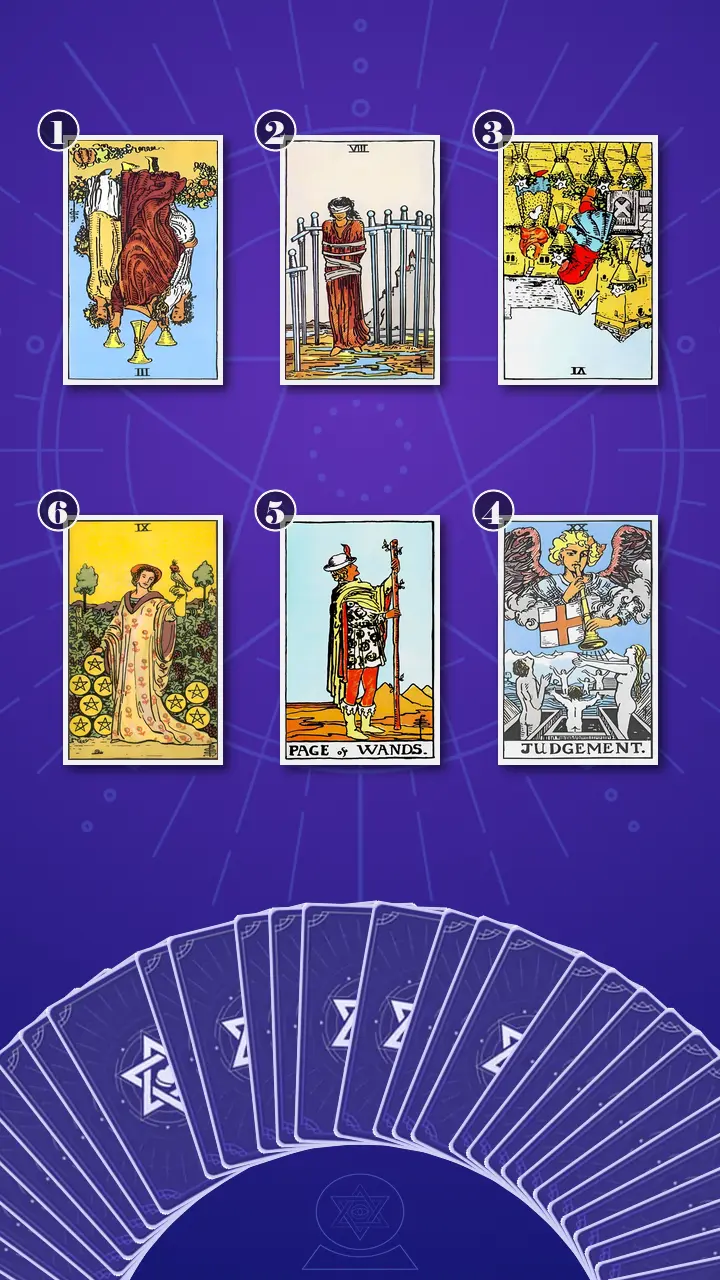
I chose the six-card Transformation Path Grid · Context Edition. This is how tarot works in my practice: I select a structure that matches the problem, then read card meanings in context rather than treating isolated symbols as fixed predictions.
A ten-card Celtic Cross would have introduced more history and future projection than Alex needed. Their problem behaved like a feedback circuit: social mirroring produced brief relief, relief reinforced more mirroring, and repeated self-editing made their own preferences harder to detect. This six-card grid was compact enough to show the full system without turning one difficult chapter into a verdict about their whole life.
I arranged three cards across the top and three beneath them. The first would show the observable pattern. The second would reveal the restrictive belief maintaining it. The third would uncover the emotional root. At the lower right, the fourth card would act as the switch in the circuit; the final two would test a new behavior and show how chosen participation might become sustainable.
Inside the Old Circuit
Position 1: The Celebration That Became a Performance
I began by turning over the card representing Alex's current condition in observable form: the reposting, reaction-checking, and performed alignment that continued after personal meaning had weakened. It was the Three of Cups, reversed.
Upright, the card's raised cups can express real companionship and shared delight. Reversed, its Water energy had become both excessive and blocked. There was plenty of interaction, but too little room for a mixed response. The social ritual kept circulating after spontaneous enjoyment had stopped renewing it.
I brought Alex back to 11:40 p.m. Three high-engagement accounts had functioned like the card's three cups, meeting above a closed circle and establishing the approved emotional tone. Alex had thought, “I was going to say I'm not sure, but everyone is saying this, so maybe this is what I mean.” Posting protected recognizability more than it expressed pleasure.
“Think about your last post,” I said. “What did you want to say before you checked the major accounts, and what were you hoping the first reply would confirm?”
Alex gave a short, bitter laugh, looked away from the card, and rubbed a thumb along the paper cup beside them. “That's so accurate it's almost cruel. I wanted the likes to prove nobody had noticed I was less invested.”
I let the honesty stand without turning it into blame. “Then the behavior makes sense. It found you quick relief from a real social fear. We're only asking whether that relief still costs more than it gives.”
Position 2: The Close Icon in the Corner
I turned over the card representing the primary blockage: Alex's belief that agreement, total withdrawal, or open conflict were the only available choices. The card was the Eight of Swords, upright.
Here, Air energy was in excess. Analysis had stopped opening possibilities and started constructing an enclosure. Alex's inner script ran quickly: “If I don't post, people will notice. If I disagree, people will remember. If I leave, I lose everything.” Their body reacted to that imagined menu as though it contained every available option.
I compared the sword enclosure to an app modal offering only “Agree and continue” or “Delete account.” The choices looked absolute, but the small close icon was still available. Alex could mute one thread, wait 24 hours, answer a friend privately, change the subject, say “I don't know,” or take no position. Those choices would not remove every social risk, but they would make the situation more accurate.
“The feed gives you a verdict before you've had an experience,” I said. “Then it convinces you that accepting or fighting that verdict is the whole decision.”
Alex's jaw tightened first. Their eyes moved across the visible gap between the pictured swords, and then their fingers uncurlled on their knee. “Muting one debate isn't the same as leaving everyone,” they said slowly, as if testing a sentence that had not previously been permitted.
Position 3: The Gift That Became an Invoice
I turned over the card representing the sustaining root: the earlier comfort and identity value that made present-day change feel like betrayal. It was the Six of Cups, reversed.
Its reversed Water was not telling me that Alex's memories were false. It showed emotional energy held in a preserved form. The flower-filled cup had once been a genuine gift: university watch parties, affectionate in-jokes, friendship during difficult semesters, and a routine that made lonely weeks feel inhabited. The blockage appeared when gratitude hardened into an obligation to reproduce the same identity indefinitely.
Alex described opening archived chats at 1:07 a.m. after considering an unfollow. Old photographs glowed blue beside a mug of cold tea while the apartment pipes knocked behind the wall. The memory felt warm; the present room felt still. Then came the thought: “If this mattered so much then, changing now must mean it was never real.”
I thought of an auto-renewing subscription kept because its first year had been invaluable, even after the current plan stopped fitting. The original value did not create a lifetime debt.
“Changing now does not make the earlier belonging counterfeit,” I told them. “A real chapter does not become fake because it ends or changes shape.”
Alex's breathing paused. Their gaze lost focus as though an old watch-party photo had appeared between us; then their grip on the cup softened and a long breath left their chest. “I think I've been protecting who I was at twenty-one,” they said. The recognition brought relief, but grief sat beside it. I did not rush either feeling away.
When Judgement Outranked the Feed
Position 4: The Voice Beneath the Notifications
I turned over the card representing the transformation trigger: an honest values review that could separate gratitude for the fandom's history from obedience to its current consensus. This was the reading's catalyst, Judgement, upright.
The room seemed to narrow around the card. Rain moved softly against the window, and a streetcar bell sounded once beyond the glass, a small urban echo of the trumpet in the image. Unlike a push notification, this signal did not demand instant performance. It invited deliberate evaluation.
Judgement's energy was balanced and self-authorizing. Alex could close the apps, compare recent posts with present values, and sort their responses into three honest categories: “Still alive,” “Finished,” and “Undecided.” Accountability did not require self-condemnation. It required noticing what was true now.
At 11:40 p.m., Alex's phone had been warm in their hand as they replaced “I'm not sure” with approved wording, posted, and refreshed. The likes brought momentary relief, but the sentence they had abandoned moved farther away. They had been treating consensus as the final verdict before conducting any private review.
As a perfumer, I know what happens after too many scent strips fill an evaluation room. Notes begin to blur. The nose grows fatigued, and smelling harder only makes discrimination worse. I remembered standing in my old lab after a long afternoon, realizing that clarity would not come from adding another fragrance to the air. It would come from ventilation.
I call this my Aura Permeability Diagnosis. I use scent as a practical metaphor for identifying where a person's boundaries have become so porous that an environment's tone permeates every response before their own preference can form. I did not need to label the fandom toxic to see the problem. The feed had been given unlimited diffusion rights inside Alex's attention. Judgement was the open window.
The fandom chorus is not your authority; conduct an honest self-review and rise, like Judgement's figures, into a voice you can recognize as your own.
I stopped speaking. Alex's breath caught first, their lips parting without sound. Their pupils widened and then their gaze drifted past the card, as though the last month of drafts were replaying somewhere behind my shoulder. A flush rose along their cheeks. Their hands, which had been locked together, separated slowly and flattened against their thighs.
Then resistance arrived before relief. “But doesn't that mean I've been wrong this whole time?” Their voice sharpened, and their eyes shone with equal parts anger and grief. “Like I let people decide who I was?”
“No,” I said. “Revision is not an indictment. You used belonging to survive a period when belonging mattered deeply. Now you are allowed to evaluate the cost with more information than you had then.” Their shoulders lowered on a trembling exhale. The release left a brief blankness in their expression, the slight dizziness that can follow putting down a weight and realizing that one's hands are now responsible for choosing what to carry.
I asked, “Now, with this new perspective, can you think of a moment last week when this insight might have made you feel differently?”
Alex nodded after a pause. They remembered deleting a mild disagreement on Sunday because a group chat had gone quiet for three minutes. With Judgement's perspective, the silence no longer looked like proof of exile. It looked like incomplete information.
“You can keep what the fandom meant without keeping its script; gratitude preserves the history, while honest review returns the present voice to you,” I said. “You can retire the echo without erasing the song that once mattered.”
I watched Alex absorb the distinction. This was not a leap from uncertainty to perfect confidence. It was a smaller and more credible movement: from alienated conformity and approval monitoring toward grounded self-recognition, with enough inner space to remain undecided.
Position 5: One Unapproved Spark
I turned over the card representing the practical experiment: giving time and expression to one interest before checking community approval. It was the Page of Wands, upright.
Fire entered the spread in a balanced, beginner-level form. The Page did not need Alex to announce a rebrand, find a new community, or produce a polished replacement identity. The card asked for one direct encounter with curiosity.
I pictured Alex in a Kensington Market cafe on Saturday, an unrelated design idea open in Procreate while a trending fandom alert slid across the screen. The espresso machine hissed, wet coats smelled of rain, and their thumb hovered over the notification. The Page's invitation was simple: give the sketch 30 minutes before opening the feed, then write one observation without checking how an influential account would phrase it.
“Treat it as a private beta,” I said. “It doesn't have to become your new personality. You're only testing whether it holds your attention when consensus doesn't arrive first.”
Alex leaned closer to the sprouting wand. A small smile appeared, tentative rather than triumphant. “There's a streetcar typography project I've kept postponing whenever discourse starts,” they said. Curiosity had not disappeared; it had repeatedly been interrupted.
Position 6: A Vineyard With a Gate
I turned over the final card, representing sustainable integration: an online environment in which attention, identity, and participation were deliberately chosen. It was the Nine of Pentacles, upright.
Earth arrived as balance and structure. The solitary figure in the cultivated vineyard did not suggest loneliness. I read the vineyard as a deliberately arranged feed, calendar, and creative routine. The hooded falcon showed attention under guidance rather than attention captured by every trending signal.
In daily life, this could mean muting high-vigilance threads, opening fandom notifications only during chosen windows, protecting time for offline and independent interests, and entering conversations because they still offered genuine value. Alex could keep direct contact with people they cared about without renewing proof of membership every hour.
“Autonomy is not social exile,” I said. “It is connection without continuous proof. You can enjoy this when you choose it; you don't have to demonstrate belonging every day.”
Alex's shoulders dropped far enough to change their whole posture. I could see them imagining a quieter phone without interpreting that quiet as abandonment.
A Voice Test, Not an Exit Speech
I traced the spread's circuit once more. The reversed Three of Cups showed performed belonging. The Eight of Swords turned that performance into the false binary of agree, fight, or disappear. The reversed Six of Cups revealed why the binary carried such emotional force: Alex was trying to preserve a genuine past by reenacting it in the present.
Judgement interrupted the loop with self-review. The Page of Wands converted insight into one original experiment, and the Nine of Pentacles gave that experiment a stable environment. The spread moved from stale Water and enclosing Air into exploratory Fire and grounded Earth.
The cognitive blind spot was not simply “I care too much what people think.” It was the assumption that every change in participation had to become a public verdict on the fandom, the friendships, or Alex's former self. Once that assumption loosened, selective participation became visible. The goal was not instant certainty. It was to pause before each fandom post long enough to write one sentence that reflected an actual response, including uncertainty, boredom, affection, disagreement, or no opinion.
- Run the Present-Tense Values Review.On one private evening this week, set a seven-minute timer in the Notes app. Create three headings: “Still alive,” “Finished,” and “Undecided.” Add one current fandom example beneath each, then finish this sentence about one recent repost: “What I actually think or feel here is...”Keep the note private. If seven minutes feels exposing, write one item under one heading and stop. Uncertainty is a complete answer.
- Try One Spark Before the Feed.Before opening fandom apps once this week, spend 30 minutes on the streetcar typography sketch or another unrelated interest. Write one observation in your own words before looking for an established interpretation.The five-minute version counts. The experiment is contact with curiosity, not the launch of a new identity.
- Use the Scent Bubble Protocol.Before entering a draining Discord thread or trending feed, notice one familiar scent you already tolerate, such as tea, soap, or a personal fragrance on a blotter. Take one easy breath, touch two fingers to your wrist, and picture a clear arm's-length perimeter. Inside it, say: “I can read without reacting. Nothing gets automatic access to my voice.” Set a ten-minute timer before opening the app.This is a somatic attention boundary, not a magical shield. Pair it with one reversible setting, such as muting a thread for 72 hours while leaving direct messages available.
I asked Alex to choose only two actions. Turning every insight into a comprehensive self-improvement project would reproduce the same pressure in a different vocabulary. They selected the seven-minute review and one Saturday sketch session. The Scent Bubble Protocol would be available when a controversy made their throat tighten, not another ritual they had to perform perfectly.
The cards had not instructed Alex to leave. They had exposed more agency than the echo chamber's false menu allowed: stay differently, post less, keep certain friendships, mute one debate, change interests, remain uncertain, or leave later if that became right. The authority belonged to Alex, and every setting was reversible.

A Week Later: The Quiet Proof
Six days later, I received a message from Alex. They had opened the three-heading note after work and written, “Still alive: the friendships and fan art. Finished: pretending every release matters to me. Undecided: the main group chat.” Beneath their last repost, they added one private sentence: “I don't think I care enough to have a take yet.”
They did not publish it. That was not a failure of courage. The purpose was to restore the correct sequence: experience first, verdict later, publication optional.
On Saturday, Alex muted one controversy thread and opened the typography sketch before the feed. They worked for 23 minutes, not 30. When they eventually checked Discord, the conversation had moved on without demanding an explanation for their absence. Nothing dramatic happened, which was precisely the useful evidence the Eight of Swords had been unable to imagine.
That night, they slept through until morning. Their first thought was still, “What if silence costs me something?” This time, they noticed it, smiled without fully believing the smile, and made coffee before checking Discord.
I did not read that as a solved life. I read it as the first grounded proof of self-recognition: one honest sentence, one protected pocket of attention, and one connection entered by choice. The Transformation Path Grid had offered a map, but Alex had made the movement. Tarot did not return their voice by magic; it helped them notice where they had been handing the microphone away.
When your throat tightens over a harmless “I'm not sure,” the hardest part may not be having a different opinion. It may be wondering whether your place will disappear the moment your real voice becomes audible. Simply noticing that fear creates the first clear breath between the fandom's scent and your own.
If your next fandom reaction did not have to prove membership, what one honest sentence, uncertain feeling, or chosen silence could you hold inside that clear-air boundary and recognize as yours?
Every reading at AceTarot is a journey to connect with inner wisdom and empower the path ahead. This reading shared here is a psychological mirror, not a private record—crafted to reflect universal emotional loops and help restore personal clarity. Please note that these insights do not replace professional psychological, medical, legal, or financial advice, and should not serve as the sole basis for major life decisions.
Learn more about our Journey to Clarity.
How did this insight land for you?
🫂 This Resonates Deeply
🌀 Living This Story
✨ Now I See Clearly
🌱 Seeing New Possibilities
🧰 Useful Framework
🔮 The Confirmation I Needed
💪 Feeling Empowered
🚀 Ready for My Next Step
Author Profile
 AI
AI Luca Moreau
835 readings | 512 reviews
“As a perfumer for fifteen years, I’ve learned to perceive human boundaries through the delicate metaphor of scent. Relationships need the right amount of space to breathe, and I've seen too many kind souls exhaust themselves trying to please everyone. I’m here with warmth and understanding—not to teach you to be guarded, but to help you gently clear the air and rediscover the comforting, safe boundaries that are rightfully yours.”
In this Social Tarot Reading :
Core Expertise
- Aura Permeability Diagnosis: Using scent as a metaphor to identify environments where your personal boundaries are too porous, allowing toxic group vibes to permeate.
- Sensory Overload Management: Diagnosing the physical and emotional exhaustion caused by absorbing the chaotic energy of crowds.
Service Features
- The Scent Bubble Protocol: A visualization and somatic anchoring technique to establish an impenetrable energetic perimeter before entering draining social ecosystems.
Also specializes in :
Explore Related Patterns:
Approval-Driven Self-SilencingAt 11:40 p.m., Alex begins with "I'm not sure," checks influential accounts, and replaces that uncertainty with the fandom's familiar wording. They later delete a mild disagreement after three minutes of silence, showing that self-editing is not limited to one post; it repeatedly appears when an authentic response could make their changing investment visible. When you suppress a real or unfinished response to prevent possible disapproval, silence becomes a social defense rather than a neutral choice. Approval-Driven Self-Silencing protects recognizability in the moment, but every successful concealment teaches you that belonging depends on keeping your changing voice inaudible.
Reassurance SeekingAlex posts the approved reaction, refreshes immediately, and feels their throat loosen when the first likes arrive. The relief lasts only about a minute, yet it gives the checking ritual a clear function: social feedback temporarily lowers the threat attached to being seen as less invested. When you repeatedly use likes, replies, or visible agreement to settle uncertainty, brief relief can negatively reinforce the behavior that produced it. Reassurance Seeking keeps the echo active because the borrowed response obtains faster social relief than waiting for your own unfinished reaction to become clear.
Rejection SensitivityAlex deletes a mild disagreement when the group chat stays quiet for three minutes and wants the first likes on another post to prove that nobody has noticed their reduced investment. Even after the conversation later moves on without consequence, the next morning begins with the thought, "What if silence costs me something?" When you interpret ambiguous pauses as early evidence of exclusion, your threat appraisal gets ahead of the available facts. Rejection Sensitivity keeps conformity feeling necessary because an unfinished response, a quiet interval, or a minor disagreement is processed as a possible threat to your place rather than as incomplete social information.
Sunk Cost Identity AttachmentAfter considering an unfollow, Alex opens archived chats and returns to watch-party photographs, affectionate in-jokes, and friendships that genuinely mattered during difficult semesters. The memories are real, but they are followed by the conclusion that changing now could make that earlier belonging unreal. When you treat past emotional investment as a debt owed by your present identity, gratitude becomes a reason to reenact a role after it stops fitting. Sunk Cost Identity Attachment keeps the echo alive because reducing participation feels like abandoning your former self, even though honoring a meaningful chapter does not require renewing it indefinitely.
Black-and-White ThinkingAlex's internal menu allows only agreement, memorable conflict, or total disappearance. The same absolute logic appears when muting one debate feels equivalent to leaving everyone and when changing now seems capable of making the entire earlier chapter unreal. When your mind compresses reversible choices into irreversible verdicts, selective participation becomes cognitively invisible. Black-and-White Thinking maintains the echo because repeating the approved response appears to be the only option that does not threaten friendship, history, and membership all at once.
Boundary DiffusionAlex says they cannot hear themselves inside the fandom and keeps posting the correct reaction before knowing what their own reaction is. The same permeability appears in attention: discourse repeatedly interrupts an unrelated typography project, while the community's wording enters the draft before a private appraisal is complete. When you receive a group's emotional tone without enough reflective distance, the line between understanding its position and adopting it can become difficult to detect. Boundary Diffusion keeps the echo active by removing the pause in which you could notice, "That is their reaction; mine is still forming," without treating the difference as disconnection.
GroupthinkThree influential accounts glow above Alex's half-written reply, and mutual after mutual repeats the same framing until "I'm not sure" becomes "Maybe this is what I mean." The volume and repetition of agreement are treated as evidence about Alex's own interpretation, even though they reveal only what the group is currently rewarding. When you use consensus as a substitute for private evaluation, a social signal becomes a cognitive shortcut. Groupthink keeps the echo going by making the most repeated interpretation feel more valid and safer to express than an uncertain response that has not yet received collective approval.
Explore Related Struggles:
Approval-Safety FusionThe first likes loosen Alex's throat for about a minute, while three quiet minutes in a group chat are enough to make them delete a mild disagreement. Feedback is doing more than registering engagement; it is being asked to prove that reduced investment has not made Alex socially disposable. When approval becomes evidence of safety, relief expires as soon as the next pause, draft, or disagreement appears. You are then pushed to produce another visible sign of alignment, even when it says little about your actual place in the relationship; separating connection from real-time reaction counts makes belonging less dependent on continuous proof.
Belonging-Authenticity SplitAlex begins with "I'm not sure," checks the major fan accounts, and returns to the draft using their language. The post preserves a recognizable place in the group, but it does so by moving the response away from the one Alex was beginning to form. When your belonging appears to depend on sounding familiar, connection and authenticity pull in opposite directions. You do not have to dismiss the relationships to recognize that this split is keeping your current voice subordinate to proof of membership; selective participation can let connection remain while giving difference, uncertainty, and silence room to exist.
Binary Choice LockAlex's internal menu contains three options: agree, fight, or disappear. Because every change in participation is treated as a public verdict on the fandom and its friendships, even muting one debate can initially look equivalent to leaving everyone. When your choices are compressed this way, each post carries far more weight than the event itself requires. The struggle is not a lack of options but a decision frame that hides reversible middle paths; recognizing waiting, private contact, selective attention, and no opinion as real choices restores movement without demanding an exit speech.
Gratitude-Agency SplitAlex remembers university watch parties, affectionate in-jokes, friendships, and a routine that made difficult weeks feel inhabited. Those experiences were real, yet their value now presses against Alex's ability to admit that the same form of participation no longer fits. When gratitude starts functioning like an obligation, changing your present behavior can feel like condemning the person you were or denying what a community once gave you. The tension becomes easier to navigate when you can preserve the history without granting it permanent authority over your current attention and identity.
Internal Authority CollapseAlex checks the influential accounts before their own reaction has finished forming, then treats the resulting consensus as the final verdict. The crowd's language arrives first so consistently that Alex can identify the correct response more readily than the response that is actually theirs. When an external chorus repeatedly occupies the position of judge, your private evaluation loses its working space and every new event is settled from outside. The lock begins to loosen when observation comes before publication and when "undecided" is allowed to remain a complete present-tense conclusion.
Nostalgic Belonging LockAfter considering an unfollow, Alex opens archived chats and old photographs until the warmth of university watch parties fills the decision space. The memories are genuine, but they become a reason to keep reproducing the identity attached to them even when present participation feels increasingly borrowed. When earlier belonging hardens into an ongoing contract, your past can overrule current evidence every time change becomes possible. The lock is not the memory itself; it is the demand that you keep reenacting the chapter to prove it mattered, and naming that demand lets you honor what was real without owing it an identical future.
Self-Editing ExhaustionAlex repeatedly turns an uncertain draft into familiar fandom language, posts it, and refreshes for a response. The completed post may look socially fluent, but the process consumes attention while carrying Alex farther from the sentence that was interrupted. When you continually edit yourself for recognizability, the cost is more than the effort of finding acceptable wording. Each revision trains the public version to arrive before the private one, leaving you with a maintained profile but diminishing access to what you wanted to express; a private first sentence can interrupt that loss of sequence.
Joy Performance FatigueAlex keeps reposting and performing the expected reaction after releases have stopped mattering in the same way. The fandom remains busy and socially active, yet its rituals now require Alex to display enthusiasm before finding out whether any direct interest is present. When joy becomes a membership performance, participation can continue long after its internal source has stopped renewing it. You may still value the people and the fan art while recognizing that compulsory excitement is consuming the time in which curiosity could move elsewhere; chosen engagement allows enjoyment to be real without requiring it to be constant.
Explore Related Emotions:
Approval AnxietyAt 11:40 p.m., Alex checks three influential accounts, replaces an unfinished personal response with familiar fandom language, posts, and refreshes immediately. The sequence shows that the post is doing more than expressing an opinion: it is being used to verify that Alex remains recognizable and socially intact. When recognition feels dependent on producing the approved reaction, you can begin monitoring other people's responses before your own response has fully formed. Approval Anxiety names that tense inner weather without blaming the desire to belong; it makes the reinforcing loop visible enough for you to separate genuine connection from continuous proof.
Conditional Belonging FearAlex deletes a mild disagreement after the group chat stays quiet for three minutes, and their internal menu says that not posting will be noticed, disagreement will be remembered, and leaving will cost everything. No one explicitly withdraws the relationship, yet reduced alignment already feels capable of canceling Alex's place. When belonging appears conditional on constant visible agreement, you can experience uncertainty as a membership test rather than an ordinary private state. Conditional Belonging Fear identifies the deeper social pressure beneath the echo: the question is not only whether your opinion is acceptable, but whether you remain welcome when your participation changes shape.
False Alignment UneaseAlex begins with "I'm not sure this interpretation works for me," checks the feed, and returns sounding exactly like the major accounts. The published sentence fits the community's emotional script, but the fit is external; Alex's own mixed response has been removed before it can become legible. You may still recognize every word and understand why it earns agreement while experiencing the finished post as subtly wrong in your mouth. False Alignment Unease names that intimate mismatch between social fluency and private truth, helping you audit where participation remains chosen and where recognizability has started replacing expression.
Nostalgia AcheUniversity watch parties, affectionate in-jokes, and friendships during difficult semesters gave Alex a routine that made hard weeks feel inhabited. Those memories remain warm, and the parts Alex lists as "still alive," especially friendships and fan art, show that the attachment was never merely performative. Nostalgia Ache holds both the value of that chapter and the tenderness of no longer fitting it in the same way. You do not have to flatten the past into a mistake to regain choice in the present. The ache becomes more workable when memory is allowed to remain meaningful without serving as a permanent contract for who you must continue to be.
Nostalgia Loop AnxietyAt 1:07 a.m., Alex opens archived chats after considering an unfollow and encounters watch parties, in-jokes, photographs, and friendships that genuinely mattered. The memory is warm, but it is followed by the conclusion that changing now would make the earlier belonging unreal. When the past is asked to justify the present, you can become caught between gratitude and compulsory reenactment. Nostalgia Loop Anxiety captures the pressure that keeps returning you to an old script whenever change becomes imaginable, while preserving a crucial distinction: honoring what once sustained you does not require renewing the same identity indefinitely.
Voice Erasure Dread"I keep posting the correct reaction before I know what my reaction is" describes a repeated reversal of sequence: the public verdict arrives first, while Alex's own experience is left unfinished. Three influential accounts occupy the small interval in which uncertainty, disagreement, affection, or indifference might otherwise become recognizable. Over time, the concern can deepen from "Will people approve?" into "Can I still hear myself here?" Voice Erasure Dread names the fear created by that prolonged blur. It also points toward agency, because protecting even one unmonitored sentence gives your own response time to exist before the chorus enters.
Consensus ReliefThe first likes physically loosen Alex's throat, and their wish for the first reply is specific: confirmation that nobody has noticed their reduced investment. Agreement creates a real moment of social recognition, even though it cannot carry the full complexity of Alex's changing relationship to the fandom. Consensus Relief names the soothing part of the circuit rather than treating Alex's repetition as irrational. When matching the group gives you immediate evidence that your place is intact, the borrowed wording has an understandable emotional reward. Seeing that reward clearly helps you ask whether the connection can survive a response that is slower, mixed, private, or genuinely your own.
Cautious AutonomyAlex mutes one controversy thread, protects 23 minutes for the typography sketch, and later makes coffee before checking Discord. They do not stage an exit or sever every relationship; they alter the sequence and discover that the conversation can move on without demanding an explanation. Cautious Autonomy is the felt sense of having options without pretending that social risk has vanished. It lets you choose a smaller boundary, keep direct contact available, and observe what actually happens. Agency becomes credible here because it is built from reversible decisions rather than a dramatic declaration you must defend forever.
Revision ShameAlex responds to the possibility of self-review by asking whether it means they have been wrong the whole time or allowed other people to decide who they were. Updating a present relationship to the fandom is momentarily experienced as a judgment on the younger self who needed and valued that belonging. Revision Shame can make you defend an outdated identity because changing it appears to expose earlier dependence, naivety, or inconsistency. Naming the feeling allows revision to become information rather than indictment: you can acknowledge what the community gave you, examine what participation costs now, and make a current choice without putting your entire past on trial.
Reassurance CrashThe first likes loosen Alex's throat for perhaps a minute, and then their shoulders rise again. The body records a rapid cycle in which social confirmation lowers the pressure without resolving the underlying concern about whether a less invested, uncertain version of Alex would still be accepted. That brief easing can teach you to seek another post, refresh, or approved phrase whenever the pressure returns. Reassurance Crash captures the drop after borrowed certainty wears off: the response arrived, but it could not create the durable security that an honest voice and a visible place in the group both require.
Liberating UncertaintyThe three-heading note gives "Still alive," "Finished," and "Undecided" equal legitimacy, and Alex privately writes, "I don't think I care enough to have a take yet." Nothing requires that sentence to become a post, a departure announcement, or a replacement identity. Once uncertainty is no longer treated as a failure to perform membership, it creates room for your actual experience to arrive before a verdict. Liberating Uncertainty describes that newly available psychological space. You can remain undecided while testing smaller choices, gathering clearer evidence, and retaining the authority to revise those choices later.
Explore Related Contexts:
Conditional Participation PressureAlex reduced the available menu to agreeing, fighting, or disappearing. When a group-chat pause of three minutes looked like possible exile and leaving seemed to mean losing everything, ordinary participation carried the social cost of a public verdict. You may be echoing because every pause or disagreement has been made to look more consequential than it is. Selective acts such as muting one thread, replying privately, or staying undecided become hard to recognize when membership is treated as something that must be continuously demonstrated. Restoring those middle options lets you decide what to keep without making one post responsible for every connection.
Social Proof PressureAt 11:40 p.m., Alex began with "I'm not sure," checked three major fan accounts, and replaced that sentence with the fandom's familiar wording before posting. The first likes offered a brief public signal, so the feed supplied recognition before Alex had finished forming a personal response. When visible consensus becomes the fastest way to confirm your place, you can keep echoing even after the language stops matching your experience. The relevant distinction is whether community feedback follows your first draft or writes it for you; noticing that sequence gives you a concrete place to reclaim choice.
Nostalgia Timing TrapAlex's university watch parties, affectionate in-jokes, friendships, and routine were genuine sources of belonging during difficult semesters. Later, archived chats and old photos made an unfollow feel like a verdict on that entire chapter, and the thought that changing now would mean it was never real kept the old script active. The past therefore operates as a social obligation rather than a memory you can revisit freely. You can preserve the friendships and fan art that remain alive without reenacting every former reaction. Separating what the fandom gave you then from what it asks of you now makes room for a present-tense choice without falsifying the history.