A 23-Minute Coffee Turned a Readiness Test Into Lived Evidence

Waiting to Feel Fully Healed at 6:20 p.m.
If you can meet every deadline in a hybrid product-design role but keep replying “maybe when I feel more like myself” to low-pressure plans, I know how quickly one resurfacing wave of sadness can turn a Friday dinner into a full readiness audit.
I first met Maya, a 29-year-old product designer in Toronto, a few days after one of those audits. At 6:20 p.m. on Friday, she had sat on the edge of her sofa with a dinner invitation open on her phone. She typed a reply, deleted it twice, and finally sent, “I need a quiet night.” The radiator clicked behind her. The screen warmed her fingertips. Her shoulders dropped as soon as the message went through.
By 8:45, the relief had curdled into something else. Instagram Stories began filling with plates from the restaurant, friends leaning into the frame, and the familiar evidence that the evening had continued without her. Maya watched recovery videos with the sound low while the untouched message thread stayed at the top of her screen.
“I keep moving the date when my life is supposed to restart,” she told me. “I can do my job. I can make meetings and hit deadlines. But if I wake up sad, I cancel anything personal. One bad day makes all the better days feel fake.”
I could see the contradiction in the way she held herself. Her hands were folded tightly in her lap, but her body leaned toward the table. The longing in her felt like standing behind the closed doors of a TTC train while the platform she wanted was already visible on the other side. She wanted connection, pleasure, and creative movement, but she kept treating a mixed mood as proof that she could not safely participate.
“You can want your life back and still be afraid of what returning might reveal,” I said. “I’m not going to tell you that rest is wrong, or that a tarot reading can certify that you’re healed. I want us to find the hidden rule that keeps turning one difficult feeling into a verdict. Then we can see whether that rule still protects you, or whether it has become life-on-hold paralysis.”
Maya looked down at her hands. “That’s exactly it. I don’t want to force myself. I just can’t tell when caution becomes hiding.”
“Then that is our Journey to Clarity,” I said. “We’ll give the fog a structure. The cards will be the map, but you will decide where, when, and whether to move.”

A Staircase Out of the Waiting Room
I asked Maya to place both feet on the floor, let one slow breath leave her body, and hold a single question in mind: “Why am I waiting to feel fully healed before living again?” I shuffled slowly. I use this brief ritual as a transition from constant mental scrolling into focused observation, not as a performance of certainty.
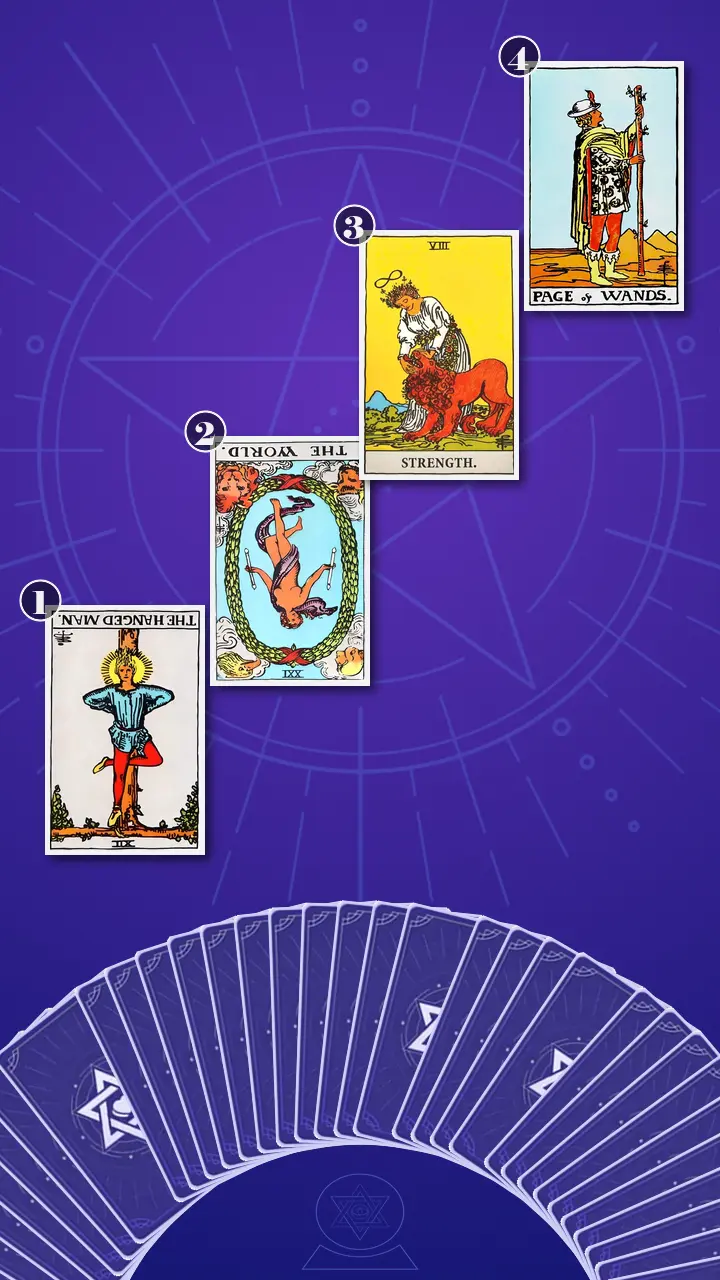
I chose the Four-Layer Insight Ladder, a four-card tarot spread for feeling stuck in healing. I arranged the cards as a diagonal ascent from the lower left to the upper right, like a staircase leaving a waiting room. The slightly larger space between the second and third cards marked the point where diagnosis would become choice.
I chose this spread because Maya was not asking for a forecast or a fixed timeline. She was asking about a protective belief. In this context, how tarot works is straightforward: I use the images and positions to externalize a pattern that has become difficult to inspect from inside it. Card meanings in context can separate visible behavior, the rule beneath it, the capacity available now, and a practical next step. The cards do not remove uncertainty; they make its structure easier to see.
I explained the route. The first position would show the visible behavior of suspending plans whenever unresolved feelings appeared. The second would reveal the hidden completion rule and the fear supporting it. The third, the hinge of the reading, would identify the inner resource capable of changing the pattern. The fourth would translate that resource into one small, reversible act of participation.
“So we’re not asking whether I’m officially ready?” Maya said.
“No,” I replied. “We’re asking what you currently do with uncertainty, and what other response is available to you.”
The Halo That Could Explain Everything Except How to Move
Position One: The Pause That Stopped Restoring You
Now I turned the card representing the diagnosis-level behavior: the way Maya suspended plans and meaningful participation whenever unresolved feelings appeared. The card was The Hanged Man, reversed.
I pointed to the figure hanging by one ankle. Even reversed, the halo remained visible around his head. “This is not a picture of someone who lacks insight,” I said. “It is a picture of awareness held in place. One rule has the rest of the life suspended.”
For Maya, that rule appeared every time a heavy mood arrived. She could explain why she was postponing a coffee, move her imagined restart date, and spend the evening researching emotional recovery. The pause had once helped her restore basic routines. Now it was functioning like a holding pattern that prevented new evidence from reaching her.
I named the energy dynamic clearly. The Hanged Man reversed showed an excess of analysis combined with a blockage of movement. Insight was present, but permission was deficient. Maya was not failing to understand herself. She was using increasingly sophisticated understanding to justify another cancellation.
“It’s almost like Severance,” I said, “except the partition is not between two identities. It is between permissions. Your work self is allowed to function with mixed feelings. Your personal self has to pass an emotional screening before it can leave the apartment.”
I asked, “When a difficult feeling appears on the day of a plan, what do you actually do next?”
Maya gave a short, bitter laugh. “That’s so accurate it’s almost cruel. I cancel, then I research why I cancelled, then I call the research progress.” Her breath caught after the last word, and she rubbed her thumb across the edge of her phone case.
“I hear the sting,” I said. “But accuracy is not a sentence against you. The pause made sense when you needed restoration. We’re only checking whether it is still restoring capacity or now postponing contact with life. No shame is required for that audit.”
Position Two: The Finish Line That Moved Overnight
Now I turned the card representing the hidden foundation: the belief that complete healing and perfect closure had to arrive before life could resume, along with the fear that an early return would cost Maya control over her safety. The card was The World, reversed.
The central dancer was still surrounded by the laurel wreath, but the reversal changed the wreath from a symbol of integration into a circular gate. I told Maya that this was healing perfectionism in one image: close enough to life to see it, yet convinced that one final standard had to be satisfied before the boundary could be crossed.
I brought her back to a Sunday morning she had described. At her Leslieville kitchen table, she had kept Google Calendar, a saved pottery class, and a Notion page called “Signs I Am Ready” open at the same time. The kettle clicked off behind her while cold coffee sat beside the laptop. She added emotional steadiness to the checklist, then confidence, then the ability to enjoy the entire class.
“What was the sentence underneath the checklist?” I asked.
She stared at The World for several seconds. Her fingers stopped against her phone, her gaze drifted beyond the card as if the kitchen table had reappeared, and then she released a small breath from deep in her chest. “If this feeling is still here, the chapter isn’t closed. If the chapter isn’t closed, I can’t begin.”
That was the mechanism. The World reversed showed an excessive demand for completion and a blockage of integration. Each checked box quietly generated two more. One hard evening became evidence that the cycle was unfinished; the definition of readiness changed; the class, trip, date, or creative project returned to the saved folder.
I told her that the fear beneath this was not foolish. Cancelling produced immediate relief because she no longer had to test whether discomfort could be contained in public. The long-term cost was harder to notice: every cancellation removed pleasure, connection, and real-world evidence of her current capacity. The lack of evidence then reinforced the belief that she was not ready.
I sometimes call my diagnostic process Pseudo-Growth Eradication. The name sounds severe, so I clarified what I meant. “I’m not calling your healing fake,” I said. “I’m stripping away the self-help packaging so we can audit the actual return. How many new inputs did you consume last month, and how many small, bounded experiments did those inputs help you attempt?”
“A lot of inputs,” Maya said. “Basically no experiments.”
Years earlier, on a Wall Street trading floor, I had watched intelligent people confuse more information with less risk. The memory surfaced as I looked at the reversed wreath. No credible risk process waits for permanent zero volatility; it sets position size, time limits, and exit conditions. I would never reduce emotion to a market variable, but the structural lesson mattered: uncertainty becomes more manageable through proportion, not through an impossible guarantee that nothing difficult will happen.
“The audit is ruthless with systems, never with people,” I told her. “Your system keeps promising certainty in exchange for one more evening of research. Its execution rate is close to zero.”
A pale oval of winter light shifted across the table and briefly enclosed The World inside another ring. Maya watched it move beyond the card.
“So the thing I thought would finish the healing is helping keep it unfinished,” she said.
“It is keeping life untested,” I replied. “That is different from keeping you unhealed. Feeling unfinished is not the same as being unready.”
When Strength Put Steady Hands on the Lion
Position Three: The Antidote to Emotional Veto Power
The room became very quiet before I turned the hinge card. Even the traffic beyond the window seemed to thin for a moment. Now I revealed the position representing the transformation-level shift from eliminating difficult feelings to meeting them with compassionate courage while acting proportionately. The card was Strength, upright.
I asked Maya to look first at the woman’s hands resting gently at the lion’s jaws. There was no weapon, no locked cage, and no demand that the lion stop being a lion. The image showed calm contact with intensity. Its upright energy was balanced: courage without force, regulation without suppression, and boundaries without disappearance.
In Maya’s life, Strength could look like noticing apprehension in her chest before an invitation, resisting the urge to launch another readiness audit, and choosing a 25-minute version of the plan with her own route home. The feeling could remain present without receiving automatic veto power.
I watched Maya circle the old equation one last time: if she accepted dinner while sad and felt worse there, she would call it proof that she had rushed recovery. The difficult feeling was real. The automatic verdict attached to it was the part now under examination.
You do not need to defeat every difficult feeling before you move; practice gentle courage now, as Strength meets the lion with steady hands rather than force.
I let the sentence rest between us.
For one beat, Maya did not move. Her breath paused high in her chest, and her fingers hovered above the rim of her cup. Then her pupils widened slightly and her gaze lost focus, as though she were replaying the Friday invitation, the sofa receiving her weight, and the first restaurant Story appearing on her phone. Her mouth tightened before her eyes began to shine. Finally, her fist loosened against her thigh, one finger at a time. Her shoulders sank, but the release was followed by a brief, almost dizzy blankness. Clarity had removed the old excuse and left the responsibility of choice in its place.
“But doesn’t that mean I’ve been doing healing wrong?” she asked. The question came out sharper than anything she had said before. Anger flashed across her face, then gave way to hurt. “I’ve lost so much time.”
“No,” I said. “It means a protective strategy outlived the conditions that created it. I won’t turn that into another standard you have failed. You used the tools you had. Now you are allowed to update the tool.”
I leaned toward the card. “With this new perspective, think back to last week. Was there a moment when this insight could have made the evening feel different?”
Maya pressed both palms flat on the table. “The dinner. I still might not have wanted the whole night, but I could have gone for one drink. Or I could have told them I had half an hour instead of disappearing.”
That was where I applied my second diagnostic tool, the Potential Actionability Assessment. I use it to stop a powerful insight from evaporating into inspiration. I asked three questions: What capacity is genuinely available now? What is the smallest executable milestone? What boundary contains the downside?
Maya’s answers were precise. Her available capacity was a short plan with one trusted person. The milestone was sending a reply before another mood check. The containment was a 25-minute limit and her own route home. This was not force, and it was not a public comeback. It was compassionate courage translated into a proportionate action.
I gave her ten quiet minutes to open one saved plan and write its smallest reversible version, end time, and route home. I reminded her that she did not have to schedule it. If her body signalled genuine danger, or if the exercise became overwhelming, she could stop and return to something neutral. She remained the decision-maker.
She chose a short coffee with a friend near her office: Thursday at 5:20 p.m., 25 minutes, subway home whenever she wanted. As she entered it into Google Calendar, I watched her jaw loosen. The apprehension had not disappeared. It had simply moved out of the driver’s seat.
I named the transition for her. This was one step from perfectionistic emotional waiting and avoidance-driven isolation toward cautious self-trust built through small, reversible experiences. The goal was not to become fearless. The goal was to discover that she could respond to fear without surrendering every choice to it.
The Page’s Beta Test, Not a Comeback Launch
Position Four: Curiosity With an End Time
Now I turned the card representing embodied action: one small, reversible act of curious participation that could create evidence of present capacity. The card was the Page of Wands, upright.
The Page stood in an open landscape, studying the sprouting wand rather than demanding to know the whole journey. I traced the visual bridge across the spread: Strength’s hand met the lion, then the Page’s hand held the living staff. The first hand established a relationship with emotional intensity. The second directed energy toward an experiment.
For Maya, this meant opening one saved idea as a beginner, not as someone auditioning to prove that the old version of herself had returned. She could try the short coffee, a limited pottery session, a café sketch, or a small personal design experiment. Afterwards, she would evaluate what was manageable instead of asking whether she had felt happy throughout.
The Page’s fire was available and balanced through curiosity, but I also noticed how little earth appeared in the spread. Inspiration needed a date, a time limit, and a defined scope. Without those, the Page could become a burst of comeback energy followed by predictable exhaustion. I specifically warned Maya against packing a whole week with plans and then treating the need for rest as proof that the experiment had failed.
“Treat the first plan like a beta test, not a product launch,” I said.
For the first time, her laugh carried no bitterness. “That language I understand.”
“Then use your product instincts on behalf of your life,” I replied. “A beta test is not required to validate an entire future. It gathers information from contact. The next step does not need to prove that you are back; it only needs to be small enough to try.”
Maya looked from the Page to Strength. “So I’m not measuring whether I felt good. I’m measuring whether I could notice what I felt, keep the boundary, and choose what happened next.”
“Exactly,” I said. “Participation can be a choice, not a performance review.”
Thirty Days and Four Pieces of Lived Evidence
I gathered the four cards into one coherent story. Maya’s pause had begun as a legitimate way to recover basic capacity. The Hanged Man reversed showed that the pause had hardened into a default condition. The World reversed explained why: every returning feeling reopened the case, moved the finish line, and withheld permission to begin. Strength restored the missing resource, not perfect calm, but the ability to meet intensity without being ruled by it. The Page of Wands converted that ability into a curious, bounded experiment.
The core pattern was like keeping a car in the garage until every warning light could be permanently eliminated, then calling the car unreliable because it had never been driven. Maya’s cognitive blind spot was the assumption that a returning feeling measured total capacity. A feeling could be accurate information about one moment without becoming the boss of the whole day.
The transformation direction was therefore specific: move from using complete emotional recovery as an entry requirement to scheduling one small, reversible act of participation each week while allowing unresolved feelings to come along. Healing and participation could occur at the same time.
I told Maya that the cards had not predicted whether Thursday’s coffee would feel good. They had exposed the rule that had been making the decision for her. Once the rule was visible, ownership returned to her.
The Evolution KPI Framework
I shaped the actionable advice through my Evolution KPI Framework, a 30-day execution challenge designed to force a philosophical realization into measurable behaviour. I was careful about what the framework measured. I did not want Maya turning healing into another productivity dashboard. The KPI would track contact with life and respect for boundaries, never emotional perfection.
For the next 30 days, the target was one bounded experiment per week. The standard would remain strict about scope and evidence, but gentle about emotion. There would be no catch-up week, no dramatic comeback, and no penalty for reducing a plan when her actual capacity required it.
- The 30-Minute Re-Entry Within the next 48 hours, choose one trusted person in Toronto and one low-pressure plan, such as a 20-minute coffee near the office, a short walk around Trinity Bellwoods, or a visit to a familiar bookstore. Put it in Google Calendar with a clear end time, then send: “I can do 30 minutes on Thursday, and I may head home after that.” Before leaving, rate only manageability from 0 to 10. Do not require excitement or confidence. Tip: Arrange your own route home. If 30 minutes feels too large, reduce it to a ten-minute walk or a voice note. Genuine safety concerns can cancel the plan; imperfect comfort does not have to cancel it automatically.
- The One-Criterion Readiness Lock Pick one low-stakes activity already saved in your notes. Give yourself ten minutes to write one practical standard, such as: “I can attend for 25 minutes and leave if I need to.” Schedule it without adding emotional conditions later. If new criteria appear, place them in a separate note instead of editing the appointment. Tip: Close the self-help tabs when the ten-minute timer ends. The boundary is against perfectionistic escalation, not against listening to your body or changing your mind deliberately.
- The Capacity Receipt Within ten minutes after the activity, record three observable facts in your phone: what you did, what feeling came with you, and what was manageable anyway. End with: “This does not prove I am fully healed; it does show that...” Complete the sentence using only that day’s evidence. Tip: Keep the receipt free of success or failure ratings. If writing feels heavy, make a 30-second voice memo. Stop if the review increases distress; no single outing has to process the whole emotional chapter.
“Your 30-day result is not a healed or unhealed verdict,” I said. “It is four opportunities to see whether a returning feeling can come with you without deciding everything. The meaningful number is not how often you felt calm. It is how often you made a proportionate choice, respected the boundary, and recorded what was actually possible.”
Maya saved the framework, then paused. “I’m scared I’ll turn this into another checklist.”
“That is a real implementation risk,” I said. “So the framework expires after 30 days. No adding categories, no optimizing the template, and no using a missed week as evidence against yourself. We are collecting a small sample, not building a permanent surveillance system.”

The Quiet Proof on the Other Side of Coffee
Eight days later, I received a message from Maya. She had kept the Thursday coffee. Her chest had tightened on the walk from the office, and for a moment she had wanted to tell her friend she was running late and then quietly go home. Instead, she named the apprehension, checked the 25-minute boundary, and entered the café.
She stayed for 23 minutes. She laughed once, drifted out of the conversation twice, and left at the time she had chosen. On the subway home, she recorded her first capacity receipt: “This does not prove I am fully healed; it does show that I can feel sad, keep a plan small, and decide when I’m done.”
That night she slept through. Her first thought the next morning was, “What if I rushed it?” She told me she smiled, because the question had returned without automatically receiving a vote.
I did not read her coffee as a triumph over pain. I read it as the first modest evidence of a changed relationship with pain. Her life was not suddenly repaired, and her unresolved feelings had not vanished. She had simply moved from monitoring every feeling to responding to one, from a readiness exam to a manageable experiment.
That was the real Journey to Clarity. Tarot supplied an objective mirror and a sequence of questions. Maya supplied the honesty, the boundary, the calendar entry, and the decision to walk into the café. The cards did not win her narrative back for her. They helped her see where she could take hold of it herself.
When one hard evening locks your shoulders over a calendar invite, keeping life paused can feel safer than risking proof that you are not fully in control. I would remember what Strength showed Maya: the part of you that longs to live is still in the room, and noticing the struggle already means you are no longer standing at its beginning.
If the next unresolved feeling were allowed to sit in the passenger seat, which saved experience could you leave open for twenty minutes, with steady hands, a clear end time, and your own route home, without asking it to prove that you are healed?