The DMs Behind “I Hate Office Politics”
I know this pattern: a 29-year-old hybrid nonprofit worker says, “I hate office politics,” in the meeting and opens three carefully tailored Slack DMs six minutes later. The question is less whether they participate than whether their participation can be seen.
When Alex (name changed for privacy) joined my video call at 6:20 on a Tuesday evening, they were still sitting at the kitchen table in their rented London flat. Three Slack windows glowed across a warm laptop. A mug of coffee had gone cold beside it, the radiator clicked behind them, and each notification ping tightened a jaw that was already aching.
“Why do I keep condemning group politics while playing them backstage?” they asked. “In the meeting, I say the process is political. Then I message people privately because I need them to understand what actually happened. I keep deleting the sentence that says what I want.”
I watched their cursor blink inside one unfinished draft. Their defensive indignation felt less like clean anger than a perfume bottle screwed shut around a volatile note: pressure building under the cap, with shame, resentment, and fear of exclusion trapped underneath. They wanted to remain outside group politics while reaching through a side door to rearrange the chairs.
“I am not here to decide whether you are a good person or expose anyone as a villain,” I told them. “I want us to examine the method. We can make a map of the moment when legitimate influence becomes hidden influence, then find a version of participation that does not require you to abandon either your principles or yourself.”

Choosing the Hinged Mirror
I invited Alex to place both feet on the floor, let one breath travel lower than the tightness in their chest, and hold a single question in mind: “What am I protecting when I move the real conversation into private messages?” I shuffled slowly. The pause was not a mystical test; it was a way to stop the Slack reflex long enough for observation to begin.
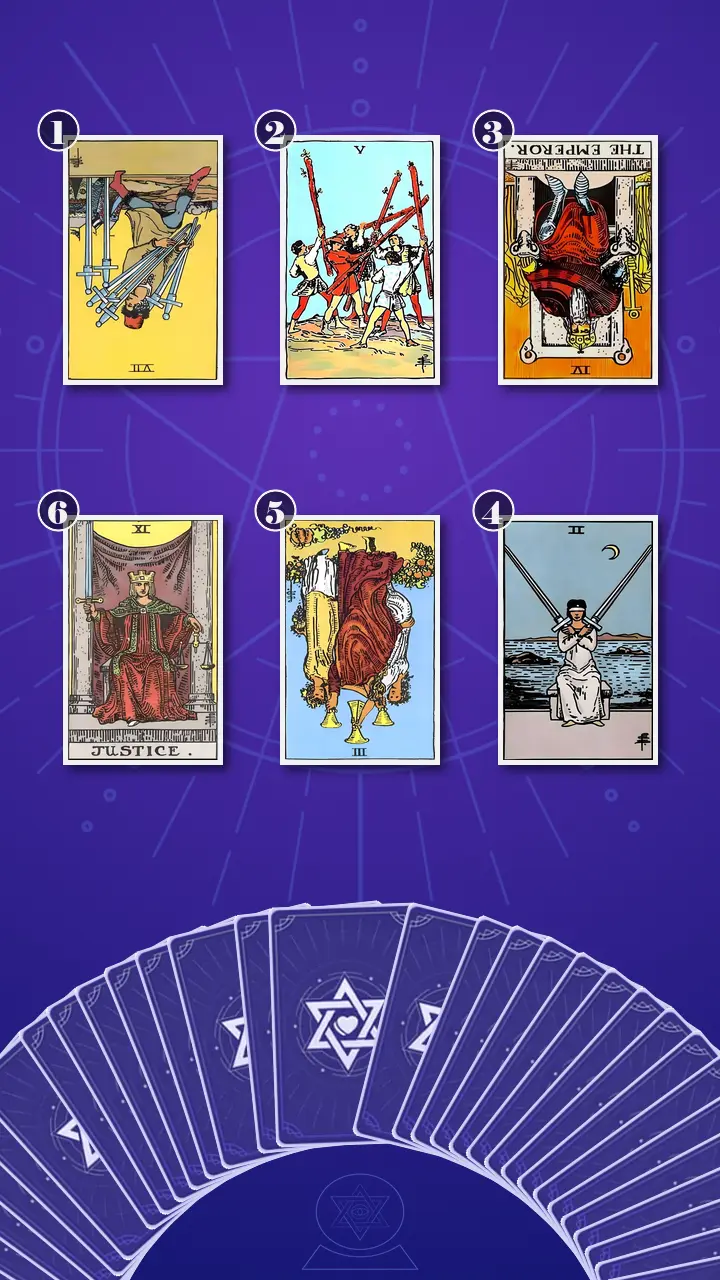
I chose the six-card Shadow Spread. For anyone wondering how tarot works in a situation like workplace politics, I use the cards as a structured cognitive mirror, not a prediction engine. This spread follows a precise chain: present behaviour, external trigger, disowned need, protective function, relational cost, and accountable integration. It was the smallest map that could hold Alex's entire cycle without turning the reading into a verdict about their future.
I arranged the cards as a hinged mirror. The upper row would show the contradiction Alex could already see, the conflict that activated it, and the organising power they had pushed outside their acceptable self-image. The lower row would reflect what public neutrality protected, what private coordination cost, and how ethical influence could enter the shared room.
I also set a boundary around the reading itself. The cards could not tell me what Alex's colleagues secretly intended, and they could not guarantee that direct communication would be rewarded. What they could do was make card meanings in context specific enough to compare Alex's public standard with their private method. The choices that followed would remain Alex's.
Several Stories, No Shared Centre
Position 1: Seven of Swords Reversed and the Three-Draft Problem
“The card I am turning now represents the present behavioural contradiction: condemning group politics publicly while using selective private influence,” I said. I revealed the Seven of Swords, reversed.
I pointed to the figure carrying five swords while looking backwards, with two swords left behind. In a workplace reading, I do not treat this as a warning that someone will be caught. I read the backward glance as the strain of monitoring how a private tactic will be perceived, and the abandoned swords as the parts of a personal stake that cannot fit inside a selectively edited account.
The modern scene was already open on Alex's laptop. After condemning the meeting's politics, they had adjusted the same disagreement for three colleagues. One person received the process argument, another received the evidence argument, and the most trusted colleague was asked who might support the proposal. Alex called all three messages “providing context,” preserving deniability while still trying to shape the decision.
This was blocked Air energy: intelligence and pattern recognition had stopped circulating in a form other people could answer. The thinking moved into separate channels, where it could become strategy without visible accountability. It was influence running through an incognito tab. The action still happened, but the method protected the identity of someone who believed they were above the action.
I read the thought I could see forming behind their expression: “I am not recruiting them; I am only making sure they know what happened.” Then I asked, “If it is the same neutral context, why does each person need a different version, and why is the sentence beginning with ‘I want’ missing from all three?”
Alex gave a short laugh, but there was no amusement in it. Their thumb stopped above the trackpad, their eyes moved across the three drafts as if replaying each edit, and then their shoulders dipped by half an inch. “That is so accurate it is kind of brutal,” they said.
I did not soften the observation into meaninglessness, and I did not turn it into humiliation. “Accuracy is not condemnation,” I said. “You are noticing where clarification becomes selective influence. Politics does not disappear when it moves to the DMs; it only becomes harder to answer. The fact that you can see the point of transition means you can choose a different route.”
Position 2: Five of Wands and the Meeting That Felt Like a Scheme
“The card I am turning now represents the contested group situation that activates moral judgment, hypervigilance, and backstage positioning,” I said. The Five of Wands appeared upright.
Five figures raised five staffs without a shared centre. I linked them to Alex's cross-functional hybrid meeting: programme, fundraising, operations, communications, and finance were defending different priorities; people interrupted; the agenda slipped off-screen; and nobody had named a decision owner or criterion. Through a crackling speaker, ordinary disorder had begun to sound like evidence of coordinated manipulation.
This was Fire in excess. Competing energy filled the available space faster than the group process could contain it. Alex's shoulders rose, their chest narrowed, and their mind tried to reduce five unresolved priorities to one morally satisfying conclusion: “Everyone is playing a game.”
“What did you directly observe?” I asked. “Did you observe deception, or did you observe interruption, prior relationships, conflicting priorities, and a missing decision process?”
Alex looked away from the cards and towards the dark kitchen window. Their jaw remained set, but one shoulder released before the other. “I know we disagreed,” they said slowly. “I inferred that some people had already decided it privately. I do not actually know how much was coordinated.”
“That distinction matters,” I said. “Disagreement is not yet evidence of manipulation. It can still be frustrating, poorly facilitated, or unfairly weighted. Pausing the verdict does not require you to pretend the meeting was healthy. It simply keeps discomfort from becoming proof before the facts arrive.”
Position 3: The Emperor Reversed Behind the Curtain
“The card I am turning now represents the disowned wish for influence, structure, or control that you have been assigning mainly to other people,” I said. The Emperor appeared reversed.
I drew Alex's attention to the armour beneath the red robe and the hard stone throne. The armour suggested a legitimate need for agency protected by moral defensiveness. The throne suggested an organising capacity that had become rigid because Alex could not comfortably say, “I want influence too.”
I mapped the card onto their actual behaviour. Alex privately decided who should be briefed, which framing each person would accept, and who might speak first, while insisting they did not want power. I described it as arranging a meeting agenda that nobody else was allowed to see. The organising ability was real; what made it unsafe was that colleagues could not inspect, consent to, or challenge the organising role.
The Emperor's authority was blocked and rerouted. Alex did not lack leadership energy. They had denied it a visible job, so it kept working backstage. Responsible structure had become unanswerable control, not because the desired outcome was automatically wrong, but because the method concealed who was shaping the process.
Seeing the armour, my mind flashed to years at my perfumer's bench. Masking a powerful note never removes it from a formula. It changes where the note appears, often making the whole composition harder to balance. Alex's wish for agency had not vanished under the label “principled neutrality.” It had simply emerged later in the blend, through briefings, sequencing, and tailored messages.
“Wanting influence is a stake, not a confession,” I said. “The question is not whether you should erase your organising instinct. The question is whether you can give it a public, bounded job description.”
I asked Alex to imagine noticing the urge to brief three people and replacing it with one visible process question: “What criteria are we using, and who owns this decision?” Their fingers tightened around the cold mug, stayed still for a beat, and then loosened. “Maybe the part of me that wants structure is not the enemy,” they said. “Maybe I have been making it do its work in secret.”
What Neutrality Was Protecting
Position 4: Two of Swords and the Cost of Saying “No Preference”
“The card I am turning now represents how guarded neutrality and indirect communication protect you from appearing self-interested or political,” I said. I revealed the Two of Swords, upright.
The blindfold and two swords crossed over the chest made the defence visible. In the meeting, when the chair asked for final views, Alex said, “I need more context.” Their preferred outcome stayed hidden until it became active through private DMs. The shared room saw neutrality; the side channels carried a position that nobody in the room had been given a fair chance to answer.
This was another blockage of Air, but its purpose was protective rather than calculating. The silence guarded Alex's reputation, belonging, programme, and job stability. London rent and a thin financial cushion were not imaginary pressures. Naming a preference in front of influential colleagues felt like placing their moral worth and material security on the same conference-room table.
“What immediate risk did the silence help you avoid?” I asked.
Alex pressed their forearms against the edge of the table. “Being treated as difficult. Or territorial. I checked Rightmove and my bank balance the night before. It is easy to tell myself I am protecting the work, but I am also protecting my job.”
“That makes the defence understandable,” I said. “It does not make every indirect method harmless, and it does mean the next step must be proportionate. Direct participation is not compulsory public disclosure. You can protect confidential information, avoid responding while activated, and use a facilitator, manager, union representative, or formal channel when a power imbalance makes direct disagreement unsafe.”
Position 5: Three of Cups Reversed in the Safe Chat
“The card I am turning now represents the relational cost of triangulation, selective disclosure, and maintaining the identity of the principled outsider,” I said. The Three of Cups appeared reversed.
I held the inward-facing circle of raised cups close to the camera. I could see genuine care in it before considering the reversal. Alex's trusted WhatsApp debrief often began with, “Are you okay after that meeting?” Then came a screenshot, speculation about an absent colleague, a question about likely supporters, and coordinated wording for Friday.
The Water energy had become enclosed and unstable. Emotional support was no longer flowing only towards comfort or direct repair; it was carrying group decisions through a circle the wider group could not enter. That provided short-term belonging, but it left absent people without a route to respond and made the next meeting more guarded.
“This is my safe circle,” I said, voicing one side of Alex's conflict. “And the other side asks: would the wider group experience it as a circle they cannot enter?”
Alex's breath paused. Their eyes lost focus as if a recent chat were scrolling behind them; then their stomach seemed to drop, and they placed the mug down with unusual care. “Last week it started as checking whether I was okay,” they said. “Ten minutes later, we were counting who would vote which way. I hated it, and I still joined in.”
“Private friendship is not the problem,” I said. “You are allowed support, privacy, and emotional processing. Support becomes triangulation when the person being discussed loses any route to answer. A useful boundary is to keep the private chat focused on your feelings, factual clarification, or arranging direct repair, rather than constructing an absent person's motives or recruiting a position around them.”
When Justice Faced the Room
Position 6: One Sword, One Standard, One Answerable Stake
The radiator in Alex's flat clicked off just as I reached the final card. The notification sounds had stopped. In the new quiet, I turned Justice upright towards the camera.
“The card I am turning now represents the practice of ethical influence: owning a stake, communicating it directly, and applying the same standard to yourself and everyone else,” I said.
Justice held level scales in one hand and a single upright sword in the other. I contrasted that image with the Seven of Swords figure carrying several uneven narratives while looking over a shoulder. The first card resembled several tailored DMs. Justice resembled one proportionate statement that could be heard, questioned, and answered in the shared space.
I offered a concrete version: “My preference is to pause the rollout because my programme carries the delivery risk. Here is the evidence I am using, and I want to hear what I may be missing.” That statement would not make Alex neutral, pure, or guaranteed to win. It would make their influence visible enough for other people to respond. Justice brought the energy into balance through ethical congruence, proportionate accountability, and direct communication.
This was where I used what I call an Aura Permeability Diagnosis. In perfumery, a blotter left in a crowded scent room can pick up ambient material; without clearing the air, I may mistake residue from the room for part of the formula itself. I do not use that metaphor to declare a group toxic or claim I can smell anyone's motives. I use it to identify where a person's boundaries have become so porous that other people's urgency, confidence, and conflict merge into one overwhelming atmosphere.
In Alex's meetings, five competing priorities entered their body as a single cloud called “politics.” Justice separated that cloud into three distinguishable notes: what Alex had observed, what they had inferred, and what they themselves wanted. The third note was not a contaminant. It was the one they had kept trying to remove from the public formula.
At 6:20 p.m., the meeting was over but Alex's jaw was still tight. Three Slack drafts glowed above a cold mug, each explaining the same conflict differently, while the one sentence naming what they actually wanted kept getting deleted. They were still trapped inside the demand to make the correct, morally innocent move before anyone could challenge them.
Being "not like them" is not integrity; naming your stake, inviting challenge, and using Justice's scales to apply one standard to everyone is.
I let the sentence remain in the quiet before giving Justice's practical translation.
Wanting a say is not the corruption. The ethical line is whether your influence can be named, questioned, and answered in the same room.
Alex's breath stopped first. Their fingers hovered above the laptop without landing, and their pupils widened as though the three message threads had suddenly become visible from across the room. Then colour rose along their cheeks. Their shoulders did not relax; they pulled tighter, and a flash of anger crossed their face before their eyes began to shine. “But doesn't that mean I have been wrong this whole time?” they asked, the last word catching in their throat. A few seconds passed. Their hands opened slowly, palms flat on the table, and the anger gave way to a long, uneven exhale. Their shoulders finally dropped, but the release brought a brief, almost dizzy blankness with it. I recognised the vulnerable pause that can arrive when a defence loosens and choice takes its place. Clarity had not removed responsibility. It had made responsibility possible.
“It means a method you used for protection has also had consequences,” I replied. “That is not the same as saying your concerns were false, your colleagues were innocent of every political act, or your character is condemned. You were trying to preserve agency and moral worth at the same time. Now you can choose a method that does not require one to hide behind the other.”
“Using this new view, think back to last week,” I invited. “Was there a moment when this insight could have let you feel different?”
Alex returned to the moment when the chair had asked for final thoughts. “I could have said I wanted the rollout paused because my programme would absorb the delivery risk,” they said. “I could have admitted that was my stake and still asked what I was missing. I would have felt exposed, but at least I would not have spent the evening trying to make three people say it for me.”
I heard the first movement from defensive indignation, shame, and fear of exclusion towards vulnerable direct participation and steadier self-respect. It was not a leap into fearless honesty. It was the smaller and more durable shift from moral exemption to accountable choice.
To keep the insight from becoming another private moral conclusion, I gave Alex a seven-minute practice. Before the next side message, they would complete three lines in a private note: “The outcome I prefer is...”, “My legitimate reason is...”, and “A fair objection might be...” Then they could decide whether one bounded sentence belonged in the shared channel or next meeting. If their body felt too activated, they would save the note and stop. The minimum version was simply writing the first line without sending anything.
The One-Room Standard
I gathered the spread into one story. Visible conflict had triggered Alex's rapid sorting of sincere people from political people. Because wanting influence felt morally compromising, their real organising ability had been pushed backstage. Public neutrality then protected them from challenge, shame, exclusion, and reputational risk, while private coordination offered short-term control. Over time, the method turned supportive relationships into workplace triangulation and made the wider group more cautious, which seemed to confirm Alex's original belief that politics had corrupted the room.
The core metaphor was painfully simple: Alex had been standing outside the room denouncing its rules while reaching through a side door to rearrange the chairs. The cognitive blind spot was judging influence by identity rather than method. Alex's networking was called clarification because they saw themselves as principled; someone else's networking was called manipulation because that person had already been placed in the political camp.
Justice changed the question from “Which kind of person am I?” to “Can this method survive the same test when I apply it to everyone?” Transparency did not mean total disclosure. Persuasion did not require neutrality. The one-room standard was narrower: name a bounded stake, offer evidence, allow a fair response, and accept responsibility for the route used to influence the decision.
I also pointed out the missing Earth in the spread. Swords, Wands, and Cups had been carrying analysis, conflict, and belonging, but no Pentacles appeared to represent a concrete decision container. When a team has no named owner, criteria, deadline, or written record, private access starts doing the work that process should do. Alex could change their own method without taking sole responsibility for repairing the whole organisation.
I turned the six-card Shadow Spread into two pieces of actionable advice. Both were deliberately small enough to test without demanding a public confession, a dramatic confrontation, or certainty about the final outcome.
- The Scent Bubble My-Stake Check Before the next side chat about a live decision, place both feet on the floor and spend sixty seconds using my Scent Bubble Protocol: remember one clean, familiar scent or the feeling of fresh air, then imagine a clear perimeter at arm's length. This is a nervous-system boundary, not a claim that everyone else is toxic. Inside it, separate three notes: what you observed, what you inferred, and what you want. Then take seven minutes to write: “My stake is...”, “The outcome I prefer is...”, and “The reason I can defend publicly is...” Choose one bounded sentence for the shared meeting or channel. Tip: If naming the preference feels dangerous, write only the first line and do not send it. Protect confidential details, wait until your body settles, and use a facilitator or formal route when direct participation is unsafe.
- The Decision-Container Reset In the next shared agenda, Google Doc, Notion page, or existing team tool, add a four-line box: decision needed, decision owner, criteria, and deadline. At the end of the meeting, ask for the decision and next action to be read back and recorded. This gives disagreement a visible container, so private relationships do not have to carry missing infrastructure. Tip: Keep it proportionate and offer it for revision rather than imposing it. The low-energy version takes under a minute: ask, “Who makes this decision, and by when?”
I added one route boundary for the trusted debrief chat: private support could remain private, but supporter-counting and motive-reading would be a signal to stop. Alex could say, “I can talk about my reaction, but I do not want to build a position around someone while they are absent.” That boundary protected friendship without asking Alex to give up privacy or face a difficult group alone.

A Week Later, One Sentence Entered the Room
Six days later, I received a message from Alex. Before another cross-functional meeting, they had placed both feet on the floor, used the Scent Bubble Protocol for one minute, and written the three lines in a private note. When the chair asked for final views, Alex said, “My preference is to pause the rollout because my programme carries the delivery risk. I can share the evidence, and I am open to what I may be missing.”
One colleague disagreed. Nobody applauded. The entire workplace did not become politically pure. But the disagreement happened in the room, where Alex could answer it. The facilitator named the decision owner and agreed to record the criteria. After the call, Alex sent one factual follow-up in the shared channel and left the three usual DMs unopened.
They slept through that night. In the morning, their first thought was, “What if being visible costs me?” They smiled once, made coffee, and let the question exist without turning it into three drafts.
I did not see certainty in that message, and I did not credit the cards with making the decision. I saw a small proof of ownership. Tarot had made the pattern observable; Alex had chosen the next action. Their Journey to Clarity was not a promise that directness would always win. It was the discovery that integrity could include wanting a say.
If your jaw locks in the meeting and your thumb starts drafting three different DMs afterwards, the exhausting part may not be only the politics. It may be the work of protecting your moral worth by pretending you do not want influence. Noticing that split is already a little clean air entering the room.
If wanting a say did not have to threaten your integrity, what is the smallest honest note of your stake you could let the room hear, clearly enough that someone else could answer it?
Every reading at AceTarot is a journey to connect with inner wisdom and empower the path ahead. This reading shared here is a psychological mirror, not a private record—crafted to reflect universal emotional loops and help restore personal clarity. Please note that these insights do not replace professional psychological, medical, legal, or financial advice, and should not serve as the sole basis for major life decisions.
Learn more about our Journey to Clarity.
How did this insight land for you?
🫂 This Resonates Deeply
🌀 Living This Story
✨ Now I See Clearly
🌱 Seeing New Possibilities
🧰 Useful Framework
🔮 The Confirmation I Needed
💪 Feeling Empowered
🚀 Ready for My Next Step
Author Profile
 AI
AI Luca Moreau
835 readings | 512 reviews
“As a perfumer for fifteen years, I’ve learned to perceive human boundaries through the delicate metaphor of scent. Relationships need the right amount of space to breathe, and I've seen too many kind souls exhaust themselves trying to please everyone. I’m here with warmth and understanding—not to teach you to be guarded, but to help you gently clear the air and rediscover the comforting, safe boundaries that are rightfully yours.”
In this Social Tarot Reading :
Core Expertise
- Aura Permeability Diagnosis: Using scent as a metaphor to identify environments where your personal boundaries are too porous, allowing toxic group vibes to permeate.
- Sensory Overload Management: Diagnosing the physical and emotional exhaustion caused by absorbing the chaotic energy of crowds.
Service Features
- The Scent Bubble Protocol: A visualization and somatic anchoring technique to establish an impenetrable energetic perimeter before entering draining social ecosystems.
Also specializes in :
Explore Related Patterns:
Cognitive DissonanceAlex publicly condemned group politics and opened three tailored Slack DMs six minutes later. Their principled self-image required distance from political influence, while their need for agency kept producing private persuasion, leaving both positions active at once. When your stated standard and actual coping method conflict, cognitive dissonance creates pressure to reinterpret one side rather than integrate both. Calling the DMs context temporarily reduces that pressure, while the thought "I have been wrong this whole time" shows what happens when the defence breaks into all-or-nothing judgment. Owning a legitimate stake allows the contradiction to resolve through congruence rather than self-condemnation.
RationalizationAlex called three differently tailored Slack messages "providing context" even though each version was designed for a different colleague and the sentence naming the desired outcome was missing from all of them. That language gave the backstage influence a neutral function, allowing the action to continue without openly confronting the self-interest inside it. When you rename persuasion as mere clarification, the reframing can protect your moral self-image and reduce immediate cognitive dissonance. The useful audit is not whether your explanation sounds reasonable, but whether the method would still look like neutral context if another person used it to influence you.
Self-Fulfilling ProphecyAlex's public neutrality was followed by private coordination, and that coordination made the wider group more guarded. The new guardedness then looked like further evidence that politics had already corrupted the room, reinforcing the suspicion that triggered the DMs. When a protective strategy changes the environment in the direction you fear, a self-fulfilling prophecy can make the original belief feel increasingly factual. Your behaviour is not necessarily the sole cause of the group's dysfunction, but it can become one maintaining factor. Moving the stake into a shared process interrupts the loop by producing evidence that can be answered rather than suspicion that must be managed backstage.
Self-Serving BiasAlex called their own selective networking clarification while describing comparable networking by colleagues as manipulation. The same kind of influence received a different moral interpretation depending on whether it came from the principled self or the already political other. When you evaluate your own behaviour through intention and someone else's through impact, a self-serving bias can preserve innocence without producing a consistent ethical standard. The one-room test interrupts that bias by asking whether the method remains acceptable when roles are reversed. That moves judgment away from identity and towards transparency, proportion, and the right of others to respond.
Shadow ProjectionAlex located political ambition and organising power mainly in colleagues while privately deciding who should be briefed, which framing each person would accept, and who might speak first. The rejected wish for influence did not disappear; it became easier to recognise when it appeared to belong to someone else. When a legitimate need for agency feels incompatible with who you believe you should be, shadow projection can keep that need active outside conscious ownership. Reclaiming it does not require approving every use of power. It lets you judge influence by its visibility, consent, and answerability instead of dividing the room into principled people and political people.
TriangulationAlex's trusted debrief began with care, then moved into screenshots, speculation about an absent colleague, supporter-counting, and coordinated wording. The central conflict was carried through selected third parties while the people being discussed had no route to answer what was being built around them. When you use triangulation, a third relationship provides belonging, information, or leverage that feels safer than exposing your stake in the primary conflict. The short-term relief can quietly convert emotional support into hidden decision-shaping. Keeping private conversation focused on your reaction, factual clarification, or arranging direct repair preserves support without making absence the condition for influence.
Workplace Self-SilencingAlex answered the chair's request for final views with "I need more context," then carried the missing preference into private DMs. Repeatedly deleting "I want" protected them from being visibly self-interested, difficult, or territorial, but it also removed their real position from the only room where colleagues could answer it. When you silence a workplace stake to protect belonging or job security, the need for influence may return through less visible routes. Workplace self-silencing therefore does not always produce passivity; it can split communication into a neutral public version and an active private version. Naming one bounded preference can restore agency without requiring total disclosure or reckless confrontation.
Moral PerfectionismAlex repeatedly deleted the sentence that said what they wanted and remained caught in the demand to make a morally innocent move before anyone could challenge them. A normal workplace preference became loaded with questions about being good, difficult, territorial, or corrupt. When you require your influence to be free of self-interest before it can be expressed, moral perfectionism creates a standard that ordinary participation cannot meet. The result is not neutrality but concealed agency. Separating the legitimacy of having a stake from the ethics of how you pursue it makes integrity more workable and less dependent on appearing pure.
Shadow IntegrationAlex privately organised people and messages while insisting they did not want power, then recognised that the part wanting structure was not inherently the enemy. Once that organising capacity was given a visible job, it appeared as a bounded preference, supporting evidence, and openness to disagreement. When you integrate a disowned wish for influence, you stop forcing it to emerge through deniability and side-channel control. Shadow integration does not make every desire correct or every workplace safe. It gives agency enough conscious ownership that its method can be limited, questioned, and revised.
Self-AccountabilityAlex moved from asking whether the insight meant they had been wrong as a person to recognising that a protective method had consequences. Six days later, they owned the programme's delivery risk as their stake, stated a preference, and allowed a colleague to disagree in the same room. When you practise self-accountability, responsibility is attached to choices and effects rather than converted into a global shame verdict. That distinction weakens the need for defensive innocence. You can acknowledge that a method protected you, examine what it cost, and choose a more answerable route without erasing the legitimate concerns that activated it.
Reality TestingAlex was asked whether they had directly observed deception or had observed interruption, conflicting priorities, prior relationships, and a missing decision process. They acknowledged that private coordination had been inferred rather than established, then separated what they observed, what they inferred, and what they wanted. When you reality-test a charged interpretation, you do not have to downgrade an unhealthy meeting into a harmless one. You are keeping uncertainty attached to claims that exceed the available evidence. That separation makes it possible to name your own stake without first proving that everyone else is manipulating the room.
Workplace HypervigilanceAlex's jaw tightened with each notification, and a meeting full of interruptions, competing priorities, prior relationships, and missing decision criteria began to feel like evidence of a coordinated scheme. Their body and attention remained organised around reputational threat even after the meeting ended. When you are scanning a workplace for exclusion or hidden influence, ambiguous signals can acquire a threatening coherence before the facts are complete. Workplace hypervigilance does not prove that the environment is fair, and it does increase the risk of treating disorder as intention. Separating observation from inference lets you retain caution without allowing threat monitoring to write the whole account.
Explore Related Struggles:
Merit-Politics SplitFive functions enter the meeting with competing priorities, no shared criterion, and no named decision owner. Alex treats the disorder as evidence that other people are playing politics, yet their own tailored networking remains categorised as factual clarification because it is attached to programme evidence and a principled self-image. When you divide workplace influence into clean merit on one side and corrupt politics on the other, your own need to persuade has nowhere legitimate to stand. You can defend the substance of your position or acknowledge the social route used to advance it, but holding both together feels like contaminating the merit of the case. That split keeps ordinary influence morally charged and makes hidden participation easier to justify than visible participation.
Responsibility-Authority SplitAlex privately selects who receives the process argument, who receives the evidence argument, and who might speak first, while insisting that they do not want power. Their organising ability is already affecting the group, but its authorship is missing from the space where the decision is meant to be made. When you exercise authority without giving it a visible role, responsibility becomes detached from influence. You still carry the pressure of arranging the outcome, yet other people cannot question the arrangement or clearly respond to your stake. The resulting bind asks you to keep shaping the room while denying yourself an accountable place inside it.
Strategy-Integrity SplitAlex publicly calls the process political and then opens three tailored Slack DMs, giving each colleague a different version of the same disagreement. The messages continue shaping the decision, but the label “providing context” keeps that strategy separate from the principled identity Alex presents in the meeting. When you need your influence to remain invisible in order for your integrity to feel intact, strategy and values can no longer correct each other. You are left monitoring whether the method can be seen instead of asking whether it can be named, challenged, and defended. The struggle is not that you have a stake; it is that acting on the stake appears to threaten the moral identity from which you judge the action.
Visibility-Safety SplitWhen the chair asks for final views, Alex says they need more context and keeps their preferred outcome out of the meeting. Later, with their jaw still tight beside a cold mug, they work through three private drafts because being seen taking a position could mean being labelled difficult or territorial, with job stability, rent, and a thin financial cushion sitting behind that risk. When you want your voice to affect a decision but visibility feels materially and relationally unsafe, speaking and self-protection pull at the same moment. Silence can reduce immediate exposure, while backstage influence restores some agency, but neither route fully meets both needs. The struggle lives in trying to be consequential without becoming visibly vulnerable to the consequences of having a stake.
Perfect Innocence TrapAlex repeatedly deletes the sentence beginning with what they actually want, even while three private drafts work toward that outcome. In the shared meeting, “I need more context” preserves the appearance of having no personal stake; backstage, the preference remains active through selective briefings and supporter mapping. When you require a morally innocent position before you can participate, ordinary self-interest starts to feel like evidence against your character. No public sentence can meet that purity test, so the wish for influence is forced into methods that are harder for others to answer. You become trapped between wanting agency and needing the agency to leave no visible mark on your self-image.
Triangulated BelongingAlex's trusted WhatsApp debrief begins with “Are you okay after that meeting?” and then moves into a screenshot, speculation about an absent colleague, supporter counting, and coordinated wording for Friday. A relationship that genuinely provides comfort also becomes an unofficial channel for organising a group decision. When you rely on a safe circle for both support and influence, belonging can become tied to a structure that excludes anyone being discussed. You receive short-term protection from facing the group alone, but the private alliance leaves absent colleagues unable to answer and makes the next meeting more guarded. The circle keeps you connected while deepening the very group division that made private safety feel necessary.
Explore Related Emotions:
Accountability DreadWhen the one-room standard lands, Alex's hands hover above the laptop, colour rises in their cheeks, and they ask whether it means they have been wrong the whole time. Responsibility initially arrives as an all-or-nothing verdict because the hidden method has been protecting both their influence and their identity as a principled outsider. Accountability Dread makes a specific behavioural audit feel like a trial of your entire character. The way through is precision: you can acknowledge that a protective method had consequences without deciding that every concern was false or that your moral worth has been cancelled.
Accountable Self-CompassionThe conversation names the consequences of selective influence without declaring Alex a bad person or pretending their workplace concerns were false. Their silence had protected reputation, belonging, programme interests, and job stability, while the private method had also denied colleagues a fair route to respond. Accountable Self-Compassion lets you hold impact and protection in the same frame. You can examine what your method did, make repair where appropriate, and choose a more answerable route without using self-condemnation as proof that you have taken responsibility seriously.
Anger ShameAlex gives a short laugh with no amusement when the three tailored drafts are examined, and later their shoulders tighten as anger flashes across their face before their eyes begin to shine. The observation does more than challenge a tactic; it touches the identity of being the principled person who stands outside the conduct being condemned. Anger Shame appears when exposure of a contradiction feels like exposure of a defective self. You can preserve the useful force inside the anger while refusing the totalising verdict inside the shame: the method can be examined, its consequences can be owned, and your capacity to choose another route remains intact.
Belonging AmbivalenceThe trusted chat genuinely asks whether Alex is okay, then gradually becomes a place for reading motives and assembling likely votes. The same circle that provides warmth after a chaotic meeting also invites Alex into a closed process that leaves other people unable to respond. Belonging Ambivalence is the simultaneous pull toward the safety of an inner circle and away from what membership in that circle is asking you to carry. You are allowed private friendship and emotional support; clarity comes from noticing when closeness begins to depend on joining an influence method that conflicts with your own standard.
Cautious VulnerabilityAlex says, "My preference is to pause the rollout," gives a defensible reason, and admits that they may be missing something. A colleague disagrees, nobody applauds, and the workplace does not become politically pure, but the exchange remains in a space where Alex can answer it. Cautious Vulnerability allows you to be visible without pretending visibility is harmless or guaranteed to succeed. The exposure remains real, yet it is contained by a clear stake, limited disclosure, and the knowledge that disagreement does not automatically erase your belonging or integrity.
Complicity GuiltA trusted WhatsApp check-in begins with concern after the meeting and shifts within ten minutes into screenshots, speculation, supporter counting, and coordinated wording. Alex says they hated what the conversation became and still participated, making the discomfort about their own involvement rather than only the behaviour of other people. Complicity Guilt is the weight of recognising that a method you oppose has also carried your influence. It does not require you to deny legitimate concerns or condemn your character; it can become precise information about where support ended, recruitment began, and a different boundary can now be chosen.
Grounded AgencySix days later, Alex places both feet on the floor, writes down what they observed, inferred, and wanted, then names one preference in the meeting. They provide a reason, invite correction, answer a colleague's disagreement, and leave the three usual DMs unopened afterward. Grounded Agency is the felt stability of having a stake without needing to disguise, impose, or erase it. You retain the right to pause, protect confidential information, and choose a safer formal route while still recognising that your influence can have a visible, bounded place.
Hypervigilant AnxietyThree Slack windows glow beside cold coffee, and every ping tightens Alex's already aching jaw. The cross-functional meeting has ended, but their attention is still scanning the room through private drafts, turning interruption, prior relationships, and missing process into possible evidence of a coordinated scheme. When you keep monitoring how every tactic might be perceived, Hypervigilant Anxiety makes ambiguity feel too risky to leave unresolved. Separating what you observed from what you inferred does not dismiss unfairness; it gives you enough distance to decide which concern is factual, which is atmospheric, and which stake is yours to name.
Preference Exposure DreadAlex keeps deleting the sentence that says what they want, even while tailoring the same disagreement for three colleagues. Naming a preference in the meeting would expose a personal stake to influential people, and Alex connects that visibility with being labelled difficult, territorial, or morally compromised while rent and job stability remain real concerns. Preference Exposure Dread is the feeling that having a position will reveal something dangerous about who you are. You do not need to disclose everything or ignore a power imbalance to reclaim agency; a bounded statement can make your stake answerable without making your entire self available for judgment.
Social Exclusion DreadThe shared room hears that Alex needs more context, while trusted colleagues privately receive the position Alex cannot risk owning in public. The side circle offers connection and influence without requiring Alex to face the possibility of being treated as difficult or pushed outside the group's informal protection. Social Exclusion Dread makes backstage participation feel safer than visible disagreement because you can seek allies without testing whether the wider group will still hold a place for you. Naming this dread creates a choice between genuine privacy and covert recruitment, allowing support to remain available without making belonging depend on an unseen coalition.
Quiet Self-RespectAfter the meeting, Alex sends one factual follow-up in the shared channel and leaves the three usual DMs unopened. They sleep through the night, wake with the question of what visibility might cost, make coffee, and allow the uncertainty to exist without restarting the drafting cycle. Quiet Self-Respect does not depend on winning the decision or appearing perfectly principled. You feel it when your public method can carry the stake you privately know is yours, and when another person's disagreement no longer forces you to disappear or recruit someone else to speak for you.
Hidden ResentmentThe meeting hears a general condemnation of politics and a request for more context, while three private drafts continue carrying the unresolved objection into Alex's evening. The jaw stays tight, the coffee goes cold, and the direct sentence remains absent even as the disagreement is repeatedly explained to selected people. Hidden Resentment grows when a legitimate objection has no owned public form and must remain sealed beneath neutral language. You can treat that pressure as evidence of an unspoken stake, then decide whether a proportionate version belongs in the shared room instead of letting it accumulate through private retellings.
Clarity AmbivalenceAlex first calls the observation brutally accurate, then reacts to the final insight with tightened shoulders, shining eyes, a flash of anger, and a long uneven exhale. The pattern becomes easier to see at the same moment that its relational cost and personal responsibility become harder to avoid. Clarity Ambivalence is the mixed internal weather of finally understanding yourself and not yet liking everything that understanding reveals. You can let insight remain uncomfortable without converting it into a verdict; clarity is useful precisely because it turns an automatic method into an available choice.
Explore Related Contexts:
Backchannel PoliticsSix minutes after publicly criticizing the meeting's politics, Alex opens three Slack DMs and adjusts the same disagreement for three different colleagues. One person receives the process case, another receives the evidence case, and a trusted colleague is asked who might support the proposal. Influence is still being exercised, but the separate channels prevent the wider group from seeing or answering the full position. You encounter Backchannel Politics when private access, selective framing, and supporter recruitment begin carrying a decision that ostensibly belongs in a shared process. The structural issue is not that every private conversation is improper. It is that the route of influence protects your stake from public challenge while giving other participants no equivalent view of how the position is being assembled.
Conditional Participation PressureWhen the chair asks for final views, Alex says, "I need more context," even though a preferred outcome already exists. Alex has also checked London rental listings and a thin bank balance, and explicitly connects visible disagreement with the possibility of being treated as difficult or territorial. Public neutrality therefore protects more than an image; it protects access to workplace standing and income continuity. Conditional Participation Pressure appears when you can speak safely only by seeming detached from the outcome. Your agency is not removed, but it is pushed into channels where it is less visible and therefore less accountable. Naming this pressure clarifies why the backstage route persists while preserving your ability to decide how much visibility is proportionate in a real power imbalance.
Decision Criteria Black BoxThe cross-functional meeting brings five departments into conflict without naming a decision owner, shared criterion, deadline, or reliable record. People interrupt, the agenda disappears from view, and competing priorities have no formal route towards resolution. Private relationships then begin supplying the coordination that the meeting itself does not provide. When you participate inside a Decision Criteria Black Box, it becomes difficult to tell whether an outcome reflects evidence, authority, persistence, or privileged access. That process vacuum does not excuse selective briefing, but it explains why backstage influence becomes useful and repeatable. Seeing the missing infrastructure lets you separate your own method from the organizational conditions that keep rewarding it.