Put on Trial by Text?

A grounded look at family chat pile-ons, related tarot cards, and tarot reading insights from similar pressure patterns.

Family Group Chat Tribunal
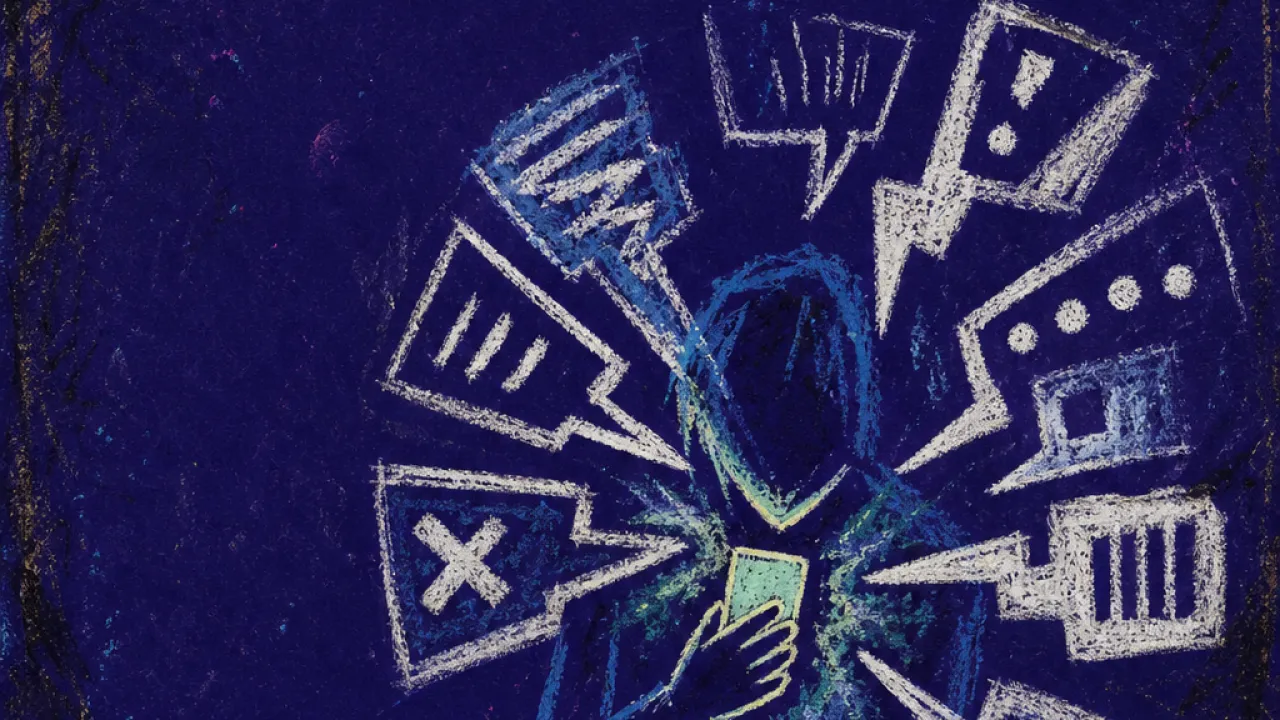
A solitary figure holding a lit phone as message bubbles press inward from every side, white marks cutting through deep indio

What is this situation?

Family Group Chat Tribunal — it starts with one message in the family thread, maybe a casual update about where you're living, who you're seeing, what you're spending, or why you didn't show up to something. Within minutes, the chat turns from conversation into cross-examination: one relative asks a loaded question, another reacts with a pointed emoji, someone screenshots an old message, and someone else arrives late but still adds their verdict. Your phone keeps lighting up while you're on the train, at work, in class, or trying to sleep, and every notification carries the possibility that your private choice has become public material. The rules are never stated, but everyone seems to know them: certain people get to demand explanations, certain people get protected from pushback, and your silence can be treated like guilt while your reply can be treated like disrespect. You start drafting messages in Notes before sending them, trimming every sentence so it cannot be twisted, then watching the typing bubbles appear like another round is about to begin. The exhaustion does not come from one disagreement; it comes from being pulled into a room you never entered, where your life is discussed by people who can mute the chat whenever they want but still expect you to answer on command, much like the Five of Wands, where raised staffs cross from every direction and one person's movement becomes part of a larger clash.

Why it's not you?

The problem is not that you are too sensitive about family communication; the problem is a group chat can turn private choices into public pressure. When several people question, react, revive old messages, or demand instant explanations at once, the format itself becomes the tribunal. That pressure belongs to the setup, not to a personal failure on your part.

Family Group Chat Tribunal in Tarot Cards

That stomach drop when the notifications stack up is part of the Family Group Chat Tribunal, where one message can become a public review of your choices. The pressure is environmental, structural, and dynamic: the chat format lets several voices arrive at once, while the family role system decides who gets questioned and who gets to question. The Tarot Cards below don't decide who is right; they mirror the shape of being watched, interrupted, and pulled into a collective argument you did not invite.

The Emperor
Reversed
The Emperor's stone throne, armour, rigid posture, and commanding symbols turn upside down, showing authority detached from reciprocal responsibility. The family group chat reflects that distortion when one protected relative can set the tone, demand an answer, or recruit others while remaining insulated from equivalent challenge. The reversal reveals that control of the forum is obstructing legitimate structure rather than providing it. You can distinguish family leadership from unilateral rule by observing whether authority creates consistent boundaries for everyone or simply protects the person already holding status.
The Hierophant
Reversed
The inverted Hierophant holds formal symbols above two followers while the crossed keys and teaching gesture lose their stable alignment. The image captures a cognitive system inherited from family life in which respect may have been defined as disclosure, immediate response, or submission to senior relatives' interpretation. The reversal makes that definition available for reconstruction because institutional-looking rules no longer appear automatically legitimate. You can differentiate respect from compulsory access, and family connection from surrendering interpretive authority over your adult choices, without pretending the social cost of that distinction is imaginary.
Justice
Reversed
Justice sits between formal pillars with scales in one hand and an upright sword in the other, but the reversed orientation destabilises the authority those instruments are supposed to legitimise. The family chat preserves the appearance of a hearing through questions, screenshots, evidence, and verdicts while withholding equal standards and a neutral process. The scales become structurally unreliable when some relatives may demand answers without being questioned themselves, and when your silence is treated as guilt while your reply is reframed as disrespect. You are placed inside a procedure whose conclusions can be chosen before your explanation is heard. The reversed image does more than describe unfairness; it exposes the gap between family accountability and selective prosecution. That distinction allows you to audit who sets the rules, whose evidence is protected, and whether the thread is actually seeking clarity or merely performing legitimacy.
The Devil
Upright
Two loosely chained figures stand beneath an elevated authority, showing a hierarchy sustained through attachment, permission, and repeated participation. The family thread mirrors that arrangement when belonging is tied to instant access, explanation, and deference, while protected relatives retain greater freedom to question, withdraw, or define disrespect. The chains are visible and not fitted tightly, making the coercive terms available for inspection. You can name how guilt, loyalty, and notification access are being linked without reducing the entire family bond to the tribunal's rules.
Judgement
Upright
A trumpet sounds above groups of figures rising with exposed bodies and raised arms, turning a signal into a public summons. One family message can function the same way when it calls the wider thread to attention and transforms a private update into a collective reckoning before you consent to the audience. The figures are visibly responding to a shared call, which reveals how individual relatives become a judging public through the channel. You can distinguish genuine accountability from compulsory exposure by examining whether the summons creates mutual review or places only your life before the assembled family.
Two of Pentacles
Reversed
The juggler, his two coins, and the rough-water ships turn upside down, showing a daily system that can no longer absorb one more moving demand. The family thread is not staying in a designated conversation window; it is competing with your commute, work, study, meals, and sleep for the same limited attention. The reversed loop makes the capacity mismatch visible. You are not failing at ordinary time management when several relatives can introduce new questions at any moment; the communication format has transferred its coordination cost into your physical routine without giving you control over the volume or schedule.
Ten of Pentacles
Reversed
The archway, elder, couple, child, dogs, and ten coins turn upside down, destabilising a multigenerational system organised around home, lineage, and material continuity. The family tribunal often activates precisely around housing, spending, partners, attendance, or other adult decisions that relatives treat as shared family assets rather than private choices. The inverted family scene shows that access to inherited belonging is no longer functioning as uncomplicated support. You can see how material concern, reputation, and generational authority become mixed together in the chat, making a practical update carry the weight of a family governance dispute.
Two of Swords
Upright
The blindfold and crossed blades hold the central figure between two equally defended directions. The family system creates that stalemate when silence is interpreted as guilt but a reply is interpreted as disrespect, making the thread's demand for communication incompatible with its punishment of unsanctioned speech. The figure's stable seat preserves your ability to observe the contradiction without resolving it on the family's terms. You can name the deadlock as a product of unequal communication rules, rather than endlessly refining a message that the group remains free to misread.
Five of Swords
Upright
A foreground figure gathers three swords while two others turn away, leaving additional swords on the ground beneath a tense, streaked sky. The scene presents a conflict organised around possession of the last word rather than mutual understanding, matching a family chat where receipts, corrections, and public verdicts become tools for winning. The upright image makes the social cost visible: someone may dominate the thread while trust, privacy, and family safety leave the exchange. You can be technically answered, quoted, or outnumbered without the underlying issue being resolved, because the conversation rewards rhetorical control over repair. The open distance around the departing figures also reveals that withdrawal is part of the conflict structure, not an automatic admission of guilt. The card separates a relative's visible victory in the thread from the quality or legitimacy of the family relationship that remains afterward.
Seven of Swords
Upright
A figure carries five swords away from a camp while looking back at two left behind, making information extraction and selective possession central to the scene. Screenshotting an old message performs the same move: a relative removes words from their original conversational setting and reintroduces them as portable evidence in the group hearing. The two remaining swords show that the extracted record is never the entire context. You can recognise the difference between a complete history and a strategically selected receipt, which weakens the tribunal's claim that a screenshot speaks for itself.
Eight of Swords
Upright
A blindfolded, bound figure stands inside a loose ring of eight swords, with wet ground beneath her and a distant structure behind. The image mirrors the internal aftereffect of a family tribunal: possible replies are mentally fenced by predictions that silence will look guilty, directness will look rude, and detail will create more material for scrutiny. The upright scene makes the restriction tangible without presenting it as permanent or purely self-created. Your self-editing has been shaped by observable family consequences, including screenshots, tone policing, loaded questions, and selective protection, so the mental grid reflects a real external learning environment. Gaps remain between the swords, and the figure is not physically touched by their blades. That spatial fact supports a careful audit of which limits are currently enforced, which are anticipated from earlier family rounds, and which interpretations belong to the tribunal rather than to the message you actually want to send.
Nine of Swords
Upright
Nine swords hang over a figure sitting upright in bed with a covered face, placing unresolved conflict directly inside the sleep environment. The family thread continues after the screen is locked because you may replay earlier wording, anticipate the next notification, or draft safer versions of a reply while trying to rest. The swords are displayed above rather than hidden inside the figure, which makes the source material available for examination. You can separate the actual messages from the overnight replay they generate, naming how an asynchronous family hearing occupies psychological time long after active participation stops.
Page of Swords
Reversed
The Page grips a raised sword while looking back over one shoulder as wind moves through the landscape and birds gather overhead. In the reversed orientation, the alert messenger becomes a communication environment where observation outruns accountability: old messages are watched, screenshots circulate, and wording is inspected for leverage rather than understanding. The sword remains sharp, but its access to clear truth is obstructed by restless monitoring, speculation, and reactive commentary. You may find that every sentence is treated as potential evidence, which encourages drafting in Notes and trimming language to survive interpretations you cannot control. The image identifies the blocked resource as trustworthy communication, not your intelligence or honesty. Once the family channel rewards surveillance and verbal point-scoring, a more precise message cannot by itself repair the system that keeps searching for material to prosecute.
Knight of Swords
Reversed
The knight's raised blade and charging horse turn upside down while the bent trees preserve the force of an uncontrolled rush. The family thread takes on this texture when relatives enter with loaded questions, sharp assumptions, and verdicts before checking what the original update actually said. The reversal shows that direct communication has lost its usable path because speed and aggression are being mistaken for certainty. You are encountering a family process that rewards the fastest accusation, leaving context and proportionality unable to catch up.
Five of Wands
Upright
Five raised staffs cross above a cluster of people whose gestures compete for the same space. No single exchange remains private or orderly; every movement enters a larger collision, mirroring how one family update can attract loaded questions, reactions, screenshots, and late-arriving verdicts from several directions. The upright scene keeps the disagreement visible rather than disguising it as neutral concern. You can see that the pressure is being produced by a crowded communication structure in which multiple relatives speak at once, not by a personal inability to explain yourself correctly. Because the figures remain standing and distinct, the image also preserves the possibility of identifying roles within the clash. You can separate the original issue from the pile-on, distinguish genuine disagreement from status performance, and recognise that participation in a noisy arena is not the same as consenting to its rules.
Seven of Wands
Upright
A lone figure holds one staff from higher ground while six staffs rise toward him from unseen people below. The uneven many-to-one composition closely mirrors a family thread in which you must respond from a single typing field while several relatives question, react, and challenge from different positions. The upright posture does not remove the pressure, but it makes your position defensible and visually separate from the crowd. You are not required to treat the number of incoming messages as proof that the family consensus is fair, accurate, or entitled to unlimited access. The high ground functions as a boundary rather than a declaration of superiority. It reveals that keeping a private decision intact under collective pressure is a distinct task from defeating every relative's argument, allowing the family's pile-on dynamic to be audited without accepting its terms.
Eight of Wands
Upright
Eight parallel staffs fly diagonally through an open sky with no visible sender and no person available to receive them. Their simultaneous arrival mirrors a family thread where questions, emojis, screenshots, and verdicts cross the screen faster than any one response can establish context. The upright momentum makes the channel highly functional as a distribution system even when it is dysfunctional as a family conversation. Information travels quickly, additional relatives can enter instantly, and one private decision becomes common material before you have chosen how much to disclose. Because the flight path is visible and unobstructed, the image allows you to separate message velocity from relational authority. You can recognise that the technology's ability to deliver eight reactions at once does not create eight valid claims on your immediate attention or personal information.
Nine of Wands
Upright
The bandaged figure watches the boundary with one staff in hand and eight standing behind him, holding earlier rounds visibly in the present scene. Repeated family pile-ons can build the same anticipatory posture, where typing bubbles, read receipts, or one relative entering the thread immediately activate a full defensive script. The ordered row of staffs makes the history countable rather than limitless. You can audit which reactions belong to the current message and which are cached from previous family hearings, preserving alertness without allowing every notification to inherit the full weight of the archive.
Ten of Wands
Upright
The bent figure carrying ten staffs toward a distant town embodies a load that occupies the body and blocks the view ahead. Each family message may appear small on its own, but the questions, reactions, historical receipts, and anticipated replies accumulate into attention work that you carry through the rest of the day. The town remains reachable, so the image preserves a distinction between your actual responsibilities and the extra burden imposed by the thread. You can recognise that the exhaustion comes from carrying a distributed family's demand for access, not from one unusually difficult sentence or an inability to communicate clearly.

Family Group Chat Tribunal in Tarot Card Reading Insights

Family Group Chat Tribunal shows up in readings when people bring the pile-on, the screenshots, and the pressure to explain themselves into the room. The focus shifts from the cards themselves to what appears when others have sat with this same kind of family chat pressure. Tarot Reading Insights from related sessions are gathered below.
Psychological Contexts Related to Family Group Chat Tribunal