Family Chat: Three Typing Bubbles, an Apology, Then One Specific Line

The 8:36 p.m. Verdict Before the Facts
If you are the city professional who can de-escalate an angry customer at work but goes blank when a Sunday family call turns on you, I want to begin with the timestamp Alex (name changed for privacy) showed me when we met online two nights later. Alex was twenty-nine, lived with a roommate in Toronto, and worked in customer success at a mid-sized software company. The message on their screen had been sent at 8:36 p.m.
After the Sunday video call, Alex had sat on the edge of their bed while streetcar brakes hissed below the window. The phone was warm in their palm, the radiator clicked behind them, and three typing bubbles pulsed in the family group chat. They wrote a six-paragraph defence, rewrote it twice, deleted every line, and sent: "I'm sorry. This is probably my fault."
"I apologize before I even know what I'm apologizing for," Alex told me. "I want to understand what actually happened, but if I push back, I become the problem all over again. Keeping the peace always seems to cost me my version of what happened."
I heard the central contradiction immediately. Alex wanted to stop taking the blame in every family argument, yet the moment belonging felt uncertain, accepting blame became the fastest available route out of the conflict. At work, they checked timelines, ownership, and evidence. At home, it was almost a Severance-style switch: the capable adult disappeared, and the assigned family role took the keyboard.
Resignation sat on their shoulders like a wet winter coat they had forgotten they were allowed to remove. Their throat tightened before they could evaluate a claim; their body entered the defendant's chair before their mind had heard the case.
"That reaction makes sense within a repeated pattern," I said. "I am not here to tell you that every criticism is false, or that a card can decide who was right. I want us to slow the sequence down. Let us make a map of the moment between accusation and apology, then see where your choices have been hidden."

Choosing a Map for the Family Fault Line
I asked Alex to place both feet on the kitchen floor and take one unforced breath. I shuffled slowly while they held one question in mind: "Why do I keep taking the blame in every family argument?" The pause was not a mystical performance. It was a transition from reacting to observing.
I chose the Relationship Spread · Context Edition, a five-card family conflict tarot spread designed to examine stance, relational pressure, the repeating mechanism, a self-led interruption, and a sustainable form of integration. A Celtic Cross could have supplied broader context, but Alex did not need ten different angles. They needed a clean view of one loop.
I want to be transparent about how tarot works in a consultation like this. I do not treat the cards as surveillance into relatives' minds, proof of hidden motives, or a fixed prediction. I use them as a structured cognitive tool. The images place assumptions outside the body long enough for us to inspect them, and the positions keep that inspection disciplined.
The first position would reveal Alex's present behavior in the scapegoat role, especially the apology that arrived before evidence was weighed. The second would show the family conflict pattern only as Alex experienced it, without pretending to know anyone else's private intentions. The center would expose the learned mechanism keeping Alex feeling stuck. The final vertical pair would identify a boundary Alex could choose and a way to combine accountability with self-protection, regardless of whether the wider family changed.
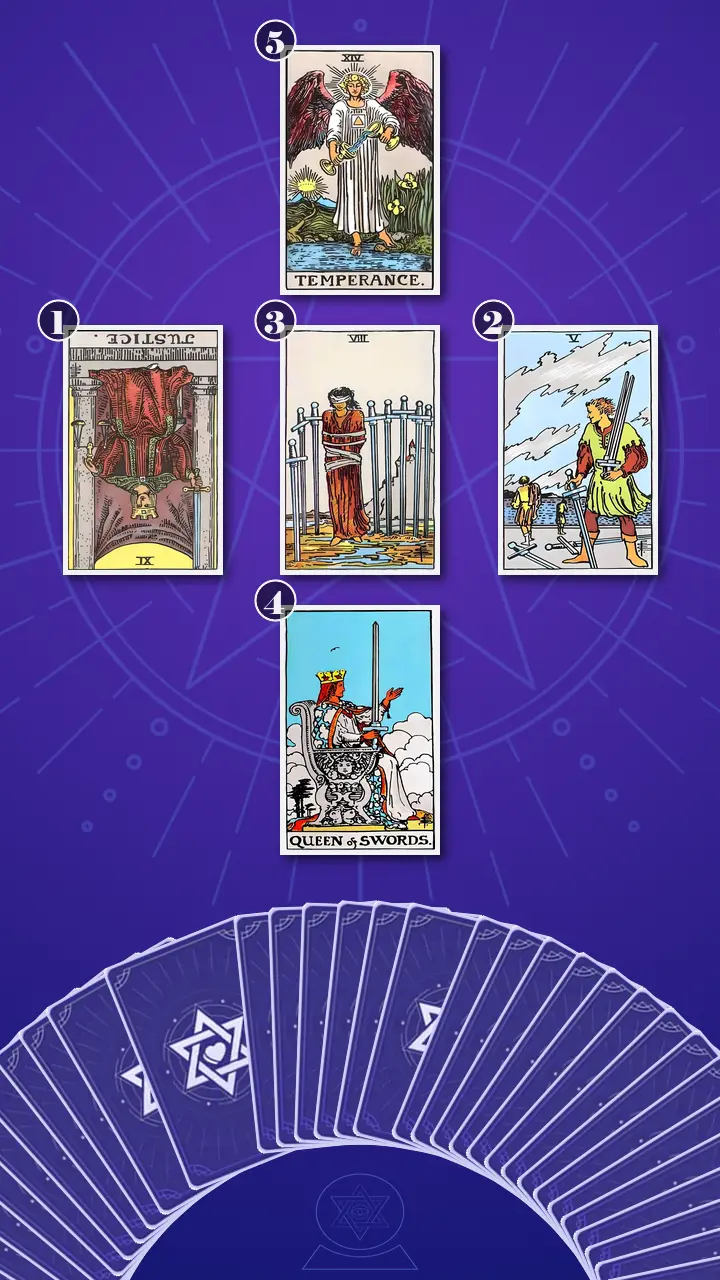
Three Ways the Old Loop Held
Position 1: The Verdict Before the Evidence
I first turned over the card representing Alex's present behavior in the scapegoat role, especially the automatic acceptance of blame before the facts had been weighed. It was Justice, in the reversed position.
I placed my finger near the inverted scales. Justice still cared about truth, fairness, and accountability, but its energy was distorted. There was an excess of self-judgment and a blockage in impartial evaluation. Alex was not avoiding accountability. They were overcorrecting so aggressively that accusation itself became sufficient evidence.
I returned to the Sunday group chat. Three incoming messages had become an apparent jury. The Notes app held the defence. The apology became a verdict entered before the scales moved. The inner logic was brutally quick: "They are all upset, so I must have done something wrong." It was like an AITA verdict appearing before the original post had finished loading.
Looking at the reversed scales, I remembered a Cambridge seminar in which an entire room had agreed on the date of an archaeological layer until one overlooked fragment changed the chronology. Consensus had sounded authoritative, but it had never been evidence. I told Alex, "The volume of an accusation is not the weight of evidence."
Alex gave a short, bitter laugh. "That is so accurate it feels a bit brutal." Their fingers tightened around the phone, then released it onto the table.
"Seeing the mechanism can sting," I said. "But this card is not acquitting you of every mistake. It is asking whether the process is fair enough to identify the mistake accurately. What specific action were you apologizing for on Sunday?"
Alex looked away from the screen. "I changed the dinner time late. But other people made decisions after that, and somehow I apologized for all of those too."
That distinction was small, but the scales had finally moved. Changing the time was an action Alex could evaluate. "You always make everything difficult" was a global judgment that no proportionate apology could repair.
Position 2: When the Group Chat Became a Contest
I next turned over the card representing the family conflict pattern as Alex experienced it, including the pressure to concede, while making no claim about any relative's unspoken motives. It was the Five of Swords, upright.
I showed Alex the foreground figure collecting swords while two people walked away toward the water. This was an excess of adversarial Air: too much argument, positioning, and pressure to produce a winner, with too little shared investigation. A discussion could technically end while trust, context, and repair remained abandoned in the background.
In Alex's modern version of the card, the family chat had stopped clarifying what happened. Seventeen messages circled the same accusation, and every explanation became another point to defeat. Alex conceded because somebody had to make the noise stop. The exchange acquired a winner, but the practical issue and shared responsibility were left lying on the ground.
"Keeping the peace is not repair if your reality is the price," I said. "You may still decide that leaving a hostile exchange is the healthiest option. The important distinction is that ending participation does not require signing your name under every accusation."
I watched Alex's mouth press into a thin line. Their gaze settled on the two retreating figures. "The apology works," they said after a moment. "Everyone gets quieter. Then I am angry for two days because I agreed to something I don't believe."
I nodded. "That is the conflict hangover. Short-term relief has been teaching you that concession is effective, while the accumulated resentment tells you it is not resolution."
Position 3: The Buttons That Looked Unavailable
I then turned over the card representing the central mechanism connecting repeated family conflict to learned helplessness and maintaining the stagnant role. It was the Eight of Swords, upright.
The blindfold, loose bindings, and incomplete enclosure showed a genuine experience of restriction without claiming that every route was physically closed. Here, Sword energy had become a blockage. Thought was no longer helping Alex communicate; it was predicting consequences so rapidly that no new option received a real-world test.
I asked Alex to picture the last dogpile. The phone displayed "Mute notifications," "Reply later," and "Leave call." Their thumb could hover over any of them, yet an old internal operating system marked every button as unavailable. "I could pause, but then they will say I am avoiding responsibility. I could ask for specifics, but then they will say I am being difficult. I could leave the call, but then they might stop including me."
"When belonging feels conditional, blame can feel safer than disagreement," I said. "One external constraint may be real: people might send more messages or react badly. The internally maintained constraint is the certainty that a ten-minute pause must end in rejection. Those are not the same kind of fact."
I call the historical inquiry I used next Generational Trauma Excavation. I do not use it to diagnose a family or declare a lineage damaged. I ask which exact phrases, roles, and consequences a person can trace across time, so inherited pressure stops masquerading as personal failure.
Alex remembered hearing a parent say, "Just apologize so this doesn't go on for days." They also remembered a grandparent praising whichever family member was willing to "be the bigger person," even when that meant accepting the whole dispute. I treated those memories as reported artifacts, not as proof of anyone's motives. Together, they showed how peacekeeping had become associated with worthiness and belonging.
I saw Alex's breathing pause. Their thumb went still above the mute icon, their eyes lost focus as if earlier calls were replaying behind the screen, and then a low "Oh" left their chest. Their shoulders loosened by a fraction.
"So the options are there," Alex said, "but my body acts like choosing one will get me kicked out of the family."
"Yes," I replied. "The fear is real. The predicted outcome is not yet the same as a current verdict. We only need one small movement to begin collecting different evidence."
When the Queen Raised One Sword
Position 4: The Boundary That Did Not Need a Closing Argument
The dishwasher behind Alex finished its cycle and clicked into silence. In that sudden quiet, I turned over the card representing the specific self-led boundary Alex could use to interrupt automatic blame-taking. It was the reading's key card and antidote: the Queen of Swords, upright.
I pointed first to her single raised sword, then to her open hand. Her Air was in balance. The sword separated fact from projection; the hand left communication possible. Her boundary was neither a counterattack nor a request for permission. She represented clear discernment, boundary confidence, and the capacity to tolerate disagreement without abandoning self-trust.
In practical terms, the Queen edited six defensive paragraphs into one accurate line: "I can own that I changed the plan late. I cannot own everyone's reaction to it." Instead of defending their entire character, Alex could identify one verifiable action, acknowledge it if appropriate, and decline the global label attached to it.
I used my Inherited Belief Stratigraphy framework to make that shift visible. On archaeological sites, I never assume that the uppermost layer tells the whole history. I separate layers carefully because a recent collapse, an older foundation, and the enduring purpose of a structure are not interchangeable.
With Alex, the upper layer was Sunday's scheduling mistake. Beneath it sat the inherited rule, "If people are upset, I must surrender quickly to remain one of them." Deeper still was Alex's authentic value: "When I cause harm, I want to repair it honestly." The Queen's sword did not cut Alex off from their family. It separated an enduring value from an obsolete, fear-based rule that had attached itself to that value.
Before I offered the core sentence, I returned Alex to Sunday night: the call over, the phone warm, three relatives still typing, their throat tightening as they deleted a defence and prepared to buy belonging with one more surrender. They were still asking how to make everyone agree.
The way out is not winning the family argument. It is refusing to turn every accusation into your verdict: own the specific action that is yours, and leave the rest unclaimed.
I let the sentence settle, then gave the Queen's message in full.
You do not need to accept every accusation to stay connected; name only what is yours, and let the Queen's upright sword separate accountability from assigned blame.
For one beat, Alex's breath stopped. Their fingers stayed suspended above the trackpad, and their pupils widened before their gaze slipped past the screen, as if the last several Sunday calls were replaying somewhere behind it. Then their jaw tightened. "But doesn't that mean I was wrong all those years?" they said, sharper than before.
I let the anger have room. "No. It means you used a strategy that reduced immediate conflict when other options felt dangerous. We are not putting your younger self on trial. We are checking whether that strategy still deserves unlimited authority."
Their eyes reddened. The hand holding their sleeve loosened finger by finger; their shoulders dropped, then lifted again with one uncertain breath. Relief arrived, but not cleanly. I saw the brief, almost dizzy blankness that comes when a familiar duty is removed and choice appears in its place.
"So I still have to decide what is mine," they said softly.
"Yes," I replied. "That is the responsibility, and also the freedom. An apology should name an action, not erase a person."
I invited them back into a recent memory. "Now, with this new perspective, think back to last week. Was there a moment when this insight could have made you feel different?"
Alex described standing in the shared kitchen while the dishwasher hummed and lemon detergent sharpened the air. Their first draft had said, "I changed the plan, but I did not make every decision that followed." After three rewrites, it became, "I should have handled everything better."
"The first version felt rude," Alex said. "But now I can see that it was just specific."
I asked them to try the Queen's version aloud: "I am sorry I changed the time without checking. I will not take responsibility for the entire argument." Their voice shook on the second sentence, but it did not disappear.
This was the reading's pivotal crossing: from resigned guilt and automatic self-erasure toward clear discernment, proportionate accountability, and boundary confidence. It was not certainty, and it was not a promise that the family would approve. It was the first believable piece of evidence that Alex could remain accountable without prosecuting themselves.
The Water That Asked No One to Disappear
Position 5: Proportion After the Argument
I finally turned over the card representing how Alex could integrate proportionate accountability and self-protection, whether or not the wider family changed immediately. It was Temperance, upright.
I showed Alex the water moving carefully between two cups, with one foot on land and one in water. Temperance brought the spread toward balance: fact and emotion, accountability and protection, connection and independent judgment. It did not ask Alex to split the difference with an unfair claim. A middle path is not half of someone else's distortion.
In Alex's life, the two cups became a short post-call note: what happened, what is mine, and what boundary remains. One foot stayed with the facts. The other acknowledged that Alex could care about their relatives' upset without using that upset as a measurement of guilt.
I also made the autonomy in this card explicit. Temperance did not require forgiveness, continued access, instant reconciliation, or permanent distance. Alex could decide what contact supported their well-being. The card described a repeatable inner practice, not a moral obligation to remain available.
"So I don't have to choose between apologizing for everything and cutting everyone off," Alex said.
"Correct. That false choice was part of the enclosure," I replied. "You can own your line without carrying the whole group chat. Then you can decide, separately, how much participation is constructive."
I noticed Alex's shoulders settle lower than they had at the start. They were not suddenly carefree. Their eyes still held the wary look of someone imagining the next wave of notifications. But they could now picture a third response: pause, weigh, answer specifically, and step away if the exchange returned to character judgments.
The Ten-Minute Gap Where Choice Returns
I gathered the five cards into one coherent history. Justice reversed showed Alex entering the conflict under distorted accountability. The Five of Swords showed why concession brought immediate relief but no real repair. The Eight of Swords revealed how earlier escalation had become an internal map of what seemed possible. The Queen transformed the surrounding swords into one consciously held instrument of distinction. Temperance made that clarity sustainable rather than combative.
The archaeological metaphor mattered here. Alex was not one ruined structure with a single guilty origin. Their current response contained layers: a present action that might deserve accountability, an older peacekeeping strategy, an inherited fear about belonging, and an enduring value of honest repair. Once those layers were separated, Alex could preserve the value without continuing to live by every rule deposited around it.
I named the cognitive blind spot directly: Alex had been treating intensity, repetition, and the number of accusers as evidence, while treating a pause as proof of selfishness or impending rejection. The transformation direction was equally direct: pause before apologizing, name only the specific action that is yours, and decline responsibility for the rest.
I offered three pieces of actionable advice. Each was deliberately small. None required Alex to persuade the family, send a perfect message, or make a permanent relationship decision.
- Pause the verdict for ten minutes. During one family disagreement this week, mute notifications, set a ten-minute timer, and open a private note with two headings: "My action" and "Not mine." Add one observable fact beneath each before deciding whether an apology belongs in the response. Sending anything is optional. If ten minutes feels overwhelming, use the minimum version: one fact under each heading and no reply.
- Save one Queen of Swords sentence. Create a phone shortcut for: "I can own my part, but I will not take responsibility for the entire argument." Say it aloud once before the next weekend call. If the conversation shifts into judgments about your whole character, use the sentence and name when you may return. A boundary governs your participation, not anyone else's reaction. Pair it with muting the chat or putting the phone down instead of defending the boundary indefinitely.
- Run the Lineage Artifact Review. Within twenty-four hours of the next difficult call, spend seven minutes writing: "What happened," "What I own," and "What I will repeat next time." Then mark one belief to preserve, such as "I repair specific harm," and one to bury, such as "I must absorb shared conflict to keep my place." Keep the review private and stop after one line per heading. It is an intellectual sorting exercise, not ammunition for the next argument.
"These steps will not control what your relatives do," I told Alex. "They are designed to give you evidence that you have choices. Tarot has drawn the map, but you decide where to place your feet."

A Week Later, One Sentence Left Standing
A week later, Alex messaged me: "I waited ten minutes, apologized for changing the time, and muted the chat." Replies still came. They made tea, slept, and woke thinking, "What if I was wrong?" This time, they checked the facts before answering.
I did not read that message as proof that the family pattern had been solved. I read it as a small, credible piece of counter-evidence. Alex had felt discomfort, named one specific responsibility, kept a boundary, and survived the unfinished feeling that followed.
That was the quiet proof in this Journey to Clarity. The cards had not rescued Alex, declared them permanently blameless, or predicted a repaired family. They had made the structure visible. Alex supplied the pause, the discernment, and the next action. The authorship remained theirs.
When the family chat lights up and your throat closes before you have checked a single fact, taking the blame can feel less frightening than discovering whether there is still a place for you when you disagree. I want you to remember that merely noticing this bargain means your own version has not disappeared.
If you let one accusation remain unanswered for ten minutes, what small piece of your own account might become audible again, and which line would you finally place beneath "Not mine"?