Two Screenshots at 10:45 p.m., Then One Direct Request in Her Own Vo

Finding Clarity in the 10:45 p.m. Family-Chat Spiral
I had learned to recognize the twenty-something hybrid worker in Toronto who could write a calm client email but started screenshotting the moment a partner said, "You're overreacting." That is how conflict triangulation often begins: a two-person fight gets sent to relatives before direct repair is complete.
Sophie (name changed for privacy), a 27-year-old marketing coordinator, sat on the edge of the bed in the rented apartment she shared with her partner. It was 10:45 p.m. The radiator clicked behind her, the phone was warm in her palm, and the same three iMessages glowed beneath her unfinished reply. Her jaw was tight. Her breathing had gone shallow. She took two screenshots and hovered over the family group chat.
"I want to keep our arguments between us," she told me, "but when my partner says I am overreacting, I need someone to tell me I am not imagining this. If I do not tell my family now, my side will disappear." She wanted to handle fights directly within the relationship, yet she feared that without family backing, her perspective would not count. The urgency moved through her like a fire alarm wired directly to her fingertips: every second without a witness felt like evidence being deleted.
I did not hear drama in that impulse. I heard a person trying to protect her sense of belonging while feeling temporarily locked outside the relationship. I said, "We can look at the pattern without shaming the need underneath it. Today, we are not trying to decide who is the villain. We are going to draw a map from the hot phone in your hand to the clear sentence you want to say in your own voice."

Choosing the Compass: A Relationship Spread for Family Boundaries
I invited Sophie to put the phone face down and take three slower breaths. I shuffled while she held the question in mind, not as a supernatural test, but as a practical transition from reacting to observing. A spread can give a charged experience separate places to land, so that one feeling does not have to pretend to be the whole truth.
I told her, and anyone following the reading, that I was using a classic seven-card Relationship Spread. It suited this question because the issue was not only what Sophie did after a fight. It was a chain involving her immediate conflict stance, her perception of her partner, the family triangulation that formed between them, the relationship's existing capacity for repair, the authority she had handed to familiar voices, the communication boundary that could interrupt the cycle, and the repeatable practice that would make change realistic.
The first card would show the stance she took in the first hot minutes. The second would show how uncertainty altered her reading of her partner. The third would reveal how a private disagreement became a family event. Beneath that, I would look for the direct-repair resource, the hidden pressure, the communication antidote, and finally a small next step. This is how tarot works in my room: the cards do not issue a verdict about the future. They help me place language around a pattern Sophie already knows in her body.
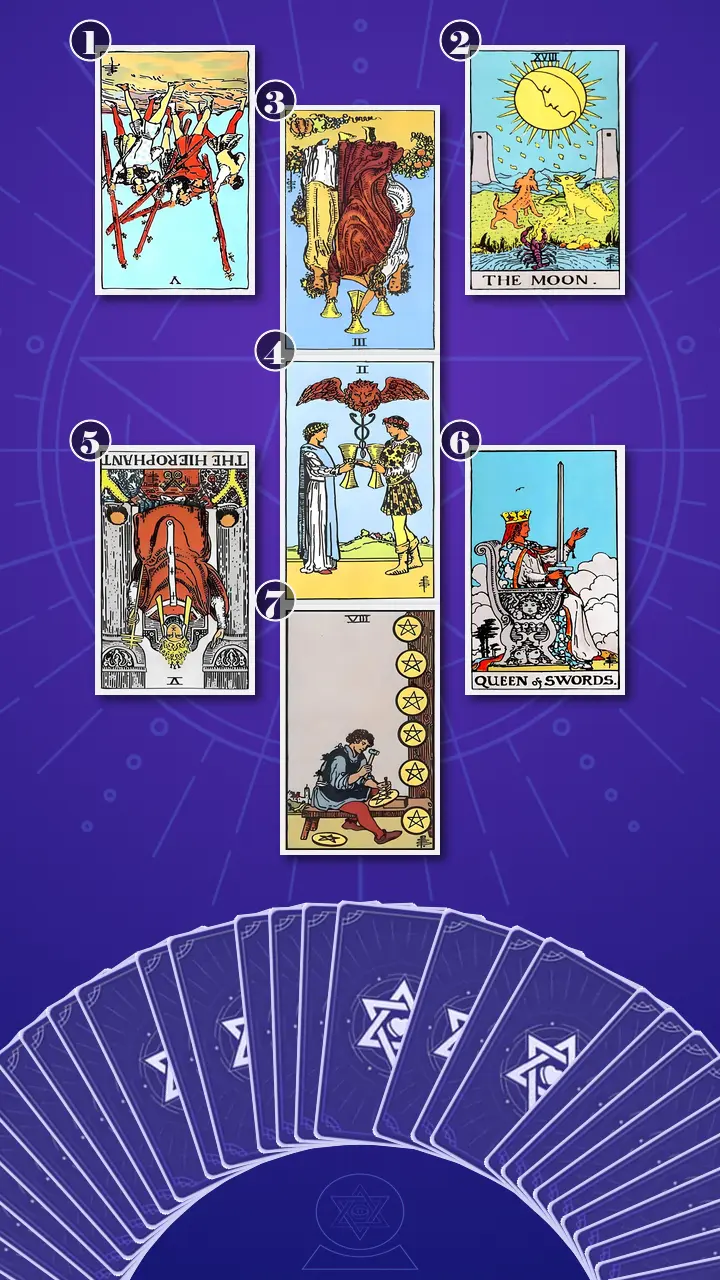
The Map Gets Crowded
Position 1: Five of Wands Reversed and the Argument That Changed Channels
I said, "The first position shows Sophie's immediate stance during conflict: direct tension becomes difficult to contain, so she redirects the argument toward family members." Then I turned over the Five of Wands, in reversed position.
At 10:45 p.m., Sophie stops replying to her partner, but she does not actually leave the conflict. She screenshots the exchange, opens the family chat, and lets several new voices carry the argument while the original two-person conversation remains unresolved. The familiar "send the screenshots to the group chat" moment has become a live transfer of responsibility. It is like closing a two-person Slack thread and reopening the dispute in a company-wide channel because the original tension feels too exposed.
The five crossing staves show competing positions with no shared direction. Reversed, the Fire is blocked: the energy is not moving into clean, direct engagement. It is suppressed, then pushed sideways. Sophie may get a few minutes of relief, but the disagreement now has more voices, more interpretations, and more material to defend. The energy is not excessive because she cares too much; it is excessive because the phone gives the urgency somewhere to go before she has identified what she actually needs.
I gave the pattern its inner sequence: "I cannot leave this hanging. I need someone to see it. I will come back once I know I am not wrong." Sophie let out a short, bitter laugh rather than nodding. Her fingers stopped above the edge of her phone. "That is too accurate," she said. "Almost a little cruel."
I answered, "I am not reading this as a flaw in your character. I am reading the handoff point. The useful question is not, 'Why am I such an oversharer?' It is, 'What happens in my body just before I choose a family verdict over one direct sentence?'" Her shoulders stayed raised, but she looked down at the unfinished reply instead of opening the chat.
Position 2: The Moon and the Message with Missing Information
I moved to the second position: "This card examines how Sophie perceives her partner while emotionally activated, especially where uncertainty may become assumption or projection rather than verified fact." The card was The Moon, in upright position.
I brought us back to an 8:12 a.m. Line 1 train, where Sophie had once zoomed in on the message, "I cannot talk about this now." The carriage had smelled of wet coats and coffee, the brakes had squealed at Bloor-Yonge, and her body had reacted before the message had finished being understood. She reread the sentence until the missing tone seemed obvious. Then she asked a relative what her partner must secretly mean.
The Moon does not say that her intuition is foolish. It shows a nervous system moving along a narrow path with only partial light. The dog and wolf react beneath the moon before the whole landscape is visible; the crayfish rises from dark water before anyone knows what else is there. This is the energy of uncertainty becoming fear-shaped certainty. The deficiency is not intelligence. It is a pause between the words that can be verified and the motive the mind supplies.
I placed two lines beside the card. "The message is incomplete, but my body is reacting as though the verdict is already in." Then I asked, "What did the partner actually write, and what did the fear add?" Sophie pressed her lips together. I watched her cross out the words "They are deliberately shutting me down" and replace them with "I assumed they were shutting me down." Her chest tightened first, then her exhale lengthened. The change was small, but it moved one claim from certainty back into inquiry.
Position 3: Three of Cups Reversed, Where Support Becomes a Jury
The third position showed the relationship's shared dynamic: a two-person disagreement expanding into family triangulation, repeated retelling, and competing loyalties. I turned over the Three of Cups, in reversed position.
I described the family chat as a live commentary room. Screenshot previews appeared beneath the original message. Typing bubbles came and went. A voice note arrived from one relative while two others reacted to the sharpest thirty seconds of a much longer argument. Sophie had asked not to feel alone, but she had returned to her partner carrying a verdict.
Upright, the Three of Cups can represent friendship, emotional support, and shared belonging. Reversed, the three raised cups create a social space with too little boundary around a conflict that began between two people. The energy is overflowing Water: genuine comfort spills into coalition-building. The short-term relief is real, but so are the costs. Relatives retain the most activated version of the partner. The couple begins repairing one evening, while the family continues reacting to an earlier version of the fight.
I said, "Support helps you return to the conversation; a verdict enters the conversation with you." I was careful with the distinction. Sophie did not need to cut off her family, and keeping ordinary conflict private was not a moral requirement. If fear, threats, coercion, abuse, or immediate safety concerns were present, outside help would be appropriate. This reading concerned the ordinary disagreements in which support was being asked to decide who was right before either partner had made a contained attempt to repair.
Sophie went quiet. Her stomach tightened as if she had swallowed a small stone. I saw the voice note from a relative still sitting in her memory: "No, you are completely right." For two seconds, that imagined agreement had loosened her chest. Then guilt had arrived, followed by the knowledge that she would have to choose between quoting the verdict and meeting her partner without an audience.
When Two Cups Made Room for Two People
Position 4: Two of Cups and the Direct-Repair Resource
The fourth position asked what strength already existed in the relationship: the capacity for direct recognition, mutual listening, and one-to-one repair. I turned over the Two of Cups, in upright position.
The scene changed in my mind from a crowded notification screen to Sophie and her partner sitting at opposite ends of the sofa two days after the fight. Rain ticked against the window. A takeaway container still smelled faintly of garlic. The family chat showed unread replies, but the couple was calmer than the thread. I asked Sophie to imagine the two of them gradually turning toward one another, not to agree instantly, but to make room for two experiences without importing a crowd.
The Two of Cups is balanced Water: reciprocal attention, equal dignity, and an exchange that does not require one person to win before the other can be heard. It does not promise that every disagreement will resolve neatly. It shows that repair begins when two people meet as participants rather than prosecutor, defendant, and jury. The relationship already held a resource that the family coalition could not provide: mutual recognition from the person actually involved.
I offered the sentence, "We do not have to agree yet. Can we each say what landed and what we need next?" Sophie exhaled and unclenched one hand from the other. She could picture a ten-minute conversation in the kitchen, with no screenshots and no family quotations. The possibility did not erase her fear of being dismissed, but it made directness feel like an experiment rather than a final exam.
Position 5: The Hierophant Reversed and Borrowed Authority
The fifth position revealed the underlying challenge beneath the family involvement: Sophie had not fully separated her own relational judgment from the authority of familiar outside voices. The card was The Hierophant, in reversed position.
I heard the pattern in her words: "Before I decide what I think, I imagine what my mother, my sibling, or my closest relative would say." The seated authority above two followers became a picture of family members positioned above the couple, while the crossed keys asked who currently had permission to decide what Sophie's experience meant. She wanted an adult relationship with its own boundaries, but whenever the conflict became uncertain, a relative's approval acted like a certificate that her feelings were legitimate.
Reversed, The Hierophant represents a challenge to inherited rules and borrowed authority. Sophie was questioning the family system without yet replacing it with a clear, couple-owned conflict ethic. The central blockage was not that she loved her relatives too much. It was that she had made their agreement the fastest available proof that she belonged and that her reaction counted.
Here I used my Shadow Projection Analysis carefully. I do not claim that one card can diagnose a childhood story. I look for the unacknowledged fear or unmet need that may be projected onto the present partner: if no one backs me, I may disappear; if my partner does not agree immediately, I may be alone; if my family does not confirm my account, perhaps I am impossible to understand. Those fears can make a current disagreement carry the weight of an older question about belonging.
I also used a modern image Sophie understood immediately: changing the admin permissions on the relationship. Her family could remain trusted contacts without controlling the final settings. She stared at the card, then rubbed her thumb over the corner of the spread. "I think I consult them before I even know what I think," she said. The admission landed with shame, but I kept my voice steady. "Noticing the borrowed authority is how you begin taking your own keys back."
When the Queen of Swords Held One Upright Blade
Position 6: Queen of Swords, the Antidote to the Family Trial
The room became very still when I reached the sixth position. This was the communication transformation, the antidote: separating facts from interpretations, speaking directly, and placing a proportionate boundary around what entered the family circle. I turned over the Queen of Swords, in upright position.
The Queen's single upright sword and open hand gave me the exact image I wanted. The sword was not a bundle of borrowed opinions. It was one accurate account, held in Sophie's own hand, with an invitation to respond. The energy was clear Air in balance: discernment without cruelty, directness without attack, privacy without isolation.
In ordinary life, this could sound like: "The conversation ended while I was still speaking. I interpreted that as dismissal. I want us to try again tomorrow for ten minutes." Sophie would be naming what happened, owning the meaning her mind added, and making a request without pretending to know her partner's hidden motive. She would not be silent, and she would not need to build a case.
I used my Attachment Loop Diagnosis as a practical lens rather than a clinical label. I traced the sequence aloud: a curt message triggers the fear of being dismissed; Sophie reaches for family backing; the partner feels surrounded or withdraws; that withdrawal confirms Sophie's fear that direct repair is unsafe; the fear sends her back to the family chat. The loop is the problem to interrupt. It does not prove that either person is entirely right or wrong.
At 10:45 p.m., the phone was warm, the family chat was open, and the unfinished reply to her partner was still waiting. Sophie's body wanted witnesses before it would risk another direct sentence. I asked her to stay with that sensation without treating it as an instruction.
Stop turning disagreement into a family trial; make one direct, bounded statement instead, like the Queen of Swords holding one upright blade rather than a bundle of borrowed opinions.
I let the sentence rest between us. Then I added, "Your experience can be valid before anyone votes on it. Clarity begins when you separate what happened from what you fear it means, then speak one need in your own name."
Sophie did not nod. First, her breath stopped halfway in; her phone hovered between her knee and the table, and her fingers held it as if setting it down might erase her case. Then her eyes lost focus. I could almost see the last argument replaying: the curt sentence, the unfinished reply, the imagined verdict. Her pupils widened, and her mouth opened and closed once. Finally, her jaw released with a small click. Her shoulders dropped, not dramatically, but enough for the chain at her neck to move. One fist opened against her thigh. She let out a shaky breath and said, "That feels... unfairly simple." I told her simple was not the same as easy. The blank space after clarity frightened her for a moment because no one else was filling it. I asked, "Now use this new perspective to think back to last week. Was there a moment when separating the fact from the story might have let you feel different before you opened the family chat?" She looked at her notes and wrote the first sentence.
I named the emotional crossing clearly: this was a first step from urgent family-backed case-building to clear direct communication and steadier self-trust. It was not proof that Sophie would never reach for outside reassurance again. It was proof that the old movement could be observed before it became automatic.
The Skill of One Careful Pentacle
Position 7: Eight of Pentacles and the Practice of Repair
The final position translated insight into a repeatable conflict routine that Sophie and her partner could refine over time. I turned over the Eight of Pentacles, in upright position.
The card showed a craftsperson engraving one pentacle at a time while completed pieces waited nearby. I saw the practical landing point immediately. Sophie did not need to make a dramatic promise to handle every future argument perfectly. She needed one contained disagreement, one pause, one direct request, and one later review. The energy was grounded Earth: deliberate practice, not instant certainty.
I told her that private conflict repair was a skill, not a personality trait she either possessed or lacked. A missed step would be information for the next attempt, not proof that she was incapable of intimacy. The town in the distance mattered too. Her relationship could remain connected to family life without allowing every relative to work inside the couple's conflict in real time.
Sophie opened the Notes app and typed three headings: "Fact," "My interpretation," and "My need." She did not send the note. She did not contact anyone. For the first time that evening, her hands were occupied by something other than evidence gathering.
From a Family Case to One Clear Request
When I laid the seven cards together, I saw a coherent story. The Five of Wands reversed showed the original heat being redirected instead of contained. The Moon showed why a short message could become a complete story about dismissal. The Three of Cups reversed showed the family chat converting a need for comfort into a jury. The Two of Cups showed that direct mutual recognition was already available. The Hierophant reversed exposed the deeper pressure: Sophie was trying to build an adult relationship while still letting familiar voices hold the keys to her interpretation. The Queen of Swords offered the shift from borrowed authority to owned discernment, and the Eight of Pentacles made that shift practical through repetition.
I told Sophie that the blind spot was not simply "I tell my family too much." It was the belief that privacy meant isolation and that support counted only when it produced a verdict. She was confusing regulation with proof. A relative could help her settle her body without deciding whether her partner was wrong. A direct request could be valid even before it received the answer she hoped for. The goal was not perfect conflict; it was one direct attempt before the group chat became part of the room.
I turned the Queen of Swords into an exercise I call The Projection Detachment Exercise. It separates the partner's observable behaviour from the triggered internal narrative, then gives the unmet need somewhere honest to go. I kept the plan small enough for a late-night apartment, a hybrid-work schedule, and a nervous system that wanted immediate witnesses.
- The Family-Chat PauseDuring one ordinary disagreement this week, Sophie can set a 30-minute timer before opening any family thread and place the phone on a charger across the room. In the Notes app, she writes one sentence under each heading: Fact, My interpretation, and My need.The minimum version is five minutes and the Fact line only. This boundary is for ordinary conflict, not fear, threats, coercion, abuse, or immediate safety concerns, where outside help remains appropriate.
- The Two-Person Repair WindowAfter the pause, Sophie can ask her partner for one ten-minute conversation in the kitchen or living room: each person names one feeling and one need, then reflects back one sentence before responding. No screenshots, family quotations, or character judgments enter that first exchange.Ten minutes does not have to solve the whole issue. The goal is one contained attempt. Either person can request a further pause if voices rise or the conversation becomes circular.
- Support Without a JuryBefore the next conflict, Sophie can message one trusted relative: "If I contact you upset, please help me slow down before helping me decide who is right." For one week, she can ask for regulation rather than a verdict, such as a walk or a phone call without forwarding live messages.Privacy is not isolation, and support does not have to become a jury. If the relative asks for every detail, Sophie can repeat, "I am not ready to analyse my partner; I need help settling down first."
I watched the shame leave the exercise and make room for responsibility. Sophie could still love her family, ask for help, and protect herself. She could also decide that an ordinary disagreement belonged to the two people who needed to repair it. The choice was no longer between secrecy and a coalition.

The First Quiet Proof of Steadier Self-Trust
Three days later, I received a message from Sophie while I was making tea. It said, "I waited the thirty minutes. I wrote the three lines. I asked for ten minutes. We still disagreed, but I did not send the screenshots." That was the change: not a perfect relationship, not a family suddenly convinced of everything, but one direct attempt made before outside opinions entered the room.
She told me that the conversation ended with a plan to try again the next evening. Then she sat alone in a cafe with her coffee, relieved but slightly unsettled by the quiet. The old question still appeared the next morning - what if I am wrong? This time, she answered it by opening her note instead of the family chat. She had not solved her life. She had practised a different response.
I think of that as the first proof of the Journey to Clarity: the experience remained real without a vote, the need became speakable, and family support could return to its proper role as care rather than authority. The cards did not take ownership away from Sophie or give it to me. They helped her notice that she had been carrying her own sword all along.
When a fight leaves your face hot and your hand already reaching for the phone, it can feel as though keeping the conversation between two people means risking that your side, and your place of belonging with it, will disappear. I hope the reading leaves behind the same cautious relief Sophie found: a pause can hold both privacy and support, and a clear account can begin before certainty arrives.
If your experience did not need a vote to become real, what is one sentence you might want to say in your own voice before opening the family chat?