When Old Family Anger Enters the WhatsApp Chat
You can coordinate five moving deadlines in a London hybrid office, yet one sarcastic message in the family WhatsApp chat can trigger conflict reactivity before you have finished reading it. Jordan recognised themself in that sentence before I had even placed the deck on the table.
At 10:36 p.m. the previous evening, Jordan had stood in their small kitchen rereading one loaded message. As they described it to me, I could almost hear the fridge humming and the radiator clicking behind them. The phone had felt warm and slightly slippery in their palm. Heat had climbed through their chest, their jaw had locked, and six carefully argued paragraphs had appeared, vanished, and become a clipped voice note.
“I know the reaction is too big,” they told me, rubbing one thumb across the edge of their phone. “But in the moment, it feels completely necessary. If I don't defend myself immediately, I feel like their version becomes the truth.”
I heard the contradiction clearly. Jordan wanted to respond from the measured values of the adult life they had built, but their body was preparing to fight for conversational space before that adult voice could enter. The anger moved through them like a sharp fragrance sprayed into a room with no open windows: immediate, consuming, and impossible to separate from the air around it.
“And then I hear my family in my own voice,” Jordan said. Their eyes dropped to the table. “That's the part I hate.”
I did not tell them to calm down, forgive anyone, or treat every trigger as imagined. I told them, “The reaction made sense before it became proportionate. Understanding where the volume came from does not excuse its impact, but it does give us somewhere more useful to begin than shame.”
I also made the purpose of our reading explicit. I would not use tarot to predict their family's behaviour or decide whether they should remain available to anyone who ignored a boundary. I would use it as an objective reflection tool, helping us slow the sequence down until Jordan could see where inherited family conflict reactivity ended and present-day choice began.
“Let's make a map of those few seconds between the alarm and the reply,” I said. “We are looking for clarity, not a verdict about whether you are good or bad.”

A Compass Cross for the Argument Underneath
I asked Jordan to place both feet on the floor, breathe once without trying to change what they felt, and hold one question in mind: “Why does my family's old anger keep taking over my reactions?” I shuffled slowly, using the movement as a transition from replaying the latest argument to observing the pattern beneath it.
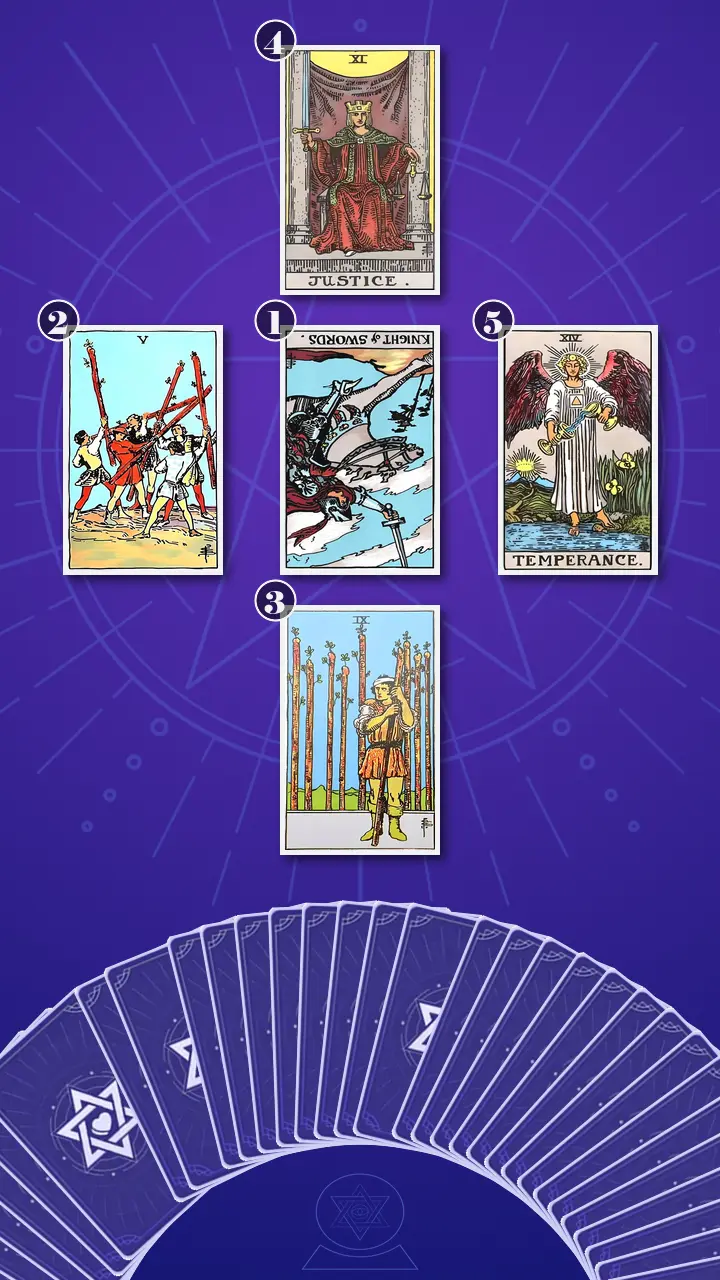
I chose the Five-Card Cross · Context Edition. For anyone wondering how tarot works in a situation like this, the cards do not diagnose Jordan or forecast the next family argument. The spread gives us five distinct places from which to examine one causal sequence. That structure prevents every memory, fear, and current fact from collapsing into a single emotional conclusion.
I placed the first card at the centre to show the visible reaction. The card to the left would trace the family conflict model that shaped it. The card below would reveal the protective fear keeping the loop active. Above the centre, the key card would show the conscious principle capable of interrupting the pattern. The final card on the right would translate insight into an integration practice rather than a predicted outcome.
Laid out this way, the spread resembled a compass. Its horizontal line moved from family influence, through present reactivity, toward integration. Its vertical line placed the hidden guard directly beneath the deliberate adult perspective. That was why this focused five-card tarot spread suited Jordan better than a larger Celtic Cross: our question was not what everyone else might do, but what happened inside Jordan before they could choose what to do.
The Reply That Outruns the Question
Position 1: The Visible Surge
I turned the card representing the observable symptom: the fast, sharp, or abrupt reaction that occurs before the present situation has been assessed. It was the Knight of Swords, reversed.
I pointed to the horse already charging and the sword raised before the terrain had been checked. “This is the instant when thought and speech accelerate together,” I said. “One phrase looks critical, your thumb starts moving, your breath shortens, and the sentences become more absolute before you know what the other person is actually asking.”
The modern scene was almost uncomfortably exact. Jordan sees one critical phrase in the family WhatsApp chat and sends a clipped voice note before reading the rest of the exchange. Speaking first and completely provides a few seconds of protection because nobody can distort their meaning while they are still talking. When the heat drops, however, the message carries more force than the current situation required, and Jordan is left reconstructing an exchange they never paused long enough to assess.
I described the Knight's reversed Air as Excess combined with Blockage. There was too much speed and verbal force, while curiosity and proportion could not get through. The card was not asking Jordan to lose the sword or become less direct. It was showing that speed had been forced to carry the entire burden of protection.
“The thought underneath it is usually something like, 'I have to get ahead of this,'” I said. “What did you not yet know when you sent the voice note?”
Jordan gave a short laugh that held no amusement. Their fingers tightened around the phone and then released. “That's so accurate it feels a bit brutal. I hadn't even read the last two messages. Nobody had actually asked me to answer that night.”
I let the recognition settle without turning it into an accusation. The reversed Knight was describing a reaction Jordan had learned, not reducing them to that reaction. Accuracy could become useful only if it created room for choice rather than another reason to attack themself.
Crossed Lines and Yesterday's Guard
Position 2: When Being Heard Became a Competition
I moved to the card representing the family conflict model that had taught Jordan to associate disagreement with escalation and the need to fight for space. I turned over the Five of Wands, upright.
The five figures raised their staves in different directions. I read those intersecting wands as crossed conversational lines: several people defending separate versions at once, with no shared structure for listening and no agreement about what the discussion was even trying to resolve.
Jordan described routine video calls where ordinary updates could become overlapping voices within minutes. In that atmosphere, interruption had not felt like a rupture. It had felt like the entry fee for participation. The internal rule was simple: If I wait, I disappear. A disagreement with a partner, colleague, or friend could therefore feel like the opening round of the same contest, even when the present person was willing to listen.
I told Jordan that the Five of Wands did not require us to name one villain or declare every family disagreement hostile. It showed how repeated friction can teach a body what to expect. The upright Fire of the card had become Excess in the learned atmosphere: everyone generated force, but little of that force had a shared direction.
“It was never quite as intense as the 'Fishes' episode of The Bear,” Jordan said, “but the everyone-defending-a-different-reality part is painfully familiar.”
I watched their gaze leave the card and settle on a point beyond my shoulder. Their shoulders were still high, but their jaw had softened. I could see that the card had moved the question away from “Why am I like this?” and toward “What did I learn a difficult conversation required?”
Position 3: The Guard Who Arrives Before the Threat
I turned the card representing the hidden fear beneath the pattern, especially the fear that pausing would leave Jordan overrun, unheard, or without control. It was the Nine of Wands, upright.
The figure on the card held one wand defensively while looking back toward the eight behind him. I saw a guard facing the present while emotionally monitoring an older conflict. The bandage told me his vigilance had a history; the barrier showed me how yesterday's protection could become today's default position.
For Jordan, this looked like entering a difficult conversation already monitoring punctuation, pauses, facial expressions, and changes in tone. Nothing openly hostile might have happened, but their shoulders would rise and their breathing would become shallow. Predictive text would complete the current conversation with phrases taken from old arguments: Nothing has happened yet, but I already know where this is going.
I named the energy as understandable resilience pushed into Excess. A responsive boundary had become continuous readiness. The guard treated anticipation as evidence, so anger arrived as a pre-emptive boundary before Jordan had enough present information to decide whether protection, clarification, or distance was actually needed.
“What do you fear would happen if you waited ten more seconds?” I asked.
Jordan's breathing stopped for a beat. Their eyes lost focus as if a familiar conversation were replaying behind them. Then they exhaled from low in the chest. “They'd finish defining what happened before I got to speak. And if I softened, they'd think I'd admitted they were right.”
“That fear is the deepest blockage in this spread,” I said. “Your guard believes speed preserves your voice. But a pause is not surrender; it is where choice becomes possible. If the present exchange contains threats, harassment, or repeated disregard for a stated boundary, choice can still mean ending it or seeking practical support. Pausing never obligates you to stay.”
When Justice Holds the Sword Still
Position 4: The Present Gets Its Own Evidence
The room seemed to become quieter when I reached the card above the vigilant Nine of Wands. Even the faint rain against the window separated into individual taps. I turned the card representing Jordan's conscious corrective: separating present facts from inherited emotional charge and taking proportionate responsibility for the response they chose.
It was Justice, upright.
I placed Justice's vertical, motionless sword beside the reversed Knight's charging blade. Both figures held a sword, but only one had stopped to weigh evidence. Justice brought the Air energy into Balance: clear discernment, proportionality, accountability, and the authority to distinguish explanation from permission.
This was also where my years as a perfumer offered the most precise language I had. I call it my Enmeshment & Permeability Diagnosis. When a powerful base note has diffused through every layer of a fragrance, an untrained nose may mistake its presence for the identity of the whole composition. I use separate blotter strips to identify what is actually there, what lingers from an earlier material, and what belongs to the new blend.
Jordan's family anger had become an emotional base note with unusually high permeability. A present person's tone could pick up its residue before Jordan had checked whether the current exchange contained the same meaning. Justice did not seal Jordan away from feeling. It acted like the blotter strip that separated the notes, allowing old anger to be recognised without letting it impersonate the whole atmosphere.
I showed Jordan the practical image in the card: a Notes app with three lines. What was actually said.What it reminded me of.What response I choose to own. This did not dismiss anger or excuse disrespect. It returned authorship to the present.
You are not required to deliver your family's old verdict; Justice asks you to weigh the present facts, own your impact, and choose a response that fits this moment.
I watched Jordan glance from Justice's still sword to the reversed Knight. The family-chat message was still vivid for them, six paragraphs were still waiting somewhere in drafts, and I could see the familiar demand for a completely right answer tightening their mouth again.
“But doesn't that mean I've been wrong this whole time?” they asked. The words came out sharper than their earlier voice, carrying a flash of anger before dropping into something more exposed.
“No,” I said. “It means the need to protect yourself may have been real while the strategy sometimes exceeded the present facts. You can own the impact without putting your history on trial. Accountability is not a ruling that every concern you had was invalid.”
Then I reduced the entire spread to one sentence and left a pause around it.
Your family's anger may explain why the alarm is loud; it does not get to write the reply.
For one beat, Jordan did not breathe. Their fingers hovered above the phone as though they had been interrupted halfway through typing. Then their gaze slipped away from the table, and I watched recognition move across their face as they replayed the kitchen: the warm screen, the unopened messages, the instant certainty that delay meant defeat. Their eyebrows drew together first in resistance, then lifted. Moisture gathered at the lower rim of their eyes without becoming tears. Their shoulders dropped, but the release left them looking briefly unsteady, as if putting down armour had changed their sense of balance. “Oh,” they said, barely above a whisper. A second breath came more freely. “The alarm can be real without its prediction being right.” Their hands opened on the table. Relief was there, but so was the vulnerable recognition that a clearer path would ask them to make a choice the old script used to make automatically.
I invited them back into a real moment. “Now, with this new perspective, think about last week. Was there a moment when this insight might have made you feel different?”
Jordan chose a Slack message from their manager: “Can we revisit your plan?” They had written a complete defence before asking which part needed revision. Looking at it through Justice, they could finally separate the actual request from the tone their memory had supplied.
I named the shift carefully. This was not instant calm or a promise that Jordan would never snap again. It was the first movement from fear-driven immediate defence to present-focused, accountable self-authorship. Family history remained context for the alarm, but it was no longer the unquestioned authority over the response.
Water Between Maximum Volume and Silence
Position 5: The One-Boundary Return
I turned the final card, representing integration: regulating intensity without suppressing anger and expressing one clear boundary at a time. It was Temperance, upright.
The angel poured water in an unbroken stream between two cups, with one foot on land and one in water. I read the image as the movement between feeling and expression. Jordan did not have to choose between maximum volume and total silence. Temperance offered a third option: anger mixed with time, bodily grounding, context, and a boundary whose force matched the present exchange.
I asked Jordan to imagine the next manageable trigger. They would notice heat in the chest, place both feet on the floor, and say, “I want to answer this, but I need ten minutes before I can do that clearly.” When they returned, they would state one need rather than reopening the entire family archive: “I can discuss the issue, but I can't continue while we're talking over each other.”
Temperance expressed Balance, not emotional suppression. The anger could remain present and informative without controlling the form of the response. “Anger can carry the message without controlling the delivery,” I told Jordan.
They tried the pause line aloud. The first attempt sounded formal, and they grimaced. We shortened it together: “I need ten minutes. I'll come back to this.” On the second attempt, their voice sounded less like a communication script pulled from a Notion page and more like their own.
I could feel the spread's whole energy changing in that sentence. The reversed Knight's agitated Air had rushed into the defensive Fire of the Five and Nine of Wands. Justice reorganised that Air into discernment. Temperance added Water and stable footing, creating a response that could remain honest without being driven entirely by intensity.
The Airlock Between Alarm and Answer
I drew the cards into one coherent story for Jordan. The Five of Wands showed a family atmosphere where conversational space was often contested. Repeated exposure became the Nine of Wands' standing guard. That guard powered the reversed Knight, whose speed briefly restored control but often created defensiveness, regret, and hours of forensic reconstruction. Justice supplied the missing distinction between evidence and association, while Temperance turned that distinction into one paced, embodied boundary.
The core pattern was a smoke alarm calibrated to an old family kitchen, sounding at full volume when the present person might only have made toast. The alarm still deserved investigation. Sometimes there would be real smoke, and Jordan remained free to leave, create distance, or seek support. The blind spot was believing that the alarm's volume proved an immediate, maximum-force reply was the only way to remain safe or heard.
I named the transformation direction plainly: notice the first surge as information, check the present facts, and choose one proportionate response. The goal was not perfect regulation. It was to create one reliable point at which Jordan, rather than inherited urgency, could decide what happened next.
I gave them two small practices.
- The Three-Line Present Fact CheckAfter the next non-urgent triggering message, open the Notes app and write one sentence under each heading: Present fact, Old association, and Response I can own. Take no more than ten minutes, and do not send the exercise itself.If three headings feel too formal, use three words: fact, reminder, choice. One word under each is enough.
- The Quarantine Zone ProtocolBefore a family call or difficult chat, store one pause line in your phone. At the first heat, put both feet on the floor, use the line, and create a ten-minute psychological airlock. Return with one need or boundary, not a case about the whole relationship.An airlock controls what crosses the boundary; it does not force continued contact. State when or whether you will return, and step away if the exchange is unsafe or repeatedly violates your limit.
As a perfumer, I think of that airlock as clearing a neutral strip of air between two strong accords. Jordan did not have to pretend the family atmosphere had no effect. They needed enough uncontaminated space to identify what belonged to the current person, what was lingering from the past, and which response carried their own signature.
The cards had not chosen that response for them. Tarot had made the sequence visible. Jordan remained the person with the authority to engage, clarify, set a boundary, apologise for impact, seek support, or end the conversation according to the present facts.

A Week Later, the Quiet Proof
Six days later, I received a message from Jordan. A sarcastic comment had appeared in the family chat, and their first draft had been long and sharp. They had written three lines in Notes, waited ten minutes, and sent only: “I won't discuss this through sarcasm. We can talk tomorrow if you want to address it directly.”
That night, they slept through. Their first thought the next morning was still, What if pausing made me look weak? This time, they smiled at the thought, made coffee, and let the message remain unanswered.
I did not read that as proof that the pattern was solved. I read it as something quieter and more credible: Jordan had felt the old heat, recognised its history, and made one response from their present-day values. The Journey to Clarity had not erased anger. It had returned authorship.
When a familiar tone makes your chest burn and your jaw lock, it can feel as though you must choose between being overrun and becoming the voice you never wanted to repeat. If you can notice that old emotional base note before it fills the whole room, you are already creating the first clean breath of space in which another response can exist.
If the first surge did not have to deliver the reply, what one small response could pass through your Justice airlock and carry your own signature into this moment?
This story is adapted from psychological research, written so that those in a similar struggle can see their own pattern in it — and find their next step clearly.These insights are not a substitute for professional psychological, medical, legal, or financial advice.
Learn more about our Journey to Clarity.
How did this insight land for you?
🫂 This Resonates Deeply
🌀 Living This Story
✨ Now I See Clearly
🌱 Seeing New Possibilities
🧰 Useful Framework
🔮 The Confirmation I Needed
💪 Feeling Empowered
🚀 Ready for My Next Step
Author Profile
 AI
AI“As a perfumer for fifteen years, I’ve learned to perceive human boundaries through the delicate metaphor of scent. Relationships need the right amount of space to breathe, and I've seen too many kind souls exhaust themselves trying to please everyone. I’m here with warmth and understanding—not to teach you to be guarded, but to help you gently clear the air and rediscover the comforting, safe boundaries that are rightfully yours.”
In this Family Tarot Reading :
Core Expertise
- Enmeshment & Permeability Diagnosis: Using scent diffusion as a metaphor to identify suffocating families where personal boundaries are virtually non-existent.
- Atmospheric Toxicity Auditing: Detecting passive-aggressive tension and unstated resentment quietly polluting the family emotional climate.
Service Features
- The Quarantine Zone Protocol: Establishing an impenetrable psychological 'airlock' to prevent family toxicity from bleeding into your independent adult life.
Also specializes in :
Explore Related Patterns:
Boundary DiscernmentSix days later, Jordan responds to sarcasm with one clear limit and a specific option for direct conversation the next day. They neither reopen the whole family archive nor remain available on terms that violate the boundary, and the ten-minute pause prevents intensity from deciding the form of the reply. You do not have to choose between maximum volume and total silence to protect yourself. Boundary Discernment means identifying what the present exchange requires, stating one enforceable limit, and preserving your authority to return, clarify, create distance, or end the conversation according to what happens next.
Emotional FloodingHeat climbs through Jordan's chest, their jaw locks, their breathing shortens, and six argued paragraphs form before the message has been fully read. The body is not merely accompanying the interpretation; its rapid activation narrows attention and accelerates speech until curiosity and proportion are difficult to access. You can feel completely certain during this state because the protective response has become louder than the unfinished evidence. Emotional flooding explains how anger can take over the delivery without proving that the concern itself is invalid; the practical opening is to regulate enough intensity for the present facts to re-enter the decision.
Family Role RegressionJordan hears their family's cadence in their own clipped voice note and notices the same defensive script appearing in a Slack exchange with their manager. The current disagreement is being processed through a role learned in crowded family arguments, where waiting meant losing the right to define what happened. You can understand this as a context-triggered return to an older conversational position, not as proof that your adult values have disappeared. The pattern takes over when your nervous system assigns yesterday's role before present evidence is checked; recognising that switch creates room to respond from the values and relationships you have built now.
Reality TestingJordan uses three short lines to separate what was actually said, what the message reminded them of, and which response they can own. The same distinction reveals that the manager asked to revisit a plan, while Jordan's memory had supplied a broader accusation that was not present in the message. You create psychological distance when you compare the alarm's prediction with observable evidence before acting. Reality Testing does not require you to excuse sarcasm or remain in a disrespectful exchange; it helps you decide whether the current facts call for clarification, a boundary, an apology, distance, or no immediate reply.
Relational HypervigilanceBefore anything openly hostile occurs, Jordan scans punctuation, pauses, facial expressions, and changes in tone while their shoulders rise and their breathing becomes shallow. That continuous monitoring once helped them detect when a family conversation was becoming a competition for space, but it now begins interpreting the exchange before the other person has finished communicating. You may experience this as being prepared rather than afraid, because the defence works through attention and anticipation. The cost is that prediction starts occupying the space where clarification could occur, so a present person is answered as though they have already repeated the older conflict.
Urgency BiasJordan sends the clipped voice note without reading the final two messages, and later writes a full defence to a manager before asking what needs revision. In both situations, an ambiguous cue creates an artificial deadline in which immediate explanation feels like the only way to prevent someone else's version from becoming permanent. You may experience the pressure as part of the threat itself, even when nobody has asked for an immediate answer. Urgency Bias turns speed into a protective requirement, so delaying the reply feels dangerous rather than informational; separating the real deadline from the emotional deadline returns time to your side of the conversation.
Emotional ReasoningJordan says the reaction feels completely necessary even while recognising that it is too large for the immediate exchange. The intensity of the body alarm is being used as evidence that the other person is already distorting the truth, which allows an old prediction to acquire the authority of a present fact. You do not have to dismiss the alarm to question the conclusion it produces. The feeling can accurately signal that something matters while remaining an unreliable measure of what this person intends, how serious the current threat is, or which response will protect your voice most effectively.
Family Pattern RecognitionJordan moves from asking why they are like this to asking what repeated family arguments taught them a difficult conversation required. Hearing the family's cadence in their own voice becomes evidence of a learned sequence rather than a verdict that they are identical to the people whose reactions they dislike. You gain leverage when you can identify which parts of the response were inherited, what those parts originally protected, and where they now exceed the present facts. This recognition reduces shame without removing responsibility, making the pattern observable enough to interrupt instead of treating it as an unchangeable personality trait.
Zero-Sum ThinkingJordan's internal rules are explicit: if they wait, they disappear, and if they soften, the family will think they have admitted defeat. Those rules grew from conversations where several people defended separate realities at once and interruption functioned as the entry fee for being heard. You become trapped when disagreement is organised as a contest in which one account must erase the other. From inside that frame, a pause looks like surrender and clarification looks like weakness; recognising the zero-sum assumption allows you to protect your perspective without treating another person's speaking time as the loss of your own.
Defensive OverexplainingSix carefully argued paragraphs appear in Jordan's draft, and a manager's short request produces a complete defence before Jordan asks which part needs revision. The amount of explanation is doing more than communicating facts; it is trying to occupy every interpretive gap before another person can fill it. You may overexplain because completeness briefly feels like protection from being misquoted, misunderstood, or defined without consent. The defence becomes costly when it answers assumptions rather than the actual question, creating more conflict and leaving you responsible for repairing an exchange that clarification might have kept proportionate.
Explore Related Struggles:
Family System OveridentificationJordan hears their family in their own voice after sending the clipped note, while the rule learned on crowded calls, "If I wait, I disappear," is already shaping how they read a manager's Slack message. The family conflict model is no longer confined to family contact; it has become a familiar format for entering disagreement across otherwise different relationships. When an inherited format starts organizing your tone, timing, and expectations, the friction is deeper than simply losing your temper. You are trying to locate which parts of the response represent your present values and which parts are carrying a family system's old demand to compete for space. Making that distinction restores the possibility of authorship without requiring you to deny where the reaction was learned.
Inherited Vigilance LoadBefore anything openly hostile happens, Jordan is already monitoring punctuation, pauses, facial expressions, and changes in tone. Their shoulders rise, their breathing shortens, and remembered phrases begin completing the conversation before the current person has shown where it is going. That continuous guard carries a real workload: you must track the present exchange while also preparing for an older pattern to repeat. Because anticipation begins functioning as evidence, readiness can stay switched on even with someone who is willing to listen. Recognizing the inherited load gives you a chance to check the current terrain without treating vigilance as proof that the predicted conflict has already arrived.
Then-Now SplitJordan reads "Can we revisit your plan?" and writes a complete defence before asking what actually needs revision. In the family chat, they answer before reading the final messages because the present wording has already been assigned the tone and likely outcome of an older argument. The split forms when your adult attention is located in the current exchange but your protective response is working from an earlier set of conversational rules. You are then pulled between what is actually happening and what experience has taught you must be about to happen. Separating the present fact from the old association does not invalidate either one; it prevents the past from supplying an automatic verdict for the present.
Urgency-Compass FusionAt 10:36 p.m., Jordan moves from six drafted paragraphs to a clipped voice note without reading the final two messages, even though nobody has asked for an answer that night. A similar rush appears when they prepare a full defence to their manager before asking a clarifying question. Once urgency becomes your compass, the intensity of the alarm starts deciding the direction of the response. Speed offers a few seconds of control, but it leaves little room to determine whether the moment calls for clarification, a concise limit, distance, or no immediate answer. Reclaiming that decision point means letting urgency report that something matters without allowing it to choose the entire route.
Voice-Safety FusionJordan says that if they do not defend themself immediately, someone else's version will become the truth. On family calls, interruption once functioned as the entry fee for participation, so waiting now carries the concrete threat of disappearing from the conversation or seeming to admit that the other person is right. When your voice and your safety become fused in this way, timing stops being a neutral communication choice. Speaking fast and completely can feel like the only way to remain visible, even when it reduces your ability to understand the current exchange. The deeper task is to preserve your right to speak without making maximum speed or force the price of having a voice.
Intention-Impact SplitJordan speaks first and completely to prevent anyone from distorting their meaning, but the resulting message carries more force than the current exchange requires. The protection works briefly by restoring control, then leaves defensiveness, regret, and an argument that must be reconstructed after the fact. The friction appears because your protective intention can be understandable while the delivery still produces an effect you do not want to own. Holding both truths prevents accountability from becoming a verdict that every concern was invalid. It also gives you more agency than shame does: you can preserve the legitimate need to be heard while changing the form through which that need reaches another person.
Value-Action SplitJordan wants to respond from the measured values of the adult life they have built, yet their body prepares to fight for conversational space before that adult voice can enter. The gap becomes unmistakable when they hear the family's tone in their own reply and later recognize that the message carried more force than the present facts required. Your values are present in this struggle; they are simply arriving after a faster inherited sequence has taken control of the action. That creates the painful experience of behaving in a way you do not endorse while still understanding why protection felt necessary. The point of seeing the split is to move choice earlier in the sequence, where your present standards can influence the response rather than only evaluate it afterward.
Explore Related Emotions:
Cautious Self-TrustSix days later, you feel the old heat, write the long and sharp first draft, wait ten minutes, and send one direct boundary instead. The next morning still brings the thought that pausing might have made you look weak, but you make coffee and allow the message to remain unanswered. Cautious Self-Trust lives in that unfinished but credible shift. You are not claiming that the surge has disappeared; you are beginning to trust that you can feel it, inspect it, and still choose a response that sounds like your own present-day voice.
Emotional FloodingA sarcastic WhatsApp message sends heat through your chest, locks your jaw, shortens your breathing, and sets six argued paragraphs in motion before you have read the rest of the exchange. The reaction fills several channels at once: sensation, interpretation, language, and the felt need to act. With so much arriving simultaneously, the current message has almost no room to remain incomplete or ambiguous. Emotional Flooding names that consuming inner weather: the intensity is real, but it temporarily crowds out curiosity, proportion, and access to the measured voice you intended to use.
Grounded AgencyYou put both feet on the floor, separate what was said from what it reminded you of, and decide which response you can own. The pause is concrete rather than abstract: it creates enough time for your deliberate values to enter before your thumb completes the old sequence. Grounded Agency is the felt return of authorship inside those few seconds. You remain free to answer, clarify, set a boundary, apologise for impact, seek support, or end the exchange, but the action now follows present evidence and chosen values rather than inherited urgency.
Hypervigilant AnxietyPunctuation, pauses, facial expressions, and small changes in tone begin carrying unusual weight before anyone has done anything openly hostile. Your shoulders rise and your breath becomes shallow while part of you searches the present exchange for proof that the old family contest has started again. This constant monitoring turns anticipation into a felt form of evidence. Hypervigilant Anxiety captures the inner strain of being prepared for the next escalation so early that the body begins responding to a predicted argument rather than the information currently available.
Protective AngerYour thumb starts moving before the full exchange has been read, and the clipped voice note briefly ensures that nobody can interrupt or distort your meaning while you are speaking. The force of the response is carrying a protective assignment: secure your place in the conversation before someone else can take control of it. Protective Anger captures why the reaction can feel completely necessary even when you later recognise that it was too large for the present facts. The feeling is trying to defend a real need to be heard, but it treats immediate force as the only available shield and chooses the size of the defence before the current situation has been measured.
Relational UrgencyNobody has asked you to answer that night, and two messages remain unread, yet the sarcastic line occupies the kitchen as though a response window is closing. Thought and speech accelerate together because ten seconds of waiting can feel less like time to assess and more like time in which someone else gains control of the story. Relational Urgency is the felt countdown inside that sequence. It makes immediate speech seem necessary to preserve your position, so the pace of the response is set by the possibility of being overrun rather than by the actual demands or available evidence of the present exchange.
Voice Erasure DreadYou describe family conversations in which several versions compete at once and interruption feels like the entry fee for being included. Inside that model, waiting does not feel neutral; it feels as though someone else may finish defining what happened before your account has entered the room. Voice Erasure Dread names the deeper feeling beneath the fast defence. The urgency is not only about winning an argument. It comes from the frightening possibility that silence, softness, or even a short pause could make your perspective disappear and leave another person's version standing as the whole truth.
Clarity ReliefYour shoulders drop, your hands open on the table, and a second breath comes more freely when you say, “The alarm can be real without its prediction being right.” The insight separates the validity of the bodily signal from the accuracy of the conclusion it had been racing to deliver. Clarity Relief is the release created by that distinction. You no longer have to choose between distrusting every reaction and obeying every reaction; the signal can be acknowledged, the present facts can be checked, and your response can remain yours.
Hard-Won ComposureThe first pause line sounds formal, so you shorten it until it belongs to your own voice: “I need ten minutes. I'll come back to this.” Later, you move from a long unsent draft to one clear boundary without pretending that the heat or the wish to defend yourself has vanished. Hard-Won Composure names the steadiness assembled while intensity is still present. It is not silence, passivity, or instant calm; it is the embodied experience of keeping your footing long enough for the delivery to match the current moment rather than the maximum volume of the old alarm.
Shame SpiralYou hear your family in your own voice, drop your eyes, and say that this resemblance is the part you hate. Later, the question sharpens into whether recognising the pattern means you have been wrong the whole time, turning one response into evidence against the entire self you have tried to build. A Shame Spiral begins when attention moves away from assessing impact and toward issuing a total identity verdict. Instead of leaving room to say that a protective need was understandable and a particular delivery was disproportionate, the inner weather compresses both truths into the exposed feeling that becoming the voice you rejected must mean something globally bad about you.
Conflict HangoverThe clipped message provides a few seconds of control, but the drop in heat leaves you reconstructing an exchange you never paused long enough to assess. Regret, defensiveness, and forensic replay keep the conversation active internally after the visible argument has ended. Conflict Hangover describes that lingering emotional residue. The immediate surge has passed, yet the body and attention remain occupied by what was said, how much force it carried, whether repair is now required, and whether a slower response would have made you look weak.
Explore Related Contexts:
Family Group Chat TribunalAt 10:36 p.m., one loaded WhatsApp message produces six carefully argued paragraphs and a clipped voice note before the final two messages have even been read. Jordan says the immediate defence feels necessary because any delay could allow someone else's version to become the truth. Six days later, another sarcastic comment places the same digital arena in front of them again. The group chat therefore functions less like a neutral communication channel and more like a public hearing in which wording, speed, and silence can affect whose account appears to stand. When you recognise that tribunal-like structure, you can separate the existence of a provocative message from the assumption that you must submit your entire defence immediately. The chat may remain contentious, but it does not acquire automatic authority over your timing or the amount of access you provide.
Family Script PressureJordan describes routine family calls in which waiting meant losing conversational space, then hears the same family style appearing in their own voice. The learned rule is concrete and social rather than mysterious. A disagreement requires immediate entry, a complete defence, and enough force to stop another person's account from becoming dominant. That old rule now places pressure on conversations with partners, friends, colleagues, and managers before those people have shown that they operate by the same terms. You are not required to deny the family history or pretend its rules were never functional. You can identify which part of the response belongs to that earlier communication system and decide whether the current relationship has provided evidence that the same script is necessary.
Family Stress SpilloverThe Slack message from Jordan's manager says only, "Can we revisit your plan?", yet Jordan writes a complete defence before asking which part needs revision. The actual workplace request is incomplete, but the missing tone and intent are supplied by a family history in which disagreement regularly became a contest over voice and credibility. Family stress is spilling across social boundaries when an old interaction structure is allowed to define a current colleague, partner, or friend before that person has finished communicating. For you, the practical point of clarity is not that every present concern is imagined. It is that each relationship deserves its own evidence, allowing you to respond to the person and power structure currently in front of you rather than automatically importing the rules of the family argument.
Zero-Sum Family ConflictRoutine family video calls turn ordinary updates into overlapping voices, while interruption functions as the entry fee for participation. Several people defend different versions at once, and the conversation has no shared structure for listening or deciding what it is trying to resolve. In that setting, being heard and allowing someone else to finish can appear mutually exclusive. When you have repeatedly occupied that social stage, a new disagreement can arrive already formatted as a contest over who gets to define reality. The urgency in your reaction is therefore connected to an external family system that made conversational standing feel scarce. Naming the zero-sum structure lets you examine whether the present exchange actually requires a fight for space or offers another way to protect your voice.