Finding Clarity in the 12:07 a.m. Notes App Spiral
If you keep saying “I’m not asking permission” while secretly refreshing your phone for a ‘safe’ reply before you can focus on work or be present on a date… you’re not dramatic, you’re stuck in an explanation loop.
Jordan sat across from me with her hoodie sleeves pulled over her hands like she could hide inside them. She’s 29, a product designer in Toronto, and she’d already done the “bold” thing: booked the one-way ticket. But her body hadn’t gotten the memo.
She described a night I could see without trying—12:07 a.m. in her downtown condo bedroom, thin duvet, phone-blue light washing the wall, radiator clicking like a metronome. Notes app open. Delete. Retype. Add one more “I’m sorry.” Her chest tightened the way it does when a sports bra is one size too small, and her stomach sank every time the family group chat’s typing bubble appeared… then disappeared.
“I bought the ticket to feel free,” she said, voice low and careful. “But the second family is… not okay, I can’t work. I can’t date like a normal person. I’m there physically, but my brain is in the group chat.”
I watched her swallow on the word family, like it had edges. Guilt wasn’t an abstract emotion in her; it was a physical event—tight sternum, hollow dip in the belly, a nervous system pulling the fire alarm because someone might be disappointed.
“Okay,” I said, gentle and direct, the way I’d speak to someone who’d been carrying an invisible backpack for too long. “Let’s make today about finding clarity. Not the kind that erases guilt overnight—more like a map that tells you where you are, why you keep looping, and what your next steady step is—so your work and your love stop being collateral damage.”

Choosing the Compass: The Celtic Cross · Context Edition
I asked Jordan to take one slow breath—not as a ritual, not as a performance, just a clean transition from spiraling to observing. While I shuffled, I kept my voice practical. “Hold the question exactly as it is: One-way ticket booked—what stops family guilt derailing work & love?”
As the cards warmed under my hands, I did what I always do as a Paris-trained perfumer: I listened for the invisible structure. In fragrance, you can’t fix a formula by adding more of everything. You have to find what’s loud, what’s missing, and what keeps hijacking the blend. Emotions work the same way.
“Today we’ll use the Celtic Cross · Context Edition,” I told her. “It’s one of the most efficient spreads for a situation where one emotional driver—family guilt—is spilling into multiple life domains: your focus at work and your availability in dating.”
For you reading this: this spread isn’t about prediction. It’s a full-spectrum diagnostic. The arc moves from the visible stuck loop (the present situation + what crosses it), down into what conditioned the pattern (the root + the emotional backstory), then forward into how it’ll be tested in real life (near future + environment + hopes/fears), and finally into integration guidance—how to relate to guilt so it stops running the schedule.
“We’ll pay special attention to three spots,” I said, tapping the table lightly like I was marking a map. “The center shows how guilt tangles your attention right now. The root reveals the learned rule that keeps it alive. And the final card—our integration guidance—will give us the most empowering next steps.”
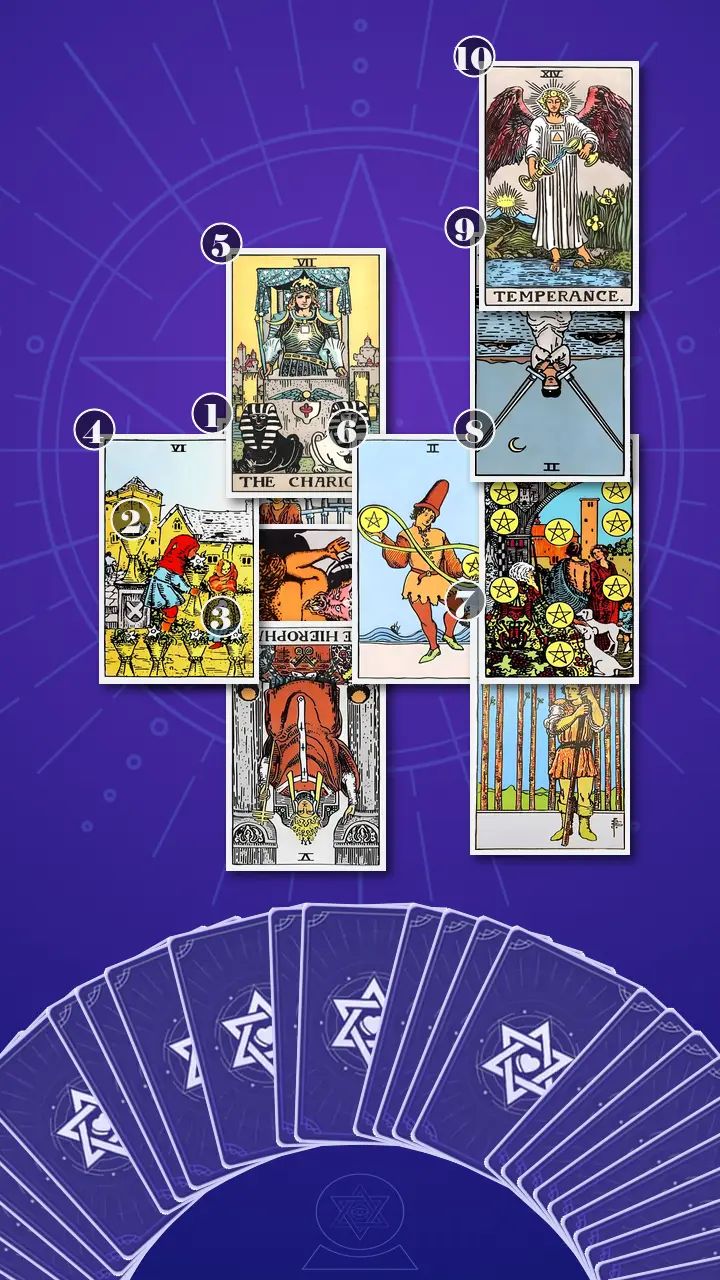
Reading the Map: How Tarot Works When You’re Stuck at a Career Crossroads
Position 1: The current stuck point — Eight of Swords (upright)
“Now we’re turning over the card that represents the current stuck point: how guilt is tangling your attention right now.”
Eight of Swords, upright.
I didn’t need to dramatize it; the image did that on its own—blindfold, loose ropes, a narrow corridor of swords that looks tighter than it is.
“This is 12:13 a.m. in Toronto,” I said, keeping it specific, “and you’re in your Notes app rewriting the same ‘respectful, mature’ explanation about the one-way ticket. The move is already booked, but your nervous system is acting like your real life can’t start until the family group chat gives a ‘safe’ response. So the phone stays within reach the next day—at work, on dates—because part of you is still waiting for permission to exhale.”
Energetically, the Eight of Swords is a blockage of agency. Not a lack of options—more like a mind-loop that narrows the hallway. The blindfold is important: it’s not “you’re naive.” It’s “you don’t want to look directly at the pain of disapproval.”
Jordan let out a small laugh that had bitterness in it. “That’s… too accurate,” she said. “Like, kind of brutal.”
“I know,” I said softly. “But also—notice the ropes. They’re not tight. This card always asks: what’s one single step that proves you still have agency, even while guilt is loud?”
And because the Eight of Swords pairs with a later card in this reading, I added the split-screen. “At night: phone glow, essay-texts, refreshing. By day: ‘I’m fine, I’m fine’ in meetings while a hidden tab in your brain plays the group chat audio.”
Position 2: The immediate blocker — The Devil (upright)
“Now we’re turning over the card that represents the immediate blocker or amplifier: what most strongly complicates this—the hook guilt uses.”
The Devil, upright.
“This isn’t about you being ‘bad,’” I said, because I never let that misunderstanding land. “This is about attachment and binding agreements.”
I translated it into her actual life: “You treat guilt like a binding contract. If family is upset, you must pay—extra explanations, extra calls, extra proof you’re still a good daughter. You pick up inconvenient calls, you apologize pre-emptively, you overfunction to keep the peace—and then you show up depleted at work and emotionally guarded in love because you’ve been chained to managing everyone’s feelings.”
Energetically, the Devil is excess obligation: love gets confused with compliance, reassurance gets confused with safety. It’s like a subscription you forgot you agreed to—every time you try to cancel, it offers you a “free month” of relief if you just explain a little more.
Jordan’s shoulders rose toward her ears without her noticing. She nodded once, sharp. “The relief when someone says ‘Okay, fine’—it’s like oxygen.”
“Exactly,” I said. “And here’s the trust-building part: needing boundaries doesn’t mean you love them less—it means you’re finally counting your own capacity.”
Then I added the line I knew she needed, because her work and love were paying rent for a family conversation they didn’t start. “Don’t let the family conversation rent space in every room of your life.”
Position 3: The deep root — The Hierophant (reversed)
“Now we’re turning over the card that represents the deep root: the learned rule about family, love, and duty that keeps the pattern running.”
The Hierophant, reversed.
At the root, this isn’t just about a few tense calls. It’s about a rulebook.
“You have an internal respectability checklist,” I told her. “The second family reacts, your mind starts translating your move into their language—practical, safe, approved—like you have to submit an application for adulthood.”
Energetically, the Hierophant reversed is a deficiency of self-authored values. Not because you don’t have values—but because you don’t let them be the authority when pressure arrives. You still hand the keys over.
I pointed to the card’s keys—then let my perfumer brain speak for a second, an “inner flashback” to Paris labs and strict briefs. “In perfumery, there’s a moment where you realize you’ve been composing for a judge you’ll never meet. The formula becomes ‘acceptable’ instead of alive. That’s what this rulebook does to your decisions.”
Jordan stared at the keys like they were a real object on the table. “I hate how much I still… want to be ‘the sensible one.’”
“That makes sense,” I said. “But we’re going to separate value from justification. One sentence can be enough.”
Position 4: The emotional backstory — Six of Cups (upright)
“Now we’re turning over the card that represents the emotional backstory: what you’re carrying forward from earlier family dynamics.”
Six of Cups, upright.
This card softened the room. Not because it made things easy—because it made them human.
“This is the tenderness,” I said. “You aren’t only dealing with pressure—you’re dealing with real warmth and history. You remember being close, being the one who kept things warm. So boundaries feel like betrayal.”
Energetically, the Six of Cups is balance in memory—until it slides into a younger role. “On calls, you slip into a version of yourself that seeks reassurance instead of relating as an adult. And then guilt hits harder, because it’s not just ‘they’re mad’—it’s ‘am I still safe here?’”
Jordan’s mouth tightened, then relaxed. Her eyes went glassy for half a second. “Yeah,” she whispered. “It’s not that they’re monsters. It’s that I… miss the old version.”
“That grief belongs in the story,” I said. “We don’t fix guilt by pretending you don’t love them. We fix it by updating the relationship so love doesn’t require self-erasure.”
Position 5: The conscious aim — The Chariot (upright)
“Now we’re turning over the card that represents the conscious aim: what you’re trying to do with the one-way ticket—values, direction, self-definition.”
The Chariot, upright.
This card has posture. It’s the moment your spine remembers itself.
“This is the moment you remember: you already chose,” I said. “The one-way ticket is your steering wheel—values first, reactions second.”
And I used the echo technique we planned, shifting from phone to body: “I picture you on a morning walk to grab coffee—cold air waking your face up, fingers wrapped around a hot cup. You feel the ticket in your inbox and your spine straightens. Two truths: I can care AND I can go.”
Energetically, the Chariot is balance through will: not emotional shutdown, not dramatic declarations—just direction. The two sphinxes are the modern conflict: loyalty and autonomy pulling in different directions. The Chariot doesn’t kill either sphinx. It holds the reins.
Jordan exhaled in a way that sounded like her ribs had been locked for weeks. “That,” she said. “That’s what I want. Not to burn bridges. Just to… drive.”
Position 6: The near-term reality check — Two of Pentacles (upright)
“Now we’re turning over the card that represents the near-term reality check: how the work-and-love balance will be tested as the move becomes real.”
Two of Pentacles, upright.
“This is a bandwidth problem,” I said, plain and kind. “Deadlines, packing, dating, family contact—competing for the same limited attention.”
I pointed to the infinity loop. “If you try to keep everyone continuously updated, you’ll give work and love the leftover version of you. This card isn’t a warning that you’ll fail. It’s a warning that juggling without named priorities becomes a never-ending loop.”
Energetically, the Two of Pentacles is excess responsiveness—competence under pressure that becomes unsustainable without limits.
Jordan’s jaw clenched. “I literally rewrote a Slack update yesterday because I didn’t want to sound… irresponsible.”
“That’s the Hierophant root talking,” I said. “Your autonomy shouldn’t need a courtroom-level defense in Slack or in love.”
Position 7: Jordan’s stance — Nine of Wands (upright)
“Now we’re turning over the card that represents your stance: how you’re showing up and coping—your self-protection and effort.”
Nine of Wands, upright.
“You’re braced,” I said. “Bandaged head energy. You enter family calls already tense, rehearsing arguments, and later you’re too depleted to be affectionate with your partner—or to be creative at work.”
Energetically, the Nine of Wands is balance tipping into blockage: resilience that becomes guardedness. The fence is protection, but it’s also isolation.
Jordan gave me a look that was half apology, half confession. “I’m tired of being on defense. Even when no one is actively attacking.”
“That’s the body remembering old rounds,” I said. “We’re going to teach it a new pattern: firmness without adrenaline.”
Position 8: The family system field — Ten of Pentacles (upright)
“Now we’re turning over the card that represents the family system field: what the environment is asking of you—expectations, legacy, pressure.”
Ten of Pentacles, upright.
“This is legacy gravity,” I said. “It’s not just one person’s opinion. It’s the feeling that you’re being measured against a stability rubric you never agreed to.”
I traced the archway on the card with my finger. “An invisible keycard door. Everything is fine until you try to access a new floor.”
Energetically, the Ten of Pentacles is excess system-weight: security, reputation, continuity—offered with an unspoken price tag. It’s why your family conversations can feel like Succession-lite, but without the suits—just the pressure.
Jordan’s lips pressed together. “It’s like there’s a family brand guideline,” she said, almost laughing. “And I’m… off-brand.”
“Exactly,” I said. “And adulthood is deciding you’re allowed to evolve the brand without being exiled from the building.”
Position 9: The push-pull — Two of Swords (reversed)
“Now we’re turning over the card that represents the push-pull: what you secretly want and what you fear it will cost—belonging versus autonomy.”
Two of Swords, reversed.
“Here’s the other blindfold,” I said, and I felt Jordan go still. “This is what happens in daylight.”
I used the split-screen echo fully: “At night, the Eight of Swords is you under the duvet, Notes app glowing, rewriting. By day, this Two of Swords reversed is you in a glass meeting room near King Street, marker smell sharp in your nose, nodding while your brain replays one line—‘Must be nice to just leave.’ Your leg bounces under the table. You’re hoping for one magical text that makes everything clean, so you keep reopening a decision you already made.”
Energetically, this is blockage dissolving into overwhelm: indecision used as pain control, until indecision becomes its own pain. It’s decision fatigue with an emotional edge.
Jordan swallowed. “I hate that my partner can tell,” she said. “Like I’m there, but I’m not.”
“You’re not choosing between family and love,” I said. “You’re choosing whether guilt gets to be the manager of your attention.”
When Temperance Spoke: Turning Guilt into a Thermostat
Position 10: Integration guidance — Temperance (upright)
I let the room quiet before I touched the final card. Even the city sounds outside—distant streetcar, a faint siren—felt like they stepped back to listen.
“Now we’re turning over the card that represents integration guidance: the most empowering way to relate to guilt so it doesn’t derail work and love.”
Temperance, upright.
Setup—because this is where Jordan lived most days: “You know that moment when the group chat goes quiet after you share your plan, and you feel your chest tighten like you just did something wrong—so you start drafting a longer explanation to fix the feeling?”
Stop treating family guilt like a verdict, and start treating it like a temperature you can regulate—Temperance turns the messy mix into something livable.
I let the sentence sit there. No extra coaching. No extra paragraphs. One sentence is still communication.
Reinforcement came in layers—the way a fragrance reveals itself from top note to base. Jordan’s reaction had a sequence I see often when someone finally stops arguing with gravity.
First: physiological freeze. Her breathing stalled mid-inhale, and her fingers tightened around her water glass like it was an anchor. Her shoulders stayed high, waiting for impact.
Second: cognitive seep-in. Her gaze unfocused, sliding slightly past the cards as if her brain was replaying every midnight Notes app essay, every “quick call” that turned into interrogation, every date where she smiled on autopilot and didn’t hear the last three sentences.
Third: emotional release. A shaky exhale escaped her, and her shoulders dropped—not dramatically, just enough to be real. Her eyes went wet with that specific look that says, Oh. I’ve been living like I’m on trial.
And then—an unexpected reaction, because clarity can sting before it soothes. Her eyebrows pulled together and her voice sharpened. “But if that’s true,” she said, “doesn’t it mean I’ve been doing it wrong? Like… I’ve been feeding it.”
I didn’t flinch. “It means you’ve been doing what worked in the old system,” I said. “And you’re outgrowing it. That’s not a moral failure. That’s an update.”
Here’s where my perfumer’s brain and my signature work as an intuitive consultant snapped into place—my Conflict Transformation System, the way I convert tension into a constructive dialogue rather than a shutdown or a blow-up.
“Temperance is emotional moderation,” I continued. “And in my world, moderation isn’t ‘muted.’ It’s measured. This angel is blending two cups—compassion and firmness—into a wearable shade. Not the color that pleases everyone. The color you can actually live in.”
I leaned in slightly. “And I want you to borrow the line that matters most: Guilt is a signal to set a boundary, not a command to surrender your life.”
She blinked fast. Her chin trembled once, then steadied. “Okay,” she whispered, like she was trying on the words for size.
“Now,” I said, gently coaching. “Use this new frame and look back at last week. Was there a moment where guilt spiked—tight chest, sinking stomach—and you started bargaining? What would Temperance have done in that moment?”
Jordan pressed her palm to her sternum, exactly where she’d described the tightness living. “I would’ve… not written the essay,” she said, almost surprised. “I would’ve sent two sentences. And then I would’ve gone to bed.”
“Yes,” I said. “That’s the emotional transformation right there: from guilt-driven tightening and over-explaining to steadier self-respect through consistency. Not perfect certainty. Consistent regulation.”
The One-Page Boundary Plan: Actionable Advice That Protects Work and Love
I took a breath and threaded the whole reading into one coherent story, because that’s what integration is: not ten separate insights, but a single, believable narrative.
“Here’s why it’s been happening,” I said. “Right now, you’re stuck in a mental trap (Eight of Swords) and the hook is guilt-as-control (Devil). Underneath, there’s an inherited rulebook that equates respectability with belonging (Hierophant reversed), powered by real tenderness and nostalgia (Six of Cups). You’re trying to drive your adult life with values (Chariot), but the logistics are getting swallowed by constant juggling (Two of Pentacles). You’re resilient but braced (Nine of Wands), and the family system carries legacy weight (Ten of Pentacles), which makes you keep reopening the decision for relief (Two of Swords reversed). Temperance says: stop trying to win permission. Regulate the intensity, set a boring boundary, and keep living.”
“The blind spot,” I added, “is thinking that if you explain enough, everyone will feel okay—and then you’ll be allowed to relax into work and love. That keeps you in a loop: family discomfort → your guilt spike → you pay with emotional labor → short relief → long-term resentment and distance.”
“The transformation direction is simpler and harder,” I said, meeting her eyes. “Shift from earning permission through explanations to practicing clear boundaries plus self-compassion when guilt shows up.”
Then I gave Jordan—and you—something you can actually do. Not a personality transplant. Tiny experiments that teach the nervous system a new rule.
- Pin the 2-Sentence ScriptOpen your Notes app and write a two-sentence boundary you can reuse: “I love you. I’ve made my decision and I’m not debating it. I can update you on logistics on Sunday at 5.” Pin it. Use it the next time you feel tempted to write an essay.Expect it to feel “mean” the first time. Discomfort isn’t proof you’re wrong; it’s proof you’re changing the pattern. If you freeze, send only the first sentence. One sentence is still communication.
- Schedule One Predictable Family WindowChoose one contact window for the week (example: Sunday 5:00–5:30 p.m.) and put it on your calendar like a meeting. If someone calls outside it, let it go to voicemail and text: “I’m not free to talk right now—let’s do Sunday.”Make your boundary boring. Repetition is what makes it real. If you worry about emergencies, set a rule: two calls in a row = step out; otherwise you respond during the scheduled window.
- Do a 10-Minute “Agency Step” After Any Guilt TriggerRight after a guilt spike—tight chest, sinking stomach—set a timer for 10 minutes and do one forward-motion task: pack one box, update one moving document, draft one work deliverable, or confirm one appointment. The point is to teach your body: guilt can be present and you still move.If 10 minutes feels like too much, do the 2-minute version. Momentum matters more than intensity.
Because I’m Luca, and scent is one of my most reliable tools for nervous-system regulation, I offered one more layer—optional, but powerful—using my Dialogue atmosphere enhancement with calming scents strategy.
“Temperance is a thermostat,” I reminded her. “So let’s give your body a physical cue that says ‘we’re safe while we hold a boundary.’ Before the Sunday call, choose one calming scent you genuinely like—something soft and clean, maybe neroli, lavender, or sandalwood. Put it on your wrist or on a tissue nearby. Not to ‘control’ anyone—just to signal your own system: steady voice, firm limit.”
Then I used my Family Energy Diagnosis lens, the way I read emotional flow through sensory preference. “Notice which family interactions make you reach for something ‘sharp’—peppermint gum, extra coffee, scrolling. That’s your body asking for regulation. Temperance is you meeting that need without paying for approval.”

A Week Later: Ownership, Not Permission
A week later, Jordan messaged me a screenshot—not of a long explanation, but of her pinned note. Two sentences. That was it. Under it, she’d typed: “Used this. Felt like my chest was doing The Bear kitchen panic for 30 seconds. Didn’t add a paragraph. Went on my date anyway.”
She told me the Sunday call still had an edge. Nobody threw confetti. But she didn’t bargain. She didn’t offer coupons—timelines, extra visits, extra proof. She repeated the boundary once, calmly, and ended the call without turning it into a trial.
Her bittersweet proof was small and real: she slept through the night, then woke up and her first thought was, “What if I’m wrong?”—and this time she just lay there for a beat, hand on her sternum, and whispered, “I’m allowed to choose.” Then she got up and made coffee.
That’s the Journey to Clarity I trust: not dramatic rupture, not perfect peace—just ownership. A life where you can love your family without negotiating your future, and where your work and your love get the present version of you.
When the group chat goes quiet and your chest tightens, it can feel like belonging is something you have to keep paying for—right as you’re trying to build a life that’s finally yours.
If you didn’t need anyone’s permission to exhale, what would your next tiny boundary look like—one sentence, one schedule choice, one ‘not tonight’—that protects your work and your love?
This story is adapted from psychological research, written so that those in a similar struggle can see their own pattern in it — and find their next step clearly.These insights are not a substitute for professional psychological, medical, legal, or financial advice.
Learn more about our Journey to Clarity.
How did this insight land for you?
🫂 This Resonates Deeply
🌀 Living This Story
✨ Now I See Clearly
🌱 Seeing New Possibilities
🧰 Useful Framework
🔮 The Confirmation I Needed
💪 Feeling Empowered
🚀 Ready for My Next Step
Author Profile
 AI
AI“As a perfumer for fifteen years, I’ve learned to perceive human boundaries through the delicate metaphor of scent. Relationships need the right amount of space to breathe, and I've seen too many kind souls exhaust themselves trying to please everyone. I’m here with warmth and understanding—not to teach you to be guarded, but to help you gently clear the air and rediscover the comforting, safe boundaries that are rightfully yours.”
In this Family Tarot Reading :
Core Expertise
- Enmeshment & Permeability Diagnosis: Using scent diffusion as a metaphor to identify suffocating families where personal boundaries are virtually non-existent.
- Atmospheric Toxicity Auditing: Detecting passive-aggressive tension and unstated resentment quietly polluting the family emotional climate.
Service Features
- The Quarantine Zone Protocol: Establishing an impenetrable psychological 'airlock' to prevent family toxicity from bleeding into your independent adult life.
Also specializes in :
Explore Related Patterns:
Boundary DiffusionJordan has already made a boundary in the physical world by booking the one-way ticket, but the boundary keeps blurring once family emotion enters the room. She is technically moving forward, yet the group chat still decides whether she can focus at work, sleep at night, or be emotionally present on a date. The mechanism is a collapse between care and responsibility. Family disappointment becomes treated as something she must absorb, explain, soothe, or prevent, so the line between 'they are upset' and 'I have done something wrong' gets dangerously thin. That is how a boundary can exist on paper while failing inside the nervous system. Boundary Diffusion fits because the core issue is not whether Jordan loves her family; it is whether their emotional weather gets to occupy every room of her life. For You, the pattern becomes visible when someone else's reaction instantly becomes Your task list. The repair is differentiation: they can have feelings, and You can still keep Your decision, schedule, attention, and love intact.
Boundary DiscernmentJordan's clearest progress appears when she sends the pinned two-sentence note, does not add another paragraph, and goes on her date anyway. The Sunday call still has an edge, but she repeats the boundary once and ends the conversation without turning it into a trial. The mechanism is discernment under emotional pressure. Instead of using guilt as proof that she should surrender the boundary, she starts treating it as information to regulate. That lets her separate three things that used to blur together: loving her family, managing their reaction, and owning her adult decision. Boundary Discernment fits because the emerging pattern is not cold distance or dramatic rupture; it is measured self-respect. For You, the shift is practical and psychological at the same time: care can stay warm, contact can become predictable, and Your work and love no longer have to lose presence every time family discomfort appears.
Defensive OverexplainingJordan's midnight Notes app ritual is the behavioral anchor: delete, retype, add one more 'I'm sorry,' then keep refreshing for a reply that feels safe. The move is already booked, but her mind keeps building a courtroom-level defense as if adulthood has to be submitted for approval. The defense mechanism is explanation used as anxiety control. By making the message more respectful, more mature, and more airtight, she tries to reduce the pain of being misunderstood or disapproved of. The problem is that every extra paragraph teaches the guilt loop that peace only comes after a stronger justification. Defensive Overexplaining fits because the story repeats this mechanism across contexts: family texts, calls, Slack updates, and even dating presence. You are not just communicating information; You are trying to purchase emotional safety through clarity. The shift is not silence, but proportion: one clean sentence can hold a boundary better than an essay written from panic.
Guilt-Driven People-PleasingJordan's pattern shows up most clearly when family discomfort becomes a problem she feels compelled to fix. She picks up inconvenient calls, adds another apology, offers extra proof, and keeps trying to make the one-way ticket emotionally painless for everyone else, even while her work focus and romantic availability take the hit. The psychological mechanism is not simple kindness; it is guilt being converted into compliance. Her nervous system treats another person's disappointment as a relational emergency, so she reaches for emotional labor as a short-term regulation strategy. The relief is real when someone says 'Okay, fine,' but the cost is that her attention, time, and self-trust keep getting negotiated away. Guilt-Driven People-Pleasing fits because the story keeps showing the same exchange: family unease rises, You overfunction to restore peace, and the brief calm reinforces the loop. Seeing the mechanism gives You a cleaner intervention point: guilt can be acknowledged without being obeyed, and care can stay intact without making Your future a payment plan for someone else's comfort.
Permission SeekingJordan keeps saying she is not asking permission, but her attention tells a different story: the phone stays close, the family chat becomes a gatekeeper, and a safe reply starts to feel like the thing that would let her finally exhale. The ticket is booked, yet her body acts as if real life has to wait for approval. The cognitive mechanism is external authority being used to stabilize internal certainty. When the inherited family rulebook gets loud, her own values stop feeling like enough evidence. She tries to borrow steadiness from the people who are also activating the guilt, which keeps her autonomy dependent on the very system she is trying to outgrow. Permission Seeking fits because the pattern is not about logistics; it is about waiting for someone else's emotional okay before You let work, love, and self-direction fully resume. The clearer move is to notice the moment You start outsourcing the right to proceed, then return the authority to a self-authored choice: You can care, explain once, and keep going.
Reassurance SeekingJordan's attention keeps returning to tiny signals: the typing bubble appearing and disappearing, the quiet after she shares her plan, the one comment that keeps replaying in a meeting. A single reassuring text starts to feel like it could make the whole decision clean, so she keeps checking for the signal that belonging is still intact. The mechanism is reassurance being used as emotional regulation. Instead of letting the guilt rise and fall inside a stable boundary, she tries to make the nervous system settle by getting external confirmation that nobody is too upset. That works briefly, then trains her brain to keep scanning for the next sign of safety. Reassurance Seeking fits because the story repeatedly shows You looking outside Yourself for permission to feel okay about a decision You already made. The pattern is understandable, especially when old warmth and family history are involved, but it becomes expensive when the search for reassurance replaces presence at work and in love.
Anxiety SpiralJordan's spiral has a clear sequence: the group chat goes quiet, her chest tightens, her stomach drops, and her mind starts drafting, refreshing, replaying, and predicting fallout. The problem is not that she lacks a decision; it is that the alarm around the decision keeps hijacking her available attention. The mechanism is a feedback loop between bodily threat cues and narrowed cognition. Once guilt registers as danger, her brain starts scanning for ways to reduce uncertainty, but every check and rewrite gives the alarm more material. Work and dating then receive the leftover version of her because the spiral has already consumed the front of the mind. Anxiety Spiral fits because the story shows a repeated escalation from trigger to body alarm to checking to mental replay. For You, the useful insight is that the spiral does not need a perfect argument; it needs interruption, regulation, and one small agency step that proves guilt can be present without running the schedule.
Explore Related Struggles:
Approval-Safety FusionThe typing bubble appears, disappears, and Jordan's chest tightens before any actual conversation has happened. A safe reply becomes the signal her body is waiting for, as if work focus, sleep, and romantic presence are not available until the family system confirms that she is still okay. The pressure deepens because approval is not functioning as simple reassurance anymore; it has become the switch that tells her whether she is allowed to exhale. You can see the trap in the relief she describes when someone says okay, fine: the relief is real, but it keeps safety dependent on the next response. Approval-Safety Fusion names the way belonging signals get mistaken for basic stability. The work is not to stop wanting family warmth, but to notice when a reply has been given the power to regulate an entire life.
Autonomy Guilt BindThe one-way ticket is already booked, but Jordan's attention keeps stopping at the family group chat before it can land in her work or her date. Her adult life has started in the external world, while her body still treats family disappointment as a brake on the road out. That is the core bind: caring for her family and choosing her own future are being forced into the same emotional checkpoint. You can feel how the choice becomes expensive, not because the ticket is wrong, but because every step toward autonomy seems to demand another payment of guilt. Autonomy Guilt Bind fits because the story is not about rejecting family or proving independence through distance. It is about learning that love can remain real while the decision stops being negotiated through family distress.
Earned Love BindWhen family is upset, Jordan starts paying immediately: another explanation, another call, another apology, another piece of proof that she is still a good daughter. The payment buys a little relief, but it also teaches the system that her capacity is always available for reassurance. Earned Love Bind fits because belonging is being treated like something that must be continually renewed through labor. You can care deeply and still become depleted when love is measured by how quickly you absorb discomfort and restore peace. The story shows why this bind derails work and love so efficiently. By the time Jordan reaches a meeting or a date, she has already spent her emotional budget proving she deserves connection somewhere else.
Permission ParalysisJordan keeps saying she is not asking permission, but the phone stays close enough to decide whether the next hour can belong to work, sleep, or love. The decision is made on paper, yet it keeps getting reopened through the Notes app, the group chat, and the hope for one text that makes everything clean. Permission Paralysis shows up in that gap between action and inner authorization. You can move forward externally and still feel frozen internally when the nervous system treats family acceptance as the final stamp on the decision. The story gives this struggle a precise shape: the ticket exists, the future is chosen, but the body keeps waiting at an invisible gate. The next step is not a more convincing explanation; it is practicing motion without another approval signal.
Internal Authority CollapseJordan does not lack values; she can name the life she is trying to build. The rupture happens when family pressure arrives and her mind starts translating the move into practical, safe, approved language, as if adulthood needs to be submitted for review. Internal Authority Collapse names the moment her own compass stops acting like the final authority. You can hear it in the respectability checklist, the need to sound sensible, and the way a personal decision gets reshaped into a defense brief for an audience that may never fully approve. This struggle matters because it explains why more explanation does not create more freedom. When the decision is placed back under the old rulebook, even the clearest adult choice can start to feel like an unfinished application.
Unspoken Expectation LoadJordan describes an invisible stability rubric, a family brand guideline, and a sense that everything is fine until she tries to access a new floor. No one has to issue a single clean command for the pressure to become real. Unspoken Expectation Load fits because the weight is ambient. You can be responding to standards that were never formally stated, yet still feel measured by them every time you make a choice that looks too independent, too risky, or too off-brand. This is why the guilt feels larger than one tense call. The family field carries reputation, continuity, and security as silent requirements, and Jordan's work and love start bending around rules she never consciously agreed to follow.
Mental Bandwidth DepletionAt night, Jordan is under the duvet rewriting the same message. By day, she is in meetings and on dates while a hidden tab in her brain keeps playing the family group chat audio. Mental Bandwidth Depletion fits because the story treats attention as a finite resource that is being quietly overdrawn. The problem is not that she has a lot to do; it is that one unresolved relational channel keeps consuming the same focus she needs for design work, packing, sleep, and intimacy. You can see the cost in the phrase leftover version of you. Work and love are not failing because she lacks care for them; they are receiving what remains after family monitoring has taken the first claim on her capacity.
Vigilance-Execution SplitJordan enters family calls already braced, rehearsing arguments before the conversation has even landed. Later, she is in a glass meeting room nodding while one family line keeps replaying in her head and her leg bounces under the table. Vigilance-Execution Split names the cost of staying ready for impact. You can still look functional from the outside, but the part of the mind needed for design decisions, affectionate presence, and steady follow-through is being pulled into threat monitoring. The story makes this split visible in the aftermath: less creativity at work, less softness with a partner, and a body that acts like it is on defense even when no one is actively attacking. Protecting work and love starts with noticing when alertness has taken over the steering wheel.
Explore Related Emotions:
Adult Child PanicOn family calls, Jordan slips into a younger version of herself, seeking reassurance instead of relating as an adult. The word family catches in her throat, her chest tightens, and the old role of being the sensible one comes back before she has time to choose a new posture. Adult Child Panic fits because the present-day move keeps waking up an earlier relational script. You can see the body react before the adult mind catches up: typing bubbles, apologies, swallowed words, and a sudden need to make everyone okay so she can feel safe enough to keep living her own life.
Boundary GuiltAt 12:07 a.m., Jordan is not changing the ticket; she is adding one more 'I'm sorry' to a note she has already rewritten. The boundary exists, but her body acts as if it has to be paid for in explanations, extra calls, and proof that she is still a good daughter. That is why Boundary Guilt fits the story. You can see it in the way family discomfort becomes a bill that work and love end up covering: lost focus, guarded dates, and a phone kept close because someone might be disappointed. The emotional core is not that she lacks care; it is that care has been trained to feel like compliance.
Cautious AutonomyOn the imagined morning walk, Jordan feels the ticket in her inbox, wraps her fingers around a hot coffee, and lets the sentence land: I can care AND I can go. She is not trying to burn the bridge; she is trying to drive without handing over the wheel. Cautious Autonomy is the steadier version of freedom in this story. You can hear it in the two-sentence script and the scheduled family window: care stays present, but it no longer gets unlimited access to her attention. The feeling is careful, not cold, because she is building independence without pretending attachment does not matter.
Conditional Belonging FearThe Ten of Pentacles scene gives the family system a stability rubric, an invisible keycard door, and a sense that Jordan is suddenly off-brand. Her move is not treated as a simple logistics choice; it presses on the fear that access to warmth depends on staying recognisable to the system. Conditional Belonging Fear is the weather under that pressure. You can love people deeply and still feel the room tighten when belonging seems to come with terms and conditions. Jordan's tension is not about rejecting family; it is about noticing how expensive closeness becomes when autonomy feels like a membership violation.
Grounded AgencyA week later, Jordan sends a screenshot of the pinned note, not a long explanation. She uses it, feels the body spike for thirty seconds, does not add the paragraph, and goes on the date anyway. Grounded Agency is visible because action returns before certainty becomes perfect. You can see her proving to herself that a guilt spike does not have to cancel work, love, sleep, or the move. The emotional shift is practical and deep at once: her life starts responding to her chosen limits instead of the loudest family reaction.
Hard-Won ComposureDuring the Sunday call, nobody throws confetti and the conversation still has an edge. Jordan repeats the boundary once, calmly, and ends the call without turning it into a trial. Hard-Won Composure names the steadiness that appears while discomfort is still in the room. You can feel how much work it takes: tight chest, high shoulders, the urge to add one more proof, and then the decision to stay measured anyway. The calm here is not effortless; it is built through repetition, restraint, and respect for her own capacity.
Hollow FreedomThe one-way ticket is booked, but Jordan says her body has not gotten the memo. She bought it to feel free, then found herself under the duvet rewriting explanations while the group chat decided whether the freedom could feel real. Hollow Freedom captures that strange, modern emptiness after a brave choice that does not yet feel inhabitable. You can have the inbox confirmation, the plan, and the direction, while still feeling like the old system is occupying the rooms where joy and focus should be. The freedom is not false; it is waiting for her nervous system and boundaries to catch up.
Permission AnxietyThe phone stays within reach the next day at work and on dates, even though the one-way ticket is already booked. Jordan keeps looking for a safe reply from the family group chat before she can settle into the life she has chosen. Permission Anxiety lives in that gap between an adult decision and the body waiting for clearance. You feel it as a suspended exhale: the move is real, but focus, romance, and sleep still seem to depend on whether the chat gives a signal that it is safe to continue.
Rulebook ShameAt the root, Jordan hears an internal respectability checklist: practical, safe, approved, sensible. The move has to be translated into someone else's language before she can believe she has explained herself well enough. Rulebook Shame fits because the shame is not random; it is tied to a learned standard for being acceptable. You can see it when she hates how much she still wants to be the sensible one. The pain is not only about choosing a city or a partner or a job rhythm; it is about feeling exposed whenever her adult values stop matching the old checklist.
Verdict DreadWhen Temperance lands, Jordan freezes around the water glass and then says it out loud: she has been living like she is on trial. The earlier scenes have already built the courtroom around her, from the essay-length explanations to the fear that one wrong tone in Slack or family chat will mark her as irresponsible. Verdict Dread names the feeling that every choice is being scored before it is allowed to belong to you. In Jordan's story, the family reaction does not arrive as ordinary disagreement; it lands like a ruling she has to pre-empt, soften, and appeal before she can return to work or love.
Performative CalmBy day, Jordan is in the glass meeting room near King Street, nodding while her brain replays the group chat. On dates, her partner can tell she is there but not really there, because part of her attention is still managing a family conversation that followed her into the room. Performative Calm names that split presence. You look functional from the outside, but the inside is running a second screen. In this story, the calm is not fake in a manipulative way; it is a costly social surface that lets work and love continue while the real bandwidth is being drained elsewhere.
Resentful ExhaustionJordan picks up inconvenient calls, apologizes before anyone asks, and keeps offering extra proof that she is still good. Each small payment buys a moment of relief, but it leaves her depleted at work and more guarded in love. Resentful Exhaustion grows where emotional labor has no clean endpoint. You can see the cost in the way reassurance becomes a subscription she cannot cancel: every explanation briefly lowers the pressure, then asks for another one. The exhaustion is not just tiredness; it is the slow ache of giving away capacity and then wondering why presence feels unavailable.
Nostalgia AcheJordan does not describe her family as monsters; she says she misses the old version. The Six of Cups softens the room because the pressure is tangled with real warmth, shared history, and the memory of being the one who kept things warm. Nostalgia Ache is the tenderness that makes the boundary hurt. You are not only leaving a rule; you are grieving a version of closeness that once felt safe or at least familiar. In this story, the ache explains why a simple boundary can feel like betrayal even when the adult choice is clear.
Explore Related Contexts:
Approval BottleneckJordan says the second family is not okay, she cannot work, and she cannot date like a normal person. The ticket is booked, but her attention still waits at the family group chat for a reply that feels safe enough to let her exhale. Approval Bottleneck fits because the family response has become an informal gate in front of her real life. You can see the bottleneck each time she refreshes the phone, rewrites an explanation, or holds herself back from full presence at work and in love until someone else signals that her adult decision is acceptable.
Conditional Family BelongingJordan describes the family field as a brand guideline and a stability rubric, where everything feels fine until she tries to access a new floor of adulthood. The one-way ticket is treated less like a personal logistics choice and more like evidence that she may be going off-brand. Conditional Family Belonging fits because love and acceptance appear to come with an unspoken price tag: explain more, reassure more, stay sensible, and prove the move does not make her disloyal. You can care about the family history while still seeing the structure clearly: belonging is being made to feel conditional on compliance with a script she did not author.
Family Boundary NegotiationJordan pins a two-sentence script, schedules one Sunday contact window, lets off-window calls go to voicemail, and later repeats the boundary once without bargaining. The external situation is not a clean break; it is a negotiated contact structure that has to become boring, predictable, and repeatable while family pressure still has an edge. Family Boundary Negotiation fits because the work is not to stop loving her family or to win a perfect reaction. You are watching an adult relationship structure being rewritten in real time, with clearer access rules so work, sleep, and dating no longer get treated as overflow space for every family emotion.
Family EnmeshmentJordan has booked the one-way ticket, yet her phone stays within reach at work and on dates because a family typing bubble can pull her attention back into explanation mode. The pressure is not coming from the move alone; it comes from a family system where availability, apologies, and extra calls are treated as proof that she is still a good daughter. Family Enmeshment fits because the family conversation is no longer contained to a call or a text thread. It spreads into her product design meetings, her romantic life, and her sleep window, turning adult autonomy into something she has to keep justifying before she can fully use her own attention.
Family Group Chat TribunalThe family group chat's typing bubble appears, disappears, and pulls Jordan back into the Notes app to add one more apology. By daylight, the same thread is still active in her attention while she sits in a glass meeting room and replays a line that makes the move feel like something she must defend. Family Group Chat Tribunal fits because the thread operates like a portable hearing room. You are not just looking at messaging friction; you are looking at a family approval arena where silence, short replies, and implied judgment can pressure her into producing evidence that her adult choice is reasonable enough to be allowed.
Family Script PressureJordan keeps translating her move into practical, safe, approved language, almost as if adulthood requires an application packet before it becomes legitimate. The repeated urge to sound respectful, mature, and sensible shows how the family rulebook is still shaping the format of her choices even after the choice has already been made. Family Script Pressure fits because the conflict is not only about a ticket or a tense call. You are seeing an inherited standard of respectability press down on a self-authored path, making a normal adult transition feel like a defense brief that must satisfy people who are not the ones living the life.
Work Life Boundary CreepJordan is under the duvet at night rewriting the explanation, then in a meeting the next day while a hidden tab replays the group chat. Her partner can tell she is physically present but not really available, and her work focus keeps getting interrupted by a family conversation that was never supposed to manage her calendar. Work Life Boundary Creep fits because the family issue has crossed domain lines. What begins as a family reaction to a move becomes a pressure system inside Slack updates, design meetings, dates, sleep, and emotional availability, showing exactly how an uncontained boundary problem can derail work and love at the same time.