When One Small Argument Feels Unsafe on the Streetcar Home
When Jordan sat down across from me, she gave me the kind of sentence I hear from thoughtful young professionals who can write clean copy all day and still spiral after one sharp tone at night: “I know it was small, so why does it feel this big in my body?” She was twenty-eight, a UX writer in Toronto, emotionally articulate, therapy-aware, and already tired of how searchable her problem had become. By the time she reached me, she had done the late-night rounds: why do small arguments make me panic in relationships, anxious after argument but everything is technically okay, why does conflict feel unsafe even when my partner is kind. None of it had loosened her chest.
Then she described the scene that mattered. It was 6:12 PM on the Queen streetcar after work, Notes app open, three apology drafts started and deleted before she had even decided what she actually felt. The fluorescent lights hummed overhead, winter air leaked in each time the doors sighed open, and her phone felt hot in her palm. She caught her own reflection in the dark window: shoulders braced, jaw tight, trying to look normal while internally the whole thing felt like a smoke alarm screaming over burnt toast.
It had been one small argument, but her body reacted like the room was not safe anymore. Fear sat on the surface; shame lived underneath it, quieter and meaner, asking why a shorter-than-usual text could make a grown woman feel as if something was ending. I told her what I often have to tell people at exactly this point: your body can call it danger before your mind has finished calling it small.
She nodded once. “The second the vibe changes, I want to fix it before it gets worse.”
“That makes sense,” I said. “And today, I don’t want to shame the pattern or romanticize it. I want to map it. Let’s see what from home still turns disagreement into danger, and how to find clarity without abandoning yourself inside the conversation.”

Choosing the Compass: A Simple Cross for Conflict Feels Unsafe
I asked her to place both feet on the floor, take one slower breath than her body wanted, and hold the question plainly: “We had one small argument—what from home makes conflict feel unsafe?” Then I shuffled. For me, that moment is not theatre. It is focus. A ritual can do what good field notes do in archaeology: mark the layer we are about to examine.
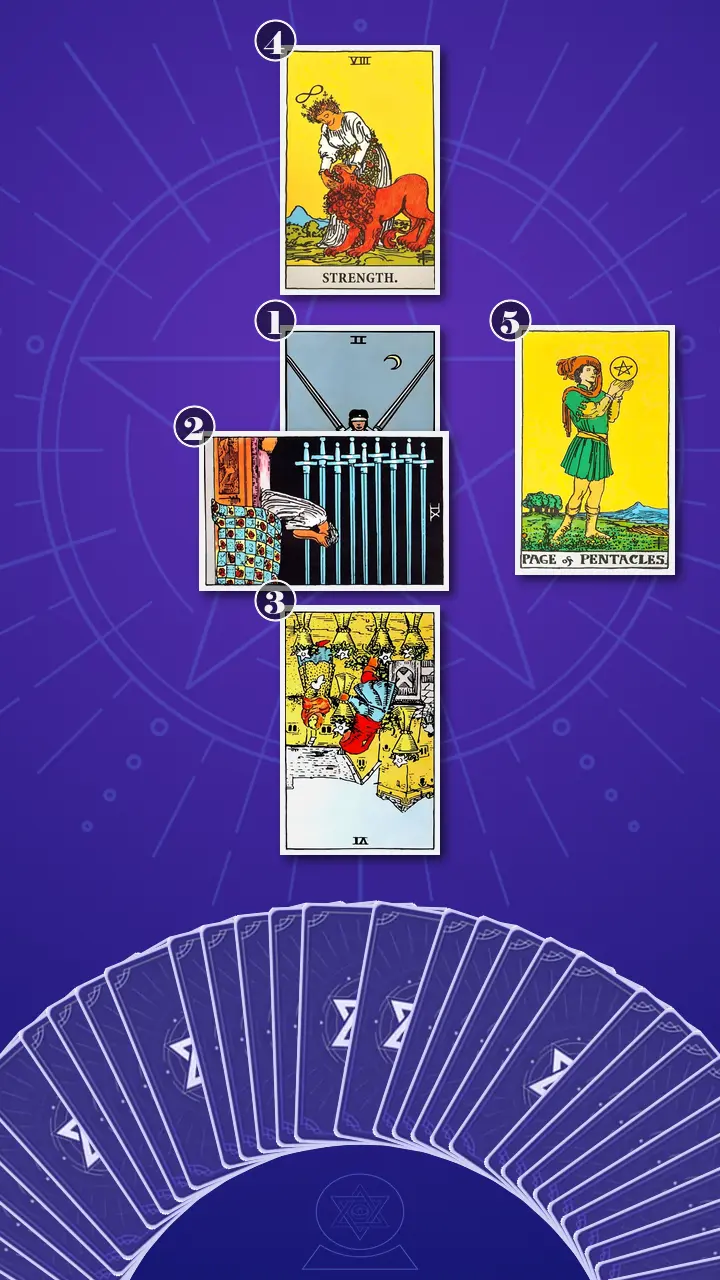
For this reading, I chose the Simple Cross, a five-card tarot spread for conflict anxiety and childhood patterns. I use it when someone needs clarity without ornamental noise. A larger spread would add clutter. A three-card line would miss the difference between the present-day trigger and the older home script beneath it. The cross shape is useful because it shows the whole chain at once: the symptom at the center, the fear crossing it, the root below, the regulating answer above, and the next walkable road to the right. That is how tarot works when it is useful: card meanings in context, not canned definitions.
I told her where we were going. The first card would show the post-argument shutdown itself. The crossing card would reveal what made one small disagreement feel mentally enormous. The lower card would uncover the older family conditioning still firing inside her body. The upper card—usually the hinge in a reading like this—would tell us what steadier inner stance could interrupt the old pattern. The last card would give us next steps simple enough to survive a real Tuesday night.
Reading the Crossed Wires After the Argument
The Quiet That Calls Itself “I Need to Think”
Now the card I turned over for the present conflict response—the specific shutdown, hesitation, and guarded behavior that appears after one small argument—was the Two of Swords, upright.
In older books, this card is often reduced to indecision. In Jordan’s life, it looked much more specific than that: phone in hand, chat thread open, honest follow-up delayed because saying less felt safer than risking one more wrong sentence. The blindfold and the crossed swords over the chest mapped almost too neatly onto her pattern of freezing, withholding, and protecting the bond by temporarily hiding her real experience. It had the emotional logic of typing a long message, selecting all, and deleting it because sending anything felt too exposing.
Upright here, the energy was not balance but blockage—Air turned rigid. She wanted closeness after conflict, yet she was trying to achieve it by becoming less visible, like putting the relationship on airplane mode to avoid one hard notification. The freeze bought short-term calm, but it also kept repair from beginning.
Jordan gave a small laugh with a bruise in it. “That is… uncomfortably exact.”
I smiled. “Exact is better than vague. Over-apologizing is sometimes fear wearing good manners.” Her fingers, which had been wrapped tightly around her mug, loosened just enough for me to see the line land.
The Mind That Makes One Text Feel Like a Forecast
Now the card I turned over for what was actively intensifying the reaction in the moment—the thinking pattern that made the disagreement feel bigger and less safe—was the Nine of Swords, upright.
This card always knows the blue light of 1:24 AM. The conversation has ended, but the nervous system has not. Here was Jordan rereading a short “okay” text, studying punctuation like forensic evidence, building an entire future story out of one ordinary relational bump. Hands over the face, swords lined on the wall: not danger itself, but the mind opening twelve browser tabs and calling it problem-solving.
The energy here was excess—Air in overdrive. The challenge was not that she lacked insight; it was that insight had been drafted into emergency service. Catastrophic meaning-making, tone monitoring, looping replay: maybe it is already colder, maybe I should have said less, maybe I should apologize first. That is how a minor disagreement becomes conflict hypervigilance.
As I said it, a streetcar bell drifted up from the road below my window, faint and metallic, and Jordan winced as if the sound had opened the same memory. Then she exhaled through her nose. “The replaying every line part got me,” she said. “That is exactly what happens on the commute, and then again in bed.”
The Older Room Hidden Inside the Present One
Now the card I turned over for the home-based emotional script beneath all this—the early conditioning that makes present-day conflict register as danger—was the Six of Cups, reversed.
Reversed, this card often tells me that time has folded in the wrong direction. A current disagreement activates an older household rule: when tension entered the room, someone had to smooth it out quickly. In modern terms, it is like the nervous system auto-filling a password from an old account into a new login. The partner in front of her may be kind, repair-capable, and present, but her body is reacting to older emotional weather.
This was the moment my archaeologist’s mind clicked into place. In a trench, if I confuse the fresh topsoil with the ash layer beneath it, I misread the entire site. So I told Jordan I wanted to borrow something from my own work—my Time Stratigraphy Method. Before we decide what this argument means, we separate the newest layer from the older one. This conversation is now. The alarm it triggered may not be.
The reversal showed a blockage in that separation. Jordan could say, intellectually, “This is probably old stuff,” yet the enclosed domestic atmosphere of the card—the younger figures, the inherited roles, the feeling that moods shape the whole room—told the deeper truth. Part of her still believed that a shift in tone was an emergency and that staying connected meant managing the atmosphere before she could even locate herself inside it.
She went very still. First her breath paused; then her eyes unfocused as if a different kitchen had briefly overlaid the one she lives in now; then her shoulders dropped a fraction. “I know this is now,” she said softly, “but I suddenly feel younger every time.” That was the card doing its work.
When Strength Placed a Hand on the Lion
The Card That Teaches Safety Without Disappearing
When I turned the fourth card, the room changed. A pale wash of late light moved across the table and caught the lion’s mane first, as if the card wanted to announce itself before I did. This was the position of guidance—the regulating truth that could interrupt the old pattern and create a safer way to stay present in conflict—and the card was Strength, upright.
Strength is often misread as control. I have never found that convincing. In this spread it was balance: gentle courage, embodied self-trust, calm emotional regulation. Not winning. Not pleasing. Not vanishing. Just the adult self keeping one hand on the body’s alarm and the other on the truth.
At moments like this, I use what I call Historical Case Matching. Civilizations do not endure because they avoid every internal clash. They endure because they learn which alarm signals a real invasion and which one is only the echo of an older siege. A city that slams every gate at the first sign of tension does not become safer; it becomes starved. Jordan had been governing her relationship like that—treating every difficult conversation as proof that the walls were about to fail.
I told her so gently. I reminded her of the streetcar, the apology drafts, the shoulders that had not unclenched even after the conversation was technically over. That was the giveaway: her body was not only in this argument.
Not every tense moment is a replay of home; let Strength place a steady hand on the lion so you can stay in the room with the truth instead of shutting the door from the inside.
I let the sentence sit between us.
First, she froze completely—breath held halfway in, fingertips hovering above the rim of her cup. Then the recognition moved through her face in stages: her eyes widened slightly, then drifted out of focus as if two timelines were briefly running side by side, then sharpened again with that unmistakable look people get when a sentence has reached the part of them that has been doing all the heavy lifting. Her jaw unclenched. The skin around her eyes brightened. “So I don’t actually need to make it disappear?” she asked, and there was resistance in it too, a small flash of grief at how long she had believed the opposite. “I just need to not leave myself while it’s happening?”
“Exactly,” I said. “The goal is not to become a person who never gets activated. The goal is to notice when old fear grabs the wheel, and answer from the present relationship without abandoning yourself.”
She looked down at the card again. “That makes me angry,” she said after a moment, quietly but honestly. “Not at my partner. Just… that I have been working this hard to keep the peace.”
“Of course it does,” I told her. “Strength is not a verdict. It is a new stance. You were using the map your body had.” I waited until her next breath came deeper. “Now, with this lens, was there a moment last week when this would have changed how it felt?”
“On the streetcar,” she said immediately. “If I’d known I could stay with the feeling instead of solving it, I wouldn’t have drafted the apology first.”
That was the hinge of the reading: not from fear to fearlessness, but from conflict hypervigilance and self-protection to steadier repair and safer closeness.
The Apprentice Card That Makes Change Believable
Now the card I turned over for the grounded next-step practice—the behavior that begins building a new conflict experience in real life—was the Page of Pentacles, upright.
I like this card precisely because it refuses drama. It is the apprentice, the beginner at the gym learning one clean movement before adding more weight. In Jordan’s life, this meant that the next win was not a flawless repair conversation. It was one small repeatable skill: asking for a pause, returning at a set time, or checking what was actually said before apologizing for meanings she had invented.
Upright, the Page brought balanced Earth into a spread that had begun in Air overdrive. Thought had been spiraling; now practice could land. Repair gets stronger when you stop treating calm as the only proof of love. The page studies the pentacle the way a person studies a new muscle pattern: one rep, one script, one return time.
Jordan nodded differently this time—less like someone trying to prove she understood, more like someone who could imagine actually trying it on a real Tuesday evening. That is usually when I know a reading has moved from insight to utility.
From Old Alarm to Walkable Ground
When I looked across the full spread, the story was remarkably clean. At the center, Jordan shut down because conflict felt unsafe. Crossing it, the mind inflated one tense moment into a forecast of criticism, shutdown, or disconnection. Beneath both lay the older home script: mood changes had once meant that the whole emotional climate of a room could turn, so her body learned to restore peace quickly. The blind spot was not that she cared too much. It was that she had quietly started using calm as the only trustworthy evidence of connection.
That is a fragile standard for love. It makes honesty wait outside until the weather improves. The transformation this reading asked of her was simpler and braver: treat disagreement as information, respond from the present relationship rather than the old household script, and build embodied self-trust through small repair reps. In elemental terms, the cards moved from Air lock and mental overdrive, through the waterlogged layer of memory, into the warm steadiness of Strength, and finally onto Earth. As an archaeologist, I have learned that sturdy structures are rarely restored in one dramatic act; they are stabilised course by course.
So I gave her three practices—not a personality transplant, just actionable advice she could use the next time the vibe changed.
- The 90-Second Steadying PauseThe next time the apology draft opens itself—on the streetcar, in the kitchen, or in the hallway after a tense moment—I asked Jordan to put both feet on the floor for 90 seconds and write three lines in Notes before replying: “What happened,” “What I fear it means,” and “What I know right now.”If 90 seconds feels impossible, do 30. The point is not perfect insight; it is interrupting fear’s first draft.
- The Then / Now Script SplitUsing my Time Stratigraphy Method, I asked her to make a two-column note after the next trigger. Under “Then,” list three things conflict meant in the home she grew up in. Under “Now,” list three facts about the current relationship before deciding what the disagreement means.Minimum version: one “Then” and one “Now.” Pattern recognition works even when the note is tiny.
- The Return-Time Voyage LogIf she needed space, I told her not to disappear into “later.” Say one grounding sentence—“I’m feeling activated, but I want to stay with this”—and name an exact return time such as “Can we come back to this at 8?”A pause is not punishment. Leave a clear route back, the way an old navigator marks harbour before nightfall.
“What if I can’t do all that in the moment?” she asked.
“Then do the smallest possible version,” I said. “One line. One sentence. One return time. We are not trying to prove you are healed. We are giving your body evidence that conflict can be survived without you disappearing.”

A Week Later, the Quiet Proof
A week later, Jordan sent me a message I could imagine many people saving as a tiny private milestone. She and her partner had another minor flare-up, this time about plans, nothing cinematic. She felt the old chest-tightening start, opened Notes, wrote the three lines, and sent one sentence instead of an apology spiral: “I’m activated, but I want to stay with this. Can we come back to it after dinner?” Her partner said yes.
The next morning she still had the first old thought—what if I got it wrong?—but she told me she noticed it, laughed softly, and made coffee instead of turning it into a verdict. Clearer was not the same as cured. It was simply the first piece of embodied proof of something I had told her at the table: you do not have to disappear to keep the connection intact.
I have spent enough of my life studying ruins to know that what survives is rarely the untouched structure. It is the structure that learned repair. That is why I still trust a Simple Cross tarot spread for uncovering home-based conflict triggers in relationships: it can show, with startling kindness, where an old alarm is still wired into a new home, and what next step begins to rewire it.
Sometimes the loneliest part is not the argument itself, but the moment your chest tightens, your shoulders brace, and you start shrinking just to keep closeness from slipping away. If tonight you recognize that reflex in yourself, then you are already closer to finding clarity than you were before. So when the next tense pause arrives, and you feel the old urge to make it disappear immediately, what is one small truth you might let yourself stay with for a few breaths longer?
This story is adapted from psychological research, written so that those in a similar struggle can see their own pattern in it — and find their next step clearly.These insights are not a substitute for professional psychological, medical, legal, or financial advice.
Learn more about our Journey to Clarity.
How did this insight land for you?
🫂 This Resonates Deeply
🌀 Living This Story
✨ Now I See Clearly
🌱 Seeing New Possibilities
🧰 Useful Framework
🔮 The Confirmation I Needed
💪 Feeling Empowered
🚀 Ready for My Next Step
Author Profile
 AI
AI“Having spent a lifetime at Cambridge and on archaeological digs, I’ve witnessed the rise and fall of countless civilizations. Please know that your current struggles are not a permanent fate, but merely a necessary fracture before rebuilding. I won't lecture you; instead, I invite you to sit with me in the ruins, using a patient, historical perspective to gently dust off the true, enduring value hidden beneath your temporary doubts.”
In this Choice Tarot Reading :
Core Expertise
- Historical Crossroad Matching: Contextualizing your dilemma by comparing it to macro-historical turning points, providing an objective bird's-eye view.
- Enduring Value Assessment: Evaluating competing options based on what will survive the test of time versus what is merely a short-term impulse.
Service Features
- The Time Stratigraphy Exercise: A mental time-travel protocol evaluating your current dilemma strictly from the perspective of your 10-year future self, instantly dissolving trivial anxieties.
Also specializes in :
Explore Related Patterns:
Assertive CommunicationJordan’s next repair attempt is not dramatic: “I’m activated, but I want to stay with this. Can we come back to it after dinner?” The sentence does several things at once. It names her state, keeps the connection open, and gives the pause a return route. Assertive Communication is the pattern because the new behavior is neither appeasing nor disappearing. It gives Jordan space without making the partner guess, and it turns conflict into something structured enough to survive. The boundary is clear, but it still protects the relationship. For You, this is the practical bridge between old alarm and present safety. A direct sentence can carry both truths: the body is activated, and the adult self wants repair. That combination helps conflict become a conversation rather than a test of whether closeness will vanish.
CatastrophizingJordan takes one small disagreement and finds herself building a future out of it: maybe the tone means distance, maybe the shorter text means something is ending, maybe one wrong sentence has changed the whole relationship. The present facts are limited, but the forecast becomes enormous. Catastrophizing names the cognitive leap from discomfort to danger. It is not a lack of intelligence; Jordan is articulate, reflective, and already aware that the argument was small. The issue is that her threat system turns ambiguity into prediction, especially when conflict touches the older belief that tension can make connection unstable. This pattern matters because it explains why the body can react before the mind agrees. You may know the disagreement is minor and still feel as if the room has become unsafe. Separating the actual event from the feared future gives You a way to respond to the argument that happened, not the collapse Your nervous system is trying to prevent.
Conflict AvoidanceJordan keeps the chat open but delays the honest follow-up because saying less feels safer than risking one more wrong sentence. She wants closeness, yet the immediate strategy is to reduce exposure, keep the conversation quiet, and wait until the relational weather feels less threatening. Conflict Avoidance fits because the pattern is not simple indecision. It is a defensive narrowing around safety: if calm is the only reliable proof of connection, then disagreement starts to feel like something that must be postponed, softened, or managed from a distance. The home script explains why avoidance can feel protective rather than evasive. If tension once meant the whole room could turn, then stepping carefully around conflict makes emotional sense. The growth edge is learning that repair does not require total calm first; You can enter a difficult conversation with structure, pacing, and enough self-contact to stay present.
Emotional RegulationJordan’s new practice is small and concrete: feet on the floor, a short pause, three lines in Notes, and one sentence that names activation without turning it into an apology spiral. She does not have to solve the whole relationship in the first wave of fear. Emotional Regulation fits the upright movement of the story because it shows a different way to metabolize conflict. Instead of letting the alarm dictate the next message, Jordan creates a brief container between trigger and response. The feeling is allowed to exist, but it no longer gets full control of the conversation. This directly answers the unsafe feeling by giving the body new evidence. You can feel activated and still stay in contact. You can pause without disappearing. You can let conflict be uncomfortable without treating it as proof that connection is about to break.
Family Role RegressionJordan can intellectually name that the argument is probably “old stuff,” but her body still reacts as if an earlier room has entered the present one. A small tone shift makes her feel younger, and the current relationship gets overlaid with the emotional rules of home. Family Role Regression describes that slide back into an older relational position. The present-day adult knows the partner may be kind and repair-capable, but the nervous system reactivates the role that once tracked moods, anticipated danger, and restored peace before the atmosphere turned. This is directly tied to the question of what from home makes conflict feel unsafe. The unsafe feeling is not only about the argument itself; it is about the old role that wakes up during conflict. When You can identify that role as a replay rather than a command, You gain more room to respond from the current relationship instead of the inherited room.
Fawning ResponseJordan starts drafting apologies before she has even identified what she actually feels. The move is fast, almost automatic: if the vibe changes, fix it before it gets worse, smooth the room before the tension has time to grow teeth. That is why Fawning Response fits this story. The apology impulse is not simply politeness; it is a safety behavior shaped by a home script where tension meant someone needed to manage the emotional atmosphere quickly. The body learns that connection is preserved by becoming agreeable, soothing, and low-risk. In the present relationship, this pattern can make repair look mature on the surface while quietly erasing You from the inside of the conversation. The deeper shift is learning that peace does not have to be purchased by instant self-correction, and that staying connected can include naming activation without immediately taking the blame.
Post-Event RuminationJordan’s mind keeps working after the conversation is technically over: rereading the short “okay,” studying punctuation, replaying every line on the commute and again in bed. The argument does not stay in the moment where it happened; it becomes a loop that keeps reopening the same threat question. Post-Event Rumination is the mechanism that makes this loop feel like problem-solving. The mind reviews, reinterprets, and searches for the one sentence that would have made the outcome safer, but the review does not create repair. It keeps the nervous system inside the argument long after the other person has left the scene. The home-based layer matters because rumination often tries to prevent a repeat of old danger. If You grew up needing to read the room quickly, replaying can feel responsible. The repair begins when You can use reflection to extract one usable fact, then stop treating endless review as the price of staying connected.
Reality TestingJordan’s practice asks her to write what happened, what she fears it means, and what she knows right now. That structure matters because it separates evidence from interpretation before the apology spiral takes over. Reality Testing fits the story’s grounded turn. The mind still produces the old thought, “what if I got it wrong?”, but Jordan notices it without treating it as a verdict. She checks the present facts instead of letting fear become the final authority. For You, this is how conflict becomes less unsafe without requiring instant calm. The nervous system may still offer an old prediction, but the adult mind can compare that prediction against the current relationship. Each small check gives the body a more accurate map of what is happening now.
Relational HypervigilanceJordan’s attention locks onto tiny relational signals after the argument: a shorter-than-usual text, a change in vibe, the punctuation of an “okay.” Those details become more than details; they start functioning like threat data, as if the relationship has entered a danger zone before anything concrete has actually happened. That is the logic of Relational Hypervigilance. Your nervous system scans for micro-shifts because an older home script taught it that mood changes could alter the whole emotional climate of a room. The monitoring is not random overthinking; it is a protective strategy that once tried to buy safety by catching tension early. The pattern becomes costly when the present partner is kind and repair-capable, but the body still reads neutral or mild tension as a warning flare. The task is not to shame the sensitivity. It is to separate signal from old alarm, so You can notice discomfort without making every tense pause responsible for the future of the relationship.
Self-AbandonmentJordan moves toward smoothing the atmosphere before she has located herself inside it. The apology draft opens before her own experience has been named, and the relationship climate becomes the first emergency to manage. Self-Abandonment is the deeper pattern underneath that reflex. It is not that Jordan does not have feelings; it is that conflict trains her attention away from them. The old home rule seems to be that connection is maintained by managing the room, which leaves her own perception, anger, fear, and needs waiting outside the conversation. The turning point arrives when she realizes she does not have to make the feeling disappear; she has to not leave herself while it is happening. For You, that means repair can start with one grounded sentence that keeps the bond open without trading away Your own inner position.
Family Pattern RecognitionJordan’s breakthrough comes from separating the present argument from the older atmosphere it activates. The partner in front of her may be kind and repair-capable, but her body is still responding to a home script where mood changes could make the whole room unsafe. Family Pattern Recognition names that capacity to see the inherited script without being fully governed by it. The point is not to blame home or flatten the past into a single cause. It is to notice when an old emotional rule is being auto-filled into a new relationship. This pattern matters because clarity begins with time separation. When You can say, “This is now, and that alarm may be from then,” the conflict stops being one giant undifferentiated threat. You gain enough space to ask what the current relationship is actually showing You before the older room writes the meaning for You.
Explore Related Struggles:
Connection-Defense FusionJordan keeps the chat thread open but delays the honest follow-up, because sending anything real feels too exposing. She protects the bond by temporarily hiding her own experience, like putting the relationship on airplane mode to avoid one more hard notification. Connection-Defense Fusion names the bind underneath that freeze. You are not simply withdrawing from closeness; you are trying to preserve closeness through the very moves that keep closeness from happening. The defense is not random. It has a logic: if less of you is visible, there is less of you that can be rejected, criticized, or blamed. The cost is that repair cannot fully begin while your truth is locked outside the room. The relationship may stay calm for a moment, but the part of you that needed to be met remains unspoken. This struggle asks for a different form of safety: staying present without turning self-protection into disappearance.
Inherited Repair BurdenJordan's first impulse after the argument is not to ask what happened inside her; it is to fix the atmosphere before it gets worse. The apology drafts appear before her own feelings have had room to form, and the shorter-than-usual text starts behaving like a task assigned to her body. Inherited Repair Burden fits because the present conflict is carrying an older home rule: when tension enters the room, someone has to smooth it out quickly. You may become the person who restores calm not because the current partner demanded it, but because an earlier emotional climate taught your body that peace had to be managed before anything else could be safe. The burden is heavy precisely because it can look like maturity from the outside. You are not refusing repair; you are over-responsible for it. The shift comes from separating repair from self-erasure, so that staying connected no longer requires you to become the entire emotional maintenance system.
Social Collapse ImprintJordan can name that the reaction is probably old stuff, but the fresh disagreement still folds into the older home layer. A present tone shift starts carrying the weight of an earlier room where moods could change the whole emotional climate. Social Collapse Imprint fits because the danger signal is stored as a relational forecast. You are not just responding to a text or a tense pause; your system is reading the first sign of conflict as the beginning of wider disconnection. The past has left a shape that the present keeps falling into. The imprint does not make your perception useless, but it does mean the signal needs checking before it becomes a verdict. The work is to let the current relationship provide new evidence, one small repair at a time, until not every disagreement has to feel like the old room returning.
Then-Now SplitJordan can say, intellectually, that the argument was small and that her partner is kind. At the same time, her body reacts as if the room has become unsafe, and she describes feeling younger whenever the vibe changes. Then-Now Split is the clearest structure beneath that mismatch. You are standing in a present relationship, but an older domestic layer starts running at the same time. The current text, tone, and pause are new; the alarm that floods them with meaning was learned somewhere else. This struggle does not ask you to dismiss your reaction or obey it without question. It asks you to sort the layers. When you can name what belongs to then and what belongs to now, conflict stops being one collapsed weather system and becomes something you can actually read.
Urgency-Compass FusionThe second the vibe changes, Jordan wants to fix it before it gets worse. Notes opens, apology drafts appear, and the need to restore calm outruns the slower work of asking what actually happened. Urgency-Compass Fusion captures the way speed starts replacing discernment. You are not just moving quickly; your inner compass is being hijacked by the need to make the alarm stop. Calm becomes the proof that the bond is intact, so anything that might delay calm feels dangerous, even if delay is exactly what would help you respond honestly. The lock-in happens when urgency begins to feel like wisdom. The body says act now, apologize now, solve now, and the quieter truth has no space to speak. The opening is not passivity; it is learning to let one breath, one fact, or one return time come between the alarm and the action.
Vigilance-Connection SplitJordan starts drafting apologies on the streetcar before she has even worked out what she feels. Her phone is in her hand, the chat thread is open, and the relationship still matters enough that doing nothing feels risky, but saying the wrong thing feels risky too. That is why Vigilance-Connection Split fits this story so closely. You can want repair and still have your body treat repair as exposure. The part of you that wants closeness reaches for the conversation, while the part of you scanning for danger tries to keep you smaller, quieter, and less available to be hurt. The struggle is not that you care too much or that the argument was secretly catastrophic. The struggle is that connection has become something you try to protect through monitoring, restraint, and pre-emptive repair. Clarity begins when you can see the split itself: one system reaching for the bond, another bracing against what the bond might cost.
Rumination EntrapmentJordan rereads a short 'okay' text, studies punctuation like evidence, and replays the conversation on the commute and again in bed. The disagreement has ended in the outside world, but it keeps generating new hearings inside her mind. Rumination Entrapment fits because the thinking is no longer creating clarity. It loops around the same few details until one ordinary relational bump starts producing an entire forecast of criticism, shutdown, or disconnection. You are trying to understand the conflict, but the replay becomes a room you cannot leave. The trap is especially convincing because it presents itself as problem-solving. If you can review one more line, decode one more tone, or draft one more version, maybe safety will return. The clearer move is to notice when analysis has stopped informing repair and started extending the argument into every private space you have left.
Explore Related Emotions:
Adult Child PanicWhen Jordan says, 'I know this is now, but I suddenly feel younger every time,' the present-day disagreement is no longer just about her partner's text. An older room has entered the current one, carrying the old household rule that tension must be smoothed before it spreads. Adult Child Panic names the body-level age shift that happens when conflict activates home-based scripts. You can be an articulate adult on the streetcar and still feel pulled into a younger role where safety depends on managing the atmosphere. The emotional clarity here is not blame; it is time separation, seeing which layer belongs to now and which one was learned earlier.
Conflict HangoverOn the Queen streetcar, the argument is already small enough to describe as technically okay, but Jordan's phone feels hot, her jaw locks, and her shoulders brace under fluorescent light. The scene shows conflict continuing inside the body after the conversation has ended: the commute becomes a second argument with no other person present. That is the logic of Conflict Hangover. You are not dealing with the disagreement only; you are dealing with the after-signal that keeps asking for proof of safety, replaying tone and timing long after the event should have been over. The feeling matters because it marks the gap between what happened and what your body is still carrying.
Hypervigilant AnxietyJordan rereads a short 'okay' text, studies punctuation like forensic evidence, and tracks the vibe as if one tonal shift could change the whole room. Her insight is not absent; it has been pushed into emergency work, scanning every line for what might be coming next. Hypervigilant Anxiety names that scanning weather. You are trying to secure closeness by catching the first sign of rupture early, but the monitoring makes ordinary ambiguity feel charged and oversized. The emotional cost is that presence gets replaced by surveillance, even with a partner described as kind and repair-capable.
Pattern Recognition CalmThe Then/Now split asks Jordan to list what conflict meant in the home she grew up in beside the facts of the current relationship. That simple separation keeps the fresh argument from being confused with the older layer underneath it. Pattern Recognition Calm is the relief that arrives when the nervous system has a map. You can see the old alarm without obeying it immediately, and you can check the present evidence before turning a tense pause into a verdict. The calm is not passive; it comes from distinguishing layers clearly enough to choose your next sentence.
Relational Catastrophe DreadOne short text becomes a forecast: maybe it is colder, maybe criticism is coming, maybe disconnection has already started. Jordan's mind builds an entire future story out of one ordinary relational bump while the present conversation is still incomplete. Relational Catastrophe Dread captures the way a small argument turns into a full-scale ending inside the body. You are not reacting only to the words in front of you; you are reacting to the imagined future those words seem to open. Naming it gives you a way to separate evidence from forecast before the forecast starts running the relationship.
Relational UrgencyJordan says the second the vibe changes, she wants to fix it before it gets worse, and the streetcar scene shows that urgency already moving through her hands. Three apology drafts appear before she has even decided what she actually feels. Relational Urgency is the inner pressure to restore safety before truth has had time to arrive. You move toward repair, but the speed can pull you out of your own center, turning connection into a task that must be completed immediately. The label matters because it shows that the rush itself is part of the old home script, not proof that the present relationship is failing.
Self-Betrayal AcheThe chat thread is open, but the honest follow-up is delayed because saying less feels safer than risking one more wrong sentence. Jordan tries to protect the bond by becoming less visible, as if the relationship will stay intact only if her real experience stays hidden. Self-Betrayal Ache names the quiet cost of that strategy. You may keep the peace for a moment, but something inside registers the loss of self-contact: the sentence not sent, the feeling not named, the apology drafted before the truth is known. The ache is not theatrical; it is the body's record of shrinking to preserve closeness.
Cautious Self-TrustThe next morning, the old thought still shows up: what if I got it wrong? Jordan notices it, laughs softly, and makes coffee instead of turning it into a verdict. Cautious Self-Trust fits because the progress is modest and embodied, not instantly complete. You do not need total certainty before you can choose a steadier response; you only need enough trust to let one old thought pass without handing it the steering wheel. The feeling is careful, earned, and practical, built from one successful repair rep rather than from a demand to be instantly unshaken.
Regulated CourageA week later, another minor flare-up arrives, and Jordan does not turn it into an apology spiral. She writes the three lines, sends one grounded sentence, and asks to come back after dinner while still naming that she is activated. Regulated Courage is the steadier stance that lets you stay in the room with tension without forcing it to disappear. The courage here is not loud or performative; it is the small adult act of keeping contact with your body and the other person at the same time. It gives conflict a container instead of letting the old alarm choose the whole response.
Shame SpiralFear sits on the surface in Jordan's telling, but shame is the quieter voice underneath, asking why a shorter-than-usual text can make a grown woman feel as if something is ending. The apology drafts are not just repair attempts; they are also attempts to get ahead of the humiliation of having a need. Shame Spiral fits because the feeling folds back onto the self. You are not only unsettled by the argument; you start judging the intensity of your own reaction, which makes the body tighten further. The spiral becomes sharper when the question shifts from 'What happened between us?' to 'What is wrong with me for reacting this much?'
Explore Related Contexts:
Designated Peacekeeper BurdenJordan says that the second the vibe changes, she wants to fix it before it gets worse. The reading ties that response to an older home rule: when tension entered the room, someone had to smooth it out quickly, and connection became something maintained by managing the atmosphere. That is the burden of being cast as the peacekeeper. The conflict is no longer just a disagreement between two adults; it becomes a social role assignment where you are responsible for lowering the temperature, protecting the bond, and preventing the room from turning before you have located your own position. The story gives this burden a concrete shape through the apology drafts, the withheld honest follow-up, and the old belief that calm is the only trustworthy evidence of closeness. Naming the role matters because it separates repair from self-erasure: you can participate in making the conversation safer without becoming the person who has to carry all of its emotional weather.
Family Script PressureThe present argument is small, but the story keeps showing an older domestic script pushing through it. Jordan can say, intellectually, that this is probably old stuff, yet the shift in tone makes her feel younger, as if a different kitchen has briefly overlaid the present relationship. That is Family Script Pressure: the rules learned at home keep assigning meaning to conflict before the current facts have been checked. A partner's shorter text or a tense pause is processed through an older household code where mood changes could turn the whole room and someone had to restore peace quickly. This label fits because the question asks what from home makes conflict feel unsafe. The answer is not a single memory or a private flaw; it is a domestic rule system still shaping the present conflict stage. Once that script is visible, you can start separating what happened now from what the old room trained you to expect.
Relationship Hypervigilance LoopJordan is on the Queen streetcar with her Notes app open, drafting and deleting apologies before she has even worked out what she feels. A shorter-than-usual text, a changed vibe, and one small argument become cues she monitors as if they can predict whether the relationship is still secure. That pattern places the relationship inside a loop of post-conflict surveillance. Tone, timing, punctuation, and silence stop functioning as ordinary communication details and become signals to decode. You are not just responding to the argument; you are trying to read the whole relational climate fast enough to prevent disconnection. The pressure point is external because the conflict environment itself becomes hard to inhabit without constant scanning. The useful clarity is that the current partner may be repair-capable, but the communication field still gets treated like unstable terrain until you create a different repair structure inside it.