How Free Is This Trial?

See how conditional workplace freedom operates, which Tarot cards mirror it, and how similar tensions appear across reading insights.

Workplace Autonomy Trial
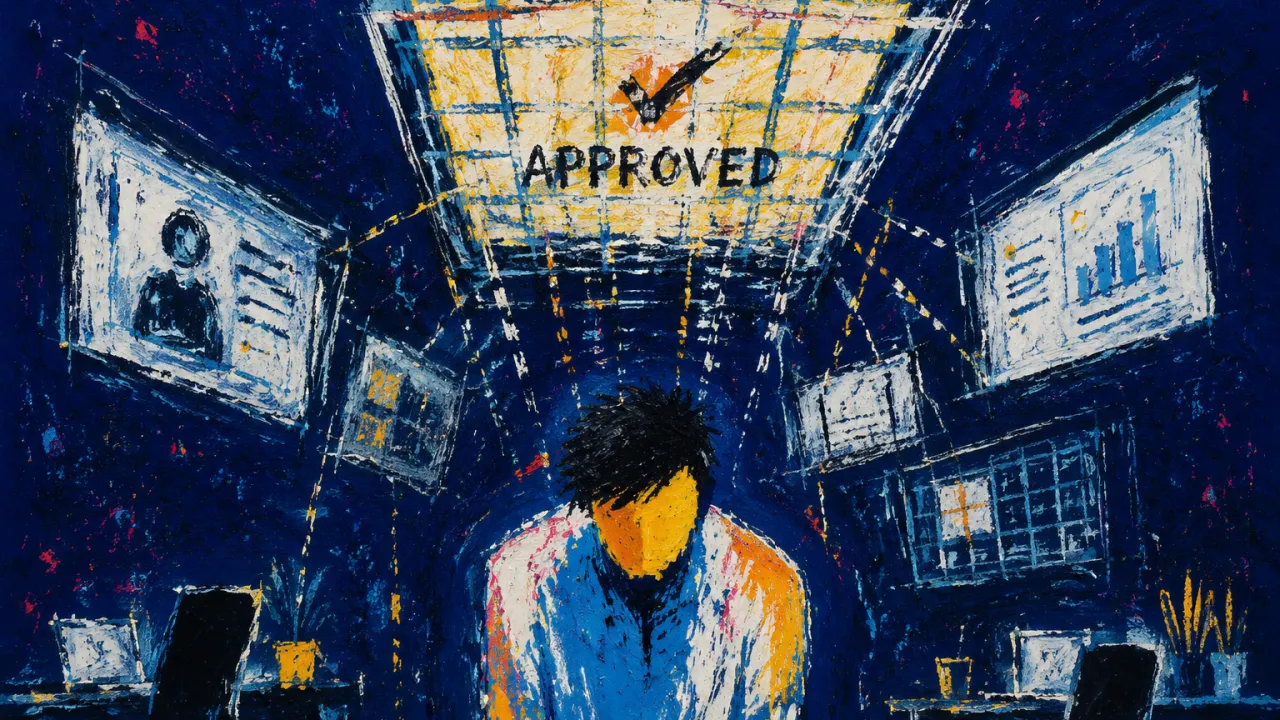
A figure with lowered shoulders inside an office frame as approval grids settle inward, narrowing the visible paths ahead.

What is this situation?

Workplace Autonomy Trial: you are told in a team meeting that, for the next few weeks, you can choose how to organise your hours, priorities, or methods, and the announcement sounds like room to work without constant permission. Once the trial begins, though, each choice still has to pass through status updates, approval threads, shared dashboards, and a manager who can reverse it without changing the deadline. You are asked to take ownership, but staffing, scope, access, and final sign-off remain elsewhere; when your judgement matches management's, your independence is welcomed, and when it does not, the limits suddenly tighten. Check-ins multiply, calendar blocks are questioned, and work you planned independently is redirected after you have already started it. Your shoulders settle lower over the laptop as you document why you made each decision, respond to messages asking where things stand, and spend more time demonstrating reliability than using the discretion you were promised. By the end of the day, the main demand is not simply the workload but the need to guess which choices will be called initiative and which will be treated as overstepping. The arrangement leaves freedom visible but conditional, much like the figure on the Eight of Swords, standing amid upright blades with open ground visible beyond the narrow enclosure.

Why it's not you?

This is not a failure to use freedom well; the arrangement offers discretion while keeping approval, measurement, and withdrawal power with management. When independence can be reversed whenever your judgement differs from theirs, the limits belong to the trial's design, not to your competence.

Workplace Autonomy Trial in Tarot Cards

In a Workplace Autonomy Trial, the promised room to decide keeps narrowing through status checks, approval gates, and decisions that can be reversed. Your shoulders settle lower over the laptop while each supposedly self-directed choice is documented and reviewed. This is an environmental and structural dynamic: discretion is offered, while final authority remains elsewhere. The Tarot Cards below reflect the contours of that arrangement.

The Magician
Reversed
A raised wand, an infinity sign, and the four working tools displayed on the table present a complete circuit between intention, resources, and execution. Reversed, that circuit is interrupted: capability remains visible, but the staffing, access, scope, and sign-off needed to convert judgement into authorised action are controlled elsewhere. You are asked to demonstrate initiative while spending increasing amounts of time proving that each initiative is legitimate. The resulting gap between visible competence and usable agency reflects the trial's resource design, not an inability to work independently.
The Emperor
Reversed
A stone throne, ram-headed armrests, and armour beneath the ruler's robes make authority look fixed, defended, and difficult to redistribute. Reversed, that hard architecture mirrors a manager who announces delegation but continues to reclaim control whenever your judgement departs from their preferred answer. You receive responsibility for execution without a corresponding transfer of governance. The trial therefore tests compliance more than autonomous judgement: when your decisions align upward, they are called initiative, and when they do not, the throne's retained veto becomes visible.
The Hierophant
Upright
A raised hand, crossed keys, and two acolytes positioned below an institutional authority create a clear chain of sanctioned knowledge and permission. The path is stable and passable, but only through established channels, closely matching a workplace where independent methods remain legitimate only after status updates, approval threads, and managerial sign-off. You are invited to exercise judgement inside the institution's existing orthodoxy, not to redefine how authority is used. When your approach matches the approved template it is welcomed as ownership; when it departs from that template, the hierarchy becomes visible and the room to act contracts.
The Chariot
Reversed
An armoured driver stands over a vehicle while contrasting sphinxes sit ahead and no physical reins are visible in his hands. Reversed, the destination and performance role remain attached to the driver, but the mechanism for directing movement is unreliable or absent, closely matching ownership without final steering authority. You remain responsible for delivering the project even when management can redirect priorities or reverse methods after work begins. The blocked steering function identifies the career problem precisely: accountability sits in your role while control over trajectory is exercised from outside it.
Justice
Reversed
A sword and a set of scales sit between two formal pillars, presenting decision power and evaluation as parts of the same institutional structure. Reversed, that structure exposes an accountability mismatch: management keeps the sword of final authority while the consequences measured by the scales are assigned to you. You may be praised for initiative when your judgement matches an unstated preference and corrected for overstepping when it does not. Because the standard changes with the evaluator's comfort, documentation becomes defensive evidence rather than a neutral record of autonomous work.
The Devil
Upright
Loose chains circle the figures' necks while both remain attached to the pedestal of a larger controlling figure. Their hands are free and the loops are visibly wider than their bodies, creating the same contradiction as a workplace arrangement that displays freedom while keeping the power to define and withdraw it elsewhere. You can organise the work until your judgement conflicts with management's preference, at which point the tether becomes operational through extra check-ins, questioned calendar blocks, and redirected tasks. The image names the binding mechanism clearly: the problem is not whether you are capable of movement, but whether the organisation recognises movement that it did not pre-authorise.
Two of Pentacles
Reversed
Two pentacles circle through an infinity-shaped loop while ships rise and fall on steep waves behind the juggler. Turned downward, that coordination loop resembles a workday repeatedly destabilised by shifting priorities, new check-ins, and managerial reversals that arrive after you have already allocated your time. You are still expected to keep deadlines, meetings, focus blocks, and status reporting in motion, but the authority to stabilise those demands remains elsewhere. What may look like personal disorganisation is more accurately a scheduling system absorbing repeated external overrides without receiving additional time or capacity.
Three of Pentacles
Reversed
A craftsperson stands on a bench while two other figures hold plans beneath a structured stone arch. Reversed, the shared worksite and blueprint become an approval bottleneck: roles appear coordinated, yet the people discussing the plan can redirect the person already doing the work. You begin execution under nominal agreement and then discover that ownership does not include protection from late-stage managerial changes. The collaboration structure therefore consumes effort through review loops and rework, revealing that the trial has not clarified who decides, who advises, and who signs off.
Four of Pentacles
Upright
Four coins pin a crowned figure at the head, chest, and feet while the city sits at a distance behind him. The concentrated grip mirrors management retaining final sign-off, access, scope, and resource control even while inviting someone else to organise the day-to-day work. You can move within the operational space that has been released, but the assets that determine whether a decision survives remain tightly held. The arrangement is therefore decentralised in labour and centralised in power, making autonomy visible at the level of tasks while withholding it at the level of governance.
Six of Pentacles
Reversed
Scales remain in one standing figure's hand while coins are distributed selectively to people below him. Reversed, the image exposes the power embedded in conditional access: management can grant enough scope, staffing, information, or permission to create the appearance of ownership while retaining control over every resource that makes ownership workable. You are expected to deliver as though the allocation were yours, yet access can be narrowed whenever your judgement differs from the person holding the scales. The imbalance is structural because responsibility moves downward while the authority to distribute support and approve outcomes stays above.
Seven of Pentacles
Upright
Seven pentacles hang on a cultivated plant while a worker pauses on his tool to inspect what sustained effort has produced. The scene mirrors a time-bounded workplace pilot in which labour is already being invested while the actual return, durable decision authority, remains under evaluation. You are living through a period that may generate evidence about whether management will convert the announcement into stable operating rights or keep autonomy at the level of temporary permission. The upright pause makes the trial observable rather than endless: what matters in this timing window is the pattern of approvals, reversals, and resource access produced over repeated work cycles.
Two of Swords
Upright
Two crossed swords hold a blindfolded figure in place while a rocky shoreline interrupts the water behind her. The balanced blades resemble two authorised-looking work options, but the covered eyes and obstructed shore show that the criteria governing those options are unavailable at the moment of choice. You may be asked to choose a method or priority while management retains the information and authority that determine whether the choice will stand. The resulting pause is not a lack of judgement; it is a rational response to a decision structure where the evaluation rules can change after action begins.
Eight of Swords
Upright
Eight upright blades surround a bound and blindfolded figure, while open terrain remains visible just beyond the narrow enclosure. The image closely reproduces a role that displays independence on paper but withholds the access, sign-off, and decision rights needed to use that independence without managerial permission. You are held accountable as an owner while operating as an implementer whose judgement can be reversed without moving the deadline. The loose bindings do not make the restriction imaginary; they show how formal freedom can coexist with practical exposure, especially when every attempt to move is judged through rules controlled elsewhere.
Seven of Wands
Upright
A figure on raised ground braces one wand against six others rising toward his position. The physical scene mirrors the repeated defence of calendar blocks, methods, priorities, and already-started work when every independent decision attracts another challenge or request for justification. You may retain a professional position and a defensible rationale, but the autonomy trial turns ordinary judgement into a continuous credibility contest. Time that could be used to execute the work is redirected into status updates, receipts, and explanations proving that you have not crossed an invisible boundary.
Ten of Wands
Upright
Ten heavy staffs fill the carrier's arms and obstruct his view even as he continues toward the town ahead. The image mirrors a role loaded with delivery deadlines, status reporting, justification work, and the consequences of choices that management can still reverse. You are carrying the operational burden of ownership without receiving the authority that would let you simplify, prioritise, or protect the route. The workload becomes heavier not merely because there is more to do, but because responsibility has been transferred downward while decision power remains above.

Workplace Autonomy Trial in Tarot Card Reading Insights

When a Workplace Autonomy Trial offers choice while management retains the final say, others have brought the same contradiction into their readings. The articles below gather Tarot Reading Insights from those sessions.

Psychological Contexts Related to Workplace Autonomy Trial