The Same Tab Glowed at 4:37—Then One Rough Sentence Moved the Day
The 4:37 P.M. One-Tab Freeze
You know the one-tab freeze: the cursor is ready, the task is manageable, and yet you check Slack, fix the document title, and wait for a level of clarity the task was never designed to provide.
When Jordan joined my video consultation at 4:37 on a gray Toronto afternoon, late traffic hissed over wet pavement below her apartment window. The same browser tab had been glowing since morning. She shared her screen, changed a heading from bold to regular, glanced at the clock, and pulled her shoulders toward her ears as a streetcar bell sounded through the glass.
“It is only one small task,” she said, rubbing the heel of one hand against the other, “so why does starting it feel like choosing my whole direction?”
Jordan worked remotely as a junior content coordinator. The assignment was a modest follow-up that might take fifteen minutes. Yet closing the tab felt like surrender, while beginning felt like placing her ability to direct her own life on trial. The task was small; the verdict she had attached to it was not.
I heard her frustration in the clipped rhythm of her sentences, then saw it settle physically: heavy hands above the keyboard, a tight jaw, breaths that barely reached her chest. It reminded me of entering a room where burnt coffee has lingered for hours. Nothing dramatic is happening, but the atmosphere has coated everything.
“I keep the tab open so I can say I am still working,” she admitted. “Then I look up and the whole afternoon feels contaminated.”
“I am not going to tell you that a card can force motivation or predict whether tomorrow will be productive,” I said. “I want us to look at the mechanics of the stuck moment. We can give the pattern a shape, separate the task from the verdict, and find one foothold that still belongs entirely to you. Let us draw a map through this fog.”

Choosing a Map for the Stalled Afternoon
I asked Jordan to place both feet on the floor, leave the work tab visible, and take one unforced breath before focusing on a single question: “What happens between seeing the task and making the first real move?” I shuffled slowly, using the motion as a transition from reacting to observing rather than as a mystical performance.
I chose the Transformation Path Grid (6) · Context Edition. For anyone wondering how tarot works in a consultation like this, I use the cards as an external cognitive map. Their symbols make an invisible loop easier to inspect, but they do not remove choice or issue commands.
This six-position tarot spread suited Jordan's task-initiation paralysis because a Past-Present-Future spread would flatten a repeating cycle into a timeline, while a Celtic Cross would introduce more context than this compact work pattern needed. The grid could trace the visible delay, the mental restriction maintaining it, the deeper search for direction, the catalyst, the practical response, and the clarity available through integration.
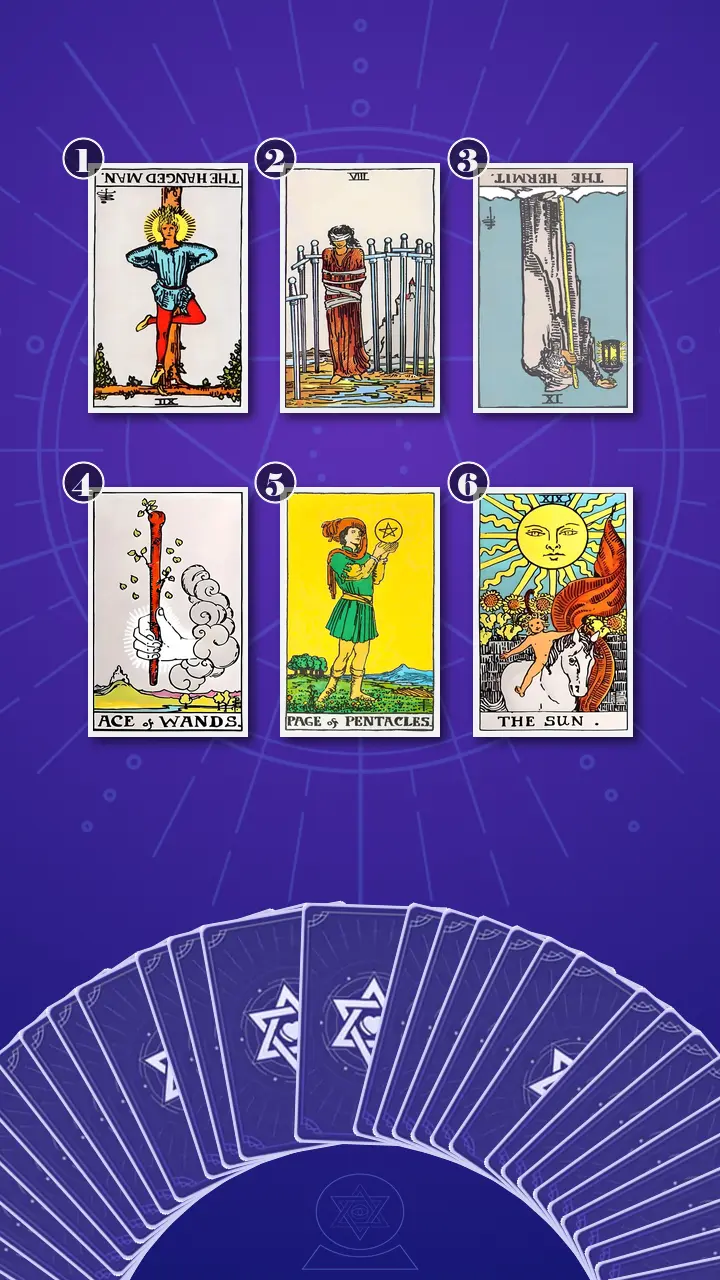
I laid three cards across the top as the diagnosis row and three beneath them as the response row. The first position would show the observable one-tab loop. The second would reveal why action seemed unavailable. The third would explore why one small task had been assigned the impossible job of making the whole day meaningful. Beneath those, the fourth would identify the catalyst, the fifth would ground it in a bounded action, and the sixth would show what became visible when the task returned to its actual size.
Reading the Loop Before Trying to Fix It
Position 1: The Tab That Never Loads New Information
I turned over the card representing the observable loop in Jordan's consultation question: leaving one small task pending until the entire workday felt stuck. It was The Hanged Man, reversed.
I pointed to the inverted figure, the bound hands, and the halo around the suspended head. Upright, this card can describe a purposeful pause that allows a new perspective. Reversed here, I read its suspension as Blockage: reflection had stopped generating information and hardened into delay.
“This is the tab staying open from morning into late afternoon,” I said. “You reread the prompt, adjust formatting, check the clock, and wait for a reason that will make beginning feel legitimate. The pause looks thoughtful, but it is no longer changing your view. Keeping the tab open is not the same as entering the task.”
I compared it to the split work-self feeling in Severance: remaining visibly inside work mode without being meaningfully engaged in the work. Jordan's body was at the kitchen table, and her attention was technically attached to the assignment, but neither condition produced an actual first move.
Jordan gave a brief, bitter laugh. “That is too accurate. Almost rude, honestly.”
I let the humor take some pressure out of the room. “Then we will keep the accuracy and remove the accusation. This card is describing a strategy, not a character flaw. Waiting may have been your way of avoiding an ungrounded choice. We only need to notice when that protection stops helping.”
I asked what she could release for two minutes. Jordan looked at the open document and said, “The idea that the first sentence has to justify why I spent the whole day on it.”
Position 2: When Every Option Feels Non-Neutral
I turned over the card representing the procrastination mechanism that transformed a small delay into paralysis, especially the belief that action had to wait for more clarity. It was the Eight of Swords, upright.
I traced the gray blindfold, the crossed bindings, and the narrow enclosure formed by eight blades. I read this as an Excess of Air contracting into Blockage: Jordan's mind was producing consequences faster than her hands could test them.
In Jordan's workday, several first moves genuinely existed. She could draft a subject line, write one rough sentence, ask a colleague a narrow question, or close the task and schedule another block. Yet her mind upgraded each option into a total commitment. A rough draft might expose incompetence. A Slack question might expose dependence. Closing the tab might expose failure.
“There are options, but none of them feel neutral,” I said. “The actual task has not trapped you. The untested meanings around each move have narrowed what feels usable.”
Jordan's fingers stopped against her mug. Her breath paused, her gaze drifted away from the screen as if she were replaying several abandoned afternoons, and then her wrists loosened against the table. “I think I keep waiting for a move that cannot be misinterpreted,” she said quietly.
“That is the blindfold,” I replied. “Not a lack of intelligence, and not proof that no path exists. It is the absence of tested information. Which constraint can you observe in the brief, and which consequence exists only in the story around starting it?”
Position 3: The Lantern Held Too Close
I turned over the card representing the existential drift beneath the procrastination: the disconnection from usable direction and the fear that one work block had to carry meaning for the entire day. It was The Hermit, reversed.
I showed Jordan the lantern held close to the solitary figure and the gray mountain disappearing behind him. Reversed, the Hermit's inward search had become Blockage, accompanied by a Deficiency of ordinary feedback. Private reflection illuminated the uncertainty but failed to light the next metre of ground.
“When the brief feels pointless, you close messaging, search for the perfect productivity explanation, and try to discover the task's deeper meaning alone,” I said. “You are asking one work block to explain the whole day.”
Jordan nodded once, then pressed her lips together. “If I ask someone what they want, I worry I will look like I cannot do my job. If I do it without understanding the point, I feel like I am wasting my life. So I watch a focus video and somehow do neither.”
“That is a lot of existential weight for a content follow-up,” I said, gently enough that she smiled. “A usable lantern might be one plain sentence: ‘This block is useful if...’ It does not need to reveal your life's direction. It only needs to identify what this small block can make easier.”
As Jordan considered the prompt, the light behind her dimmed and her face became clearer in the laptop screen. She finally said, “This block is useful if it gives the senior coordinator something concrete to respond to.”
I wrote the sentence down. It was modest, but it had moved purpose out of the mountains and back onto the desk.
When the Ace of Wands Moved the Cursor
Position 4: The Smallest Catalytic Shift
I reached the lower row and turned over the card representing the smallest shift capable of interrupting the loop. It was the reading's key card and catalyst: the Ace of Wands, upright.
A streetcar bell came faintly through Jordan's microphone and then the room seemed to hold still. I pointed to the hand emerging from a cloud, the fresh leaves on the wand, and the distant path. I read the upright Fire as a catalyst in Balance: not a command to become intensely motivated, but an available spark that would become real only through Jordan's response.
I brought us back to the next morning Jordan had described: at 9:06, yesterday's tab restored itself, the laptop fan started, and she opened a productivity video because she wanted evidence that this morning would be different before she risked making it different.
This was where I used what I call Spatial Boundary Scenting. In perfumery, an aroma does not respect the edge of its bottle once released. It moves through air, settles into fabric, and changes the character of a room. I saw the same systemic imbalance in Jordan's work-life bleed: the unfinished task no longer occupied one browser tab. Its atmosphere had spread into lunch, the sofa, the grocery queue, and the next morning.
“The task has become an ambient condition,” I said. “The Ace is not asking you to overpower it. It is offering one contained release of energy: type a deliberately rough sentence before evaluating what it means. The action creates evidence that your mind does not currently have.”
I said the core of the insight plainly.
You do not need a clear direction to earn a beginning. Sometimes the smallest imperfect action is how direction becomes visible.
Then I placed my fingertip beside the sprouting wand and gave Jordan the sentence at the heart of the reading:
Do not wait for a complete sense of direction before moving; let one small, imperfect start become the Ace of Wands that turns drift into usable information.
I allowed the silence to remain.
Jordan's breath stopped first. Her fingers stayed suspended above the keyboard, and her eyes widened before losing focus, as though the previous week's stalled mornings were replaying behind them. A quick line appeared between her brows. “But doesn't that mean I was wrong this whole time?” she asked, her voice suddenly sharper. “That I wasted all those afternoons waiting for something I could have made?”
I watched anger arrive before relief, and I did not rush to soften it. “It means the strategy made sense as protection and became too expensive as a routine,” I said. “You were trying not to act without enough direction. The cards are showing you another way to obtain direction, not putting your past self on trial.”
Her jaw remained set for a moment. Then her eyes reddened, her shoulders lowered in two uneven stages, and her clenched right hand opened against the table. She released a breath that trembled at the end. Relief crossed her face, followed by a brief, almost dizzy blankness. Clarity had returned a choice to her, and the responsibility for that choice felt both lighter and more exposed.
“Now, with this new perspective, think back: was there a moment last week when this insight could have made the experience feel different?” I asked.
Jordan looked at the blinking cursor. “Tuesday morning. I could have typed anything and learned that the brief was missing a detail. Instead I spent two hours trying to understand why I did not want to type.”
I invited her to write the smallest visible action as a verb-object pair. She chose draft opening. I asked her to set a two-minute timer, do only that action, and reserve the right to stop when the timer ended. She pressed Start and typed a deliberately disposable line while repeating, “This does not have to prove where I am going; it only has to show me what comes next.”
The change was almost anticlimactic, which was precisely why it mattered. Her hands warmed enough that she stopped rubbing them together. Her shoulders dropped slightly. The cursor moved instead of blinking. When the timer sounded, she stopped, read the sentence, and noticed that the next missing piece was now obvious.
“Clarity is sometimes the receipt from action, not the entry fee,” I told her.
I named the scale of the shift carefully. This was not a cure, a productivity promise, or a complete answer about Jordan's direction. It was the first step from stagnant, shame-tinged task initiation anxiety and existential drift to grounded attention, clearer self-trust, and practical agency. She had produced evidence through her own action, and the evidence belonged to her.
The Spark Learns to Stand on Solid Ground
Position 5: One Tangible Definition of Done
I turned over the card representing the bounded, practical action that could build self-trust without requiring Jordan to decide the meaning of the entire day. It was the Page of Pentacles, upright.
I drew her attention to the Page's steady gaze, the pentacle held at eye level, and the cultivated green field below. I read this as Earth in Balance: attention placed on one observable object, with enough patience to learn from an imperfect result.
“The Page does not ask whether the task confirms your identity,” I explained. “The Page asks what can physically exist after ten minutes: one rough paragraph, one sent follow-up, or three clearly labelled bullet points. A rough sentence can be information without becoming an identity statement.”
I framed the work block as a small workflow experiment. Jordan could choose one countable deliverable, keep her attention on it, and record what doing revealed. The result did not need to confirm her direction. It only needed to make the next practical decision more visible.
“What could exist at the end of ten minutes today?” I asked.
“A rough paragraph and one bracket where I need an answer,” Jordan said. She straightened the laptop without adjusting anything on the screen. The movement was small, but it was the first time I had seen her touch the workspace without disguising avoidance as improvement.
Position 6: The Rest of the Desktop Reappears
I turned over the final card, representing the clarity and agency available when one small task became one part of the day rather than proof of Jordan's overall direction or worth. It was The Sun, upright.
I pointed to the radiant sun, the open child on the white horse, and the sunflowers behind the wall. I read the card as visibility in Balance. I did not treat it as a prediction that every workday would become bright or easy. Its gift was proportion: after one bounded block, the unfinished pieces could remain separate instead of merging into one global judgment.
“You can write down what action made clearer and what still needs its own question,” I said. “Then the wider afternoon becomes visible again. You might send the draft, take lunch, ask for clarification, or schedule another block. One unfinished task is an item on the day, not a summary of it.”
At that moment, a narrow band of late sunlight appeared across Jordan's kitchen wall, brightening the edge of her laptop without erasing the gray weather beyond the window. The image echoed the card perfectly: visibility had increased, but reality had not been edited into permanent sunshine.
I thought briefly of my perfume bench. For fifteen years, I had learned that clarity in a formula rarely arrived through staring at the closed bottles. I had to place one measured drop on a blotter, wait, smell what was actually present, and let the result guide the next adjustment. A test was not a verdict on the whole fragrance. It was information.
“That is what this spread is offering,” I said. “Not certainty before participation. One measured contact with the real task, followed by a choice.”
The One-Tab Foothold
I drew the two rows together. The Hanged Man reversed showed preparation-shaped avoidance: a pause that looked reflective but no longer produced perspective. The Eight of Swords revealed how every first move had acquired an imagined identity consequence. The Hermit reversed exposed the deeper pressure beneath the loop: Jordan was privately asking one routine work block to prove that her time and life had direction.
The response row changed the elements of the story. The Ace of Wands introduced a small Fire-based start. The Page of Pentacles grounded that start in one tangible result. The Sun returned the task to proportion, allowing the rest of the day to appear as separate choices. Jordan did not need to solve existential drift in thought before moving. She could let a bounded action provide the mind with new evidence.
I identified the cognitive blind spot directly: Jordan had been treating the feeling of uncertainty as evidence that a crucial piece of information was missing. Often, the missing information could only be generated after contact with the task. Her transformation direction was therefore not “become more disciplined.” It was a shift from waiting for perfect meaning to defining one observable action and allowing completion to create usable clarity.
When I proposed a timed start, Jordan raised a practical obstacle. “I already have three Pomodoro apps,” she said. “I can spend five minutes choosing the timer sound and still not press Start.”
“Then the intervention cannot depend on another productivity system,” I replied. “We will use the timer already on your phone, and we will give the work block a physical edge. The aim is not to force output. It is to prevent one task's atmosphere from diffusing through the entire day.”
- The Two-Minute Evidence Start Within the next 72 hours, write one verb-object action beside the open task, such as “draft opening,” “label question,” or “send clarification.” Use the timer already on your phone, work only on that action for two minutes, and decide afterward whether continuing feels genuinely available. Start with sixty seconds if two minutes feels loaded. No new app, playlist, productivity video, or redesigned workspace is required. Stopping when the timer sounds is a valid completion of the experiment.
- The Physical Boundary Protocol Before the same 72-hour window closes, choose one sensory trigger to partition output mode from recovery mode. Jordan chose the click and warm light of a small kitchen-table lamp. She would switch it on only after naming a bounded deliverable, then switch it off, close the laptop, and move the device away from the table when the block ended. Keep the cue simple and consistent. Its job is not to manufacture motivation; it marks where the work atmosphere begins and ends so lunch, rest, and the rest of the apartment do not have to carry it.
- The Bounded Beginner Block Choose one ten-minute deliverable for the next workday: a rough paragraph, three bullet points, or one sent follow-up. At the end, write two lines: “Action made this clearer...” and “This still needs its own question...” If ambiguity blocks the first step for five minutes, send one narrow message such as “Should this draft prioritize X or Y?” Keep the result physical and countable. “Make progress” is too vague; “write three rough bullets” can be observed. Do not turn the reflection into a performance review of the entire day.
I asked Jordan which action felt smallest without feeling fake. She chose the two-minute evidence start and the lamp boundary. I reminded her that these were experiments, not obligations. She could adapt them, stop them, or discard them based on what her own experience revealed.
Three Days Later: The Quiet Proof
Three days later, I received a short message from Jordan. At 9:12 that morning, she had written draft opening on a sticky note, switched on the lamp, and set the timer for two minutes. Her first sentence was, in her words, “genuinely bad and immediately useful.” It showed her that the brief needed one example, so she inserted a bracketed question instead of reopening Google.
She stopped when the timer sounded. Ten minutes later, by her own choice, she returned for a bounded block and completed a rough paragraph. At the end, she wrote that action had clarified the missing example, while the campaign priority still needed a separate question. She sent that question to her coordinator and closed the laptop for lunch.
That night she slept through, but her first thought the next morning was, “What if yesterday was a fluke?” She told me she smiled at the thought, wrote label question on a sticky note, and switched on the lamp anyway.
I did not see a life perfectly organized. I saw the first credible evidence of a different relationship with beginning. Jordan still felt uncertainty, but it no longer had sole authority over her hands. Her task had become a source of information instead of a verdict on her worth, and her remaining day had regained separate edges.
That was the real Journey to Clarity. The tarot spread had made the pattern visible, my questions had helped translate the symbols into Jordan's workday, and the boundary protocol had given her an experiment. But the cards did not move the cursor. Jordan did. She remained the author of every next step.
If one small tab has been glowing for hours and your shoulders grow heavier each time you look at it, it can feel as though you are failing to direct your whole life. Yet noticing that you are caught between wanting movement and demanding that movement feel completely justified already thins the atmosphere around the task.
If your next tiny action did not have to prove anything about who you are or where the day is going, which verb-object pair would you place beside the Ace's sprouting wand, and what sensory cue could protect two quiet minutes for beginning?