An Automatic RTO Yes Was Interrupted by Evidence and One Question

When RTO Pressure Outlives the Job Fit
It was Sunday night in Toronto, and the calendar was already colour-blocked with office days and transit buffers. At 8:47 p.m., I watched Jordan (name changed for privacy), a 29-year-old non-binary operations specialist, open an updated return-to-office reminder, check the TTC route planner, and move a personal appointment before asking whether the new day was workable. Their phone had gone warm in their palm. The radiator clicked through the quiet of our video call. Then they typed, “I can make it work.”
Only afterward did Jordan notice that their chest had tightened and their shoulders had crept toward their ears. “I keep calling it temporary,” they told me, “but I’ve been adapting to it for months. I want a job that fits, but the second RTO pressure shows up, I rearrange my life and act like everything’s fine.” Resignation sat on them like a wet wool coat: heavy, familiar, and uncomfortable enough to drain them, but not dramatic enough to justify taking it off.
I told Jordan I was not there to decide whether they should stay, leave, or challenge the policy. “We’re going to separate the actual workplace conditions from the conclusions fear is making for you,” I said. “Let’s give this fog a map. By the end, I want you to see where choice still exists, what evidence you need, and which next step would genuinely belong to you.”

Choosing a Grid That Could Show the Loop
I asked Jordan to put both feet on the floor, take one ordinary breath, and hold the question without trying to solve it: “Why do I keep accepting RTO pressure when this job no longer fits?” I shuffled slowly, using the movement as a transition from reacting to observing. There was nothing mystical I needed Jordan to perform. The point was attention.
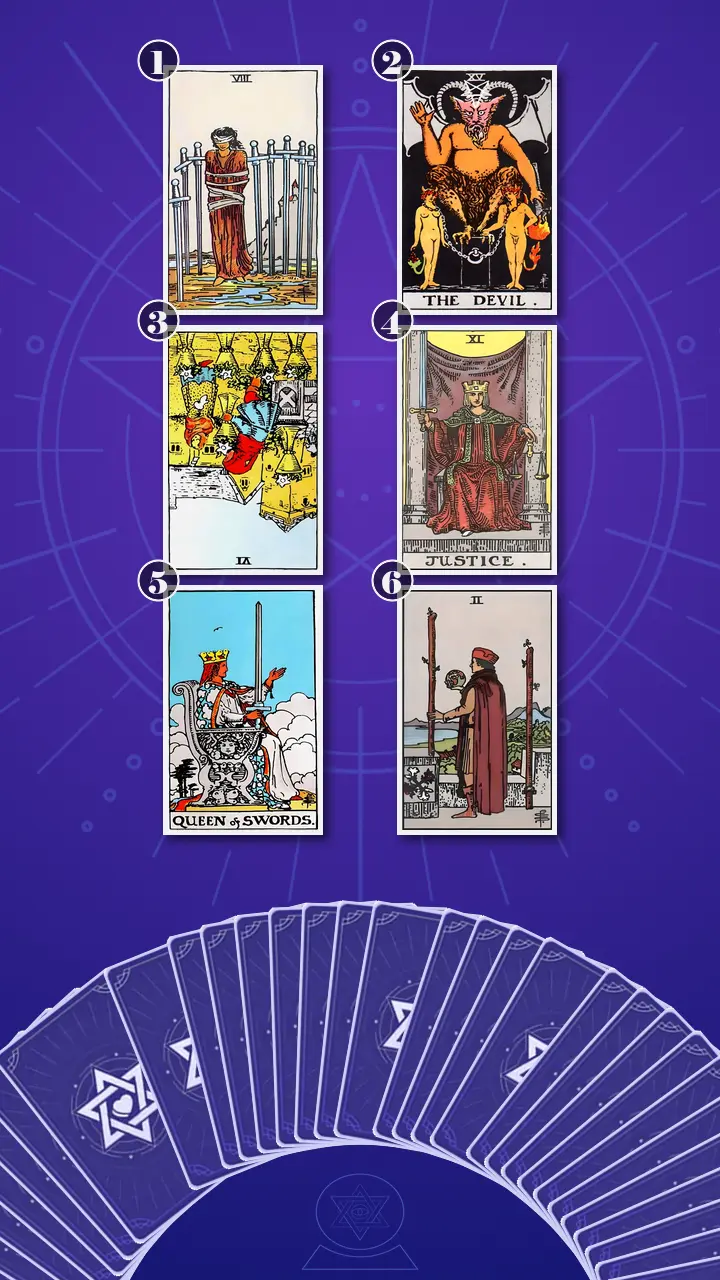
I chose the Transformation Path Grid (6) · Context Edition, a six-card tarot spread for return-to-office pressure and job-fit assessment. I use this spread when the apparent problem is a decision, but the deeper problem is a repeating system. A larger outcome-focused spread could have scattered our attention across speculative futures. Jordan needed something tighter: a diagnostic flowchart showing the trigger, the belief, the repeated response, the interruption, the action, and the wider path.
I placed the cards in a two-by-three grid. The first position would show the visible pattern of agreeing and reorganizing the week. The second would reveal the belief that made compliance feel necessary. The third would trace the familiar response underneath it. Justice, in the fourth position, would act as the hinge between automatic agreement and fair assessment. The last two positions would turn that clarity into communication and deliberate planning.
This is how tarot works best in my practice. It does not issue a verdict or make a career decision on someone’s behalf. It makes patterns visible enough to question. Card meanings in context can bring intuition, behaviour, and concrete evidence into the same frame, but the person across from me remains the author of what happens next.
Reading the Trap Before It Reads the Week
Position 1: The Transit App as a Blindfold
Now I turned over the card representing the visible current pattern: accepting an RTO reminder, rearranging personal plans, and suppressing the statement that the job no longer fits. It was the Eight of Swords, upright.
I showed Jordan the blindfolded figure, the bound hands, and the ring of surrounding swords. “This is perceived restriction,” I explained. “The workplace may have real constraints, but your mind reaches a no-choice conclusion before those constraints have been examined.”
In Jordan’s life, the card was almost literal. An RTO message appeared in Slack; Jordan opened the TTC route planner, moved an appointment, and drafted an agreeable response. The office requirement became a ring of closed options even though no one had yet heard what Jordan needed or been asked which conditions were genuinely fixed. The transit app became a blindfold, calculating the route before Jordan had considered whether the destination still justified the trip.
The energy here was a blockage of perspective. Jordan had plenty of analytical ability, but it was being used to rehearse manager reactions instead of test them. Each sword resembled another line in an imaginary Slack thread: “They’ll think I’m difficult.” “I’ll look unreliable.” “Everyone else can cope.” The predictions were sharp, but they were not confirmed facts. Meanwhile, the loose bindings suggested that at least one form of movement remained available: pause, clarify, ask, record, or compare.
“When the next reminder arrives,” I asked, “what do you do in the first five minutes?”
Jordan gave one short laugh, but there was no humour in it. “That’s too accurate. Honestly, it feels a little brutal.” Their fingers stopped on the edge of the phone, their gaze drifted toward the calendar behind our call window, and then their jaw loosened. “I don’t decide. I start proving I can handle it.”
That distinction mattered. Jordan was not failing to find a choice after careful consideration. They were beginning the process after choice had already been mentally removed.
Position 2: The Hidden Belonging Fee
Now I turned over the card representing the immediate blockage: the belief that compliance was required to appear reliable or preserve workplace belonging. It was The Devil, upright.
I am careful with this card. I do not use it to label a workplace evil or portray every manager as malicious. Here, I focused on the loose chains around the two figures. The image showed an attachment maintained not only by external pressure, but by an emotionally persuasive bargain.
Jordan received an attendance requirement, but internally it arrived as a membership fee for being considered committed. They silently renewed the agreement by moving their week, absorbing the commute, and withholding the mismatch. The message itself might say, “Be in the office.” The inner contract added, “Give up whatever flexibility is necessary, and do it pleasantly, or you may lose your place.”
I described it as a recurring workplace subscription with a hidden belonging fee. Every automatic yes renewed the plan before Jordan checked the cost. The accumulated charge appeared later as ninety-minute transit buffers, cancelled dinners, late meals, heavy shoulders, and weaker trust in their own judgment.
The energy was an excess of attachment and a blockage of agency. The need to belong was not the problem. The problem was allowing that need to set an unlimited price. I put the inner monologue into words: “If I make this easy, they’ll know I’m committed. If I ask for a different condition, they may decide I’m difficult.”
Jordan’s hand tightened around their mug. Their shoulders lifted, held for a beat, then dropped with a long breath. “That is exactly the bargain,” they said. “I keep paying it because no one sends me an invoice.”
“The price of belonging is not automatically your personal flexibility,” I replied. “What bargain do you believe you must keep, and what does it cost each time you silently renew it?”
Position 3: The Reply Written by an Earlier Version of You
Now I turned over the card representing the underlying repetition: returning to the same agreeable response whenever RTO pressure appeared. It was the Six of Cups, reversed.
The traditional imagery holds familiarity, memory, and an established exchange. Reversed in this position, the card showed familiarity answering a present-day question too quickly. I drew Jordan’s attention to the flower-filled cup being offered and the walled village behind it. The concession was known. The exchange felt sheltered. But what had once helped Jordan feel dependable no longer necessarily supported the life they were trying to build.
Each calendar change triggered the same sequence: call it temporary, move a plan, agree quickly, and postpone the job-fit conversation. It was like an old email template sending itself before Jordan had read the new request. The current version of Jordan, with current responsibilities and current needs, rarely got to edit the reply.
The energy showed familiarity in excess and present-day assessment in deficiency. The reversal did not advise Jordan to reject every office request or send an angry message to prove they had changed. That would let the old pattern control the opposite response. The invitation was smaller and more accurate: write down what the present request actually is before an earlier version of the self answers it.
“After the last RTO update,” I asked, “which familiar sentence spoke first: ‘It’s temporary,’ ‘I should be adaptable,’ or ‘I can make it work’?”
Jordan looked down. Their thumb pressed once against the mug handle, then released. “All three,” they said. “And I’ve been treating repetition as evidence. Like if I’ve managed it this many times, it must still be the right arrangement.”
“A familiar yes can still be a costly answer,” I said. “Surviving a pattern proves capacity. It does not automatically prove fit.”
When Justice Put the Workweek on the Scales
Position 4: The Pause That Separates a Fact from a Verdict
Now I reached the card representing transformative clarity: the pause that separates the actual RTO mandate from the belief that accepting it proves worth or belonging. The radiator in Jordan’s apartment clicked once and went quiet. The small domestic sound disappeared, and the room seemed to make space for the card.
I turned over Justice, upright.
I showed Jordan the balanced scales, the upright sword, and the direct gaze between the pillars. Justice brought balance to a spread that had begun with constricted thought and fear-based attachment. It did not declare compliance good or resistance good. It asked for a transparent assessment of requirements, effects, assumptions, values, and consequences.
In modern terms, I saw a one-page Toronto workweek inventory. On one side of the scales sat the stated RTO requirement and any work that genuinely benefited from office presence. On the other sat commute time, moved appointments, lost flexibility, after-hours checking, usable energy, and Jordan’s criteria for a sustainable role. The upright sword separated what had been confirmed from what Jordan feared a question would prove.
I asked Jordan to return mentally to 8:47 p.m.: the warm phone, the open TTC route, the relocated appointment, and “I can make it work” already waiting in the message box. Jordan was still caught in a binary: agree and remain safe, or question the arrangement and become a problem. One workplace conversation had expanded into a referendum on career, belonging, and all the time already invested.
You are not required to repeat compliance to prove you belong; use Justice's scales and upright sword to separate the actual RTO mandate from the limiting belief that your worth depends on accepting it, then make one transparent, self-authored request.
I let the sentence stand without explaining it away.
Jordan’s inhale stopped halfway. Their fingers remained suspended above the phone, as though the old reply had frozen before being sent. Their pupils widened, then their gaze lost focus; I could see them replaying months of reminders, transit calculations, and quick assurances. Their mouth tightened. “But doesn’t that mean I’ve been wrong this whole time?” they asked, the words sharper than anything they had said so far. “Doesn’t it mean I kept doing this to myself?” I told them no. It meant the response had protected them from conflict until its cost became greater than its usefulness. Their eyes reddened at the edges. One hand opened slowly on the table, their shoulders sank, and a trembling breath left their chest. The relief came with a brief, blank look, like stepping off a moving walkway and needing a second to trust the floor. Clarity had returned responsibility to them, and that felt lighter and more exposed at the same time.
“Now, using this new perspective, think back: was there a moment last week when this insight could have made you feel different?” I asked.
Jordan nodded slowly. “Monday morning. The manager posted the reminder, and I answered before I checked my calendar. If I had seen the message as information instead of a test, I could have asked what was actually fixed.”
“Exactly,” I said. “Before, the message became a command. Now, it can become a question: what is required, what is the impact, and what conditions would make this workable? Reliability is not the same as making yourself easy to override. RTO pressure is information about the arrangement, not a verdict on your worth.”
Seeing Justice’s scales, I flashed back to my Wall Street years. I remembered models that looked attractive only because the inconvenient costs had been buried outside the main calculation. A clean number is not objective when the ledger excludes what someone is actually paying.
I brought in a framework I call Strategic Path Valuation. Instead of asking whether Jordan could technically endure the current arrangement, I asked how each macro-direction would scale: staying as-is, seeking workable conditions, or exploring a more flexible role. The return was not only salary or status. It included meaningful work, autonomy, energy after the commute, manager communication, future growth, and usable time outside work. Justice did not tell Jordan which path would win. It made sure all three paths were being valued with the same complete ledger.
“I thought saying yes was evidence,” Jordan said. “What if it was only my fastest way to avoid being judged?”
That question was the hinge of the reading. It marked the first movement from resigned RTO compliance and approval-driven self-doubt toward evidence-based self-advocacy and deliberate job-fit evaluation. Not a completed transformation. Not sudden certainty. A credible pause before the automatic yes.
I also gave Jordan an explicit permission: the Justice exercise could remain private. Ten minutes would be enough. If their chest tightened or the note felt too exposing, they could close it and return only when continuing felt like their choice. Insight was not another mandate.
The Open Sky After an Honest Sentence
Position 5: A Clear Question Is Not a Loyalty Test
Now I turned over the card representing actionable self-advocacy: a small behaviour that could replace automatic compliance by stating the impact of RTO and asking about workable conditions. It was the Queen of Swords, upright.
I highlighted the raised sword, the composed posture, and the open sky behind the figure. Her energy was balanced: clear without becoming cruel, independent without becoming disconnected, and direct without demanding a guaranteed response.
For Jordan, the card became a two-line draft: “The current RTO schedule is affecting my commute and the flexibility I need to do this role sustainably. I want to understand what workable conditions are available.” The point was not to win approval or stage a rebellion. It was to replace vague resentment with language specific enough for a real workplace conversation.
The Queen’s sword cut apologetic filler from the message. The open sky represented the room created when Jordan no longer wrote three paragraphs trying to prove they were reasonable before asking one factual question.
“A clear question is not a loyalty test,” I said. “You can name the impact without accusing anyone. You can ask what is negotiable without pretending you already know the answer. You can also draft the sentence and decide later whether to send it, raise it in a one-to-one, or keep refining the boundary privately.”
Jordan read the sentence aloud once. Their first attempt sped through the words. The second was slower. On the third, they stopped adding “Sorry” at the beginning. “That feels almost too short,” they said.
“Short can feel exposed when over-explaining has been your armour,” I replied. “But precision gives the other person something concrete to answer.”
Position 6: Three Routes, No Verdict
Now I turned over the card representing integrated agency: a deliberate way to evaluate the current role and possible alternatives without making the decision a verdict on personal worth. It was the Two of Wands, upright.
I pointed to the globe in the figure’s hand, the second wand fixed to the wall, and the distant landscape beyond the parapet. The card held the known world and the wider one at the same time. Its fire was a balanced form of agency: enough energy to investigate, not so much that Jordan had to make a dramatic leap before gathering information.
In Jordan’s workweek, this became three columns: stay as-is, ask about workable conditions, and explore other roles. Under each, Jordan could compare commute, flexibility, meaningful work, manager communication, growth, and usable time outside work. Then they could take one information-gathering step: review one week of calendar data, ask one workplace question, or save one flexible operations role without closing the tab.
The Two of Wands did not choose a future for Jordan. It restored perspective at a career crossroads where decision fatigue had been disguising one familiar route as the only route. Jordan could keep the current job in view while investigating a renegotiated version and a possible next role. No option had to prove their courage, loyalty, or worth.
I also noted that the spread contained no Pentacles. That absence did not predict material instability. It reminded me that Jordan’s next stage required grounding. The reading had moved through constricted thought, emotional familiarity, balanced discernment, and emerging fire. Now the insight needed calendar data, commute hours, role requirements, and actual working conditions.
Jordan leaned back for the first time in the session. “That feels less like blowing up my life,” they said, “and more like finally looking at it.”
From the Revolving Door to a Deliberate Route
When I read the grid as one story, the pattern became coherent. The Eight of Swords showed Jordan reorganizing life before checking whether there was room to respond. The Devil revealed why: immediate agreement reduced the threat of judgment and preserved a feeling of belonging in the short term. The reversed Six of Cups showed the same agreeable script returning because familiarity felt safer than present-day evaluation. Justice interrupted the sequence with evidence. The Queen of Swords gave the evidence a voice. The Two of Wands widened the route.
I described Jordan’s old pattern as standing inside a revolving office door. They kept taking the familiar rotation because every visible exit felt like a verdict on their reliability. Yet staying in motion was not the same as choosing a destination. The first opening was not resignation, confrontation, or perfect certainty. It was the moment they stopped letting momentum make the decision.
The cognitive blind spot was simple but powerful: Jordan had been treating short-term relief from conflict as evidence that compliance was responsible and that the job still fit. They were also allowing time, education, familiar colleagues, and accumulated status to argue for the future merely because those investments already existed.
This was where I used my second diagnostic lens, Sunk Cost Decoupling. I asked Jordan to respect what the role had given them without forcing those past gains to dictate the next five years. Experience does not become worthless if a work arrangement changes. Skills travel. Relationships can matter even when conditions no longer fit. A previous choice can have been reasonable then and still require reassessment now.
The transformation direction was not “be braver” or “quit.” It was more exact: stop using automatic compliance as proof of reliability; record the actual impact of RTO; name one boundary or question; then evaluate the role against criteria Jordan had consciously chosen.
The Smallest Useful Next Steps
- Make the ten-minute Justice RTO impact inventory. During one quiet evening this week, create a private note with three headings: the exact attendance request, its observable impact, and one unanswered question. Record only one recent office week. Include commute time, appointments moved, work that genuinely required the office, flexibility lost, and after-hours effects. End with: “Which parts of this attendance pattern are fixed, and where is there room to discuss workable conditions?” Tip: Stop when the ten-minute timer ends. Three factual lines are enough. This is an information check, not a commitment to confront anyone or make a final job decision.
- Draft the Queen of Swords impact-and-question script. Before the next manager conversation, write one impact sentence and one direct question: “The current RTO schedule is affecting [specific part of my workweek]. I want to understand what workable conditions are available for this role.” Choose the channel that gives you the most clarity: an email, a scheduled one-to-one, or a short agenda item in an existing meeting. Tip: Remove apologies and long defences. Keep the draft unsent for at least one hour so sending, speaking, revising, or waiting remains a deliberate choice.
- Run the 5-Year Horizon Stress Test. Set a fifteen-minute timer and make three columns: stay as-is, ask for workable conditions, and explore flexible roles. For each route, write how its current conditions would scale over five years across commute, autonomy, meaningful work, growth, relationships, and usable personal time. Within 72 hours, make one “Hold or Pivot” micro-decision. Hold means gathering one more week of evidence or asking one factual question. Pivot means saving one suitable role, requesting one informational chat, or submitting one carefully chosen application. Neither means resigning today. Tip: Use one line per criterion. The framework is designed to challenge the path, not manufacture a perfect forecast. Your only obligation is one small information step.
Jordan frowned at the third action. “I don’t have time to build a five-year model,” they said.
“Good,” I replied. “Don’t build one. Fifteen minutes, one line per category. We’re testing whether the current path scales, not pretending we can predict five years. The useful output is a micro-decision within seventy-two hours, not a life verdict.”
That answer seemed to settle something. Jordan wrote “Hold or Pivot is not Stay or Quit” at the top of the note. I watched them underline it once.

A Week Later, the First Honest Line
Six days later, I received a message from Jordan. It did not announce a resignation, a dramatic confrontation, or a magically transformed workplace. It said: “I didn’t send ‘I can make it work.’ I wrote down the request, calculated the actual commute cost, and asked which parts of the schedule were fixed. We have a meeting booked. I also saved one flexible role and left the tab open.”
The policy had not disappeared. Jordan still did not know whether the current role could become workable. But the automatic agreement had been interrupted, and that was the first observable proof of grounded workplace self-advocacy.
They had slept through the night, but their first thought on waking was still, “What if I’m wrong?” This time, they said, they smiled and opened the Justice note instead of the transit app.
I thought back to the original grid. Tarot had not rescued Jordan from a fixed future. It had organized the evidence, exposed the hidden belonging fee, and reflected a capacity Jordan already possessed. Jordan had made the pause. Jordan had written the question. Jordan would decide what counted as a workable life.
That was the real Journey to Clarity: not certainty about staying or leaving, but the recovery of authorship. The cards offered a map. They did not own the road.
When an RTO reminder lands and your chest tightens before you even open the calendar, you can want the job to fit and still keep agreeing because belonging feels safer than admitting you have been overriding yourself. Noticing that conflict means the old reply is no longer sending itself completely unseen.
If you let that realization sit beside you without turning it into a verdict about your worth, what one small fact about your actual workweek would you place on Justice’s scales first?