Career Decision Paralysis: From Seven Warnings to a Seven-Day Test

When Past Disappointments Start Writing Open Choices
I recognized the pattern before Jordan had finished taking off their coat: they were a Toronto product designer used to making calls with incomplete information, yet one familiar phrase in a job description had triggered career decision paralysis before Monday's first stand-up.
At 11:40 p.m. on a Tuesday, I watched Jordan sit in the living room of their shared Toronto apartment with an unfinished internal job application open beside an old journal and three archived message threads. The radiator clicked in the corner, the laptop fan hummed against the silence, and cold peppermint tea left a stale taste in the room. Their fingers moved from tab to tab as they added a seventh warning sign about the phrase comfortable with ambiguity.
They looked at me and said, “I know the choice is still mine, but it already feels contaminated by what happened before. I keep calling it pattern recognition when it might be fear with a spreadsheet.”
I could see the ambivalence in the tight hinge of their jaw, the shallow breath that never quite reached the ribs, and the restless hands arranging evidence without completing the choice. It was like trying to drive forward while giving the rearview mirror authority over every lane. Jordan wanted the autonomy this role might offer, but every attempt to protect the open possibility made its ending feel more predetermined.
“It makes sense that your mind is trying to protect you from another disappointment,” I said. “The strategy has a short-term benefit: delay lowers the immediate exposure to regret. But it also lets the deadline, rather than you, make more of the decision. I am not here to tell you whether to take the role. I want to help you see what belongs to the past, what belongs to the present, and what remains yours to shape. Today, I will help us draw a map through the fog and find clarity without pretending uncertainty can be eliminated.”
A Staircase Out of the Loop
I asked Jordan to put both feet on the floor, take three unhurried breaths, and hold the question in view without trying to solve it. I shuffled slowly while they focused on the application, the old workplace, and the difference between a warning and a verdict. The process was a transition into attention, not a test of fate.
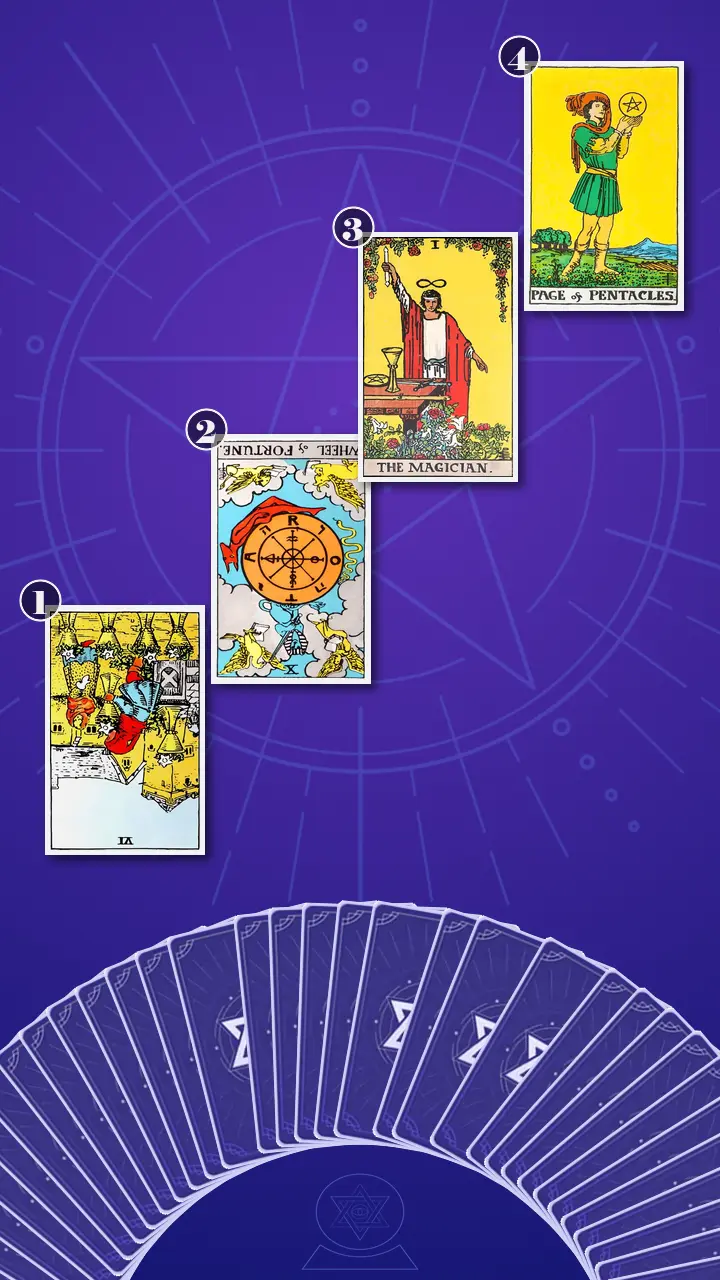
For this consultation, I chose the Four-Layer Insight Ladder · Context Edition, a four-card tarot spread for past baggage and decision paralysis. The consultation question is structured around a self-reinforcing loop, so I needed a spread that could show how old emotional evidence enters a current choice, what belief gives that evidence too much authority, where agency is still available, and how to convert insight into a practical experiment.
A past-present-future spread would suggest a neat linear story. A decision cross would assume two supplied options that Jordan had not actually presented. A larger spread would add more symbolic material without necessarily clarifying the feedback mechanism. This staircase was smaller and more useful: it moved from visible behavior to root attribution, then from an agency lever to grounded integration. Tarot would offer a structured reflection tool; Jordan would remain the person deciding what to do with the information.
The first card would show the present enactment of the baggage transfer loop. The second would reveal the root belief sustaining the agency-fate split. The third would identify one capacity Jordan could direct without controlling the whole outcome. The fourth would turn that capacity into a small, reversible action capable of generating present-day evidence.
Reading the Map Without Handing It the Wheel
The Flower-Filled Cup in the Open Draft
Now turned over is the card representing the present enactment of the baggage transfer loop, the observable way old emotional evidence enters a choice that remains open: the Six of Cups, in reversed position.
In the Rider-Waite-Smith image, an older child offers a flower-filled cup while six other cups stand between the figures in an enclosed courtyard. Reversed, the image asks whether an old emotional package is being handed to a new opportunity without first checking whether its contents still fit. The white blossoms are not evil or useless. They are simply being transferred without inspection.
For Jordan, the scene was precise. At 11:40 p.m., they kept the difficult former role visible beside the internal application by leaving the old journal and archived messages on the same screen. When the new job description used familiar language, remembered tension quietly became current evidence. The application was no longer being assessed only through its manager, scope, resources, decision rights, and exit options. The previous experience had received the deciding vote before the new role had spoken for itself.
I read the reversed energy as an overextension of memory and a blockage in emotional release. Jordan was not lacking care. They were trying to use experience wisely, but the lesson had become a rule: if a new choice resembled the old one in even one visible detail, the emotional outcome was treated as already known. The protective behavior was concrete: reopen messages, highlight matching phrases, add another warning sign, postpone a response, and feel briefly safer because no fresh exposure had occurred.
I asked, “What do you usually reopen when a present opportunity begins to feel real?” Jordan named a former manager's message, a performance review, and a journal entry written after the previous role became constraining. Their thumb paused above the phone before they gave a short laugh with a bitter edge.
“That is painfully accurate,” they said. “I thought I was being responsible.”
“Responsibility is exactly why this loop can feel so convincing,” I replied. “The question is not whether the past has anything to teach you. The question is whether you are taking one lesson from it, or asking the entire archive to make the new decision.” Their shoulders remained raised, but their thumb stopped reopening the same thread. The first layer had become a behavior rather than a character judgment.
The Wheel That Mistook a Loop for a Law
Now turned over is the card representing the root attribution sustaining the Agency-Fate Split, the belief that recurrence means the present outcome is already beyond meaningful influence: the Wheel of Fortune, in reversed position.
The upright Wheel speaks of cycles, changing conditions, timing, and the limits of personal control. Reversed, its energy becomes a blockage when recurrence is converted into inevitability. Jordan sees one repeated phrase in a new job description, mentally loads the entire previous workplace around it, and concludes, “It looks familiar, so I already know where it ends.” The mind calls this preparation. The body experiences it as a closing door.
I pictured the large wheel turning while the four winged figures in the corners remained steady and observant. That contrast mattered. Conditions can change without becoming controllable, yet observation does not have to become surrender. Like Groundhog Day, repetition does not become a sentence simply because the setting looks familiar; participation inside the repeated conditions can still change.
“Resemblance is data, not destiny,” I said.
Jordan's chest tightened. Their breathing became shallow, and their hand began moving between the application, a Notion risk matrix, and an old Teams export without opening anything new. I asked which exact current detail had triggered the sentence this week. After a pause, Jordan said, “Fast-moving environment.”
I asked what that phrase had meant in the former workplace and what it might mean on this team. Jordan described the old pattern: shifting priorities without clear decision rights, little support, and a manager who treated every boundary as a lack of commitment. I asked what was actually known about the new role. The current description named a smaller team, a defined product area, and a hiring manager Jordan had not yet questioned about autonomy.
“The same words are there,” Jordan said, “but not necessarily the same conditions.”
“That distinction is where current evidence can begin,” I said. “I will not ask you to ignore the warning. I will ask you to stop allowing one familiar phrase to carry every other variable out of the room.” Outside, a streetcar bell sounded twice and then faded. The repeated note did not mean the route was fixed; it only marked one moment on a changing line. Jordan's hand settled beside the laptop instead of above the archive.
The Wheel exposed the deeper fear beneath the research: if a deliberate choice recreated an old disappointment, Jordan would have to face the possibility that judgment offered no meaningful control. Postponement provided relief because a missed deadline could be blamed on timing. Its long-term cost was harder to see: fewer present-day experiments, less feedback from reality, and a growing belief that meaningful choice had never been available.
When the Magician Raised One Usable Tool
The radiator clicked once and went quiet as I reached for the third card. The room seemed to narrow around the staircase on the table. We had arrived at the visual pivot, where the reading stopped asking why the loop existed and began asking what could interrupt it.
Now turned over is the card representing the agency lever that interrupts Inner Conflict, one available capacity Jordan can deliberately direct without needing control over the whole outcome: The Magician, in upright position.
The Magician's raised wand, downward-pointing hand, and four suit tools on the table made the answer practical. The cup, sword, wand, and pentacle suggested that emotion was one resource among several, alongside questions, skills, initiative, boundaries, and material constraints. The card did not promise command over every result. It asked Jordan to direct one available resource toward one choice that was still open.
Here I used my signature lens, Cognitive Stratigraphy. Years on archaeological digs taught me to distinguish a surface artifact from the foundation beneath it. A sudden emotional trigger can be real and informative without being the whole structure. I asked Jordan to identify the surface artifact, locate the older epoch that gave it its charge, and then inspect the present site for conditions that were genuinely different.
For Jordan, the surface artifact was the phrase fast-moving environment. The older foundation was the belief, “If this choice resembles the past, it will end the same way.” The previous workplace had supplied evidence for that belief under particular conditions. It had not supplied a universal law. The current team, decision rights, manager, support structure, and exit options were still unexamined variables.
I have spent enough time around broken walls to know that a visible crack does not tell me whether an entire structure must be abandoned. On a dig, I do not repair a ruin by pretending the damage never happened. I map the fracture, test what remains sound, and decide which stones can support the next course. That is the patient logic I call Ruins Restoration Thinking: a fragmented sense of self and chronic mental exhaustion can mark a necessary phase of internal transition, but neither should be romanticized or allowed to dictate the future.
Before I said more, I returned Jordan to the exact moment that had begun the loop. The application was still open beside the old journal and archived messages. One warning sign had become seven, and the desire for autonomy was still present beneath the caution. The choice had not vanished; only its emotional weight had expanded beyond its actual first step.
Jordan was caught in an old equation: if they did not explain every similarity, they would be reckless; if they chose and felt disappointed, the regret would belong entirely to them. The application remained open at 11:40 p.m., but their body acted as though its ending had already been filed.
Old baggage is not a command to repeat the wheel; choose one variable you can direct now, as the Magician raises the wand above the tools already on the table.
Jordan did not nod. First, their breath stopped halfway through an inhale, and their fingers pinched the lower edge of the card. Then their pupils widened slightly and their gaze went unfocused, as though an old meeting were replaying behind their eyes. Finally, their hand released the card, their shoulders dropped a fraction, and a flush reached the rims of their eyes.
“But doesn't that mean I was wrong all along?” Jordan asked. The question carried a brief flare of anger, followed by a smaller, almost embarrassed silence. I let the resistance remain. “No,” I said. “It means you found a protection that once had a job. You can keep the information and retire the rule. Choosing a present input is not confessing that the past was meaningless.”
For a few seconds, Jordan looked down at the four tools. A rough exhale came from deep in their chest. The relief was real, but it was accompanied by a light dizziness, the blankness that can arrive when an old instruction stops filling every available space. Their hands were no longer searching for another tab. They looked more vulnerable, not magically certain, because one piece of responsibility had returned to them.
“Now,” I asked, “use this new angle to remember a moment last week when this insight could have made the moment feel different. What was one input you could have directed, even without knowing the result?”
Jordan named a question they could have asked the hiring contact instead of building another warning column. I watched them underline the word question on a blank page. The movement was small, but it was vertical: attention rising out of the circular tab-switching and landing on one usable tool.
The First Course of Rebuilding
This was the key crossing in the reading: from contracted ambivalence and retrospective pattern-matching toward grounded self-trust through present-day feedback. The shift was not from having a past to having none. It was from prediction to participation, from asking memory to guarantee safety to choosing how the next piece of evidence would be gathered.
The past could stay on the table without taking the whole table. Jordan did not need to discard history, override a genuine red flag, or force a positive interpretation. They needed to give each source of information its proper size.
The Pentacle Held at Eye Level
Now turned over is the card representing the integration experiment, a small, practical, reversible action that creates present-day evidence before reflection turns back into delay: the Page of Pentacles, in upright position.
The Page studies one pentacle at eye level while standing in a cultivated field, with blue mountains in the distance. The figure is attentive to one tangible object and still aware of a longer journey. The energy is grounded and balanced. It offers Jordan a learner's posture instead of a judge's verdict: choose the smallest real-world version of the decision, give it a time limit, name what it should teach, and review what actually happens.
I translated the card through product-design language Jordan already trusted. An application is not acceptance. An informational call is not a commitment. A seven-day exploration is not a permanent identity decision. A portfolio draft is not a promise to leave the current role. Each can function as a prototype whose purpose is feedback, not proof that Jordan's judgment will never fail.
Jordan reached for their phone and opened the calendar. Their thumb hovered over a Sunday review date, then pressed the screen. I saw the familiar urge to make the test larger begin to rise, so I asked, “What is the minimum version that could teach you something current without exceeding your time, privacy, money, or emotional capacity?”
“One completed section of the application,” Jordan said. “And one question about decision authority. I can review the answer in seven days instead of checking it every hour.”
Their mouth tightened for a moment, then softened. The Page was not asking Jordan to become fearless or to accept an outcome in advance. It was offering a credible way to learn while keeping the right to stop, revise, or decline.
From Archive to Prototype
I gathered the four cards into one story. The Six of Cups reversed showed the old emotional package being placed beside a new application until memory received the deciding vote. The Wheel of Fortune reversed showed the root attribution: recurrence had become inevitability, and one familiar condition was carrying the weight of an entire forecast. The Magician restored the agency lever by gathering the tools already available. The Page of Pentacles grounded that agency in a bounded experiment capable of producing current evidence.
The cognitive blind spot was not that Jordan failed to recognize patterns. It was the assumption that recognizing a resemblance required treating the whole present as a replay. Jordan was confusing a warning with a verdict, and confusing an application with an irreversible career decision. The transformation direction was clear: separate one past warning from one present fact, choose one controllable variable, and run a bounded experiment before asking for more certainty.
I introduced the Trigger Excavation Exercise, my practical way of separating an emotional trigger's surface artifact from the older epoch that gave it force. It would not require Jordan to reopen painful archives or produce a perfect postmortem. The aim was to distinguish what happened then, what is verifiably happening now, and what Jordan could direct next.
- Excavate the triggerOn Tuesday evening, choose the internal application as one reversible choice. Set an eight-minute timer and open a note titled “One Variable I Can Direct.” Write four lines: Current choice, Past warning, Present fact or difference, and One variable I can direct. Finish by naming one reversible test that could begin within 48 hours.Do not reopen archived messages during the timer. If four lines feel too large, write only Past warning and Present fact. Stop if the material becomes overwhelming; safety, privacy, financial limits, and emotional boundaries remain outside the experiment.
- Ask for present evidenceBefore Thursday, draft a three-sentence message to the hiring contact asking one concrete question about decision authority, workload, or how the team handles changing priorities. Sending the message is optional; saving the draft is the minimum version.Write the question you need answered rather than the reassurance you wish someone could provide. A specific answer can update the present without requiring the past to be erased.
- Run a seven-day prototypeTreat the internal application as a seven-day discovery sprint. Spend 20 minutes completing one section, then place a review appointment on the calendar for the following Sunday. At the review, record what the test taught you about autonomy, support, and fit before deciding whether to continue.An application can be an experiment before it becomes a decision. Set the time, cost, and exit point in advance, and redesign or stop the test if it crosses a boundary that matters to you.
I reminded Jordan that the Four-Layer Insight Ladder was not a machine for producing the right answer. It was a way to move from present enactment to root belief, from root belief to agency, and from agency to observable learning. The cards could organize the question, but only Jordan could choose the variable, set the boundary, and decide what the new evidence meant.
The Quiet Proof of a Different Ending
A week later, I received a message from Jordan while I was cataloguing pottery fragments from an excavation near Cambridge. It read, “I drafted the question, finished one application section, and sent the application. It felt like a test, not a verdict. I put the review date in my calendar.”
The role was still undecided. No card had promised that the team would be perfect, that disappointment was impossible, or that the past had been healed in one evening. What had changed was smaller and more reliable: Jordan had allowed present evidence to enter before the deadline could make the choice for them.
Jordan later told me that they slept through the night. The first thought the next morning was still, “What if I'm wrong?” This time, they smiled, opened the calendar, and found the review date waiting there. The question remained, but it no longer held the steering wheel.
Ownership, Not Certainty
I think of that as the real Journey to Clarity. The reading did not remove Jordan's history or turn uncertainty into a guarantee. It gave the history a place, the present a voice, and the next action a manageable size. The emotional transformation began when old baggage became reference material rather than a verdict, and cautious agency became something Jordan could practice through live feedback.
When a new option echoes an old disappointment, I know how easily the jaw can lock and the hands can reach for the archive, caught between wanting to choose freely and fearing that one more regret will prove control was never yours. That reaction deserves understanding, not shame. It may be a trigger, a pattern, and a choice point arriving together.
If the past could sit beside you as one source, rather than in front of you as the judge, what tiny, reversible possibility would you be curious to explore next?