After the Month-End Report, Work Continues: Setting a Recovery Block

The 9:40 p.m. Finish Line That Would Not Hold
I knew the month-end close was technically over when Jordan, a twenty-nine-year-old financial operations analyst in Toronto, appeared on my screen with the required report already submitted and Microsoft Teams still open. At 9:40 p.m., they sat at a condo kitchen table renaming Excel tabs and checking a minor reconciliation. The refrigerator hummed through the microphone. A blue unread badge glowed beside a plate of cooling dinner, and the laptop cast a hard, pale light across their raised shoulders.
I watched Jordan press their tongue against a tight jaw while their fingers moved quickly over work whose practical urgency had already passed. Their body looked like a phone stranded at one percent while an invisible background app kept draining the battery. The deadline was over, but their nervous momentum had not received the message.
“I am technically finished, but I do not feel allowed to stop,” Jordan said. “Rest is easier when nothing is hanging over me, and something is always hanging over me. I know recovery would help next month, but working gives me relief right now.”
The question they brought me was direct: “Why do I push through every month-end instead of recovering?” Beneath it, I heard the sharper contradiction. Jordan wanted a genuine recovery pause, yet every unfinished detail made stopping feel like carelessness rather than an ordinary scheduling decision. They had even searched phrases like “why can’t I relax after month-end close?” and “guilty resting when work is unfinished,” hoping the right explanation might finally quiet the urge.
“I am not going to tell you that caring about your work is the problem,” I said. “I want us to identify where responsible effort ends and where fear quietly takes over. Let’s give this fog a structure, then see where your choices become visible again.”

Choosing the Switchback Map
I invited Jordan to take one slow breath and hold the question in mind while I shuffled. I treat this brief ritual as a transition for attention, not as theatre: it helps us stop chasing every possible explanation long enough to examine one pattern carefully.
I chose the Transformation Path Grid · Context Edition, a six-card tarot spread designed to map behavior, blockage, root belief, catalytic shift, practical response, and integration. That is how I use tarot: not as a verdict about the future, but as an objective cognitive tool. The cards externalize a pattern so card meanings can be tested against context, actual workplace requirements, and the choices available to the person sitting with me.
For a recurring push-through cycle, a simple past-present-future reading would have shown repetition without explaining what keeps restarting it. A ten-card Celtic Cross would have added more information than this focused question needed. The six-card grid was the smallest map that could show the complete feedback loop: staying online delays recovery, delayed recovery reduces next-cycle capacity, and reduced capacity makes even more vigilance feel necessary.
I arranged the cards as a two-row switchback trail. The upper row would show Jordan’s visible post-close behavior, the immediate obstacle to recovery, and the worth-based rule underneath it. The path would then turn sharply into the lower row, where an interrupting principle, a practical recovery structure, and a sustainable form of strength could emerge. I reminded Jordan that the final card would describe a capacity to practise, not a guaranteed outcome.
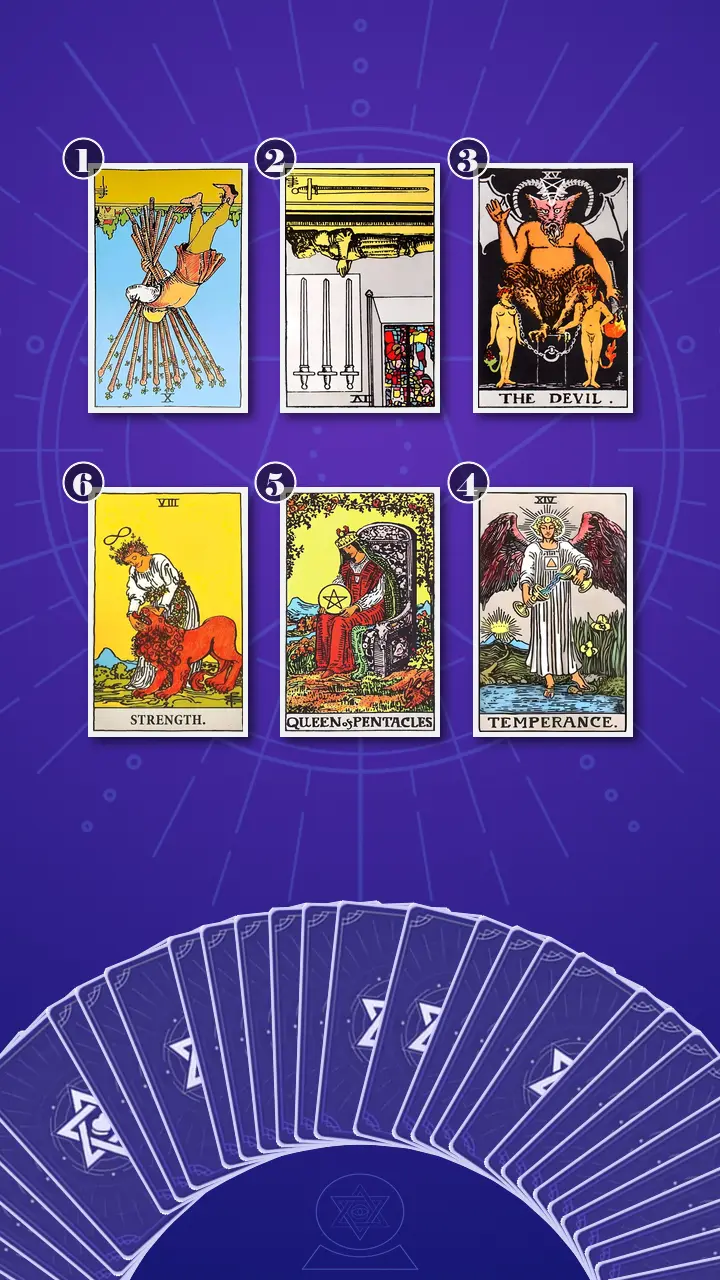
Where the Finish Line Disappeared
Position 1: The Load That Hid the Arrival
“The card I am turning now represents the present-state behavior: what continuing after the essential deadline looks like in observable life,” I said. I revealed the Ten of Wands, reversed.
The figure on the card is nearly at the town, but the bundle in his arms blocks his view. I set that image beside Jordan’s screen-filling task list. At 9:40 p.m., the required close report was already submitted, yet they were still bent over the kitchen table renaming tabs and clearing routine messages. The reversed burden was not simply having too much to do. It was being unable to set down work whose practical urgency had expired.
I read the reversal as an excess of assumed responsibility combined with a blockage in release. Jordan’s internal line sounded like this: The main thing is done, but I cannot stop while this small discrepancy is still open. That sentence made optional continuation resemble conscientiousness, even while the extra hour obscured the fact that the real destination had been reached.
“After your last submission, what was the first completely non-urgent task you picked up?” I asked. “And what did you predict would happen if you left it until morning?”
Jordan gave one short laugh, but there was no amusement in it. Their fingers tightened around the edge of the table before slowly releasing. “Renaming the tabs,” they said. “That is so accurate it is almost rude. No one needed it that night. I just thought leaving the file messy would mean I had been sloppy with the whole close.”
“Then we have our first distinction,” I replied. “The cleanup offered immediate relief, but relief and urgency are not the same thing. We are not trying to abandon the tabs. We are asking whether they had to remain in your arms at 9:40.”
Position 2: Rest With an Invisible Meeting Still Running
“The next card represents the immediate blockage: what prevents technically available downtime from becoming actual recovery.” I turned over the Four of Swords, reversed.
The traditional image shows a body at rest beneath three suspended swords. Reversed, the protected interval becomes unstable. In Jordan’s life, that looked like closing the laptop but leaving Teams visible on their phone, refreshing messages from the sofa, and filling the next morning with errands and planning. The body became stationary while attention remained mobilized for work.
“It is a bit like Severance without the separating elevator,” I said. “You have left the workday, but the work mind has followed you into the living room. You are resting, except part of you is still checking whether rest is safe.”
I read the reversed Swords as a blockage of mental withdrawal and an excess of task-scanning. Even a so-called recovery day could become a Notion-style personal operations dashboard: groceries, laundry, a workout, meal prep, a course module, and a finance podcast packed back to back. Productive distraction kept stillness from exposing the guilt underneath, but it also kept the nervous system inside the close cycle.
Jordan’s jaw tightened again. Their eyes moved from the card to the Teams window and stayed there. “I call that my Sunday reset,” they said. “But I finish it feeling like I worked another shift.”
“The card is not asking you to become calm on command,” I said. “It is asking whether the first restless hour can remain unproductive without being treated as a failed recovery attempt. Closing the laptop may be the beginning of rest, not proof that rest has already become comfortable.”
Position 3: The Contract No Manager Wrote
“The third card represents the underlying root: the private rule that makes stopping feel unsafe or irresponsible.” I revealed The Devil, upright.
As the card landed, the blue Teams badge flashed at the edge of Jordan’s screen. The timing was almost too precise. I directed their attention away from the imposing central figure and toward the loose chains around the two human figures. The pattern had real power, but the image did not present it as an inescapable sentence.
In everyday terms, a routine reconciliation could remain open overnight, yet Jordan experienced that carryover as an identity test. They accepted one more task or reopened the tracker without being asked because completion briefly quieted a deeper equation: If anything remains open, I am careless. If I am careless, I am less useful. If I am less useful, I am less secure.
I read The Devil as an excessive attachment between productivity and personal worth, strong enough to block Jordan’s perception of choice. The card did not diagnose them, and it did not blame ambition. It showed how an ordinary scheduling decision had become charged with the force of an identity verdict.
I used a lens I call Power Dynamic Deconstruction. I asked three practical questions: Who actually established this rule? Who can enforce it? Where does Jordan possess evidence, discretion, or leverage that the rule ignores? In upward management and cross-departmental negotiations, those questions separate a genuine demand from an assumption that has acquired authority through repetition.
“Has a manager explicitly told you that every minor close item must be finished that evening?” I asked.
Jordan paused. Their eyes went slightly unfocused, as though replaying old reviews and late-night messages. Then they shook their head. “No. There are real deadlines and occasional urgent corrections, but no one has said the tracker must be empty. I think I made that part up because being the reliable one felt safer.”
“That does not make the pressure imaginary,” I said. “It means part of the pressure is negotiable. An open task is not a verdict on your worth.”
When Temperance Rewrote the Close Cycle
Position 4: The Two Cups at the Turning Point
The refrigerator compressor clicked off in Jordan’s kitchen, and the sudden quiet seemed to widen the room. “We are turning the corner of the spread now,” I said. “This position holds the key interrupting principle, the antidote that can loosen the push-through cycle without asking you to reject ambition.” I revealed Temperance, upright.
The angel transfers liquid between two cups, with one foot on land and one in water. I read that movement as balanced regulation: exertion passing into handoff, decompression, and later return instead of being drained from one container with no transfer point. In Jordan’s month-end routine, it meant defining one complete procedure: submit the essential report, document carryover, close the laptop at a predetermined time, protect a recovery interval, and return to non-urgent work when scheduled.
I brought Jordan back to 9:40 p.m.: the report submitted, dinner cooling, shoulders still lifted, fingers renaming tabs. They were caught inside one demand: I must make the feeling of incompletion disappear before I am allowed to stop, even though the essential work was already complete.
The two cups triggered an old Wall Street memory for me. On a trading desk, a system was not considered responsible because it operated at one hundred percent capacity until it failed. Sound risk management preserved liquidity, defined transfer points, and protected the resources required for the next session. Human capacity deserved at least as much commercial intelligence.
I then used my Transferable Asset Pricing lens. I normally use it to audit what someone’s core skills are actually worth when corporate noise has confused competence with endless availability. Jordan’s reconciliation judgment, pattern recognition, and record of submitting required reports did not lose value when Teams was muted. Continuous availability was not their core asset. It was an unpriced withdrawal from the capacity they would need next month.
You do not have to drain yourself to prove commitment; build effort and recovery into one measured rhythm, as Temperance keeps energy moving between two cups.
I left the sentence alone for a moment. Then I made its operational meaning explicit.
Recovery does not begin when the list is empty. It begins when you decide that the essential work is complete and give the remaining work a scheduled place to go.
Jordan went completely still. Their inhale stopped halfway, and one index finger hovered above the trackpad without touching it. For several seconds, their gaze moved past the screen, as if they were replaying every post-close evening when a minor task had quietly taken the place of dinner, sleep, or a plan with a friend. Then their jaw loosened. Their eyes reddened at the edges, their shoulders dropped by an inch, and a long breath left their chest. Relief arrived, but it did not stay simple. Their mouth tightened again, and their voice came out lower and sharper. “But does that mean I have been doing this wrong for years?” I did not rush to turn the insight into a victory. “It means the strategy gave you short-term relief, and now its long-term cost is visible,” I said. “You were trying to protect your reliability. We can respect that intention without preserving the depletion loop.” Jordan looked down at the cooling plate, then back at the card, carrying both recognition and the vulnerable blankness of having no old rule to hide behind.
“Now, using this new perspective, think back: was there a moment last week when this insight could have made you feel different?” I asked.
“Friday on the TTC,” Jordan said. “A friend asked me to meet near Ossington. I stayed home for a spreadsheet item that could have waited. If I had written down when I would return to it, maybe going out would not have felt like dropping something.”
I named the crossing clearly. This was not a leap from overwork to effortless calm. It was the first movement from depleted, guilt-driven post-deadline overwork to measured self-regulation and confidence in sustainable limits. The stopping point would create a new responsibility: Jordan would have to choose and maintain it without waiting for an empty list to make the choice on their behalf. That clarity brought relief, but it also made their agency impossible to outsource.
A Garden, a Lion, and the Work of Stopping
Position 5: Making Recovery Visible
“The fifth card represents the practical response: the small, observable structure that carries Temperance into daily life.” I revealed the Queen of Pentacles, upright.
The Queen holds her pentacle with full attention inside a cultivated garden. I read her as balanced earth energy: practical stewardship of food, space, time, and finite capacity. Her version of recovery was not an abstract promise to practise more self-care. It was visible infrastructure.
For Jordan, the card translated into preparing an easy dinner before the deadline sprint, activating Focus mode after submission, placing the work laptop inside a bag, and leaving a low-demand evening unavailable to optional tasks. A warm lamp, a charged personal phone, and a meal that could be eaten without opening Outlook were not trivial details. They changed the environment from an extension of the office into support for a protected interval.
“My body and home are resources I manage too,” Jordan said slowly. They reached across the table and closed the lid of the untouched meal container, as though noticing it properly for the first time.
“Exactly,” I said. “Reliability includes protecting the capacity you will need next month. The Queen does not make recovery a moral reward. She provisions it before optional work can spend the time.”
Position 6: The Urge Can Exist Without Becoming an Order
“The final card represents the integrated capacity: how sustainable strength can look when the urge to continue is felt without automatically controlling behavior.” I turned over Strength, upright.
The woman on the card does not defeat the lion or pretend it has vanished. Her hands remain gentle and steady around its jaws. I read this as balanced fire: drive regulated through calm contact rather than exhausted through force.
I asked Jordan to picture 10:12 p.m. after a planned shutdown. They are on the sofa under a warm lamp when an unanswered email returns to mind. Their pulse rises, one foot begins bouncing, and the laptop suddenly seems louder from inside its bag. Strength does not require the urge to disappear. It allows Jordan to note the email for morning, tolerate the unfinished feeling, and leave the chosen boundary intact.
“The old definition of strength was enduring another hour,” I said. “This one is staying present for two uncomfortable minutes without letting urgency seize the steering wheel. A boundary can be working even while it feels uncomfortable.”
Jordan nodded, but not with the quick agreement I had seen earlier. Their hand rested flat on the table. “So I do not have to win the argument with myself before I close the laptop.”
“No,” I said. “You only have to notice that the urge is information, not an instruction. Temperance defines the rhythm, the Queen supports it materially, and Strength helps you remain with the discomfort long enough to keep the decision you already made.”
The Not-Tonight Queue and the Next Twenty Minutes
I gathered the six cards into one coherent story. The Ten of Wands showed Jordan carrying optional work past the real finish line. The Four of Swords revealed why closing a laptop had not produced mental unavailability. The Devil exposed the productivity-worth contract beneath that blockage. Temperance introduced transfer and proportion; the Queen made recovery operational; Strength returned ambition in a regulated form rather than extinguishing it.
The spread resembled a month-end dashboard that tracked every open item but had no field for remaining human capacity. Excessive fire kept producing action, restless air kept scanning for risk, and emotional permission had been excluded from the workflow. Temperance supplied movement between effort and restoration. The Queen added practical ground. Strength showed that drive could remain present without consuming the whole system.
“The blind spot is that you have been waiting for completion to feel emotionally certain,” I told Jordan. “But recurring work continuously generates new loose ends. A credible finish line has to be operationally defined. Your shift is from asking whether you have earned recovery to protecting a predetermined post-close recovery block before non-urgent follow-up begins.”
Jordan raised a practical objection. “Some nights finance leadership sends a real correction at 7:25. I cannot just pretend I control the shutdown time.”
“Agreed,” I said. “A useful boundary must survive contact with your actual job. We will keep deadline-critical and regulated obligations outside the experiment, preserve the formal escalation channel, and distinguish them from routine badges and optional cleanup. The goal is not to manufacture certainty. It is to stop giving every open item emergency authority.”
The Leverage Mapping Protocol: Close Edition
I adapted my Leverage Mapping Protocol, normally used before a performance review or salary negotiation, to Jordan’s close cycle. The same principle applied: before setting a boundary, identify the bargaining chips that make it credible. Here, those chips were a submitted essential deliverable, a written handoff, dated follow-up, a record of reliability, and a clear emergency route.
- Map the real close boundary.Before the next close, take eight minutes to open a note called “Not tonight.” Create three headings: essential before shutdown, non-urgent carryover, and genuine escalation. At shutdown, move three routine items into the carryover section and give each one a next-action date.Use the minimum version if needed: one item and one date. Keep the agreed emergency channel available, and stop the exercise if it creates more pressure than clarity.
- Give recovery a start time.On the morning of the final business day, place a twenty-minute Outlook or Google Calendar block immediately after the planned submission time and title it “Close complete: offline transition.” Set one alarm labelled “Essential work ends here.” When it sounds, save the files, update the handoff note, and close the laptop.Treat this as a one-cycle test, not a permanent law. Exclude genuine deadline-critical duties, and protect only twenty minutes if a whole evening feels implausible.
- Build the Queen’s recovery container, then use Strength.Before opening the close files, put one easy meal or snack where it will be visible. After shutdown, mute routine work alerts and move the laptop into a bag or separate corner. If the urge to reopen it appears, set a two-minute timer and write: “I want to work because I am afraid that...” Record the urge, the action chosen, and what happened by morning.Pick one environmental support rather than designing a perfect routine. The two-minute pause does not require calmness, and the boundary has not failed merely because the urge remains.
I asked Jordan to treat the plan as evidence gathering. If an essential obligation genuinely failed, we would revise the boundary using facts. If routine tasks simply waited until morning, that would also be evidence. Tarot had clarified the hypothesis, but Jordan would determine the stopping point, run the test, and decide what belonged in their working life.

Six Days Later, the Badge Was Still There
Six days later, I received a message from Jordan: “The blue badge was still there. I put three items in Not tonight, moved the laptop, and ate while dinner was warm. I hated the first twenty minutes. Nothing broke.”
Jordan slept through that night. Their first morning thought was still, What if I missed something? This time, they opened the dated queue at the hour they had chosen rather than checking from bed. The doubt remained, but it did not get to set the schedule.
I did not read that as a solved life or a permanent cure for unfinished-work guilt. I read it as the first credible proof that a protected pause could coexist with commitment. The cards had supplied a map and a language for the pattern; Jordan supplied the boundary, the experiment, and the decision to keep the laptop closed.
When a deadline has passed but your jaw is still tight and your eyes keep returning to a blue unread dot, stopping can feel as though it might expose something about your worth that one more completed task could keep hidden. I hope Jordan’s two cups offer a different possibility: noticing that contract, and giving unfinished work a scheduled place to go, means you no longer have to obey it invisibly.
If recovery could become the final cup in your own close cycle rather than evidence that you have done too little, what is the smallest pause you could give a start time and protect this month?