From an Unanswered Slack Draft to Three Ordinary Reps in Six Days

The Twenty-Minute Window That Needed Permission
I recognized the pattern before Maya had finished her first answer. At 27, she was already trusted to coordinate product operations across a hybrid Toronto team, yet one self-directed learning block could make her feel as if she were about to cross a line. On Monday at 8:10 a.m., she had sat at a small Liberty Village kitchen table with a twenty-minute analytics lesson open beside a color-coded Notion tracker. The laptop fan hummed, her coffee had turned bitter and lukewarm, and Slack pings landed through one earbud while her fingertips tapped the mug.
I heard how the available window disappeared. Maya compared two habit apps, changed the calendar color, moved the start date, and asked colleagues when they studied. By the time her meeting alert appeared, she had not completed one exercise.
“I can make a perfect tracker before I can do the habit once,” she told me. “I keep waiting for a cleaner week, but every week gets used up. What keeps me waiting to start, and what can I actually try?”
I watched her press both palms around a fresh cup as if the ceramic could hold her still. Her hesitation was not an empty lack of motivation. It felt more like standing with one foot above a TTC train while checking three route apps, chest tightening until the doors closed, then feeling the guilty physical relief of no longer having to choose.
“What you are describing sounds like permission-seeking procrastination at the habit starting line,” I said. “The planning is doing something real: it temporarily protects you from finding out what an imperfect, self-directed attempt looks like. I am not going to call that laziness, and I am not going to tell you that one card can guarantee a new identity. I want us to find where preparation stops helping, then design a start small enough to produce evidence.”
Rain threaded down the window of my consultation room while a streetcar bell sounded beyond the glass. I turned Maya's question into one sentence and placed it between us: What keeps the habit in waiting, and what would create a workable first repetition? I told her that our journey was not about forcing certainty. It was about drawing a clear map through the fog and returning the start signal to her.

Choosing the Four-Rung Map
I asked Maya to take one slow breath and picture the exact moment before she usually opens a tracker or Slack. I shuffled while she held that moment in mind. I use this brief pause as a change of mental context, not as a supernatural test. It helps separate the live question from the browser-tab noise surrounding it.
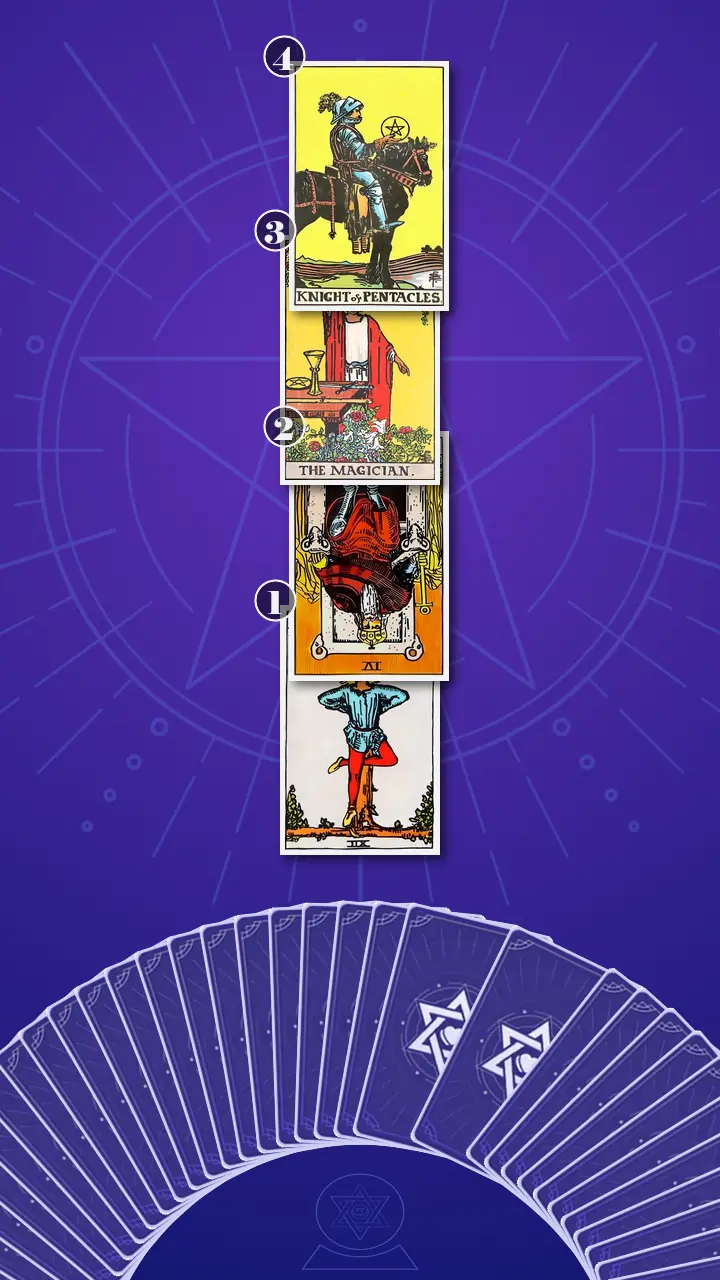
I chose the Four-Layer Insight Ladder, a focused tarot spread for tracing habit-launch procrastination from visible delay to its underlying authority structure, then toward agency and repeatable practice. A Celtic Cross would have introduced more context than this question needed. A decision spread would have implied that Maya needed to choose between competing habits, when the actual issue was the cycle preventing any habit from receiving a first attempt.
I arranged the four cards vertically like rungs. The first would show the observable behavior: preparing, rescheduling, and reaching the end of the window without one repetition. The second would reveal the belief making that delay feel responsible. The third would identify the leverage point where self-directed agency could return. The fourth would turn that agency into a modest experiment repeated three times before evaluation.
This is how tarot works in my practice. I do not treat the cards as commands, diagnoses, or fixed predictions. I use the structure to slow a fast mental loop, compare card meanings in context, and make assumptions visible enough to test. Maya would remain the decision-maker throughout. The spread was a map; she was still the person choosing where to place her feet.
Reading the Loop That Looked Like Preparation
Position 1: The Window Planned Away
I turned the card representing the visible habit-launch behavior, the part anyone could observe on Maya's screen, calendar, and clock. It was The Hanged Man, reversed.
I pointed to the figure attached by one ankle, inverted but illuminated around the head. Upright, this archetype can describe a purposeful pause that changes perspective. Reversed here, the suspension had become a blockage. Maya possessed plenty of insight, but insight was circulating without reaching her hands. Reflection had exceeded its useful dose while action remained underfunded.
I brought the card back to Monday at 8:10. The analytics lesson was open. During the next fifteen minutes, Maya compared trackers, moved the start date, and asked colleagues about their routines until the meeting alert ended the window. The inner script sounded responsible: I will start as soon as I confirm the right method, but now there is not enough time to do it properly. The waiting no longer produced perspective. It protected her from seeing an awkward first attempt.
“Planning can be useful and still become the place where the habit goes to wait,” I said. “The question is not whether a setup task looks productive. The question is whether it directly helps you complete one repetition inside the available window.”
Maya gave one short laugh, but there was no amusement in it. Her fingers tightened around the cup before loosening again. “That is so accurate it is almost cruel,” she said. “I literally made the tracker prettier while the lesson sat there.”
I let the reaction land without turning accuracy into accusation. “Then the card has identified a behavior, not a character flaw. You were buying short-term relief from exposure. That makes sense. It also means the loop can be interrupted without declaring war on your personality.”
I asked her to think of the last twenty-minute window she had reserved. “Which preparation step gave you information you needed for the first rep, and which step only helped you avoid feeling unready?” Her eyes moved toward her phone, where the tracker still lived. She did not answer immediately, but her shoulders shifted a fraction lower.
Position 2: The Empty Slack Thread on the Stone Throne
I turned the card representing the hidden structure beneath the delay: the professional approval habits and permission seeking that made an independent start feel premature. It was The Emperor, reversed.
I showed Maya the armored ruler on the severe stone throne. Reversed, the authority in this card was not simply absent. It had become distorted and internalized. External structure was operating in excess, while proportionate self-governance was in deficiency. No manager needed to stand in the room because Maya had carried the approval workflow home with her.
I described the modern version already present in her week. Maya placed a fifteen-minute analytics block on Outlook but marked it tentative. She drafted, Is it okay if I use this time for analytics practice? When no reply appeared, she cancelled the session even though no one had objected. Slack silence had acquired the authority of a formal rejection.
For a second, I remembered my own years on Wall Street, where approval matrices could protect millions of dollars and still become absurd when copied onto every low-risk choice. I had watched capable people attach a corporate sign-off process to decisions that were reversible by lunchtime. Structure matters, but the return collapses when the cost of authorization exceeds the risk of the experiment.
“Your role has trained you to respect checkpoints,” I said. “That can be a professional strength. The problem begins when your personal operating system marks every self-chosen development block as tentative while every incoming request defaults to accepted. A tracker can record a habit; it cannot authorize one.”
Maya's breath stopped just above an inhale. Her fingertips went still against the cup. Then her gaze slipped out of focus, as though she were replaying the blinking cursor in that unanswered Slack draft. “If nobody has approved the time, it feels like I am stealing it,” she said quietly. “Even when it is before my first meeting.”
I separated the real boundary from the emotional one. “If workplace policy governs the time, equipment, or course, ask the factual policy question and follow the answer. Self-authorization does not mean ignoring legitimate rules or refusing useful input. But if the lesson order, timer length, or use of a permitted personal window is already yours to decide, asking someone else to choose it does not create safety. It transfers authorship.”
The Emperor reversed explained why The Hanged Man's suspension could feel legitimate. Maya was not only waiting for a better schedule. She was waiting for an authority signal strong enough to protect her from being responsible for an imperfect choice.
When the Magician Put Both Hands to Work
Position 3: The Existing-Tools Start
I reached the larger gap in the spread, the threshold between the two reversed cards and the agency-and-practice half of the ladder. Even the room seemed to pause. The rain softened against the window, the radiator clicked off, and the small silence made the next card feel visually brighter.
I turned the card representing the leverage point that could challenge the need for externally confirmed readiness. It was The Magician, upright, the key card of the reading.
I traced the image without rushing it. One hand raises the wand; the other points toward the ground. Intention is not left floating above the table. It is directed into material action. The cup, sword, wand, and pentacle are already present, just as Maya already had an open lesson, a laptop, a timer, a notebook, and ten available minutes.
The Magician's energy was in balance: thought could choose, fire could initiate, emotion could tolerate the embarrassment of being a beginner, and earth could record what actually happened. Nothing new had to arrive before version 0.1 could ship to its first and only user, Maya herself.
I translated the card into the motion available at her desk. She could close the tracker-comparison tabs before opening anything new, set a ten-minute timer, and complete one analytics exercise. That result would not certify her discipline or prove her professional worth. It would give her the first usable evidence about task size, attention, and friction.
I then used a lens I call Time-Asset Valuation. In high-stakes work, I learned to ask what an investment actually purchases rather than what it promises in theory. Maya's twenty minutes of tracker comparison had purchased temporary relief, but no practice data. A ten-minute repetition would carry a small emotional cost, the discomfort of acting without a green light, yet its return would be concrete: one completed unit, one friction point, and one fact about what to adjust.
I brought her back to the exact setup. At 8:10 on Monday, the lesson was open, the coffee was cooling, and her first meeting was twenty minutes away. She edited the tracker, checked Slack for a green light, and felt her chest loosen only when the practice window disappeared.
Waiting does not make you more ready; use the Magician's already-stocked table to make one small repetition with what you have.
I stopped speaking. For two beats, Maya did not move. Her lips parted, but the inhale seemed to catch behind her ribs. One hand remained suspended above the cup, fingers slightly curled. Then her eyes shifted away from the card and fixed on the dark window, as if several lost Monday mornings were replaying in the reflection.
Her jaw tightened before her face changed. Frustration arrived first, sharp enough to lift her chin. “But does that mean I have been doing all of this wrong?” she asked. “I have spent months trying to build a system. That time is just gone.” The final words came more quietly. Her eyes reddened, not with panic, but with the sting of recognizing how often a wish to be responsible had kept her from practicing.
I answered the anger rather than trying to rush her toward relief. “It means your planning had a protective function, and now its hidden price is visible. That is not the same as saying you were foolish. Sunk time does not need to become a sentence. It can become the last piece of evidence that changes how you allocate the next ten minutes.”
Her fingers slowly opened. A long breath left her chest, and her shoulders dropped. The release was followed by a brief, almost dizzy blankness, the look that can appear when a person realizes clarity also returns responsibility. She gave a small, uneven laugh. “So there is no perfect start signal coming.”
“Not one that can do the rep for you,” I said. “Now, using this new perspective, think back to last week. Was there a moment when this insight could have made the window feel different?”
Maya remembered Tuesday on a southbound Line 1 train. A former classmate had posted a new analytics certificate on LinkedIn, and Maya had opened three course-comparison pages before reaching Bloor-Yonge. “A ten-minute exercise looked embarrassing next to the certificate,” she said. “But the certificate was not actually in my kitchen on Monday. My lesson was.”
I nodded. “Exactly. You already know enough to choose one rep. The rep does not have to prove you are disciplined. It only has to produce information. The missing evidence is not another opinion. It is one completed rep.”
I made the boundary of the experiment explicit. Maya would close the tracker, tutorial, and comparison tabs. With the lesson already selected, she would set a ten-minute timer and attempt one exercise. At the end, she would write only three lines: It happened. I learned. The friction was. She would not redesign the routine until she had tried it three times.
I added that if work time or equipment required approval, she should use an allowed personal window or ask the policy question separately. If ten minutes felt too exposed, she could set the timer for two. She could stop at any point without turning the result into a verdict on her discipline.
This was the central emotional shift: from waiting for a complete plan or external permission toward grounded confidence built through one bounded repetition and, eventually, three ordinary attempts. The Magician did not promise that discomfort would disappear. It restored self-authorized agency, practical resourcefulness, and enough experimental confidence to act while discomfort was still present.
Position 4: Three Mornings Ordinary Enough to Count
I turned the final card, representing the grounded next step through which Maya could practice and integrate that agency. It was the Knight of Pentacles, upright.
I directed her attention to the Knight holding one pentacle steadily while the dark horse remains calm above cultivated fields. This was not launch-day adrenaline. The card's earth energy was in balance: patient, specific, observable, and repeatable. The Knight narrowed the Magician's many available tools into one practical unit of work.
I described three ordinary Toronto mornings. The same kitchen table. The same lesson source. Coffee that might still go lukewarm. One analytics exercise each time, completed before Maya changed the tracker, course, timing, or target. After the third attempt, and not before, she could use the notes to adjust one variable.
“This is almost too ordinary to count,” Maya said.
I watched her shoulders lower as she said it. The pressure for an impressive launch had begun to lose its grip. “That is why it may be repeatable,” I replied. “A polished streak performs an identity. Craft develops one. Do three ordinary reps before you redesign the system.”
I asked which windows could hold the experiment without taking from sleep, meals, paid obligations, transit safety, or needed recovery. Maya chose three permitted pre-work mornings at her kitchen table. She kept the unit the same: one practice query or chart exercise, followed by the three-line note.
The Knight did not predict that every morning would go smoothly. It offered a more useful standard. A disrupted session would become scheduling data rather than evidence that Maya could not manage herself. Professionalism could mean dependable observation and proportionate adjustment, not a dramatic certificate reveal or a flawless public streak.
Turning Four Cards into a Launch-Window Laboratory
I drew the four-card story together. The Hanged Man reversed showed the visible stall: preparation consuming the only window in which practice could happen. The Emperor reversed revealed why the stall felt respectable: an approval-heavy work identity had become an internal permission gate. The Magician restored the resource Maya had overlooked, her authority to make one bounded, low-risk choice with tools already present. The Knight of Pentacles converted that choice into three ordinary repetitions that could generate reliable evidence.
The core conflict was not motivation versus laziness. Maya wanted to start, but she also wanted a complete plan or external green light to protect her from the possibility that a rough attempt might expose poor judgment. That protection brought immediate bodily relief when she postponed, but it prevented the very experience that could build self-trust.
I named the cognitive blind spot directly: Maya had been asking planning to provide evidence that only practice could produce. She had also been treating missing approval as a negative decision. The transformation was not from structure to chaos or from collaboration to isolation. It was from borrowed authority to proportionate self-governance, with workplace policy respected and low-risk personal choices reclaimed.
Before adding any new demand, I used another strategic check from my former working life: Bandwidth Bankruptcy Prediction. I asked whether the habit would be financed by less sleep, skipped food, frantic transit, or a recovery block she genuinely needed. It would not. The original twenty minutes already existed. The structural leak was the high-friction sequence of comparison, redesign, Slack checking, and then LinkedIn scrolling that looked like preparation and felt like rest but restored nothing.
I proposed my Energy Portfolio Restructuring strategy as a forty-eight-hour guardrail. Maya would subtract one high-friction habit, tracker and productivity-content comparison, for two days. Any time recovered from that behavior would be reinvested exclusively in a high-yield recovery block, such as an unhurried breakfast or a ten-minute screen-free walk. Her analytics repetition would remain in its separate permitted window. I wanted her development habit supported by recovered bandwidth, not funded by self-neglect.
The One-Rep Start and the Three-Repetition Rule
I gave Maya two next steps. Both were deliberately small enough to begin without manufacturing a new identity around them.
- The One-Rep Start Signal.Within the next twenty-four hours, Maya would use the first permitted ten-minute window at her kitchen table, close every planning and comparison tab, open the analytics exercise already selected, and work until the timer ended. She would then add one phone note: It happened: yes or no; I learned: ___; friction: ___.Tip: If ten minutes felt too exposed, she would use two minutes. Method questions would go into a one-line review after rep three parking lot instead of opening a new research branch.
- The Three-Repetition Rule.Maya would place the same small analytics block in three ordinary, permitted windows that week. She would keep the lesson source and task unit unchanged, record the same three facts after each attempt, then spend five minutes reviewing the notes after the third session and change no more than one variable: timing, duration, location, or task size.Tip: Boredom would not invalidate the experiment, and one crowded morning would not justify rebuilding the system. She could shorten the rep, but she would not sacrifice sleep, meals, work obligations, or needed recovery to preserve a streak.
“Treat the launch window as a lab, not an exam,” I told her. “The cards have not chosen a habit for you. They have made the loop observable. You will create the useful evidence by deciding, beginning, and recording what actually happens.”

Ownership, Not Certainty
Six days later, I received a message from Maya: “Three ordinary reps. Same lesson. No new tracker.” She said the old question, “What if I drop it again?” still arrived the next morning, but she smiled, opened the exercise, and let the question sit beside her rather than drive.
I learned that her first note named notification noise as the main friction. Her second showed that one exercise fit comfortably inside ten minutes. After the third, she changed one variable by putting her phone face down across the room. She did not buy another app, announce a streak, or claim that her procrastination had been permanently solved.
I regarded that modest result as the real proof of our Journey to Clarity. Maya had moved from contracted hesitation to tentative curiosity, then toward grounded confidence built from evidence. The reading had supplied an objective structure, but it had not performed those repetitions. She had closed the tabs, started the timer, tolerated the unapproved feeling, and made the practice real.
When a free twenty minutes arrives and your chest tightens over using it the wrong way, waiting may feel safer than risking one ordinary attempt that seems capable of judging your professional worth. If you can notice that internal approval workflow without shaming yourself, you are already standing somewhere different from the starting line.
If your next available window became a small laboratory rather than an exam, which tool on your own Magician's already-stocked table would you use for one ten-minute repetition before asking whether it is the right one?