From Approval Limbo to Visible Authorship: A Reversible Next Step

Approval Limbo at 5:40 p.m.
I have learned that career ownership anxiety can look surprisingly professional: immaculate status updates, timestamped files, and a prototype block that keeps moving because no response window has an ending.
Jordan (name changed for privacy), a 30-year-old non-binary product designer, joined my call from a half-empty King West office in Toronto. At 5:40 p.m., an Outlook banner slid across their monitor: the stakeholder review had moved for the third time. I watched them refresh Slack, duplicate the Google Slides deck as version twelve, and drag tomorrow’s 45-minute Figma block into the following week.
The monitor gave off a dry electric hum. Their last coffee had gone cold and burnt, and each time the red unread badge appeared, the hinge of their jaw tightened. The pressure seemed to sit inside them like an airport departure board that kept changing the gate while they remained packed, standing, and unable to decide whether leaving the queue would protect the journey or ruin it.
“I keep preparing for a conversation that keeps moving,” Jordan said. “If I act before they reply, they might say I ignored them. But every revision makes the idea more acceptable and less recognizable. I’m trying to protect it without looking territorial.”
Their practical question was precise: “When do I act before stakeholder delays reshape my idea?” Beneath it, I heard the harder contradiction. Jordan wanted to move soon enough to preserve the concept’s shape and visible authorship, yet waiting seemed politically safer because stakeholder feedback could still affect scope, support, and career visibility.
I told them, “I’m not going to use tarot to invent an exact date or pretend I know what your stakeholders are privately thinking. We’re going to identify the observable threshold between responsible waiting and letting delay make decisions for you. Let’s draw a map through the fog and find the part of the timing you can actually govern.”

Choosing a Map for the Stalled Conversation
I invited Jordan to place both feet on the floor, release their tongue from the roof of their mouth, and take one ordinary breath. I shuffled slowly while they held the question in mind. I treat this small ritual as a change of attention, not a supernatural performance: it gives the nervous system a clean beat between reacting to the latest notification and examining the pattern underneath it.
I chose a five-card Relationship Spread for stakeholder timing and collaboration boundaries. Although Jordan’s question sounded like a request for the perfect moment, the real issue was relational: Jordan’s planning habits, the stakeholders’ observable delays, the shared review structure, and the project’s missing decision boundary were continually shaping one another.
This is part of how tarot works in my practice. I use the cards as an external cognitive map. Their symbols help me separate a tangled experience into positions, compare patterns, and ask sharper questions. The cards do not remove uncertainty or make Jordan’s professional decisions for them. Their value lies in making assumptions, trade-offs, and available agency easier to see.
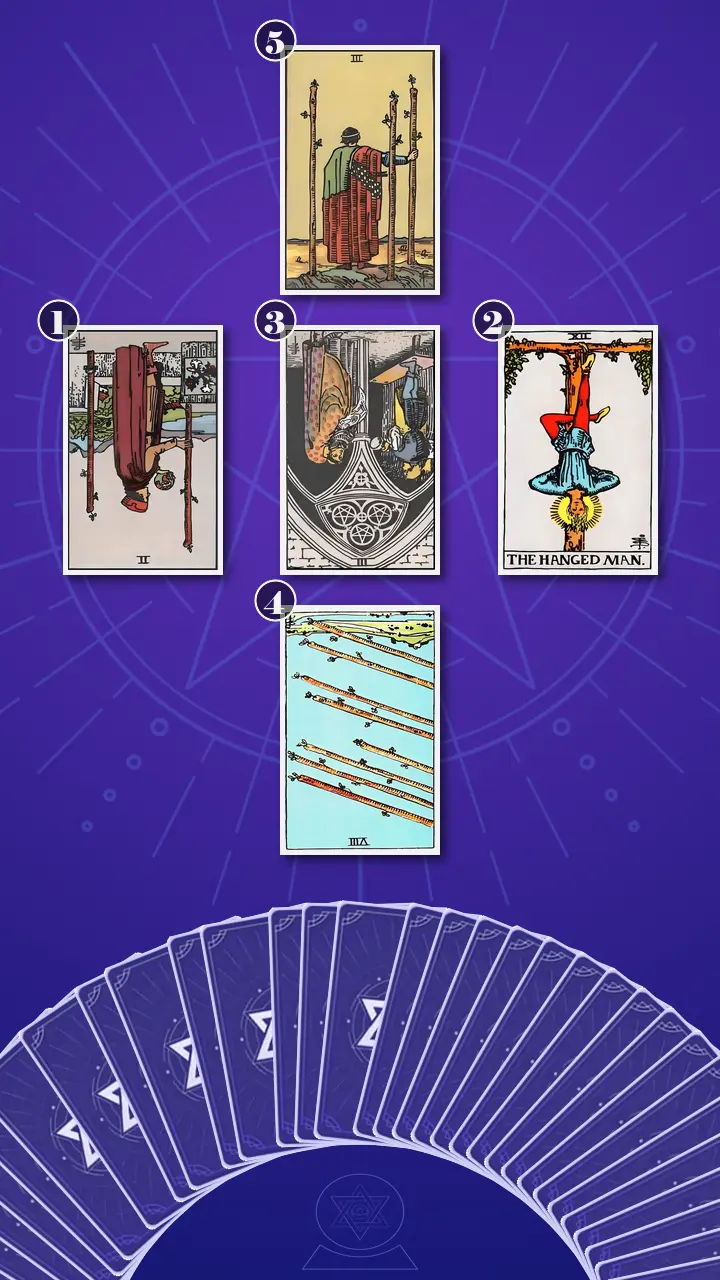
I arranged the cards as a cross. The first position would show Jordan’s contribution to the stalemate. The second would examine the stakeholder side using only observable behavior. Those two positions would meet at the center, where the spread would reveal the collaboration knot. Beneath it, the fourth card would expose the operational mechanism sustaining the delay; above it, the fifth would define a self-directed bridge from waiting to responsible action.
The layout resembled a suspension bridge in cross-section: two banks feeding pressure into a stressed central joint, an anchor underneath, and a lookout point above. That structure made the Relationship Spread more useful than a simple act-or-wait comparison. Jordan did not need a binary verdict. They needed to know what kind of pause was useful, which decisions genuinely required approval, and what reversible movement could remain within their authority.
The Globe That Never Left the Wall
Position One: Two of Wands Reversed and the Blank Prototype Date
I began with the position representing Jordan’s present contribution to the stalemate: strategic foresight becoming repeated planning, scenario modelling, and postponed action. I turned over the Two of Wands, reversed.
In the Rider-Waite-Smith image, a figure holds a globe while standing behind a stone battlement. The whole horizon is visible, yet the body remains inside the wall. Reversed, the card showed blocked Fire: Jordan had initiative and vision, but that energy had been diverted into an excess of contingency planning. Foresight was no longer preparing movement. It was trying to eliminate exposure before movement began.
I brought the image directly into Jordan’s Tuesday. After the review moved again, they opened version twelve of the concept deck, added another possible objection, and left the 45-minute Figma prototype unscheduled. They could see the product horizon clearly, but acting before every response arrived felt like risking support and revealing how little control anyone really had over the final direction.
“The inner sentence sounds like this,” I said. “‘If I can model one more reaction, then I can move without political cost.’ But if another round of planning cannot remove political risk, what is the extra slide actually protecting?”
I let the question settle before adding, “Responsible preparation has an action condition. Indefinite containment always finds one more condition to add. Waiting is still a decision when delay is allowed to edit the work.”
Jordan’s breath caught first. Their gaze slipped away from the card as if they were replaying the last three calendar changes. Then they gave a brief, bitter laugh and rubbed their thumb along the rim of the coffee cup.
“That’s too accurate,” they said. “It’s almost rude. The prototype date is literally blank.”
I smiled, but I did not soften the distinction. “The card isn’t calling you indecisive. It’s showing that a skill you genuinely have has become overextended under pressure. You are good at seeing consequences. The question is when that skill stops protecting the work and starts keeping it behind the wall.”
I asked Jordan to name one component that could be tested without changing a production system, exposing a customer, spending budget, or committing the team to a direction. They identified an internal navigation flow. The answer did not resolve the stakeholder question, but it revealed that the whole project was not equally blocked.
Position Two: The Hanged Man and the Difference Between Pause and Projection
I moved to the card representing the stakeholder side through observable timing behavior, while separating actual constraints from motives or reactions Jordan might be projecting onto the delay. I turned over The Hanged Man, upright.
The suspended figure hangs by one foot, but the face is calm and the head illuminated. In balance, this card can describe a conscious pause that earns its time by changing perspective. As a blockage, it describes suspension with no purpose, owner, release condition, or agreed ending.
I was careful here. “The meeting moved,” I said. “That is observable. We do not yet know that the stakeholders oppose the idea, intend to dilute it, or think you acted badly. Tarot cannot give us access to their private motives, and assuming those motives would only add another imagined dependency.”
I drew a line down a sheet of paper and labelled the two sides Observed and Assumed. Jordan reviewed the postponed meeting and found one confirmed engineering dependency. On the other side, they named five predicted objections involving leadership support, attribution, launch language, team capacity, and the possibility of appearing difficult.
“The pause produced one useful fact,” I said. “That fact deserves to influence the work. The other five concerns may become real, but right now they are simulations. The Hanged Man asks what is holding the step and what would release it. A useful pause has a job. Undefined waiting simply transfers shaping power to whatever feedback arrives latest.”
Jordan’s fingers, which had been curled around the cup, loosened. They looked at the two columns for several seconds before saying, “I’ve been treating a calendar change as evidence that there’s opposition. But the only thing I actually know is that the meeting changed.”
“Exactly,” I said. “You do not have to dismiss the delay. You only have to stop asking it to carry information it does not contain.”
Position Three: The Blueprint with No Legible Roles
I turned to the center, the position revealing the current relational knot: delayed and fragmented review was blurring contribution, standards, and ownership of the idea. The card was the Three of Pentacles, reversed.
The upright image shows distinct people gathered around an architectural plan: a craftsperson, specialist contributors, and a visible blueprint. Reversed, the Earth energy was blocked. Everyone was around the work, but the practical structure could no longer hold clear roles, evaluation standards, or decision rights.
I translated the scene into Jordan’s actual workspace. Product, engineering, and leadership were all leaving comments in the same deck. A market-framing preference, a technical warning, and an actual approval decision appeared in the same visual layer. Jordan incorporated the latest language to keep the process moving, then discovered that the concept had become more acceptable to everyone and attributable to no clear decision structure.
“I am trying to be collaborative,” Jordan said, “but I can’t tell which comment is optional, which one changes the premise, or who owns the call.”
Seeing the reversed blueprint, I thought of a multitrack recording in which every channel has been pushed to the same gain. More audible material does not automatically create harmony; without roles and levels, the mix loses its melody. Jordan’s project had plenty of contribution, but no shared way to distinguish expertise from preference, advice from approval, or a scope change from a wording suggestion.
“Collaboration is not the enemy here,” I said. “Ambiguous collaboration is the blockage. The latest comment should not become the loudest requirement by default. A useful project baseline would let new expertise improve the idea without erasing its point of departure.”
At that moment, a Slack notification sounded from Jordan’s laptop. I watched their shoulders rise automatically. They turned the phone face down, and the small movement seemed to echo the card: for once, an incoming signal had not been granted immediate control over the plan.
I asked whether the current deck showed the original problem, the protected design principles, the open decisions, each contributor’s input, and the actual decision owner. Jordan shook their head. Version history proved that changes had happened, but it did not preserve the decision logic in a form anyone could use.
Their expression tightened, and then their chest sank with a long exhale. “I thought keeping every version protected my authorship,” they said. “But it only proves I kept making files.”
“That is the distinction,” I replied. “A trail of files is not the same as a visible baseline. Authorship does not require denying other people’s contributions. It requires a legible record of the original intent, the reasons for change, and who had responsibility for each decision.”
Position Four: Eight Messages with Nowhere to Land
I moved to the lower position, representing the underlying mechanism sustaining the tension: disrupted communication and the absence of a shared response window or decision threshold. I revealed the Eight of Wands, reversed.
Upright, eight staves move together across an open sky. Reversed, that coordinated Fire becomes scattered movement: plenty of speed and signal, but no shared arrival point. This was the spread’s operational catalyst because it translated Jordan’s stuck feeling into a workflow that could be observed and changed.
I named the four channels already carrying fragments of the same review: a Slack thread, an email reply, a reopened Google Slides comment, and a meeting that had moved again. None contained the exact decision, the accountable owner, a reasonable response date, and the next protected action.
“There is plenty of communication,” I said, “but nowhere a decision actually lands. Message volume is being mistaken for decision clarity. Every new ping spikes the sense of urgency, yet the project still has no shared trajectory.”
Jordan nodded and told me about drafting three separate responses on Line 1 after receiving a Slack reply to yesterday’s email, a reopened slide comment, and another calendar update. By the time the train reached Bloor, there were more words in circulation but still no answer to the blocking question.
I gathered the imaginary channels with one hand over the card. “The change begins when those scattered staves converge into one written statement: the decision needed, whose input is requested, the response window, and the smallest reversible action you plan to take if no new constraint appears.”
Jordan’s forehead creased. “That sounds like an ultimatum. And silence isn’t approval.”
“Correct,” I said. “Silence must never be treated as permission for customer exposure, production changes, spending, hiring, security decisions, legal commitments, accessibility exceptions, or anything else requiring formal authority. But silence also does not have to freeze every private mock-up, annotated flow, or internal test plan already within your remit. A response deadline is not an ultimatum when it names a reversible default.”
Their shoulders dropped on the exhale. What had felt like a personality problem now looked more like calendar Tetris running without an end condition: each moved review automatically displaced focus time because nobody had defined what could continue safely while the decision remained open.
When the Three of Wands Sent One Ship Beyond the Shore
Position Five: The Bridge from Unanimous Readiness to Visible Authorship
I reached the upper position, the card defining a self-directed bridge from waiting to action: preserve the core intent, state the decision boundary, and advance one reversible step without attempting to predict a perfect date. The ventilation in Jordan’s meeting room clicked off, and the sudden quiet made the distance between us feel smaller.
I turned over the Three of Wands, upright.
A figure stands on an elevated shoreline beside three planted wands. Ships are already moving across the water. The figure has not abandoned the larger horizon, but progress no longer depends on keeping the whole idea behind a wall. In card meanings applied to context, the Three of Wands offered disciplined foresight, visible authorship, and proportionate initiative.
I described the modern scene the card suggested. Jordan publishes a one-page baseline naming the original problem, protected principles, open decisions, and contributors. When a written response window expires, or another delay would materially change scope, attribution, or reversibility, they begin a low-risk internal prototype within their authority. Stakeholder input remains welcome, but it enters a visible structure instead of silently replacing the point of departure.
This was where I applied what I call a Tempo Misalignment Audit. Over ten years of working with sound and rhythm, I have found that the sensation of pushing against a wall often appears when psychological tempo and executable tempo have fallen out of sync. Jordan’s mind was running at the speed of every possible second-order consequence, while their daily work could only move through finite design blocks, named decisions, and actual evidence.
I identified the repeating beats. A meeting moved; Jordan’s internal BPM accelerated. They refreshed four channels; the executive rhythm fragmented. They revised the deck to regain temporary control; the prototype beat disappeared from the week. Their ambition was not deficient. It was being forced to play against a stakeholder rhythm that had no reliable downbeat.
My Execution Rhythm Calibration shifted the diagnostic question. Instead of asking, “How can Jordan make everyone ready at once?” I asked, “What beat can remain stable even when the review tempo changes?” The answer was not a full launch. It was a documented baseline, a written decision window, and one reversible internal test already placed on the calendar.
I could see Jordan still caught in the old calculation: if they moved, they might lose support; if they waited, they might lose the idea. They were searching for a politically cost-free instant, even though each search had already allowed delayed feedback to alter the work.
Unanimous timing is not the price of authorship: define the horizon and launch one bounded experiment, like the Three of Wands sending a ship beyond the shore.
I stopped speaking.
For one beat, Jordan did not move. Their breath froze high in their chest, and their fingers hovered above the table as though an invisible keyboard had vanished beneath them. Their eyes lost focus, replaying something I could not see; then their pupils widened and the muscles beside their mouth tightened. Recognition arrived before relief. Their shoulders began to lower, but the release left them looking briefly unsteady, as if setting down a heavy case had revealed how long they had been carrying it.
Their eyes shone, yet their voice came out sharper than before. “But doesn’t that mean I handled all of this wrong? I’ve spent weeks trying to be responsible.” The anger lasted only a moment. Their hand opened, palm upward, and the question softened into a shaken exhale. “If I stop waiting for the perfect moment, then I’m the one who has to choose the boundary.”
“Yes,” I said. “Clarity returns responsibility as well as relief. But this does not mean your earlier strategy was foolish. It reduced immediate conflict and helped you gather one real dependency. It only became costly when a temporary safety strategy turned into the project’s permanent tempo.”
I gave Jordan the practical threshold in one sentence:
Act at the edge of reversibility, not the edge of certainty: when the written decision window closes, or another delay would change scope or attribution, document the idea and move the smallest authorized step.
I then asked, “Now, using that new perspective, think back to last week. Was there a moment when this insight could have made the situation feel different?”
Jordan looked toward the darkened office behind their screen. “Friday,” they said. “Engineering had confirmed one dependency, but I postponed the whole flow. I could have prototyped the internal navigation states. They wouldn’t have touched production or committed anyone to the launch direction. I treated one unresolved decision as if it blocked every form of learning.”
I set an eight-minute timer and asked Jordan to open a private note. They wrote four lines: the idea’s core intent, the exact decision still pending, a reasonable response cutoff, and one reversible step available within their authority if that cutoff passed. I told them they did not have to send anything during the consultation. The first task was to see whether a safe boundary could be stated plainly.
I also made the guardrail explicit. If the proposed step could affect customers, production systems, budgets, employment conditions, security, legal obligations, or accessibility requirements, it would remain an internal mock-up or planning artifact until required approval existed. If the process felt politically or personally unsafe, Jordan could stop at one private sentence and review it with a trusted peer.
When the timer ended, the note held a core intent that still sounded like Jordan’s original idea. Their jaw had unclenched, although they still looked at the response date with a flicker of apprehension. I named the transition I had witnessed: this was a first movement from pressured vigilance and approval-dependent hesitation toward grounded confidence in visible authorship and proportionate initiative. It was not certainty. It was a usable relationship with uncertainty.
The Three-Day Syncopation Reset
I read the spread back as one coherent story. The Two of Wands reversed showed Jordan holding the whole horizon inside a planning wall. The Hanged Man revealed that one confirmed dependency had become entangled with five assumed reactions. The Three of Pentacles reversed showed those assumptions entering a collaboration structure where advice, approval, and decision ownership were not distinguished. The Eight of Wands reversed exposed the mechanism: fragmented messages and moving meetings with no shared release condition. The Three of Wands then repositioned the same foresight on an open shoreline, where one bounded test could move without abandoning the larger plan.
The cognitive blind spot was not simply “overthinking.” That label would have ignored legitimate power dynamics and real dependencies. The blind spot was treating the absence of complete stakeholder readiness as proof that no reversible learning could begin. Jordan had also been treating repeated communication as if it would eventually generate a decision boundary on its own.
The key shift was practical: move from waiting for everyone to become ready at the same time to setting a written response deadline, preserving the original decision logic, and advancing one authorized, reversible step when the threshold passed. Stakeholders could still improve the work. What changed was their input no longer had to enter as an unlabeled edit to the idea’s identity.
To convert the reading into actionable advice without creating another elaborate process artifact, I shaped the next steps into my Syncopation Reset: a three-workday tempo adjustment. Each day restored one beat that approval limbo had displaced.
- Day One: Run the five-minute pause audit.After the next moved meeting, open a private note with three columns: “Observed,” “Learned during the pause,” and “Assumed reaction.” Use no more than three bullets per column. Circle the one confirmed fact that genuinely changes the prototype, then write the date, missing fact, or scope change that would end useful waiting.Keep the audit factual and private. Do not infer motives or use it to prove that a stakeholder is unreasonable. If the context feels unsafe, ask a trusted peer to check your fact-versus-assumption distinction.
- Day Two: Plant a one-page authorship baseline.Reserve one 25-minute block in Notion, Confluence, or the team’s usual workspace. Record the original problem, a one-sentence hypothesis, three protected design principles, open decisions, relevant contributors, and the known decision owner for each question. Link it from the current deck and log later changes as input received, decision affected, outcome, and contributor.Frame the page as project memory, not a claim of sole credit. If a full page feels politically heavy, begin with only “Core intent,” “Open decisions,” and “Change log.”
- Day Three: Create one decision window and protect the next beat.Spend 15 minutes drafting one message in the existing project channel with four labels: “Decision needed,” “Input requested from,” “Response requested by,” and “Reversible next step if no new constraint appears.” Place a 45-minute Figma block immediately after that cutoff, label the file with the single hypothesis it tests, and add explicit stop conditions for security, user risk, contract, accessibility, or hard-to-reverse scope changes.Draft the minimum four-line version privately first. Silence is not approval. If authority is unclear, limit the default to an internal mock-up, annotated flow, or test plan with no customer, production, financial, legal, employment, security, or accessibility impact.
I told Jordan that the Reset was not designed to make them work faster. Its purpose was to restore a stable beat inside a variable environment. The stakeholder tempo could remain imperfect; Jordan’s baseline, response window, and reversible prototype block did not have to disappear every time the calendar changed.
That distinction mattered. Protecting creative ownership did not require locking the deck, rejecting new expertise, or launching the full concept in defiance of dependencies. It required a visible thread through the collaboration labyrinth: where the idea began, which turns new evidence justified, who contributed, and what Jordan could responsibly test next.
Six Days Later, Three Clickable Frames
Six days later, I received a short message from Jordan. They had completed the Observed-versus-Assumed note, published the three-heading version of the concept baseline, and sent a procedural response request in the existing project channel. The message named the pending decision without pretending that silence would authorize anything beyond an internal mock-up.
When a late slide comment arrived, Jordan recorded it as input connected to a specific open decision. They did not automatically rewrite the opening premise. After the response window closed without a new constraint, they kept the protected Figma block and built three clickable internal frames testing the navigation hypothesis.
The prototype did not solve the project, settle attribution, or guarantee support. It produced one piece of real evidence, preserved the original question, and gave the next stakeholder conversation something concrete to examine.
That night, Jordan slept through. Their first thought the next morning was still, “What if I got this wrong?” They told me they smiled, checked the stop conditions, and made coffee before opening Slack.
I did not see tarot choose Jordan’s future. I saw it help them hear the difference between a rhythm imposed by approval limbo and a rhythm they could set within their actual authority. The cards supplied the map; Jordan supplied the boundary, the documentation, and the movement.
I want to leave the same recognition with anyone whose jaw tightens over version twelve when another meeting moves. The hardest part is not simply waiting. It is feeling that action could cost support while waiting may erase your hand from the work. Noticing that conflict already brings the planning wall into view.
If you let your next decision window have an ending, what is the smallest internal, reversible ship you can allow to leave the shore while the idea still sounds like yours?