Workplace Hyper-Independence: Choosing a Bounded Ask Before Crisis
At 6:40 p.m., Workplace Hyper-Independence Looked Like a Spreadsheet
You are an early-career city professional, and a colleague's “happy to help” message is sitting unread while you build another tracker from scratch. Workplace hyper-independence can look remarkably productive from the outside.
That was how Maya appeared on my screen from her Toronto apartment at 6:40 on a Tuesday evening. She turned her laptop towards the camera and showed me a Google Sheets tracker with its status columns renamed for the third time. The fan hummed under her palms. A mug of tea sat beside the keyboard, cold enough that a faint skin had formed across the surface.
In the corner of the screen, a Slack banner read, “I used a template for this last month and can walk you through it.” I watched Maya's shoulders lift before she even opened the message. Her jaw settled into a hard line, and her next breath stopped somewhere high in her chest.
“The offer creates relief for half a second,” she told me. “Then the rule arrives: I should understand the workflow before I reply. I know people have offered to help, but I should at least know what to ask first.”
What she called frustration seemed to sit in her body like a browser tab playing sound somewhere out of sight: impossible to locate, impossible to ignore, and quietly draining power from everything else. She wanted practical support that would help her act. At exactly the same time, receiving it felt dangerously close to admitting she could not act alone.
“It feels faster to do it myself until it suddenly isn't,” she said. “I don't want help to become evidence that I couldn't handle it.”
I told her I did not hear laziness, ingratitude, or a lack of motivation. I heard a protective system making a reasonable resource feel like a verdict on her worth. Support can be visible and still fail to become usable.
“I won't use the cards to predict whether you succeed or to tell you which offers you must accept,” I said. “I want us to see the sequence clearly enough that you can choose where to interrupt it. Let's make a map of the fog, then find one door you can test without giving away the keys.”

Choosing the Folded Map
I invited Maya to put both feet on the floor, lower her shoulders as far as they would comfortably go, and take one unforced breath while holding the question: “Why do I keep overlooking support that could help me act?” I shuffled slowly. The pause was not a mystical performance; it was a way to move her attention from the noisy task into the pattern surrounding it.
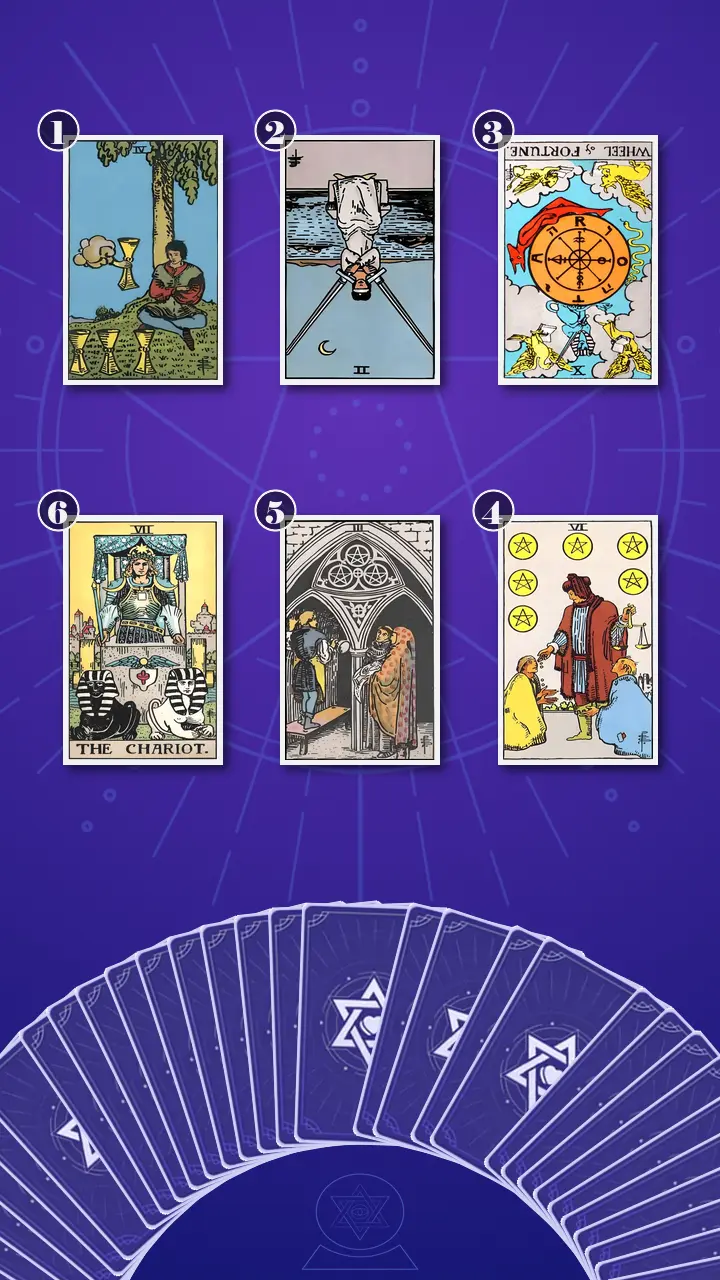
I chose the Transformation Path Grid - Context Edition, a six-position tarot spread for mapping overlooked support, the self-reliance loop, and supported action. For readers wondering how tarot works in a situation like this, I use card meanings in context as structured prompts. The images externalise a pattern that is difficult to examine while it is happening. They give us something concrete to question, compare, and test against lived evidence.
This spread was more useful than a broad ten-card reading because Maya's difficulty had a specific causal chain. The first three cards would show the visible habit, the immediate blockage, and the recurring mechanism beneath it. The fourth card would mark the leverage point. The final two would translate that insight into a collaborative method and an integrated form of agency.
I placed cards one, two, and three across the top row. I set card four directly below the third, then moved left through cards five and six. The layout resembled a folded transit map: the upper row traced the familiar dead end, while the lower row revealed a route back into movement. The cards would not choose the destination. They would help Maya see where she kept missing the transfer.
The Upper Row and the Familiar Dead End
Position One: The Fourth Cup Inside a Slack Banner
I began with the position representing the observable symptom: continuing to plan alone while an available offer of help goes unused. I turned over the Four of Cups, upright.
I pointed to the seated figure's folded arms, the three familiar cups receiving all his attention, and the fourth cup being extended plainly into view. In Maya's workday, that fourth cup was not hidden in a cloud. It was the Slack notification beside her tracker.
At 6:40 p.m. in her Toronto apartment, Maya had been rebuilding a project tracker while an unread message offered the exact template and walkthrough she needed. The support was visible on the screen, but her attention remained fixed on the familiar task of solving the problem privately. The offer existed, yet it had not become actionable information.
I read the card's Water energy as blocked receptivity. There was no deficiency of available support in this scene and no deficiency of effort. The blockage was attentional: inward absorption made the known problem feel more relevant than the offered resource. It was like muting the one Slack thread containing the answer while repeatedly refreshing a blank search tab.
“The sentence underneath this card sounds like, 'I see it, but I cannot use it until I understand enough to deserve it,'” I said. “The card is not accusing you of rejecting people. It is showing how quickly your focus closes around private control.”
Maya gave one short laugh, but no amusement reached her eyes. Her fingers tightened around the cold mug before loosening again. “That's so accurate it's almost cruel,” she said.
I slowed down rather than treating recognition as agreement I had won. “Accuracy is not an accusation,” I told her. “This is a behaviour we can observe, not a character verdict. Think about the last task that stalled. What message, template, meeting, or contact was already visible while you began another private plan?”
She looked back at the unread Slack banner. “That one,” she said. Then she opened Slack's Save for Later list and showed me three more offers, each preserved carefully enough to become a quiet archive instead of an action.
Position Two: Two Drafts, No Free Hand
I moved to the position revealing how an offer of support becomes another decision point, producing hesitation rather than movement. The card was the Two of Swords, reversed.
The blindfold narrowed the figure's perception. The two swords crossed over her chest occupied both hands, leaving no hand available to receive anything or begin the work. Reversed, the card showed Air in blockage and excess: too much interpretation circulating without a decision strong enough to release it.
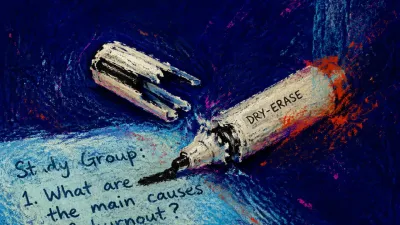
I asked Maya to describe the last time an ordinary reply had become a private referendum on competence. She told me about sitting in a glass phone booth at her hybrid office. The ventilation had rattled overhead, and the booth smelled faintly of dry-erase marker. Two replies waited on her screen: “Yes, could you show me?” and “Thanks, I think I have it.”
She had alternated between the drafts, deleted neither, and returned to the tracker without sending anything. Relief had said the walkthrough could help. Self-protection had said that asking too early might expose what she should already know. Maintaining both interpretations consumed the attention she needed for the next visible step.
“If I accept, they may think I don't belong in the role,” Maya said. “If I decline, I still have to solve it, but at least nobody sees the gap.”
I watched her palms press into her knees. Her breath paused, her gaze moved away from the cards as though replaying the phone-booth screen, and then her jaw softened by a fraction.
“That is the competence stalemate,” I said. “The reversed Two of Swords does not ask you to resolve every feeling before replying. It asks whether you can reduce the choice to one person, one question, and one next step. Otherwise, image protection becomes a second task layered on top of the first.”
I also named the overcorrection risk. Escaping the deadlock by asking five people a broad question would only create a new pile of advice to organise. The alternative was not total self-sufficiency or indiscriminate help-seeking. It was discernment with a narrow scope.
Position Three: The Algorithm That Kept Serving the Same Loop
I turned to the position exposing the repeated mechanism beneath the blockage: returning to solo control because its familiarity provides short-term relief. I revealed the Wheel of Fortune, reversed.
I was careful with this card. I did not read the reversed Wheel as bad luck or a prediction that Maya was doomed to repeat herself. I read it as a system diagram. Its energy showed a blockage in adaptive change: a familiar response kept receiving the same input and generating the same result.
Maya described three supposedly different assignments that had followed one sequence: an incomplete brief, a fresh private plan, ignored resources, mounting deadline pressure, and an urgent request for broad help. On Sunday, she had found files named “project-tracker-final,” “project-tracker-final-v2,” and “new-approach” beside the untouched team template. The blue-white screen had made her eyes ache while Monday's deadline alert waited in the corner.
The pattern had the workday logic of Groundhog Day, but it was not controlled by fate. It was more like an algorithm learning that private overwork reliably held her attention, then serving her another solo method whenever uncertainty appeared. Every duplicated Notion board promised a fresh start while carrying the same bottleneck into the copy.
This was where I used what I call Limiting Belief Deconstruction. I audited the loop without turning it into a diagnosis: ambiguity triggered the hidden rule that capable people should proceed alone; the rule produced private rebuilding; rebuilding created a short-term sense of control; the delay created deadline pressure; crisis-driven help-seeking then made support feel chaotic or unreliable. The final experience appeared to confirm the belief that had produced it.
“Another private plan can feel like progress while preserving the stall,” I said. “The self-sabotage is not that you want control. It is that the method you use to recover control quietly increases the conditions that make you lose it.”
Maya's fingers stopped moving over the mug. Her eyes narrowed first, then drifted towards the version history on her screen. Finally, she exhaled through her nose. “Every time this happens, I tell myself this version will be different because I'll finally make the perfect system,” she said. “But it is the same sequence with better column colours.”
I asked her to look at the loop as the sphinx above the Wheel might: not from inside the spin, but from the observing position. The practical question was no longer, “Why am I like this?” It was, “Which repeated response can I change before the cycle gathers speed?”
When the Six of Pentacles Gave the Request Edges
Position Four: The Exchange That Preserved Agency
The laptop fan dropped into silence just as I reached the visual pivot of the grid. Late-winter light shifted across Maya's kitchen wall, and the Slack banner faded from the corner of her screen. I turned over the card representing the leverage point: recognising support as a bounded, reciprocal resource rather than evidence of incapacity.
It was the Six of Pentacles, upright, the key card and antidote in the reading.
The scales in one hand suggested practical discernment. The coins moving from the other hand showed a resource becoming real through an explicit exchange. I read the Earth energy as balance: receptivity with boundaries, generosity with proportion, and retained responsibility rather than rescue.
In Maya's daily life, this looked like accepting a colleague's twenty-minute walkthrough for one defined part of the tracker. She could ask to see the existing handoff template, clarify one decision, and remain responsible for adapting the process and delivering the final version. Support became a measured exchange instead of a referendum on her capability.
I returned to the opening image: at 6:40 p.m., the laptop fan hummed, the tea was cold, and the helpful Slack message stayed unread while another tracker took shape. The task looked like the problem, but the breath held before replying revealed the real decision point.
Then I used Imposter Syndrome Decoding to separate Maya's authentic potential from the fear of being found out. Her potential was visible in her ability to define the question, evaluate a template, adapt the advice, and own the result. The fear had collapsed one knowledge gap into a global claim: “If they see what I do not know, they will discover that I am not capable.”
The scales exposed the missing variables in that equation. Who was being asked? For how long? About which part? What information was appropriate to share? Which decision remained Maya's? Once those terms were restored, “asking for help” stopped being one enormous identity test. It became one reviewable exchange.
The stall is not proof that support is absent. It is the moment to give one available offer clear edges: one person, one need, one next step.
Needing help does not cancel your agency; a specific request creates movement, just as the Six of Pentacles turns available resources into a balanced exchange.
For one beat, Maya froze. Her breath stopped halfway in; her index finger hovered above the trackpad; her eyes widened, then lost focus as though the two phone-booth drafts were replaying behind them. Colour rose under her eyes. Her shoulders dropped, but the release seemed to leave her briefly unsteady, like stepping off an escalator that had been carrying her backwards. Then her mouth tightened. “But if that's true, doesn't it mean I made all of this harder? That I was wrong every time?” Her voice had an edge before it thinned into a shaky exhale. I let the anger have room. “It means the strategy protected you from exposure and charged you in delay,” I said. “You were not foolish. You were using an expensive protection, and now you can price it accurately.” Her fist opened against the table. Her eyes shone, and she gave a small, almost embarrassed laugh. I asked, “Now, using this new perspective, think back to last week: was there a moment when this insight could have made the situation feel different?”
“The phone booth,” she said after a pause. “I could have asked for the template without explaining my entire confusion. I would still have decided how to use it.” Her relief came with a visible blankness, the slight dizziness of putting down a weight and realising that free hands also carry responsibility.
I told her this was the key crossing in the reading: from guarded self-reliance and crisis-driven help-seeking towards grounded agency through bounded collaboration. It was not a promise that every offer would be useful or safe. It was the beginning of testing support before pressure narrowed her options.
“Receiving input is not handing over the steering wheel,” I said. “Competence is not the absence of support; it is the ability to use support without abandoning your judgement.”
The Route Back Into Movement
Position Five: The Rough Draft on the Workbench
I moved left to the position showing how Maya could involve one person in one clearly defined next step. I turned over the Three of Pentacles, upright.
The craftsperson remained on the workbench while two other figures examined the plan. Nobody displaced the maker. Each person had a distinct role, and the unfinished structure improved through visible, relevant input. I read this second appearance of Earth as balanced collaboration: practical knowledge moving early enough to shape the work.
For Maya, the modern scene was a fifteen-minute peer review. She could share a rough tracker, ask a trusted colleague to review only the handoff workflow, and then implement the next version herself. The colleague would examine one defined section; Maya would remain the builder, choose what to apply, and own the next action.
“They are reviewing this part; I am still building the whole,” I offered as the card's working sentence. “It is like granting comment access to one section of a Google Doc, not handing over the entire file and your authority with it.”
Maya pulled the tracker back onto the centre of her screen. She started to apologise for how unfinished it was, caught herself, and closed her mouth. Then she drew a yellow box around the handoff column.
“This section,” she said. “I actually know the question. I just thought I had to clean up everything around it before anyone saw it.”
“That is the practical shift,” I said. “Polished privacy becomes useful early visibility. One person. One question. One next step.”
Position Six: The Charioteer Between Two True Needs
I reached the final position, which depicted the integrated state: coordinating inner tension and external support while retaining responsibility for the chosen direction. The card was The Chariot, upright.
I pointed to the black and white sphinxes. I did not ask Maya to defeat one and obey the other. I read them through a Jungian psychological lens as opposing but legitimate impulses: one valued autonomy; the other recognised the usefulness of connection. The charioteer's task was to hold the centre and choose where their combined energy would go.
The Chariot's will was in balance, rather than the excess control of doing everything alone. In workday terms, Maya could use a colleague's input to clarify the route, record the next action in the project board, and move forward without waiting for every uneasy feeling to disappear. Support informed the direction; it did not select the destination.
Looking at the card, I remembered navigating an unfamiliar city years before smartphones. A stranger could point me towards the correct tram, but the destination remained mine. The guidance changed what I could see, not who chose the journey.
“Both impulses are here, and I can still decide what happens next,” Maya said, testing the sentence aloud. She sat back for the first time in the reading. Her shoulders stayed lower, although one thumb still rubbed the edge of her phone.
I also showed her what the spread did not contain: there were no Wands. I did not see a lack of drive that needed to be fixed with more motivation. The blocked half of the spread was inward Water and crossed Air: absorption, interpretation, and self-questioning. The lower row brought repeated Earth: a template, a time boundary, a shared plan, and a concrete next action. Her intention had been present all along. It needed a grounded channel.
The Support Check Before Another Blank Document
When I read the spread as one story, the answer to Maya's question became precise. The Four of Cups showed the visible offer that did not become usable. The reversed Two of Swords showed why: receiving support carried relief and threat at once. The reversed Wheel showed how private replanning briefly restored control, then created deadline pressure and crisis-driven help-seeking. The Six and Three of Pentacles inserted a different input: a bounded exchange followed by role-specific collaboration. The Chariot returned the final decision to Maya.
Her starting state had been like pacing inside a room with several unlocked doors while continuing to search for a hidden exit. The cognitive blind spot was not simply “I forget that help exists.” It was the assumption that support had only two forms: complete self-sufficiency or surrendered ownership. That binary prevented her from evaluating ordinary questions about scope, trust, access, time, and relevance.
I also made the safety boundary explicit. The reading did not tell Maya to accept every offer, disclose sensitive work, or trust someone whose authority or communication style felt unsafe. An offer does not create an obligation. Discernment includes a clear decline. The change was to evaluate support deliberately instead of allowing an automatic worth judgement to decide before the offer had even been opened.
The transformation direction was simple enough to remember: before creating another solo plan, identify one existing source of support and make one bounded request tied to the next visible step. For finding clarity to matter, however, I wanted the insight converted into actionable advice she could test without restructuring her life.
The Cognitive Reframing Protocol for a Bounded Ask
I introduced my Cognitive Reframing Protocol, a short journaling structure for translating vague fear into risk-management data. The goal was not to argue Maya out of discomfort. It was to separate a prediction about her worth from observable facts and a reversible experiment.
- Run a seven-minute existing-support scan. Before opening a new document for one stalled task, Maya will sit at her desk or use a quiet meeting room and write three lines: “Fear predicts...”, “Available evidence says...”, and “The smallest bounded test is...” She will then search the relevant Slack channel, shared drive, or project folder for one already-connected person, template, or example. Tip: The minimum version is to write one person's name and one resource, then stop. Identifying support does not obligate her to use it.
- Send the two-sentence bounded request. From her desk or a private room, Maya will message one trusted colleague: “I'm deciding how to structure [specific part]. Could you show me the template you used or tell me which option you would start with?” She will keep the request to one decision, one resource, and no more than twenty minutes of the colleague's time. Tip: Use a two-sentence cap and ask only about the next visible decision. If sending the full request feels too exposing, send one screenshot with one section highlighted. Maya retains the right to accept, adapt, or decline the input.
I asked Maya to set the seven-minute timer while we were still together. She opened the stalled task, typed her colleague's name, and wrote the subject of the question: “Which handoff status should trigger review?” She did not have to send it during the session. Drafting it was enough to prove that the fear could be given edges.
The cards had not supplied an external command. They had slowed the self-reliance loop until Maya could see its decision points. The next move remained hers.

Friday Morning, With Both Hands on the Wheel
On Friday, Maya sent me a photo of the updated board in winter light. She had used the template, asked about one handoff column, and kept the next decision. “I still woke up thinking, What if I'm wrong?” she wrote. “I checked the criteria and kept going.”
I valued the uncertainty in that message as much as the progress. She had not solved workplace confidence forever, and accepting one walkthrough had not erased the old reflex. She had simply noticed the stall earlier, tested one appropriate resource, and acted before urgency took over.
That was the quiet proof of this Journey to Clarity. Tarot did not make the colleague helpful, complete the tracker, or steer the project. It gave Maya a structured mirror for the pattern. She supplied the judgement, the boundary, the message, and the next step. The movement belonged to her.
When a helpful message arrives and your shoulders rise before you even open it, the hardest part may be the collision between wanting the relief it offers and fearing that accepting it will say something about your worth. If that collision is familiar, noticing it already places you above the turning Wheel, where a repeated response can become a conscious choice.
So, if you gave your next request the Six of Pentacles' clear edges, which tiny part of your next step would you let one trusted person see: one tracker column, one draft paragraph, or one decision you still intend to make yourself?