From Couch-Bound Waiting to Focused Agency: One Five-Minute Start

The Morning That Needed a Green Dot
If you are a junior hybrid worker whose work-from-home morning has no meeting or urgent Slack message, you may know the task-initiation freeze of waiting on the sofa for the day to officially begin. I met Jordan on a wet Tuesday in London, and I could see that the question was not really about furniture.
At 9:05 a.m., Jordan sat folded into the sofa of a small flat, laptop balanced against one thigh, phone warm in one hand. The tea beside them smelled tannic and had already gone lukewarm. Outside, a bus exhaled at the kerb while Jordan refreshed Slack, scanned an empty calendar, and felt their jaw tighten around the thought of choosing the first task alone.
'I want to get up and start,' Jordan told me. 'But if nobody has named the task, how do I know my choice counts? A calendar invite feels more real than my own plan. I can start when someone tells me what counts.'
I heard the conflict clearly: wanting to get off the couch and begin, while waiting for permission before taking the first step. The shame-tinged helplessness had the texture of standing outside an unlocked office with the lights on, waiting for someone to say that entry was allowed. The body was still, but the attention was working overtime, listening for a manager's ping, a deadline, or a meeting to make the day legitimate.
'I do not think this is a character flaw,' I said. 'We can look at the loop without shaming the rest you may genuinely need. My job is not to choose your career or become another authority figure. Let us use the cards as a clear, structured mirror and try to draw a map through the fog together.'

The Four Cards Between the Sofa and the Desk
I asked Jordan to take one easy breath and hold the question in mind without trying to force an answer. As I shuffled, I treated the movement as a transition into focused observation, not a supernatural test. I use a Jungian psychological lens, so I let the images give shape to patterns that are often difficult to see while they are happening.
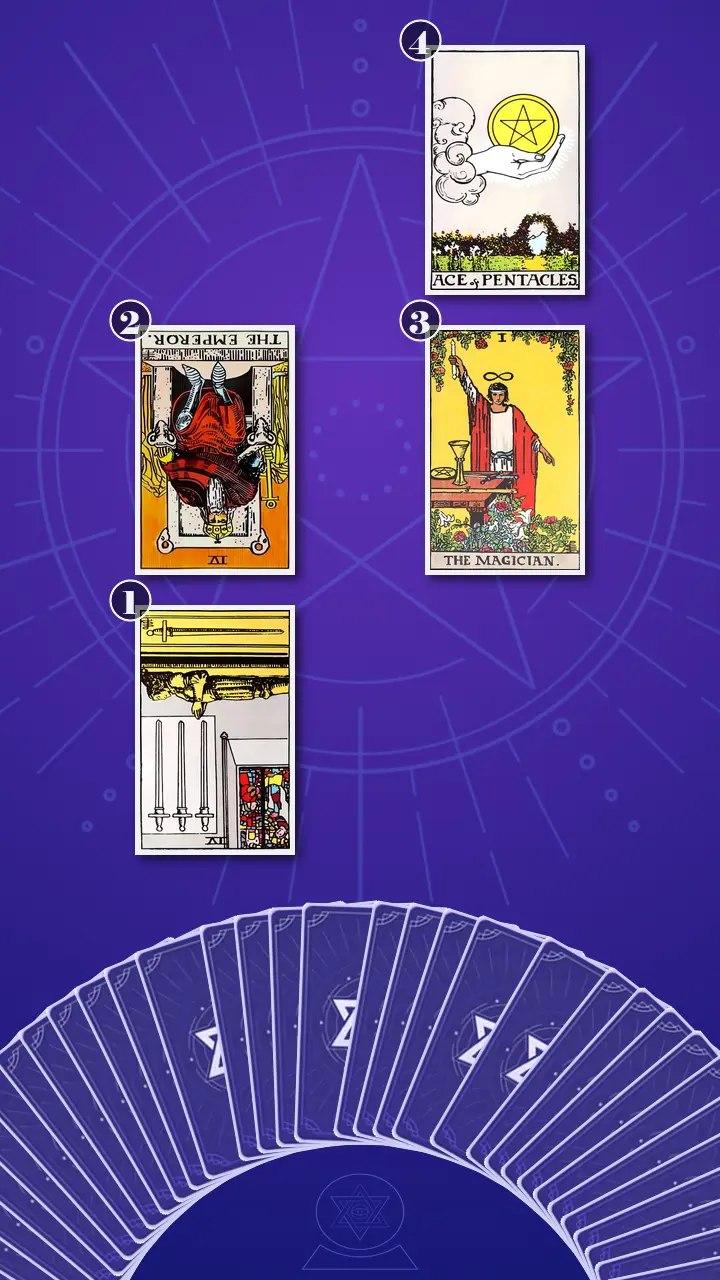
For this reading, I chose the Four-Layer Insight Ladder Context Edition, a custom four-card tarot spread for work procrastination and self-direction. It is deliberately narrow because Jordan was not asking me to predict a promotion, a resignation, or an entire career future. They were asking why an ordinary first move felt as if it required approval.
This spread works as a small systemic deconstruction. The first position shows the present loop, the concrete Couch Rot Spiral of staying on the sofa and checking notifications. The second reveals the root permission script, the borrowed authority that makes self-directed work feel unofficial. The third is the key shift, where agency can be practised. The fourth translates that perspective into action and integration, one grounded step that Jordan can choose without turning it into a verdict.
I explained this to Jordan, and also to anyone reading along: this is one way of understanding how tarot works as a reflective tool. The cards do not issue orders. Their symbols create enough distance for the mind to examine a behaviour, a fear, and a possible experiment without confusing any of them with fate.
Where Rest Turns Into a Waiting Room
The Reversed Four of Swords and the Couch Rot Spiral
I turned the first card, representing the present loop: the concrete Couch Rot Spiral, the notification checking, and the stagnant emotional energy that makes starting feel unavailable. The card was the Four of Swords, in reversed position.
The stone figure lying motionless beneath the swords immediately brought me back to Jordan's sofa. At 9:05 a.m., the laptop was open, the phone was within reach, and the possible tasks were hanging overhead like suspended blades. Slack, email, the calendar, and the task list kept moving through Jordan's attention, but no meaningful work had begun. This was the modern-life translation of the card: the body was paused while professional questions remained active.
The reversed energy was blocked rest. It was not a deficiency of effort or a moral failure. Genuine restoration had been interrupted by unresolved choice. Jordan's physical stillness offered short-term relief from the risk of selecting the wrong task, yet the same stillness kept the task hypothetical and made the next morning harder. As I watched the phone glow against their palm, I thought of a Slack loading screen that had become a waiting room. Nothing new was arriving, but leaving would mean choosing the next destination.
I said, 'You are not resting if part of you is still waiting to be summoned. That does not make rest wrong. It tells us to ask whether this particular pause is restoring you or postponing a decision.'
Jordan looked down at their own phone and gave a small, bitter laugh. 'That is almost too accurate. It is a little cruel.'
I did not rush to turn the reaction into agreement. 'I hear the sting,' I said. 'We are not going to punish you into motion. What would a five-minute action look like if it only had to let rest end, not prove that you have solved the day?'
Jordan's thumb stopped above the screen. Their shoulders shifted, then settled again. The distinction had landed: rest could be a choice, while waiting for permission was a holding pattern disguised as rest.
The Empty Throne of an Open Calendar
I turned the second card, representing the root permission script: the hidden belief that turns self-directed work into something requiring approval from a manager, deadline, or imagined authority. The Emperor, in reversed position, appeared beneath the reading light.
The Emperor's rigid throne became an empty approver field in Jordan's workflow. Jordan had drafted messages asking whether it was okay to begin an ordinary tracker update, reread the role description, and searched the calendar for a meeting that could appoint the first priority. An open workday felt like an office with no manager present, as if useful work became unofficial when nobody was watching.
The reversed energy showed an excess of rigid internal control alongside a deficiency of self-authored authority. Supportive structure had become an approval gate. Jordan's inner rule sounded like this: 'I could choose, but if I choose wrong, the choice might reveal that I do not belong here.' That fear connected a reversible task to professional worth, job security, rent, and future options. I could see why a manager's two-line message brought relief and resentment at the same time. It removed the burden of choosing, while reminding Jordan that the same body had been capable of moving all along.
'The empty throne is not evidence that nobody is in charge,' I said. 'It shows where you have not yet counted your own judgment. That is different from ignoring a real approval requirement. It is about ordinary decisions already inside your role.'
I used my Psychological Bandwidth Audit at this point. I asked Jordan to notice how much daily energy had already been spent before work began: comparing possible priorities, rehearsing the consequences of a wrong choice, monitoring Slack, and preparing to prepare. The audit did not diagnose Jordan. It simply made the hidden cost visible. Their bandwidth was being drained by permission-seeking before the first task had even been touched.
Jordan's jaw tightened first. Then their gaze went unfocused, as if an empty calendar had suddenly replayed a hundred mornings. Their fingers curled against the mug, held there for a breath, and slowly opened. 'I keep treating the blank space like a test,' they said. 'I thought I needed more structure, but maybe I have been waiting for someone to occupy the throne.'
'That is a useful distinction,' I replied. 'We can build light structure without handing your judgment away.'
When the Magician Stood Up
The room became quieter when I reached for the third card. I placed it at the mid-right hinge of the ladder, the position for the key shift: the insight and agency practice that can interrupt waiting for permission and loosen the fear of professional exposure.
The card was The Magician, in upright position. Its raised wand, the table, and the wand, cup, sword, and pentacle arranged before the figure offered a direct counter-image to the reclined body beneath suspended swords. The energy here was activated and balanced. Initiative did not mean frantic movement or limitless confidence. It meant coordinating the resources already present: information, judgment, feeling, communication, and a small amount of practical time.
I applied my Compensatory Routine Decoding lens. The colour-coded list, the extra productivity video, and the repeated task research were not evidence that Jordan lacked discipline. They were coping routines that reduced the discomfort of choosing. Once I saw them as protection rather than proof of failure, the next question became more precise: what small action could replace the routine for long enough to create information?
At 9:05 a.m., your laptop is open on the sofa and nothing is technically stopping you. You refresh Slack, rebuild the list, watch one more clip, and wait for a calendar invite to make standing up feel professionally legitimate.
You do not need to remain beneath the authority of an imagined gatekeeper; like the Magician gathering the wand, cup, sword, and pentacle on one table, you can use the resources already present and begin one focused task.
Permission is not the missing resource; a self-authorized five-minute start is how you test the authority you already have.
Jordan's thumb froze above the phone. Their breath paused, and the hand holding the mug tightened before going still. Their eyes lost focus as if the scene were moving backwards through the morning: the empty calendar, the cold tea, the task list rebuilt for the third time. Then their shoulders dropped by a fraction. Jordan placed the phone face down, looked at the table, and let out a breath that seemed to come from below the tightness in their chest. 'So my first move does not have to prove that I am qualified?' they asked, the last word wavering. There was relief in the question, but also a brief blankness, the light dizziness of finding out that responsibility has returned to your own hands. I told them that the point was not to feel certain first. The point was to let a limited action show what information was available. 'Now, use this new perspective to think back: was there a moment last week when this insight might have made you feel different?'
This was the emotional movement I wanted to name carefully: from shame-tinged helplessness and dependence on external cues toward focused agency and steadier self-trust. It was not a transformation into someone who never hesitates. It was one step from needing a verdict before action to allowing action to become evidence.
One Pentacle, Not a New Personality
I turned the fourth card, representing action and integration: the small physical step that carries the new perspective from the sofa into a chosen, role-appropriate task. The Ace of Pentacles, in upright position, offered one pentacle in an open hand.
I connected it to the simplest version of Jordan's morning. Feet on the floor. Laptop moved from the sofa to the table. One relevant document opened. Three draft lines, one updated tracker row, or two questions written for a colleague. The modern-life scenario was intentionally modest because the Ace of Pentacles is a tangible seed, not a promise that the whole career question has been solved.
The upright energy was grounded balance. The garden, archway, and visible path suggested that self-trust can be cultivated through contact with real work. It does not have to arrive as a feeling before participation begins. 'I am placing one piece of work into the day, not solving my career,' I asked Jordan to try saying. Their shoulders relaxed, and they chose the weekly update rather than the entire operations backlog.
One Piece of Work Into the Day
When I linked the four cards, the story was direct. The reversed Four of Swords showed a body held in place while attention kept scanning for a signal. The reversed Emperor revealed the rule underneath: an empty calendar had become an imagined approval gate, so choosing a task felt like submitting evidence about professional worth. The Magician brought the authority back to the person holding the tools, and the Ace of Pentacles gave that agency a small, visible form.
The blind spot was not simply failing to identify a priority. It was treating the absence of an instruction as a prohibition, then treating the delay caused by that rule as evidence that self-direction was impossible. The shift was to replace external-cue dependence with a self-authorized five-minute start on one useful, reversible task. The first move could generate information without becoming a verdict.
I then introduced my Ego Unplugging Protocol, a mental boundary exercise for separating self-worth from daily productivity metrics. Before reviewing the result, Jordan would ask three practical questions: Is this task within my role? Is the first action reversible? What can I learn in five minutes? The protocol did not replace manager approval where approval was actually required. It simply unplugged the ego from the idea that every small output had to certify belonging.
I gave Jordan three possible next steps, each small enough to begin and clear enough to stop.
- Choose before SlackOn one home-working morning, write on paper, 'I authorise myself to spend five minutes drafting the first three lines of the weekly update,' then open that document before checking notifications.Tip: Preselect something useful, reversible, and inside your role. It does not need to be the ultimate priority.
- Move the body firstWhen the urge to refresh appears, place both feet on the floor, move the laptop from the sofa to a table or counter, and set a five-minute phone timer for one defined task.Tip: If five minutes feels too loaded, reduce the experiment to standing up, moving the laptop, and opening the relevant file for sixty seconds.
- Review evidence, not worthAfter the timer, save one visible result and write one factual sentence in a note called 'Started Without a Ping': what changed, or what information became clearer?Tip: Stop when the timer ends if you want to. Do not turn the note into a streak, scorecard, or performance review.
I reminded Jordan that self-authorisation has limits. A draft, a tracker row, or a question may be an appropriate start; changing scope, committing money, handling protected data, or making a manager-only decision may still require confirmation. Knowing when to ask is part of self-direction. The cards were not taking the manager's place, and neither was I.

A Small Proof on the Desk
Four days later, I received a message from Jordan: 'I put my feet on the floor before opening Slack, moved the laptop to the table, and wrote three lines of the update. When the timer rang, I stopped. It was not a huge thing, but the document was no longer untouched.'
The change was clear but fragile. The next morning still began with the thought, 'What if I am wrong?' Jordan smiled at it, opened the same file for sixty seconds, and then decided whether more information or approval was actually needed.
I did not read that as card magic or a finished transformation. I read it as the first observable evidence that action could precede certainty, and that Jordan could remain the person deciding what the evidence meant. That is what finding clarity looked like here: not a perfect routine, but a less punishing relationship with the first move.
When an open morning leaves you slumped around a warm phone with your jaw clenched, it may not be because you do not want to move; standing up may feel as though it could expose whether you were ever qualified to choose for yourself. Noticing that difference is already a way of meeting yourself with more accuracy.
If your first move did not have to prove that you were ready, what tiny piece of work might you be curious to place on the desk for five minutes?