Approved, But Was It Your Answer?

Define why you edit yourself for approval, then explore matching tarot cards and insights drawn from readings where the pattern appears.

Approval-driven Self-editing
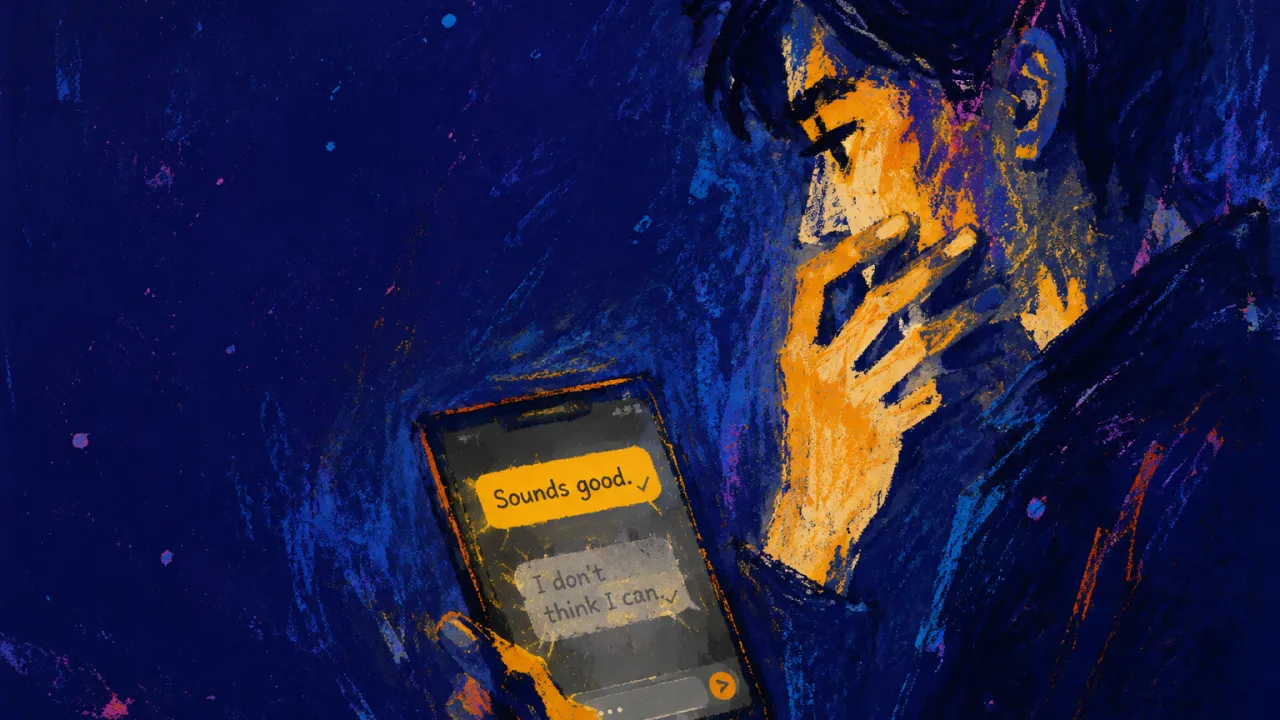
An upright figure touches their jaw while editing a glowing phone message, amber light suspended against deep blue-grey.

What is this really?

You reread a text, scan faces, read receipts, and pauses, then quietly replace the joke, preference, or disagreement you first had with a version more likely to land well. You are trying to stay welcome and prevent the small shift in someone else's expression that can make acceptance suddenly feel uncertain. Yet every successful edit deepens the cognitive dissonance: their approval lands, but it lands on the version you assembled for them, while your first answer becomes harder to hear inside you.

Why did it happen?

This can begin in settings where a small change in someone's tone meant that speaking more carefully helped you stay included and avoid the cold pause after saying the wrong thing. Your mind learned to check the room before letting a thought leave you. Now the same subconscious loop can switch on even when the stakes are low, leaving you rehearsing, revising, and feeling mentally spent before you know what you wanted to say.

How does it feel?

  • You type a reply, watch the other person's typing bubble appear, then erase your first sentence and add 'no worries' before sending. In that pause, your fingertips may hover above the screen while your breathing turns shallow; you can let the pause exist without forcing the next word.
  • In a meeting, you begin with a clear point, catch one raised eyebrow, then give a quick half-smile and replace 'I disagree' with 'maybe I'm missing something.' As the words change, your jaw may stay fixed and your shoulders inch upward before you notice; it is okay to register that reaction without naming it.
  • When a friend asks where you want to eat, you glance at their face, fold the menu closed, and say, 'I'm easy,' before naming a choice. A hollow feeling may settle in your chest as your eyes move back to them for a cue; not knowing your preference yet is allowed.
  • You draft a caption, rest a fingertip along your jaw, delete the sharpest line, swap three words for softer ones, then lower your phone and reopen the post when the first reaction arrives. Your fingertips may feel restless and your eyes slightly strained, as though they are still checking the screen; you can allow the uncertainty to remain for a moment.
  • After a conversation, you replay your voice note, repeat one sentence under your breath, wince at a word, and type a clarification nobody requested. Afterwards, your jaw may feel tired and your shoulders heavy even though the exchange went smoothly; you can leave the moment unfinished for now.

Approval-driven Self-editing in Tarot Cards

Approval-driven self-editing is the reflex to replace a clear point with a safer-sounding version as soon as another face shifts. When your jaw stays fixed and your shoulders inch upward before you notice, Jungian archetypal theory offers a framework for the gap between the accepted presentation and the unspoken response. The Tarot Cards below mirror the unconscious dynamics beneath this editing reflex:

The High Priestess
Upright
The high priestess sits silently between black and white pillars, holding a scroll partly concealed by her robe while a veil covers the space behind her. The image separates visible presentation from protected knowledge, making silence and withheld information feel like a structured response to uncertain judgment. You may notice a first feeling or preference and immediately place it behind an internal veil while you scan for the socially acceptable version. The hidden response is not absent; it has been screened from awareness long enough that approval becomes easier to locate than your own unedited signal.
The Hierophant
Upright
The hierophant sits centrally between two pillars while two figures kneel in front of him, their attention directed toward a formal authority. The image presents belonging as participation in a family code whose rules are learned through observation and repetition. You may censor preferences, soften disagreement, or adopt familiar language around relatives because a small tonal shift has historically signaled disapproval. The pattern can preserve connection in the moment, but it carries an old acceptance rule into adult family interactions where your original voice needs more room.
Reversed
The hierophant raises a formal hand between two pillars while kneeling figures receive the established symbols of instruction. The ritual makes inherited standards visible, showing how a person can learn to measure personal validity through conformity to an approved structure. Read in a reversed orientation, the same arrangement describes the point where borrowed rules no longer support development but continue to edit it from the inside. You may reject a preference, goal, or opinion because it does not fit the identity your community rewards, leaving growth filtered through an authority you have not consciously chosen.
The Lovers
Reversed
The two figures stand beneath an angel with separate trees behind them, one marked by a serpent and the other by flames. Their exposed positions make identity and values visible as choices, while the observing presence represents the pressure to make those choices legible to a larger moral or social frame. Read in a reversed orientation, the scene shows development diverted by the need to remain acceptable. You may adopt the version of a goal or belief that receives approval, then feel the resulting cognitive dissonance when external alignment has replaced genuine commitment.
The Hermit
Reversed
The hermit stands alone on a mountain holding a lantern that contains a small star, with a staff supporting his body. The isolated light represents an inner reference point that can be consulted away from the crowd, while the mountain makes the distance from outside approval physically apparent. Read in a reversed orientation, the withdrawn lantern describes a disconnection from that inner reference rather than a restorative retreat. You may keep looking outward for permission to define what you feel, leaving the original response in shadow while social calibration takes over the task of self-knowledge.
Justice
Upright
The seated figure holds a sword upright in one hand and balanced scales in the other, facing the viewer directly. The image concentrates attention on judgment, evidence, and the possibility that every statement will be weighed against a standard outside the speaker. You may pre-edit workplace communication as if a manager, hiring panel, or colleague were already scoring its acceptability. The careful calibration can look professional, but it becomes costly when avoiding a negative verdict matters more than communicating the clearest version of your judgment.
Reversed
The seated figure faces forward with an upright sword in one hand and balanced scales in the other. The direct gaze and measuring instruments create an internal courtroom in which every thought can be assessed for whether it is reasonable, acceptable, or likely to draw a negative verdict. Read in a reversed orientation, the same physical symbols describe judgment distorted by an imagined audience. You may revise your first response before examining its truth, treating social approval as the scale that determines whether your own experience is allowed to count.
The Hanged Man
Upright
The figure hangs from one leg with his hands behind him and a halo around his head, suspended between ordinary movement and a changed viewpoint. The physical pause makes perspective revision visible, but it also shows how action can be withheld while the mind waits for a safer interpretation. You may keep analyzing whether a new value, preference, or way of speaking will be accepted before allowing it to become part of your life. The pause can support genuine reorientation when chosen consciously, but approval-driven suspension keeps growth theoretical and protects the familiar self from being tested.
The Devil
Upright
The chained figures stand at the base of a pedestal, close enough to the horned figure that the source of power dominates their posture. Their loose chains show how a protective behavior can become self-maintaining when the mind confuses continued compliance with continued safety. You may preserve an approved identity by editing every new preference before it can challenge the old one. The pattern becomes a growth barrier when the relief of being accepted reinforces dependence on external feedback and keeps cognitive ownership outside your own value system.
The Moon
Upright
The moon casts an ambiguous light over the path while a dog and wolf face it from opposite sides and a crayfish emerges from dark water. The scene fills the mind with incomplete signals, creating the exact conditions in which projection and threat monitoring can replace direct knowledge of what is happening inside. You may treat a facial pause or delayed reply as a clue about your worth, then edit your remembered feeling to match the imagined verdict. The uncertainty is real, but the loop turns it into a demand for self-correction and makes your own emotional data harder to trust.
Judgement
Reversed
Figures rise from coffins with their arms lifted toward the angel's trumpet, responding to a call that comes from beyond the ordinary social scene. The image separates awakening from the verdict of a single audience and presents recognition as an invitation to hear a deeper signal. Read in a reversed orientation, the rising figures become a picture of hesitation before an internal summons because imagined judgment still controls the response. You may edit a developing identity into something more acceptable before it can be lived, preserving approval while delaying the self-recognition that would allow real change.
Two of Cups
Reversed
The two figures stand face to face with matching cups raised between them, joined visually by the caduceus and winged lion above. Their mirrored attention captures the sensitivity of a close friendship in which each person is watching the other for signs that the exchange remains mutual. Read in a reversed orientation, the shared gesture becomes a lopsided effort to preserve reciprocity. You may replace your first preference with a more agreeable one after reading a friend's face, receiving the resulting harmony as proof that the edit was necessary rather than as evidence that your real answer could have survived.
Three of Cups
Upright
Three friends lift their cups toward one another in a shared circle, surrounded by flowers and gathered fruit. Their coordinated celebration makes mutual recognition tangible and shows why preserving the group's emotional rhythm can become more urgent than expressing an unedited preference. You may agree to the restaurant, joke, or plan that seems easiest for the group, then notice later that your original answer disappeared before anyone rejected it. Friendship remains warm on the surface, while participation becomes dependent on continuous social calibration.
Four of Pentacles
Upright
The figure locks one coin against his chest while placing his feet over two more and keeping another on his head. The compressed body shows emotional and informational containment, as though revealing a preference could unsettle the whole arrangement of family security. You may hold back an opinion, need, or plan until you can predict how relatives will receive it. The guarded posture reduces immediate exposure, but it also leaves the family interacting with a controlled version of your position and leaves you carrying the burden of maintaining that control.
Five of Pentacles
Upright
Two people walk through cold weather beneath a glowing stained-glass window, visibly separated from the shelter beside them. The exposed bodies and downward movement make exclusion feel like a physical condition, priming the mind to search for the behavior that might restore entry. You may reshape a preference or apology around what you think will keep a friend from pulling away. The edit can secure a quick sign of acceptance, but it also confirms the fear that friendship is available only when you remove the parts of yourself that might create friction.
Six of Pentacles
Reversed
A standing figure distributes coins to two kneeling people while holding a balanced scale in the other hand. The arrangement places care, resources, and social position in the hands of a giver, making acceptance look connected to how well the recipients fit the terms of the exchange. Read in a reversed orientation, the unequal posture highlights how family approval can become conditional and difficult to question. You may edit your requests, opinions, or needs to avoid losing practical or emotional support, confusing accommodation with genuine mutuality.
Eight of Pentacles
Upright
The worker bends over a bench, producing one pentacle after another while the completed pieces line the wall. The repeated hand movement and solitary concentration make correction visible as a practiced loop rather than a single act of care. You may keep rewriting notes, essays, or answers to make them look unquestionably acceptable, even after the underlying idea is sound. Approval rewards the polished surface, while the first interpretation becomes harder to hear and the learning process starts to feel like a test of social safety.
Ten of Pentacles
Upright
Older and younger figures, children, dogs, archways, and patterned robes fill the courtyard, while the family elder sits beneath a canopy of inherited symbols. The dense arrangement makes belonging look like a complete system with roles and traditions that each person must learn to inhabit. You may edit your opinions, lifestyle choices, or emotional responses to remain recognizable within that family system. Approval protects access to shared history and support, yet the ongoing performance can make it difficult to tell which values are inherited and which ones you genuinely endorse.
Two of Swords
Upright
The blindfolded figure holds two swords tightly across her chest, with her back to the water and the distant land. The crossed weapons convert an unspoken judgment into a physical barrier, suspending the first answer until the surrounding emotional conditions feel safe enough. You may experience a choice as an instruction to monitor every face, pause, or possible objection before naming what you want. The apparent neutrality protects you from immediate disapproval, but it also prevents the decision from revealing your own preference.
Five of Swords
Reversed
One person collects swords while two others recede across the bleak shoreline, leaving the social field marked by an uneven contest. The physical separation turns disagreement into a possible loss of connection, which makes preemptive appeasement feel like a rational protective response. Read in a reversed orientation, the retreat becomes the pattern's familiar move toward smoothing things over before the conflict has been fully expressed. You may trade a clear boundary for a quick no worries, preserving the friendship while teaching yourself that direct communication carries too much relational risk.
Seven of Swords
Upright
The figure carries five swords away from the camp while looking over his shoulder at the two remaining swords. His movement is purposeful but divided, showing how a person can conceal a meaningful part of their position while monitoring whether the group has detected the omission. You may share a carefully edited version of your needs with a close friend and call it being low-maintenance. That strategy reduces the chance of immediate disapproval, but it prevents the friendship from responding to your actual preference and leaves you doing all the work of maintaining ease.
Eight of Swords
Upright
The woman is blindfolded and bound among eight swords, with a castle visible beyond the enclosure. The scene depicts a self-limiting belief made tangible, where anticipated consequences restrict movement before the person has tested the actual range of available choices. You may edit a new ambition or insight as soon as it risks separating you from an approved identity. The short-term safety behavior keeps the old self coherent, but it also blocks the cognitive flexibility required to let development become visible in practice.
Nine of Swords
Upright
The figure sits on the bed with their face covered while nine swords hang in a stark line across the wall. The repeated blades resemble a mental archive of tiny errors, showing how an exchange can be replayed until each word feels like evidence requiring correction. You may repeat a sentence under your breath, wince at a phrase, and write a clarification even when nobody requested one. The loop promises control over the past, but it keeps attention fixed on an imagined audience and makes self-acceptance contingent on finding a perfect revision.
Page of Swords
Upright
The page raises a sword while watching the unsettled sky, with his feet planted as though ready to respond to a sudden change. The posture resembles cognitive hypervigilance, where incoming information is scanned for threat before it is integrated. You may read a tutor's comment, a classmate's expression, or a grading cue as a signal that your answer needs immediate alteration. The checking behavior feels intellectually responsible, but it can turn learning into constant anticipation of judgment instead of contact with the material.
Six of Wands
Upright
The mounted figure enters before a visible crowd with a laurel on the head and another around the wand. The scene makes professional recognition public, so approval is not merely felt internally but displayed as a standard the performer is expected to maintain. You may edit a presentation, email, or opinion toward the version most likely to earn visible agreement. Each positive response reinforces the performance, while a quieter original judgment becomes harder to trust because it has not passed through the audience's approval.
Eight of Wands
Reversed
Eight wands travel in parallel through an open sky, carrying the visual force of messages already in motion but showing no speaker or receiver. The uncluttered trajectory makes any hesitation feel concentrated in the unseen moment before communication leaves your hands. Read in a reversed orientation, the image holds the communication channel in a state of delay, where a draft can be repeatedly interrupted by imagined reactions. You may keep softening a text while the social moment moves on, using revision to manage uncertainty that no amount of timing control can fully remove.
Ten of Wands
Upright
The figure bends forward beneath a bundle of wands so large that it blocks his view of the road ahead. His body shows the accumulated load of carrying more than can be comfortably seen, including the invisible work of anticipating every response before a simple interaction is complete. You may experience everyday planning as a chain of small revisions, each one designed to prevent friction with housemates, family, or partners. The system still functions, but your energy is spent transporting other people's imagined preferences instead of hearing which routines are actually sustainable for you.

Approval-driven Self-editing in Tarot Card Reading Insights

Others have brought approval-driven self-editing into readings when the edited answer arrived before their own preference was clear. The Tarot Reading Insights below show where this pattern surfaced alongside their cards:

Psychological Patterns Related to Approval-driven Self-editing