Too Many Paths, One Deadline

Explore crowded study options, the tarot cards reflecting them, and selected reading insights shaped by competing paths and deadlines.

Academic Choice Overload
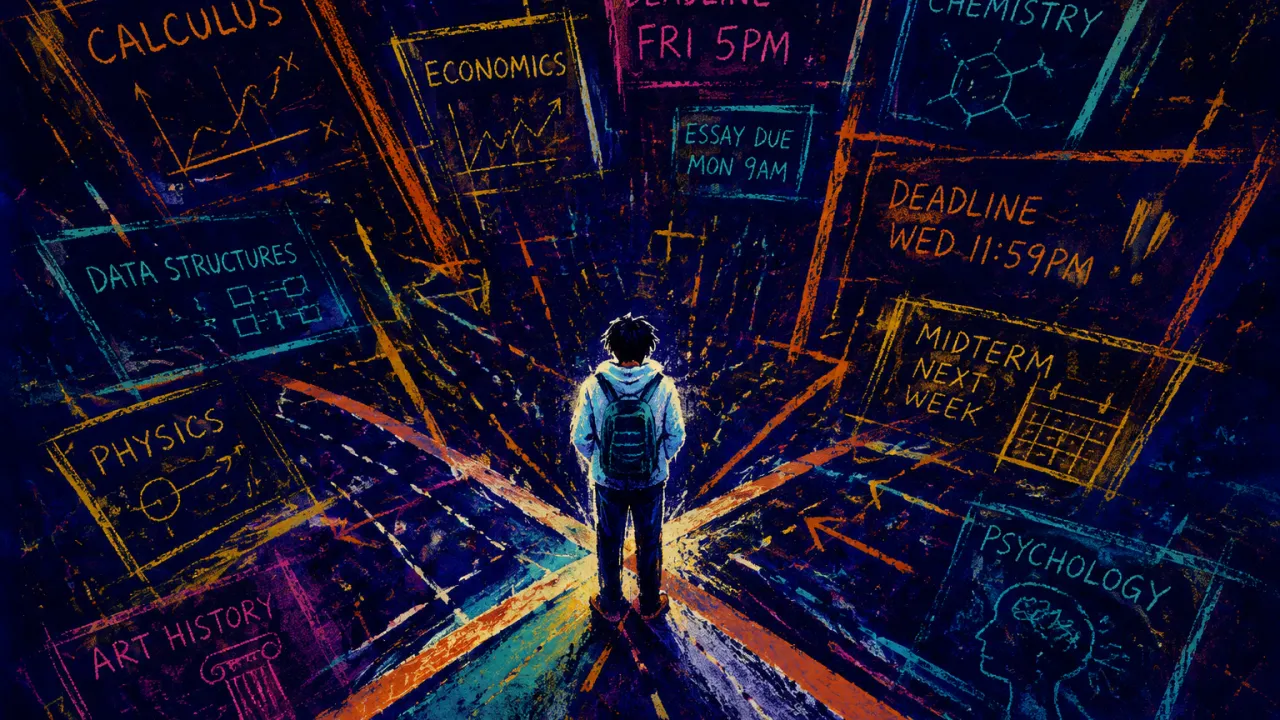
A solitary figure stands with feet fixed on a divided floor as route lines and deadline frames press inward from every side.

What is this situation?

Academic Choice Overload: you open a course catalogue, admissions portal, or degree planner expecting to make one decision and find a chain of them waiting: major, minor, modules, internships, exchange terms, postgraduate routes, and the careers each choice is supposed to unlock. At first, more options look like freedom, but each page adds prerequisites, application windows, tuition differences, timetable clashes, and warnings that popular places may fill before you have compared them. An adviser tells you to keep your options open; a lecturer urges specialisation; classmates announce polished plans; hiring pages ask for experience you can only get by choosing early. Institutions ask for a confident answer while giving you partial information, and every deadline turns a possible direction into an expiring slot. One selection changes what fits next term, which funding applies, and how long a programme may take, so clicking “submit” can feel less like choosing a class than closing several unseen doors. Evenings disappear into tabs, comparison sheets, rankings, and rewritten pros-and-cons lists; your eyes sting, your shoulders stay braced, and the decision remains crowded by advice that cannot all be followed. The cost is not simply uncertainty; it is having to make a high-stakes academic commitment inside a system that offers abundance without a clear way to compare it, much like the figure in the Seven of Cups facing a cloud of vessels, each displaying a different possibility while none reveals its full contents.

Why it's not you?

The problem is not that you are bad at making decisions; academic systems routinely ask you to compare courses, costs, credentials, and career outcomes before the information is complete. Conflicting guidance, interlocking prerequisites, and fixed deadlines make the choice crowded regardless of how carefully you compare it.

Academic Choice Overload in Tarot Cards

Academic Choice Overload is the pile-up of majors, modules, career routes, and deadlines that all demand comparison at once. The stinging eyes and braced shoulders after hours of open tabs mark an environmental burden shaped by structural constraints and a dynamic of competing demands. The Tarot Cards below reflect the visible contours of that crowded crossroads without deciding the route for you.

The Chariot
Reversed
A charioteer stands beneath a star-patterned canopy behind one black and one white sphinx, with no visible reins connecting his hands to their opposing bodies. Reversed, this control architecture becomes the central problem: majors, exchange plans, placements, and postgraduate routes pull through different prerequisites and deadlines, while the student is still expected to produce one coherent forward motion. The reversed vehicle deprives effort of a shared direction, so increased determination cannot by itself coordinate incompatible academic tracks. You can identify the blockage at the level of route design rather than personal discipline; movement remains stalled until the chosen pathway, institutional requirements, and available resources can function as one system.
Justice
Upright
A seated figure holds balanced scales in one hand and a vertical sword in the other between two formal pillars. The scene resembles an institutional judgement point, yet its instruments also expose what the academic portal lacks: a transparent way to weigh costs, duration, prerequisites, learning value, and career access before the final submission cuts off alternatives. The upright scales remain available as a comparison resource, while the sword makes the consequence of closure explicit rather than disguising it as a frictionless click. You can see why the choice feels disproportionate: the system requires a precise answer from variables measured in different units, and the work of deciding includes naming whose standards define value before those standards can be applied consistently.
The Moon
Upright
A winding path runs from the water between two towers and into distant terrain under a moon whose light falls in droplets, while a dog, a wolf, and an emerging crayfish respond from different zones of the landscape. The route is physically present, but its depth and destination remain difficult to judge, matching an academic pathway whose advertised outcomes are visible while its lived workload and career consequences remain partly concealed. The upright path continues through the uncertainty rather than ending at the foreground, so incomplete prediction does not erase the possibility of direction. You can separate what the academic system genuinely leaves unknown from what is already concrete: prerequisites, tuition, application windows, and timetable effects belong to the mapped terrain, while prestige narratives and imagined futures belong to the shifting light around it.
Seven of Cups
Upright
Seven cups rise above the student-like observer, each containing a different object and none disclosing its full material setting. Their simultaneous presentation mirrors a course catalogue in which modules, minors, internships, and exchange terms appear equally clickable even though they carry different prerequisites, workload patterns, funding rules, and effects on programme length. The upright card preserves access to the range of academic possibilities while exposing the cloud that prevents immediate comparison. You can locate the study friction in the planner's architecture: the system presents learning opportunities as separate choices, but their dependencies make them one interconnected decision whose consequences only become visible after selection.
Two of Pentacles
Upright
Two pentacles connected by a continuous loop move between the figure's hands as ships negotiate alternating crests behind him. This is a close visual analogue for an academic plan whose modules remain linked: moving one class can alter another semester's prerequisites, placement eligibility, tuition profile, or time to completion. The upright figure has enough movement to keep the linked resources active, but the image also makes the coordination labour visible. You can read the study bottleneck as dependency management rather than simple indecision; the catalogue lists separate options, while the degree structure makes each choice part of a shifting system that must still leave capacity for actual learning.
Ace of Swords
Reversed
A hand emerges from a cloud holding a single sword crowned with a wreath, forming a strong vertical line of authority and definition. Reversed, that line no longer provides a stable organising hierarchy for the academic decision: rankings, career claims, personal interest, tuition, and timetable reality all compete to occupy the crown while the choice still demands one clear answer. The reversed structure withholds a reliable criterion rather than simply withholding intelligence or information. You can recognise the growth bottleneck as a problem in the decision architecture itself; until the competing measures are named and weighted, additional course data will continue to multiply arguments without producing a clearer academic commitment.
Two of Swords
Reversed
The blindfolded figure sits between a rocky shoreline and an unsettled sea while two long swords cross over the chest. Read in reverse, that defensive arrangement no longer contains the competing inputs: tuition, prestige, interest, prerequisites, career claims, and deadline warnings press against a decision boundary that was built to hold only a simpler either-or choice. The reversed structure withholds a reliable hierarchy for sorting evidence, so additional comparison can intensify rather than resolve the blockage. You are not facing two equivalent academic paths with all facts available; you are being required to produce certainty from asymmetrical information, and that distinction identifies why the decision remains unstable even after extensive research.
Eight of Swords
Upright
Eight upright blades surround a bound, blindfolded figure whose feet stand in pooled water, while the institutional-looking building remains distant. The image directly carries the experience of trying to study inside a planner crowded by compulsory modules, eligibility rules, timetable collisions, and administrative information that cannot be viewed from one position. The visible spaces within the enclosure keep the upright structure from becoming a claim that every academic route is closed. You can recognise the educational friction as an access problem: a theoretical pathway may exist, but it is not yet operational when the rules, exceptions, and consequences are distributed across systems that leave you unable to see the whole route.
Nine of Swords
Upright
A figure sits upright in bed with the face covered while nine swords hang horizontally across the dark wall and a patterned quilt remains pulled over the body. The separation between the resting place and the accumulated blades captures how course comparisons, closing windows, and imagined opportunity costs continue occupying mental space after the academic workday has ended. The upright image makes the hidden cost visible: the swords remain on the wall rather than entering the bed, allowing the external decision inputs to be recognised as distinct items rather than one total future verdict. You can locate the internal blockage in the absence of a stopping boundary; the academic system keeps its consequences active overnight even when no adviser, portal, or additional comparison is available to resolve them.
Two of Wands
Upright
A figure stands on a battlement holding a globe, with one wand secured to the wall and another held upright while land and sea extend beyond the enclosure. The image distinguishes a stable academic base from a wider field of possible routes, making the central issue not whether possibilities exist but which one will receive planning, time, and institutional access. The upright position keeps both the established platform and the outward view available, so commitment does not have to mean pretending the future is fully predictable. You can see the long-term bottleneck as a sequencing problem: a direction must become concrete enough to unlock prerequisites and experience, while the unchosen horizon remains information about opportunity cost rather than evidence that the selected route is wrong.
Five of Wands
Upright
Five differently dressed figures raise and cross their wands in a crowded open space, with no single line of movement organising the encounter. Their competing positions closely resemble an adviser, lecturer, peer group, hiring page, and family voice each pressing a different model of academic success into the same decision. The upright scene resembles active contest rather than settled defeat, leaving the conflicting priorities visible enough to identify. You can locate the study overload in the governance gap: other people supply strong recommendations, but their criteria are incompatible and the downstream workload, debt, and eligibility consequences remain concentrated in your degree plan.
Eight of Wands
Upright
Eight parallel wands travel rapidly through a clear sky toward an open landscape, with no figure positioned to slow or redirect them. Their shared trajectory mirrors registration deadlines, funding windows, and application dates arriving in close succession, turning a crowded academic comparison into a compressed sequence of submissions. The upright flight path is unobstructed, indicating that the window for action is real and currently usable even though it is brief. You can distinguish timing pressure from evidence about academic fit: the approaching deadline changes the cost of waiting, but it does not make the fastest, most visible, or most popular option inherently better.
Ten of Wands
Upright
A bent figure carries ten long wands in one dense bundle toward a town that is already visible ahead, with the load blocking much of his view. The image maps academic options as obligations to investigate, schedule, fund, and keep eligible, showing how possibility becomes labour when every route is carried beyond the point at which it can realistically be pursued. The upright figure is still moving toward a finite destination, so the burden can be understood in relation to an actual programme milestone rather than as limitless pressure. You can see that the study problem is not insufficient effort; the option set has become heavy enough to obstruct the degree path, and the visible cost is lost study time, sustained physical tension, and reduced awareness of what must happen next.

Academic Choice Overload in Tarot Card Reading Insights

Academic Choice Overload appears in readings when others bring the same mix of options, advice, and deadlines to the cards. The articles below collect Tarot Reading Insights from those sessions.

Psychological Contexts Related to Academic Choice Overload