Wait-Mode Procrastination: From Portal Checks to One Study Block
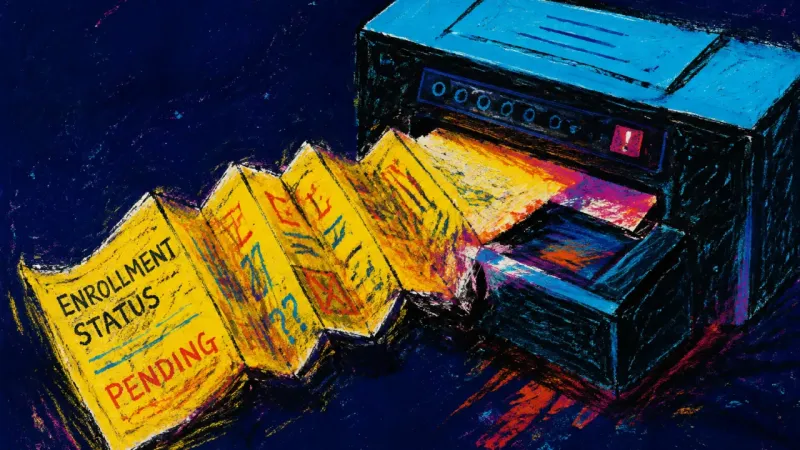
The Waitlist That Ate the Study Hour: wait-mode procrastination: checking the enrollment portal and reorganizing plans to avoid choosing a possibly misdirected study task
I had seen this exact pattern before: a final-year student in Toronto would open the enrollment portal before nearly every study session, then tell herself the routine could begin once the waitlist changed. That was how Maya arrived at my reading table, already carrying the shape of the problem in her hands.
At 10:15 a.m. in the university library, Maya had a reading document open, but her thumb kept moving to the Quercus enrollment page. The fluorescent lights buzzed overhead, the laptop fan pushed warm air toward her wrists, and the desk felt cold beneath her skin. She dragged three Google Calendar blocks into new positions, saved two articles, and watched forty minutes disappear without finishing a page of notes.
She looked at me and said, 'I keep preparing to study instead of actually studying. I know I have work I could do, but none of it feels like the right work. It feels pointless to build a routine when the timetable might change.'
I heard the contradiction clearly: she wanted to build a workable study routine now, while fearing that anything she chose without the course syllabus might be misdirected. Her uncertainty was like a transit app stuck on service update inside her chest: every route was visible, but no departure felt trustworthy. Frustration sat in her shoulders, guilt followed close behind, and restless hands kept reaching for the phone.
I did not treat the waitlist as imaginary, and I did not ask her to force certainty into existence. I said, 'The delay is real. Our question is what it is allowed to delay. Let us make a map of the loop, find the place where your choice is still available, and take this Journey to Clarity one honest beat at a time.'

Choosing a Compass in the Waiting Room
I invited Maya to put both feet on the floor, name the question once, and take one slow breath before I shuffled. I use this brief preparation as a focus point and a psychological transition, not as a promise that the cards can control an enrollment decision.
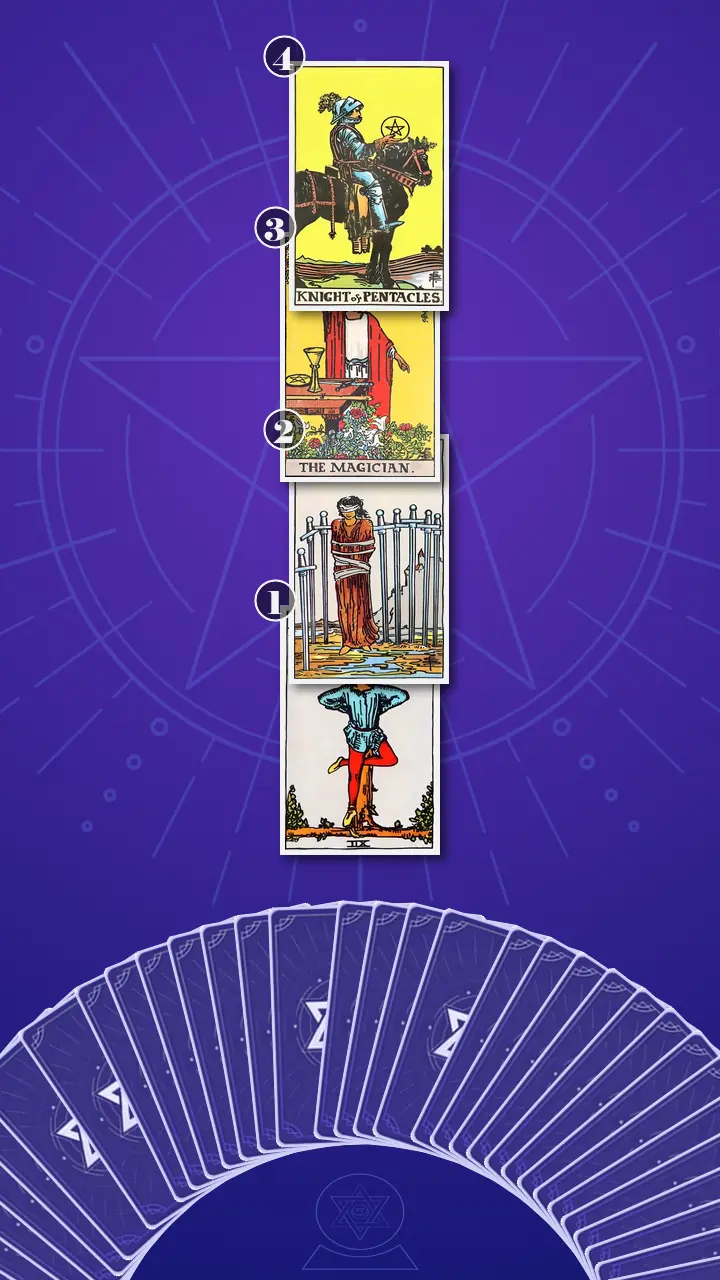
For this reading, I chose the Four-Layer Insight Ladder tarot spread. Its four cards move upward from visible behavior to the hidden rule beneath it, then to the capacity that can interrupt the pattern and the practice that can make the change sustainable.
I explained the logic for you as well as for Maya: this is a study-procrastination loop, not a choice between two courses and not a question that needs ten layers of prediction. The Four-Layer Insight Ladder is the smallest sufficient structure for tracing how waiting, checking, and reorganizing reinforce one another. It lets tarot work as an objective reflection tool, turning card meanings in context into observable questions and practical next steps.
The first position would show the diagnosis-level behavior: what the stall looked like in her hands and browser tabs. The second would reveal the belief or fear maintaining it. The third, our visual hinge, would identify the capacity that could transform the root pattern. The fourth would translate that insight into a repeatable routine that could survive an uncertain timetable.
Reading the Map: The Loop Beneath the Surface
The Hanged Man Reversed and the Pause That Hardened
I began with the role of the first position. 'This position presents the diagnosis-level behavior you can observe: checking, reorganizing, and remaining suspended instead of completing a study task while the course is waitlisted.'
I turned over The Hanged Man, in reversed position.
The figure was still suspended, one foot tied above the ground, but the halo around the inverted head was no longer the part Maya could feel. In her modern version of the card, the reading document stayed open while her attention hung from one unresolved status. She checked the portal, shifted calendar blocks, and waited for the course to make the next task feel legitimate. The pause had begun as a real enrollment delay; now it had become a stop signal for study that was already possible.
Reversed, this was blocked suspension and an overextended pause, not a warning about her future. The energy was stuck between reflection and resistance. Every portal check gave her a few seconds of relief from choosing an imperfect task, but that relief quietly trained the next session to wait for another check.
Maya gave a small, bitter laugh. 'That is a little brutal,' she said. 'The course is genuinely delayed, though.'
'It is,' I replied. 'I am not asking you to pretend otherwise. I am looking at the repeatable action that follows the check. What do you postpone immediately after you learn that nothing has changed?'
She lowered her eyes to the open document. I let the silence stay ordinary and kind. Then I said, 'You are not waiting for study materials; you are waiting for permission to choose among the materials you already have.' Her fingers stopped moving over the trackpad, just for a moment.
The Eight of Swords and the Rule No Syllabus Wrote
I lifted the second card and stated its role before naming it. 'This position reveals the psychological root beneath the procrastination loop: the belief that study chosen without the awaited course structure may be invalid, wasteful, or outside your control.'
The card was Eight of Swords, in upright position.
The blindfold and loose bindings matched the open gap among the swords. Maya had several readings, review notes, and practice questions on her laptop, yet the internal rule made them feel invisible as valid options. Her experience sounded like this: 'If I choose this and the course later points somewhere else, I will have wasted the time.' The laptop showed an opening, while her mind treated the missing syllabus as a locked door.
This was an excess of air: analysis had become a closed rule system. The restriction felt complete, but it was partly maintained by a belief she had added to the factual situation. The waitlist removed the official sequence; it did not remove every useful study action. The hidden fear was not simply choosing the wrong reading. It was choosing, discovering that the effort needed redirecting, and taking that as evidence that she lacked control over her own progress.
I placed my finger near the visible gap between two of the swords. 'Which part is factual because the syllabus is missing,' I asked, 'and which part is the rule that says no independent work counts yet?'
Maya's breath paused first, and her thumb hovered above her phone. Then her gaze went unfocused, as if she were replaying the library sessions, the colour-coded calendars, and the saved study videos. Finally, a long breath left her chest and her jaw loosened. 'I want to move,' she said quietly, 'but I only trust movement that someone else has authorized.'
I nodded. 'That distinction matters. The wrong task is not the only risk; losing every available task to checking is a cost too. We can acknowledge frustration, guilt, and restless uncertainty without turning them into a verdict about you.'
When The Magician Put the Pen in Her Hand
The Hinge: One Tool Already on the Table
I paused before the third card. The library printer stopped rattling, and the room seemed to lower its volume around us. 'This position identifies the key transformation from waiting for permission to using an existing resource for one self-directed and bounded act of study.'
I turned the card: The Magician, in upright position.
The Magician stood with one hand raised and the other directing energy toward the table, where the four suit tools were already arranged. For Maya, the translation was simple and physical: one existing reading, one notebook, one pen, and one visible 25-minute timer. The point was not to collect another resource, build a better Notion dashboard, or manufacture certainty. The point was to give one available tool one clear purpose.
I use a diagnostic lens I call the Tempo Misalignment Audit. When someone describes the feeling of pushing against a wall, I listen for a disruption in psychological and executive BPM: is ambition trying to run at a speed the available daily capacity cannot carry? With Maya, ambition was present. The friction lived at the handoff between intending to study and selecting a task.
Then I applied my Execution Rhythm Calibration: I narrowed the question until it could be answered by her hands. Where, exactly, did the rhythm fall out of sync? At the portal. She was asking external structure to authorize the beginning, so every delay sent her back into preparation.
It was 10:15 a.m. in the university library. The reading document was open, but Maya's thumb kept returning to the enrollment portal, her calendar kept changing shape, and the forty-minute study window quietly became another planning session. The unresolved page had started to feel like a locked door.
The course does not have to hand you permission to begin; choose one tool already on The Magician's table and use it for one bounded study block today.
For a beat, Maya did not nod. Her thumb froze above the phone; then her jaw tightened, as if she could hold the old rule in place by clenching it. Her eyes lost focus and moved past the cards, replaying the library sessions, the calendar edits, and the saved videos. 'But if I choose and the course later makes it irrelevant,' she said, 'haven't I just proved I should have waited?' I answered, 'It could need redirecting. That is different from being wasted, and we are testing a small block, not predicting the syllabus.' Her fist opened against her knee. I placed one reading, one notebook, one pen, and a visible timer together. She looked at the little workbench instead of the portal. 'I keep looking for the right resource,' she whispered, 'but the real decision is whether I will use one resource on purpose.' Her shoulders dropped; the exhale came out uneven, followed by a brief, almost dizzy blankness. I asked, 'Now, use this new perspective to remember last week: was there a moment when this insight could have made you feel different?'
I added, 'The waitlist may be unresolved, but your next useful step does not have to be. Agency begins when one available resource becomes one finished block, not when uncertainty disappears.' Maya looked down at the reading she had brought with her. The recognition was modest rather than theatrical: she had been waiting for permission to use what was already here.
For me, that was the first movement from restless waitlist uncertainty and accumulated guilt to practical self-trust and grounded flexibility. It did not answer when the course would open. It changed the question from What will the institution decide? to What small choice can I make while the institution is still deciding?
The Knight of Pentacles and the Routine That Can Survive a Timetable Change
I moved to the fourth position and named its role first. 'This position translates the transformation into a repeatable study practice that can function before the waitlist is resolved and adapt if the course later becomes available.'
The card was Knight of Pentacles, in upright position.
The Knight held the pentacle with steady attention, and the dark horse stood still among cultivated fields. I read the energy as balanced earth: patience, reliability, and visible completion. This was the opposite of frantic calendar redesign and also the opposite of a six-hour catch-up timetable that would collapse after one missed block. The useful routine would be modest enough to repeat tomorrow, flexible enough to change its content, and concrete enough to leave evidence behind.
I asked Maya to imagine returning to the same realistic cue: arriving at the library, finishing lunch, or sitting at the small desk in her shared apartment. She could keep the cue stable while letting the task vary. She traced a square around one line in her notebook, and I saw her shoulders settle without becoming perfectly relaxed. 'Let the course become part of your routine later,' I said, 'instead of asking it to create your ability to begin.'
The One Resource, One Purpose, One Finished Block Route
I gathered the cards into the same vertical line. The Hanged Man reversed showed the visible pause that had hardened into delay. The Eight of Swords showed the rule beneath it: without the awaited sequence, no self-chosen study could feel valid. The Magician supplied the lever, and the Knight of Pentacles gave that lever a steady place to land.
I returned to the image of a delayed train at Union Station. A delayed train is one route I cannot control; it is not an instruction that I must remain physically unable to move around the station. The course could matter deeply to Maya and still not be the sole source of direction. A waitlist can delay a course without having to delay every useful study action.
The Blind Spot Beneath the Refresh Button
Maya's cognitive blind spot was easy to miss because it looked responsible. She had mistaken the need for more information for the need for permission, and she had mistaken a provisional task for a wasted task. Checking the portal, reorganizing Google Calendar, and saving resources reduced the discomfort of choosing, but the temporary relief cost her the only part of the session that could create new evidence: completed learning.
The transformation direction was therefore practical, not dramatic: move from waiting for the course to define the routine toward authoring one small task, then let repetition build self-trust. I told Maya that tarot could make the pattern visible, but it could not study for her, open the course, or guarantee that every choice would be perfectly aligned. She remained the author of the next step.
The Syncopation Reset for a Provisional Routine
I offered Maya my Syncopation Reset, a three-day tempo adjustment experiment. We would break the forced routine into smaller, harmonious beats: one cue, one resource, one purpose, one finished block. The exercise was not a test of character and did not require her to pretend the enrollment delay was secretly helpful. It was a low-stakes way to see whether a pre-portal study block could create movement inside uncertainty.
- The Before-the-Portal BlockAt Maya's next library session, she will choose one existing reading, review section, or practice question and write a visible endpoint, such as summarize two pages or answer three questions. She will place that resource, one notebook, and a timer on the desk, put her phone in her bag, and work for 25 minutes before opening the enrollment portal.If 25 minutes feels too large, use a five-minute minimum: read one paragraph, solve one question, or write three notes. She may stop when the timer ends; the portal becomes an after-block boundary, not a forbidden site.
- Three Steady BeatsFor the next three study days, she will attach one defined block to a realistic cue, such as arriving at the library, finishing lunch, or sitting at the apartment desk. After each block, she will record the date, task, and one sentence beginning with I learned in Apple Notes, Google Docs, or a paper notebook.Keep the cue stable while allowing the content to change. A difficult day can use the five-minute version, and a missed day does not require a catch-up marathon or a redesigned week.
- Let the Course Join LaterAt the end of three days, Maya will review the three entries and notice which cue made starting easiest. When the course becomes available, she will add its first task to that existing cue instead of rebuilding the entire routine from scratch.The goal is repeatability, not proof that she no longer needs institutional structure. The course can support the scaffold later without being asked to rescue lost momentum now.
I called this actionable advice because every part could be observed: the task selected, the timer completed, the sentence written, and the portal checked afterward. If the experiment felt unhelpful, Maya could reduce it, stop it, or choose a different maintenance task. Her choice remained hers throughout.

A Small Green Light
A week later, Maya messaged me from the library: 'Three blocks done. I woke up thinking, What if I choose wrong? Then I opened one reading anyway.' The waitlist remained. So did the question, but over breakfast she smiled at it and began.
I did not read that message as proof that the semester was solved. I read it as the first visible unit of a flexible, self-directed study routine: a small green progress bar advancing by completed work instead of perfect planning. Her uncertainty had not vanished, but it no longer held the pen.
That is what I trust the Four-Layer Insight Ladder to do at its best. It makes a loop visible, names the fear without feeding it, and returns the next decision to the person living it. The cards did not open the course or choose Maya's path; they helped her hear her own direction and give it one manageable beat.
When the course stays waitlisted, the tightness in your chest is not only about missing a syllabus; it is also the fear that choosing for yourself could make your effort look wasted. Noticing that fear does not solve the timetable, but it can give you a little room to move.
If one small, self-chosen study block were allowed to count before the portal gave you an answer, what might you notice about your own direction?