Ten Questions Before Settings: How Practice Interrupted the Loop

The 7:30 p.m. Dashboard Trap
If you are an undergraduate in London who can turn a twenty-minute revision block into a full comparison of Anki settings, Notion templates, and focus timers, you may be dealing with productivity-tool procrastination rather than a lack of effort.
Alex, a 21-year-old non-binary student preparing for end-of-term exams, came to me after exactly that kind of evening. At 7:30 p.m. on a Tuesday, they had taken a seat in a crowded campus library, opened a question bank, and noticed that the app’s daily target no longer matched the exam schedule. The radiator clicked beside the desk. Highlighters scraped across the table behind them. Their phone grew warm in their hands as they recoloured three subject categories, divided two flashcard decks, adjusted the review intervals, and checked the new streak forecast.
They had come to answer twenty practice questions. The app offered a cleaner, safer task: redesign the conditions under which those questions might eventually be answered.
When the closing announcement played, the first answer box was still blank.
“The dashboard says I’m active,” Alex told me, pressing their thumb into the side of their index finger, “but I can’t explain what I learned. I just keep thinking I need to fix the system before I start.”
I noticed the tightness in their jaw and the small, continuous movement of their hands. Their restless frustration felt like a phone vibrating somewhere under the skin, impossible to ignore but difficult to locate. Underneath it sat guilt, and underneath the guilt was a more exposing question: what if direct practice revealed that they were further behind than the app statistics suggested?
“I don’t think the effort is fake,” I said. “You are spending real attention and energy. I think we need to find out why that effort keeps being redirected towards the machinery of studying instead of the material itself. Let’s make a map of the loop, without treating it as a flaw in who you are.”
A busy dashboard is not the same as a learning trace. That distinction became the starting point of our Journey to Clarity.

Choosing a Map Through the App-Optimisation Maze
I invited Alex to put both feet on the floor, take one unforced breath, and hold the question in simple language: “Why do I keep tweaking study apps instead of learning?” I shuffled while they focused, using the pause as a psychological threshold between replaying the problem and observing it.
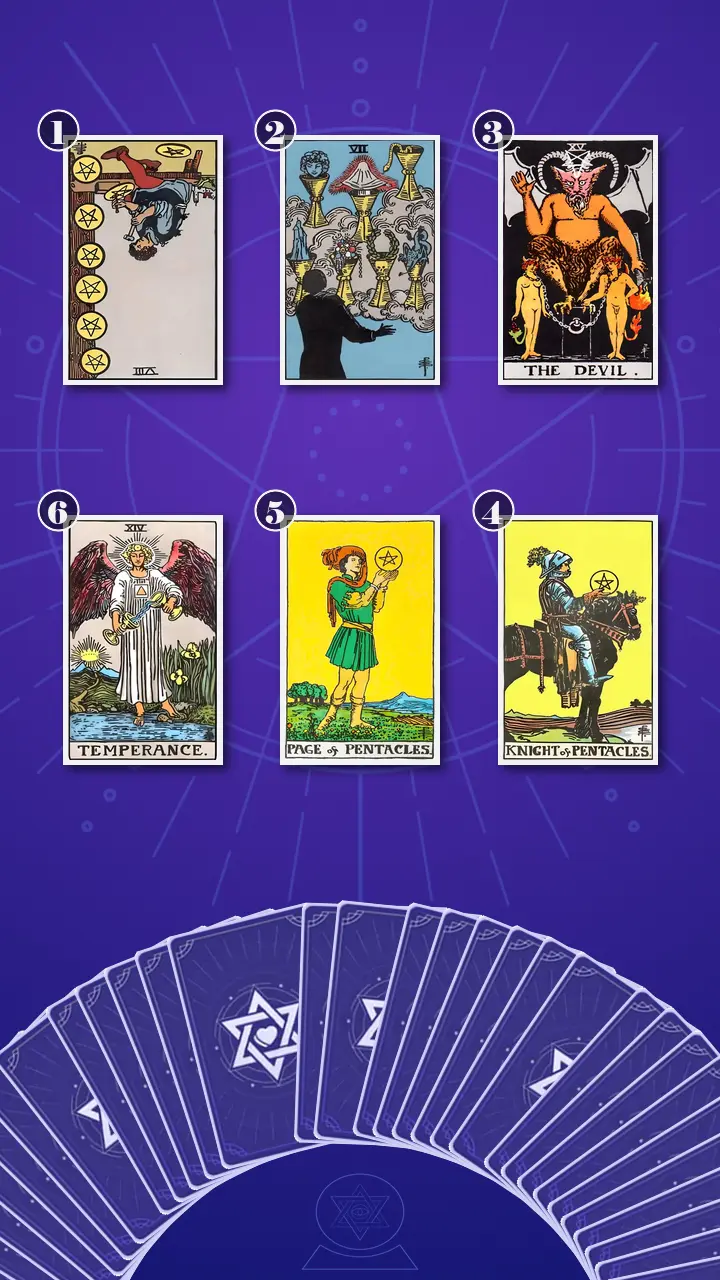
I chose the six-card Transformation Path Grid · Context Edition. This is a focused tarot spread for study-app procrastination, built to follow a repeated behaviour from its visible symptom to its hidden reward, then identify an interruption, a practical experiment, and an integrated way forward.
This is also how tarot works in my practice. I do not use the cards to predict Alex’s exam results or declare what they must do. I use the images as an objective language for patterns that are often difficult to see while we are inside them. The question had the structure of a feedback loop, so it needed a spread that could show sequence and cause rather than a large collection of unrelated influences.
I arranged the cards in two rows. The upper row would diagnose the loop: the setup labour, the competing options, and the immediate reward that kept the pattern alive. The lower row would reconstruct the process: the internal shift, one observable learning action, and a balanced relationship with technology. I read the grid like a maze whose return path had become visible.
The first position would show the repeated setup work that looked productive but postponed retrieval. The third would expose what the behaviour offered emotionally. Directly beneath it, the fourth position would reveal the antidote. The final two cards would answer a practical question: what could Alex do differently without deleting every app, building another perfect routine, or waiting to feel completely confident?
Across cultures, I have seen people mistake a map for a verdict. I was careful to make the distinction here. The spread could show us where Alex’s attention kept turning, but Alex would remain the person deciding where it went next.
The Upper Row: How Setup Became the Work
Position 1: Eight of Pentacles Reversed and the Blank First Answer
The card I turned over first represented the observable symptom: repeated setup work that looked productive while postponing retrieval, practice, and comprehension. It was the Eight of Pentacles, reversed.
In its balanced form, this card concerns repetition in service of skill. Reversed, its Earth energy was blocked and misdirected. The work was real, but its connection to mastery had broken. The craftsperson’s narrowed focus and the repeated pentacles resembled Alex’s screen full of carefully maintained decks, tags, targets, and statistics. Meanwhile, the distant town on the card echoed the exam itself, still present but pushed beyond the edge of attention.
I brought Alex back to the library scene. They had edited deck structures, colour codes, review intervals, and daily targets until the screen displayed a tidy trail of labour. Yet the closing announcement arrived before they had attempted one practice question. Their app contained evidence that they had been active, but they had produced no evidence of recall, comprehension, or application.
“The question this card asks is very plain,” I said. “Does the action you are taking change what you can recall, explain, or apply? If it changes none of those things, it may be setup rather than study.”
Alex gave a short laugh, but there was bitterness in it. “That’s painfully accurate. Almost a bit brutal. I was working for an hour, so why was the first answer still blank?”
“Because effort and direction are different variables,” I replied. “This card is not calling you lazy. It is validating that you are exerting yourself, then asking whether your concentration is serving the destination or polishing one part of the vehicle while the car remains parked.”
Their fingers stopped rubbing together. I watched recognition arrive without the additional wound of shame. That mattered. Shame would only create a fresh desire for the next clean reset.
Position 2: Seven of Cups and the Scroll of Plausible Delays
The next card represented the immediate attentional obstacle: features, rewards, and alternative configurations competing with the single task of learning. I turned over the Seven of Cups, upright.
Its energy appeared as excess. Possibility had multiplied past the point of usefulness. The seven floating cups became themes, streak forecasts, premium modes, challenge systems, deck layouts, timer integrations, and links to other platforms. Each option could plausibly help. Together, they allowed selection to replace practice.
I asked Alex to picture the Victoria line between Finsbury Park and King’s Cross. They had twelve minutes available and had opened one lecture deck. Before the first card appeared, a challenge banner and streak forecast caught their thumb. Then came the reasonable-sounding chain: “I should choose the best mode first. I should check whether the target still makes sense. I should compare one more app now so I don’t waste the proper study session later.”
By King’s Cross, they had evaluated five options and tested none of their memory.
“It’s the streaming-platform problem,” I said. “You browse for so long that there’s no time left to watch anything. Except here, every preview is selling you a slightly different identity as the person who will finally become consistent.”
I saw their chest lift and hold for a second. Their eyes moved away from the card as if the familiar row of app icons had appeared behind it.
“StudyTok does that to me,” they said. “I’ll see someone’s Sunday reset or perfect Notion dashboard, and suddenly my own setup feels unusable.”
“Then comparison fatigue is choosing the task before you do,” I said. “The blockage is not that you lack resources. It is that too many attractive resources reach you in the few seconds between intending to learn and beginning one meaningful action.”
The Seven of Cups was not asking Alex to find the perfect cup. It was asking them to accept the limit of choosing one solid question while the other possibilities remained unopened.
Position 3: The Devil and the Certainty Transaction
The third card represented the conditioning pattern beneath the repetition: attachment to stimulation and controllable metrics as protection from uncertain learning. I turned over The Devil, upright.
I did not frame this card as a diagnosis or a claim that Alex was powerless. Its energy appeared as an attachment with a real reward. At 11:53 p.m., after avoiding a difficult module, Alex would check a broken streak in their dark flat-share bedroom. Blue light sharpened the edges of the room. A bus hissed along the wet street outside. When the app offered to reset the goal, tapping it produced a small, immediate loosening in their stomach.
The repaired metric changed nothing about what they could explain. It still offered relief faster than a difficult question could offer understanding.
“I know it doesn’t change what I know,” Alex said quietly, “but for a second it makes me feel back in control.”
“Exactly,” I said. “The setup is giving you certainty that the material cannot promise.”
Through a Jungian lens, I saw this less as a battle with a bad habit and more as a bargain with a protective part of the psyche. Direct practice could expose gaps, slowness, and mistakes. The app offered bright, controllable proof of activity instead. Every reset whispered that the problem belonged to the system, which meant Alex did not yet have to face the possibility of answering badly.
The Devil’s chains were loose. I centred that detail because it preserved the truth on both sides: the pull was genuine, and it was not a permanent identity. Alex was not “an unmotivated person” or “someone who could not be trusted with technology.” They were repeating a transaction: uncertain feedback was exchanged for immediate digital reassurance.
I watched their response move through three small stages. First, their hand tightened around their phone. Then their gaze lost focus as they seemed to replay a specific reset. Finally, they placed the phone face down and let out a slow breath from deep in the chest.
“So the urge gets strongest when the next question might tell me something I don’t want to know,” they said.
“Often, yes. And recognising the exchange already loosens its authority. You can feel an urge without treating it as an instruction.”
When the Knight Held One Pentacle Still
Position 4: The Antidote to Stimulation
The room seemed to grow quieter when I reached the card directly beneath The Devil. This position represented the catalyst: replacing novelty-driven optimisation with a deliberately plain, repeatable study action. I turned over the Knight of Pentacles, upright.
The Knight’s energy was patient, balanced Earth. The horse did not rush. The Knight held one pentacle steadily at eye level. Behind them, cultivated fields suggested that progress would come from returning to useful work, not from manufacturing another dramatic beginning.
I narrowed the scene for Alex. It was 7:30 p.m. again. The radiator clicked. Their phone displayed a newly recoloured dashboard. Ten minutes remained before closing, their jaw was tight, and the first practice question was untouched. This time, the settings stayed exactly as they were. Only one existing question remained in view.
Alex was still caught in the demand to make the “right” start. Beginning without one more adjustment felt ordinary, uncomfortable, and potentially exposing. The Knight did not promise that the discomfort would vanish. It showed that Alex could carry one real task through it.
Stop treating stimulation as proof of progress; choose one steady action and carry it forward like the Knight's single pentacle.
I let the sentence remain between us for a moment.
You do not need a more stimulating system. You need one repeatable action that leaves evidence of what you can recall, explain, or apply.
This was where I used a lens I call Performance Anxiety Decoupling. I asked Alex to imagine that the first practice answer was not a judgment on their intelligence, discipline, future, or worth. It was a data point about retrieval at one specific moment. A score could describe the current distance between memory and material. It could not describe the value of the person taking the test.
For one beat, Alex stopped breathing. Their fingers hovered above the table, slightly curled. Then their brows drew together and their eyes fixed on the Knight’s pentacle as if an uncomfortable memory had begun playing behind it. Colour rose around their eyes, but the first emotion in their voice was not relief.
“But doesn’t that mean I’ve wasted all those sessions?” they asked, sharper than before. “That I’ve basically been doing it wrong?”
“It means the strategy protected you from something difficult, and it also cost you learning time,” I said. “Both can be true. We do not need to shame the protection in order to stop paying its price.”
Their jaw tightened once more, then slowly released. Their shoulders sank by a few centimetres. A trembling breath left them, followed by a tiny shake of the head. I could see the release, but I could also see the brief disorientation beneath it. If the system was no longer responsible for making them feel ready, Alex would have to choose the first question while still feeling unready. Clarity had returned agency, and agency carried responsibility.
“Now, using this new perspective, think back to last week,” I said. “Was there a moment when this insight could have made you feel different?”
Alex looked down at the table. “Wednesday night. I broke a streak because I kept avoiding one topic. I reset the goal and felt better for about thirty seconds. If I’d treated one bad answer as information instead of proof that I was failing, I might have just tried the question.”
“That is the shift,” I said. “Not from discomfort to permanent confidence, but from restless control-seeking to grounded attention and earned trust. You do not have to trust yourself because a dashboard says you were consistent. You build trust by watching yourself complete one honest action.”
The Knight’s message was modest enough to use and strong enough to interrupt the loop: let completion, rather than stimulation, mark the beginning of progress.
The Return Path to One Real Learning Object
Position 5: Page of Pentacles and the Ten-Minute Evidence Task
The fifth card represented the practical next step: choosing one piece of material and producing observable evidence of understanding before adjusting the tool. I turned over the Page of Pentacles, upright.
The Page held one pentacle in both hands as though the rest of the landscape had temporarily gone quiet. This was underused energy moving towards balance: beginner-minded contact with one real subject. Alex did not need to become the designer of an entire learning environment. For ten minutes, they could simply become a student of one concept.
I described the experiment. Alex would choose one lecture concept, open a blank page, and write a short explanation from memory. Then they would check the explanation against the lecture slide or textbook and circle only the first specific gap. The result might be one corrected definition, one answered question, or two imperfect sentences. It did not have to look impressive or be shared in a course WhatsApp chat.
“Treat the written answer as the Page’s pentacle,” I said. “It is tangible. You can inspect it. It proves that contact with the material happened.”
Alex looked at the card, then mimed writing with one finger against the table. “I don’t need to solve the semester,” they said. “I need to meet one concept honestly.”
“Yes. One completed practice answer is the receipt that proves a study session actually occurred.”
Their expression softened, although a line of doubt remained between their brows. The smallness of the task made it possible, but it also deprived the inner critic of the drama of a complete reinvention. That slight anticlimax was part of the medicine.
Position 6: Temperance and a Clearer Job for Technology
The final card represented cognitive integration: using gamified tools in moderation while measuring progress through recall, explanation, and application. I turned over Temperance, upright.
Its energy was balance in motion. Water passed deliberately between two cups. One foot stood on land and one in water. I read the cups as two separate containers: learning time and tool-calibration time. Information could pass between them, but only when a completed study session produced evidence that a change was useful.
In practical life, this meant Alex could keep a simple flashcard and timer setup, complete the learning task first, and review the tool during a scheduled Friday appointment. If an actual session showed that cards appeared too frequently or a reminder arrived at the wrong time, that evidence could justify a change. Discomfort in the middle of a difficult question would no longer be enough to trigger a rebuild.
“I don’t want you to delete everything tonight,” I said. “The Eight of Pentacles reversed warned against swinging into another extreme and creating a rigid no-technology system that is too inconvenient to sustain. The goal is not less technology. It is a clearer job for the technology.”
I thought of the journeys I had made across unfamiliar cities, where a transport app could help me find the route but could not take the actual steps for me. A map was useful precisely because it remained a supporting tool. The moment I confused adjusting the map with moving through the city, I was still standing in the same place.
Temperance restored proportion. The app could schedule, prompt, and record. Alex would decide whether learning had happened by asking what they could now recall, explain, or apply.
“So I can change the system,” Alex said, “just not every time the work makes me uncomfortable.”
“Exactly. Calibration is allowed. Interruption is contained.”
The final card did not promise technological purity or perfect self-control. It showed a sustainable middle position in which the tool supported the production rather than becoming the entire show.
Learning First, Tool Review Later
When I read the grid as one story, the logic was coherent. The Eight of Pentacles reversed showed real effort trapped in the study apparatus. The Seven of Cups showed how themes, modes, dashboards, and competing apps scattered attention before the first learning task. The Devil revealed why the pattern repeated: controllable metrics delivered reassurance faster than messy practice could deliver mastery. The Knight and Page redirected the same capacity for repetition towards one tangible task, while Temperance gave app adjustment a measured place instead of banning it.
The core metaphor was simple: Alex had been polishing the dashboard while the car remained parked. Their cognitive blind spot was not merely believing that a better setting would help. It was interpreting the physical discomfort before retrieval, the tight jaw, raised shoulders, restless hands, and shallow breathing, as evidence that the system needed fixing. Often, that discomfort was performance anxiety appearing at the threshold of honest feedback.
The transformation direction was evidence before optimisation. Alex would stop asking the app to make them feel fully prepared and begin allowing one imperfect answer to show them what to practise next. The spread contained no Swords, so I supplied the missing Air through one explicit verbal boundary: “Learning first. Tool review later.”
I translated that boundary into three small actions. None required a new subscription, an elaborate routine, or confidence in advance.
- Use the Inner-Critic Mute ProtocolBefore the next 7:30 p.m. library session, place this rule on your phone lock screen: “No settings until one ten-question set is complete.” When the thought “A bad score will prove I’m behind” appears, answer it once: “This result measures current retrieval, not my worth or final outcome.” Give the inner critic a later appointment, start a twenty-minute timer, and keep the current app settings unchanged.If ten questions feel unmanageable, use the minimum version: one closed-book question before one app change. Record the urge instead of obeying it immediately.
- Complete One Pentacle-Sized Learning UnitOn Wednesday, choose one lecture concept and spend five minutes explaining it from memory on paper or in a blank document. Check the source, highlight only the first specific gap, and save one visible artifact: an answered question, a corrected explanation, or three recalled definitions.The task may look unimpressive beside a polished dashboard. That is acceptable. Its purpose is evidence, not presentation. Two sentences and one checked gap still count.
- Open the Friday Calibration WindowSchedule one fifteen-minute tool review for Friday at 5:00 p.m. Place every configuration idea in a note titled “Friday Tool Review” during the week. At the appointment, approve a change only when a completed study session revealed a specific tool problem. Keep one useful feature, remove or ignore one distraction, and leave everything else unchanged.Set a timer and stop when it rings. The minimum version is a five-minute review of one setting, with no change unless real study evidence supports it.
These actions applied the Knight’s consistency, the Page’s direct curiosity, and Temperance’s proportion. More importantly, they returned choice to Alex. The cards had identified the loop, but no card could answer the practice question, tolerate the imperfect score, or protect the Friday boundary for them. Those were acts of authorship only Alex could perform.

A Week Later: The Quiet Proof
A week later, I received a message from Alex. At the same library desk, they had seen the urge to fix an outdated target, read the lock-screen rule, and completed ten questions first. They scored six out of ten. The result stung, but instead of rebuilding the deck, they circled three knowledge gaps and recorded the target issue for Friday.
At the Friday review, they changed one reminder time and left every other setting alone.
They also told me that they had slept through the night after that first session. In the morning, their first thought was still, “What if I’m further behind than I think?” This time, they gave a small laugh, opened the list of three gaps, and chose one.
I did not see a life perfectly organised or an exam outcome guaranteed. I saw the first evidence of the emotional transformation: restless control-seeking had made room for grounded attention, and digital reassurance had begun to give way to trust earned through completed practice.
That was the real Journey to Clarity. Tarot had not made Alex study. It had helped us separate the person from the pattern, translate a vague urge into a visible cue-reward loop, and reveal the point where choice could re-enter. Alex supplied the courage to leave the dashboard imperfect and meet the material honestly.
If tonight your dashboard looks busy while the first answer remains blank, I invite you to notice the tight jaw and restless hands without turning them into a verdict. They may be holding both sides of the struggle: the wish for proof that you are in control and the fear that real practice will reveal where you are not. Recognising that transaction is already a loosening of the chain.
Before you polish the dashboard again, which one pentacle-sized piece of learning evidence would you be curious to finish first?