Twelve Research Tabs Closed, Then 287 Words Made a Direction Testable

The 10:48 p.m. Cursor
If you are a final-year master's student in Toronto who opens the capstone after a research-assistant shift, changes the title twice, and tells yourself one more paper will make the direction obvious, this is meaning-before-action paralysis in a very polished outfit.
I met Alex (name changed for privacy) at 10:48 p.m. in a quiet corner of the university library. The fluorescent lights buzzed overhead, stale coffee cooled beside the warm laptop, and twelve research tabs crowded the screen like a committee waiting to vote.
I watched Alex drag three outline headings into a new order, rename the working title, highlight one more quotation, and hover over the paragraph beneath the blinking cursor. Their shoulders stayed fixed, their jaw tightened, and their eyes had the gritty shine of someone who had been reading long after the words stopped entering.
Alex looked at me and said, 'I keep saying I need a direction, but I mostly keep collecting options. If I pick one question, every other version starts looking smarter. I can spend three hours preparing to write without writing a paragraph.'
The contradiction was plain: Alex wanted to choose a capstone direction and move the draft forward, yet kept staring at the document without selecting a direction. Their apprehension felt like holding several Google Maps routes open on a dark screen and refusing to start any of them until the app could guarantee the entire journey. Every possible question had become a verdict about intelligence, control, and whether the capstone would mean enough.
I did not call that laziness or a lack of discipline. I told Alex, 'You are not short on ideas; you are keeping every idea alive so none has to be tested. We can look at the pattern without shaming it. Our work tonight is to turn this crowded screen into a map, then let you decide where the first small line goes.'
Choosing a Shadow Spread for Academic Indecision
I asked Alex to place both feet on the floor, take one slow breath, and name the question exactly as it had been asked: What keeps me staring at my capstone instead of choosing a direction? I shuffled slowly, using the pause as a transition from frantic problem-solving into deliberate observation rather than as a supernatural test.
I chose a four-card Shadow Spread. In my Jungian psychological lens, tarot works here as a structured cognitive tool: the images give us a shared language for noticing defensive habits, hidden fears, and usable resources. The cards do not predict Alex's degree, select a career, or deliver a verdict. They help us examine what the mind is doing with uncertainty so that Alex can make a more informed choice.
This particular spread suited capstone direction anxiety because it follows one compact mechanism from symptom to integration. The first card would show the visible shadow, the conscious behavior through which the blockage appeared. The second would reveal the hidden root beneath it. The third would show the protective pattern that lowered discomfort in the short term while keeping the draft unchanged. The fourth would point to shadow integration: the practical quality that could turn the hidden material into action.
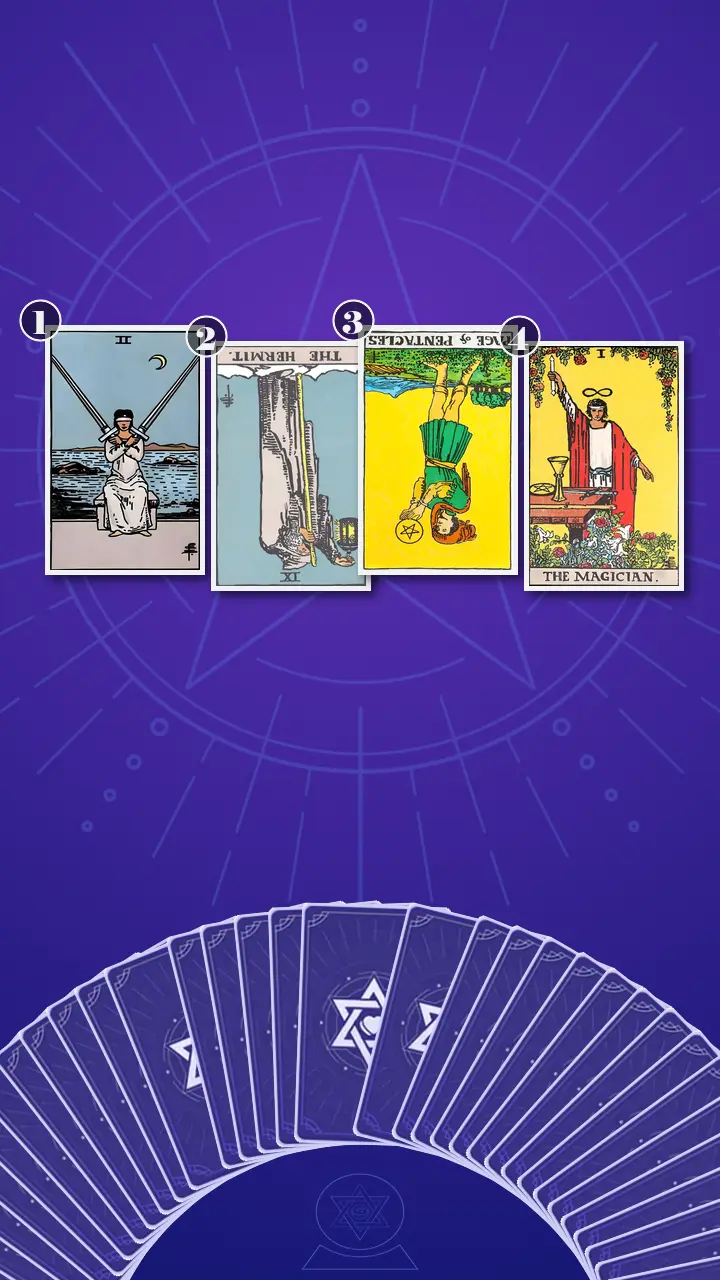
The four cards lay in a straight line. I wanted the eye to move from suspended choice, through isolated searching and stalled preparation, toward one place where thought could meet the page.
When Every Route Stays Open
Position 1: The Two of Swords and the Safety of Not Choosing
Now I turned the card representing the observable capstone bottleneck: the position where Alex held several directions in suspension and repeatedly stared, compared, and reorganized instead of choosing.
The card was the Two of Swords, in upright position. In the Rider-Waite-Smith image, a blindfolded figure holds two crossed swords in exact balance while rocky water sits behind them. I connected it directly to Alex's two or three capstone questions living in separate Google Docs, their titles and outlines compared night after night while the cursor blinked beneath an empty paragraph. The work of preserving neutrality had consumed the evening.
This was Air locked in balance. Thought was not missing; it was overinvested in comparison and underused for making a claim. The blindfold was not a lack of intelligence. It was the effort of refusing to see which option could produce evidence because choosing one would end the temporary protection of being impossible to judge. I asked, 'What exact choice did you postpone the last time you moved an outline heading, and what did you do during the next ten minutes instead?'
I offered Alex the inner sentence I heard in the pattern: 'If I keep both options alive, I cannot be wrong yet, but I also cannot learn what either one can become.'
Alex did not nod. They gave a short, bitter laugh and said, 'That is too accurate. Almost rude.' Their fingers stopped on the edge of the card, and the laugh left a little silence behind it.
I answered, 'I hear the protection before I hear the problem. This is commitment versus temporary safety, not laziness versus discipline. Comparison gives you a few quiet minutes because no direction has to face evaluation. Then the unchanged draft returns the pressure to you.' Alex lowered their gaze to the blinking cursor, recognition arriving without requiring them to turn it into a confession.
Position 2: The Hermit Reversed and the Lantern with a Small Radius
Now I turned the card representing the hidden root: the fear that committing without total certainty might make the project feel empty or expose a loss of control over where it was going.
The card was the Hermit, in reversed position. The upright Hermit's lantern illuminates only a small circle of ground, enough for the next few steps but never the whole mountain. Reversed, the useful solitude of reflection had become an isolated search for a complete answer. Alex was asking private thought to reveal the entire purpose of the degree before writing or feedback could provide any evidence.
I described the image through a Toronto detail Alex knew well. The lantern was like a phone flashlight on a dark TTC platform: it would not reveal the whole city, but it could show where to place the next foot. The capstone's next section might be visible before the complete route was. After a research-assistant shift, Alex stayed alone with a notes file and refused to send even a rough question to their supervisor because the question had to sound finished first.
I said, 'The private rule here sounds like this: I should not show this question until it sounds like I already know what I am doing.' Alex's mouth tightened. I asked which outcome felt most exposing: wasting the work already collected, discovering that one topic felt empty, or being seen as someone who did not know what they were doing.
Alex's hand moved toward their jaw and then stopped. I saw a small tightening in the chest before they released a long breath. 'Being seen as not knowing,' they said. 'My supervisor asked for a workable question, but I hear it as proof that I should already have the whole argument.'
I told Alex that the Hermit was not asking them to abandon reflection. It was asking them to bring the lantern back into contact with another person. A fifteen-minute conversation could illuminate the next stretch without pretending to map the entire degree. Feedback could be information about a draft direction rather than a final evaluation of Alex's intelligence.
Position 3: The Page of Pentacles Reversed and Preparation Without Authorship
Now I turned the card representing the protective shadow pattern: the coping response that reduced discomfort briefly while preserving the larger drafting problem.
The card was the Page of Pentacles, in reversed position. The Page stared so intently at the pentacle that the green field around them remained uncultivated. I saw the same movement in Alex downloading another paper, highlighting three quotations, cleaning the bibliography, renaming the file, and opening Google Scholar as soon as a sentence required a clear claim.
This was Earth blocked. The research activity was real, but it was not becoming tangible capstone output. The preparation system had become a loading dock where boxes kept arriving while the shop floor remained empty. An outline could look busy while the argument remained untouched.
Here I used my Draft Paralysis Deconstruction lens. I asked what perfectionism might be protecting Alex from: potential academic criticism, the discovery that a provisional argument needed revision, or the ordinary vulnerability of authorship. When the draft stayed in planning mode, no one could point to a weak paragraph. The short-term relief was understandable, but the unchanged document then made the next attempt feel even more consequential.
I gave Alex the inner-OS sentence that matched the Page reversed: 'This counts as progress, so I can postpone the part that might expose whether I have an argument.'
Alex glanced at their laptop version history, where final, final2, and final-revised sat in a neat row. 'I know that is what I do,' they said. 'I just never thought of it as protection. It feels productive while I am doing it.'
'That is why the loop survives,' I said. 'It offers a clean dashboard, a new citation, or a better heading exactly when the paragraph would ask for more courage. We do not have to punish the protective habit. We only have to notice the moment it tries to replace evidence with activity.'
When the Magician Put One Question on the Table
Position 4: The Magician and the Work of Making Evidence
The room became unusually quiet as I moved to the final card. The fluorescent hum was still there, but the small lamp on my desk caught the four suit symbols and made them look less like ornaments than tools waiting to be used.
Now I turned the card representing shadow integration: the practice of coordinating existing resources around one provisional question and letting a small amount of writing produce the evidence needed for further clarity.
The card was the Magician, in upright position. One hand raised a wand while the other pointed toward the table, joining intention to the work surface. The cup, pentacle, sword, and wand already arranged there represented Alex's curiosity, existing notes, workable language, and chosen writing block. The Magician did not wait to acquire a perfect system. The Magician coordinated what was already within reach.
I connected this to the practical capstone scene: one working question, one existing research note, the draft, and a ten-minute timer on the same desk, with the research tabs closed. The question would not be a permanent identity statement. It would be a tool for discovering what felt specific, curious, and workable in actual prose.
This was where I used Performance Anxiety Decoupling, one of my clearest analytical lenses. I separated Alex's core self-worth from exam results, peer comparisons, supervisor evaluations, and the eventual quality of one capstone direction. A draft could receive criticism without becoming evidence that Alex lacked ability. A provisional question could feel wrong and still have done useful work by showing what needed revision. After years of listening across cultures and academic systems, I have learned that a person can mistake an evaluation of one artifact for an evaluation of the whole self when the pressure is high.
At 10:48 p.m. in the university library, Alex had twelve tabs open, moved three headings, and watched the cursor blink beneath a title renamed twice. Their hands were busy; the project was still waiting for one question to be allowed onto the page.
Clarity is not the entry fee for action; placing one provisional question on the Magician's table lets the tools already within reach turn thought into evidence.
I let the sentence rest between us. No card could make the decision for Alex. The image only made a different use of effort visible: the Two of Swords spent effort preserving neutrality, while the Magician spent effort creating something that could answer back.
Alex's fingers stopped above the keyboard. For a second, their breath caught and their shoulders stayed lifted. Then their gaze moved from the card to the blank paragraph, as if the cursor had begun replaying every title change, every untouched draft, and every polished LinkedIn update. Their jaw tightened; one hand closed around the pen. 'But doesn't that mean I have been doing it wrong?' they asked, with a flash of anger that quickly went thin. I did not rush to turn it into optimism. I told them the old strategy had protected them from exposure and had worked for a few minutes at a time. Then the hand opened. A long exhale moved through their chest, their shoulders dropped, and their eyes shone without spilling. They looked almost unsteady, as though a smaller room had appeared inside the larger problem. That was the new vulnerability: with one direction allowed onto the page, Alex could no longer hide behind comparison, but they also had something real to respond to.
I asked, 'Now, using this new perspective, can you recall a moment last week when this insight might have made you feel differently?'
Alex remembered the supervisor's message asking for a workable question. The message had not demanded a life plan; it had asked for something testable. I offered a reversible experiment: set a ten-minute timer, close every research tab, and write three rough sentences beginning with This draft is testing whether... Do not edit or decide whether the direction is right until the timer ends. If the pressure rose too high, Alex could stop and choose a smaller version another time.
This was the first movement from directionless apprehension and identity-level choice anxiety toward grounded confidence built through exploratory writing and visible evidence. The shift was not confidence before action. It was permission to let action create information.
The 300-Word Magician Test
When I placed the four cards side by side, the story became practical. The old demand for a meaningful capstone direction had turned Air into a courtroom, asking thought to guarantee the whole future before the first sentence. The Hermit reversed sent that demand into private searching. The Page of Pentacles reversed converted the search into citations, headings, and polished systems that felt active but produced no paragraph. The Magician offered the missing bridge: curiosity, notes, language, and a short block of time could work together before certainty arrived.
I described the capstone as a modern labyrinth. Alex did not need a complete map before moving; they needed a thread that could be held for one section at a time. A provisional research question was that thread, and it remained revisable. The blind spot was treating meaning as a prerequisite for writing rather than something that could become more specific through writing, limited feedback, and revision.
The transformation direction was therefore clear: move from waiting for a fully meaningful direction to choosing one provisional question and drafting 300 exploratory words before evaluating it. This was actionable advice, but it was not a command to force a perfect routine. It was a small experiment with an exit, a boundary, and a way to learn.
- The Closed-Tab Provisional Question SprintOn one weekday before 9 p.m., duplicate the capstone document, name the copy Provisional Test, write one provisional question at the top, close the research tabs, and use one existing note to draft 150 to 300 rough words for ten minutes. Begin with This draft is testing whether...Before the timer, use my Inner-Critic Mute Protocol: write the critic's prediction in the margin, label it Prediction rather than Fact, then write This paragraph is an experiment; feedback is information. If 300 words feels too exposed, start with 100 and stop when the timer ends.
- The Two-Question Feedback TestBy Friday, send a supervisor or trusted peer two one-sentence capstone directions and ask which one creates the clearest next thing to investigate, not which one proves the project's ultimate value. Use a fifteen-minute conversation to record the concrete follow-up each direction produces, then choose one to test in the next draft.If contacting the supervisor feels high-stakes, use a trusted peer first. Ask for a direction test rather than a verdict, and write a three-line note afterward: provisional question, evidence that made it workable, and what would make you revise it later.
- The Later Sources BoundaryDuring the next twenty-five-minute writing block, make a one-page evidence log with three columns: existing note, claim it may support, and question the draft still needs to answer. Convert one highlighted quotation into a rough paragraph before opening Google Scholar, Zotero, or another source.Keep tempting papers in a list called Later Sources so curiosity is not lost, but do not review that list until the writing block ends. No new article earns attention until the current note has become usable prose.
I reminded Alex that none of these actions required a permanent commitment. The document copy created an exit, the timer created a boundary, and the feedback conversation created evidence without handing anyone else control of the decision. The paragraph was not a life sentence; it was evidence.
A Draft Direction, Not a Verdict
Four days later, I received a message from Alex while I was making tea. It said, 'I duplicated the document, closed the tabs, and wrote 287 words. The question still feels temporary, but now I have something specific to revise. I also sent the two-question email to my supervisor.'
I pictured the same library desk with a different arrangement: one note, one question, one timer, and a paragraph that could answer back. The twelve tabs had not disappeared from Alex's life, and neither had the need for feedback. The change was that research no longer automatically received the job of protecting every possibility.
A week later, Alex told me they had slept through the night after sending the question. The first thought on waking was still, 'What if I am wrong?' They smiled, opened the draft, and underlined the next sentence.
That was the first visible evidence of the journey to clarity: not a solved degree or a flawless thesis, but a move from directionless apprehension toward grounded confidence through exploratory writing. The cards had not chosen Alex's topic. They had helped make the pattern visible, and Alex had decided what to test.
My role was to hold the images steady long enough for Alex to hear their own thinking without the usual volume of the inner critic. Their role was, and remains, to direct the work. A provisional question can earn its meaning through the next paragraph, and the person writing that paragraph remains the author of the path.
When the cursor blinks and your shoulders lock, you may be trying to protect yourself from choosing a direction that feels empty or wrong by keeping every direction alive, even as that protection makes the untouched page feel like proof that you have lost control.
If one provisional question could be a test rather than a verdict, what is the smallest paragraph you might let yourself write before deciding what the project means?