Six Tabs, an Unsaved Degree Path: Testing What Research Could Not
Academic Choice Paralysis at 11:47 p.m.
If you are a second-year student with six degree tabs open and no pathway saved, the problem may be academic choice paralysis, not a lack of research. I heard that pattern immediately when Alex joined my video consultation from their shared apartment in Toronto.
Alex described the previous Tuesday at 11:47 p.m. The degree planner had been open beside a colour-coded spreadsheet and six course pages; the laptop fan hummed, cold tea tasted metallic, and their phone felt warm from a group chat full of classmates naming majors and internships. They selected a pathway, hovered over Save, checked one more tab, and closed the portal.
“Researching feels productive until I notice I still haven't chosen anything,” Alex said. “I keep waiting for one option to feel obviously right. If I pick now, I might close a door I need later.”
I watched their fingers tap against the mug while their shoulders stayed lifted. The feeling was like standing in a campus corridor where every sign pointed somewhere plausible, but each doorknob seemed wired to lock all the other doors. Alex wanted a reliable direction for their degree; they postponed choosing because no direction felt certain enough.
“I don't think you are failing to take this seriously,” I said. “I think you have taken uncertainty so seriously that research has become a shelter from contact. We are not asking the cards to select a major for you. Let us use them to map where the process keeps jamming, then find one next move that remains yours.”
Choosing the Four-Layer Insight Ladder
I asked Alex to place both feet on the floor, take one unforced breath, and hold one question in mind: “Why do I keep putting off choosing a path for my degree?” I shuffled slowly. The preparation was not a supernatural ritual; it was a deliberate transition from spiralling through options to examining one pattern at a time.
I chose the Four-Layer Insight Ladder, a compact four-card tarot spread built for inner excavation. For anyone wondering how tarot works in a degree decision, I treat the cards as structured prompts: they make habits, assumptions, and possible responses visible. They do not predict a destined career, and they do not remove the need for official programme information.
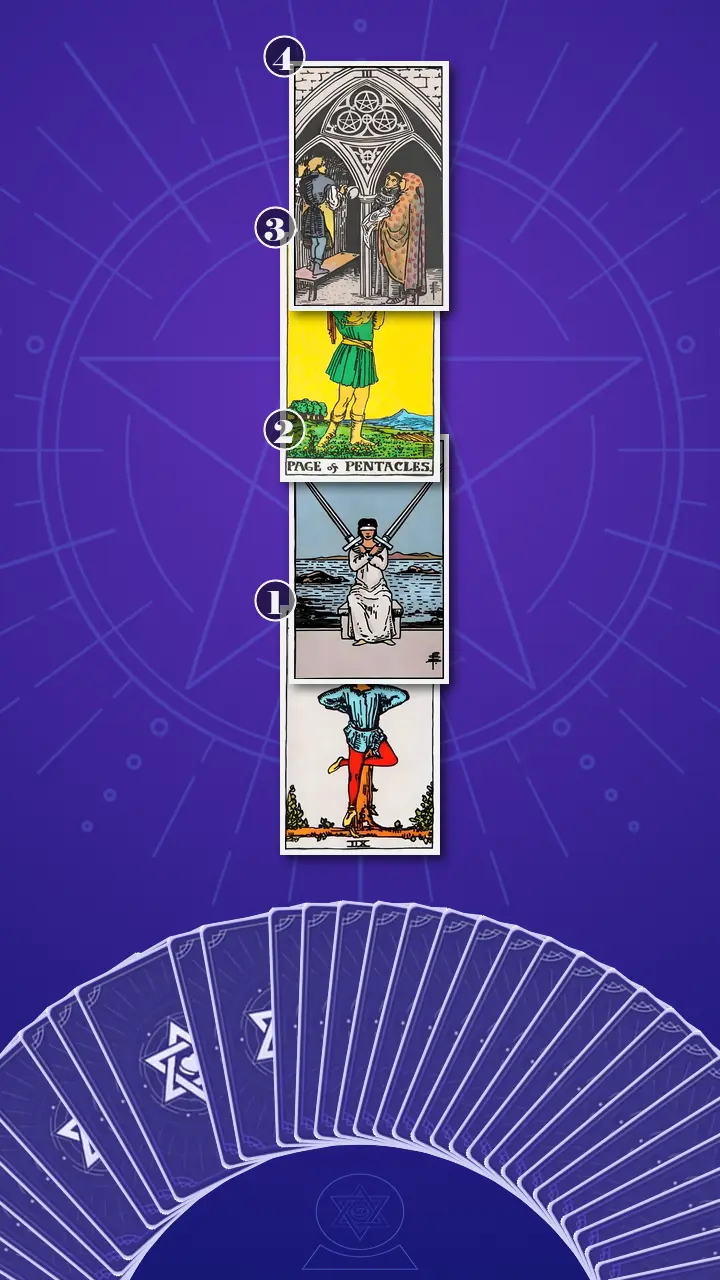
The cards would form a vertical ladder. The bottom position would show the visible stagnation. The next would uncover the protective belief keeping it in place. The third would identify the shift capable of changing Alex's relationship to the decision, and the top card would turn that insight into an actionable next step. A larger spread such as the Celtic Cross would have introduced influences and outcomes we did not need; this focused question required the smallest map that could still explain why the loop persisted.
The Pause That Stopped Producing Perspective
Position One: The Hanged Man and the Unsaved Planner
“The card I am turning over now represents the observable form of your direction stagnation: repeated research, delayed submissions, and a pause that no longer produces new clarity,” I said.
It was The Hanged Man, reversed. In the familiar image, one ankle is tied while the figure's head is surrounded by a halo. Upright, that suspension can be a chosen pause that allows an unfamiliar perspective to form. Reversed here, I read the energy as a blockage: reflection had been extended beyond the point at which it was producing insight.
I connected it directly to Alex's Tuesday night. The planner remains open beside a new comparison sheet and six course tabs. A pathway is selected, another research pass promises clarity, and the portal is closed without saving. From the outside, the pause still looks responsible. Inside the process, however, the same questions are circulating without new evidence.
“The private line underneath this card might be, I call it preparation because admitting that I am stuck would make the deadline feel real,” I said. “Useful reflection changes what you can see. Protective delay repeats the view. More tabs cannot answer a question that requires contact.”
I asked what genuinely new fact Alex had learned during their last three-hour research session. Their mouth opened, then closed. A bitter little laugh escaped.
“That's so accurate it's almost cruel,” they said. “I reorganised the spreadsheet. I don't think I learned anything.”
“The accuracy does not make you foolish,” I replied. “This strategy once gave you breathing room and a sense of control. The card is only showing that it has reached the end of its useful life. Under deadline pressure, the answer is not to swing to the other extreme and click something at random. It is to distinguish the fact you can still verify from the question that only participation can answer.”
Position Two: Two Swords Across the Chest
“The card I am turning over now represents the belief maintaining the procrastination loop: withholding a choice feels safer than risking the loss of alternatives or control,” I said.
The card was the Two of Swords, upright. A blindfold covers the seated figure's eyes. Two blades cross over the chest while rough, rock-dotted water waits in the distance. I saw thought being used in excess as a defensive barrier: not a lack of intelligence, but intelligent analysis recruited to keep the emotional cost of choosing at arm's length.
In Alex's life, two plausible pathways remained equally abstract because ranking either one felt like sacrificing the other future. They compared employment outcomes, graduate profiles, and Reddit stories about major regret. Non-choice appeared neutral, even as registration dates passed and neither pathway received enough direct attention to become clearer.
“It is Chidi-style decision paralysis from The Good Place,” I said, “except the philosophical crisis is happening inside a registration drop-down. The thought is, If I do not rank them, I have not lost either one yet. But indecision is not neutral; it is already shaping your degree. It costs time, access to experiences, and the evidence that could loosen the decision.”
As I spoke, the reflection from Alex's window crossed their jumper in two pale lines. They pressed one palm briefly to their chest, looked away from the screen, and then named the feared door.
“What if one pathway rules out a graduate programme I want later?” they said. After a pause, they added, “I haven't checked whether it actually does. I've just been assuming it might.”
I did not tell them the fear was irrational. Tuition and employability made the decision consequential. I asked a narrower question: “Which parts of that consequence are confirmed in the official handbook, and which parts have expanded in imagination because no one has checked them yet?” The swords did not demand immediate commitment. They asked Alex to stop treating every feared loss as equally permanent.
When the Page Looked at One Real Thing
Position Three: The Working-Hypothesis Pathway
The radiator behind Alex clicked once and fell quiet. Their phone screen, which had lit up twice during the first cards, finally went dark. I placed my hand on the third card before turning it.
“The card I am turning over now represents the key transformation from certainty-seeking to one bounded, practical learning experiment that can generate direct evidence,” I said.
It was the Page of Pentacles, upright. The Page stands on solid ground, holding one pentacle at eye level. The gaze does not scatter across six symbols or scan the distant mountains for a guaranteed destination. One tangible possibility receives sustained attention.
I translated the card into Alex's actual week: close the general career forums, choose one pathway as a working hypothesis, and spend 25 minutes with its real syllabus and a representative assignment. Record where curiosity rises, where effort feels deadening, and what still requires a class, event, or conversation. The goal is evidence, not a permanent identity.
The Page brought balanced Earth energy into a problem dominated by static Air. Alex did not need complete emotional certainty or a cinematic burst of passion before beginning. They needed enough grounded contact for interest, effort, and fit to become observable.
I laid out the scene the card exposed: at 11:47 p.m., the planner, spreadsheet, six tabs, and major-filled group chat were all open while Alex's chest tightened over Save. The research felt responsible; the unchanged decision did not. Thought was being asked to solve a question whose missing evidence lived in participation.
Stop treating certainty as the admission price for action; study one real possibility with the Page of Pentacles' focused gaze and let learning create clarity.
I let the sentence remain between us for several seconds.
On archaeological digs, I use stratigraphy to understand a site: the newest debris sits at the top, while older assumptions and more durable evidence lie beneath it. I applied that same Academic Stratigraphy here. Alex's six tabs were the loose surface layer. Beneath them sat a compacted rule: I must know before I move. Deeper still was the evidence they actually needed, evidence that could only be uncovered by opening one small test square and staying with it long enough to find something real.
“In Research Bottleneck Analysis, I do not treat a block as a personal failure,” I said. “I treat it as a signal that the current method can no longer answer the question. You do not need a wider excavation. You need one bounded square. A degree path can be a working hypothesis, not a permanent identity.”
Alex's breath stopped first. Their fingertips hovered above the mug, perfectly still. Then their eyes lost focus as if the previous registration nights were replaying behind the screen; their brow tightened, and a flush rose along their cheeks. “But doesn't that mean I've been doing all this wrong?” they asked, with a brief edge of anger. I answered carefully: “No. It means a method that once protected you has reached its limit. Learning that is evidence, too.” Their jaw loosened before their shoulders did. One hand opened on the table, then the other. A long breath left them with a slight tremor. Their eyes reddened, but the relief was not simple; I could also see the blank, exposed feeling that arrives when a familiar excuse disappears and choice becomes possible again.
“Now, using this new perspective, think back to last week,” I said. “Was there a moment when this insight could have made you feel different?”
“There was a departmental session on Wednesday,” Alex said quietly. “I skipped it because I thought I should research enough to know whether it was worth attending. I could have gone there to find out.”
I set a ten-minute timer and asked Alex to choose one pathway already open in their tabs. On a sheet, they made two columns: Facts I Can Verify and Questions Only Experience Can Answer. They added one item to each, then named the smallest test they could run that week. I reminded them that they did not have to submit a pathway that day and could stop if the exercise became uncomfortable.
I named the crossing I had just witnessed: this was not instant certainty. It was a first movement from tense, research-driven degree indecision toward grounded confidence built through provisional choice and direct evidence. Alex still had responsibility for the decision, but they no longer had to produce confidence before earning any evidence.
A Third Point at the Planning Table
Position Four: Three of Pentacles and Borrowed Evidence
“The card I am turning over now represents the grounded next step: combine one academic test with collaborative feedback while keeping ownership of the decision,” I said.
The final card was the Three of Pentacles, upright. A craftsperson stands beside completed work while two collaborators hold visible plans beneath a stone arch. I read its energy as balanced collaboration: private study meets contextual knowledge, but no authority takes the tool from the person doing the building.
For Alex, this meant sending the adviser email with two provisional possibilities and one unresolved question, then bringing a short evidence sheet to the meeting. The adviser could clarify requirements and help design a subject-level test. The adviser could not deliver a verdict about Alex's identity or future.
“The Two of Swords made the situation feel like a sealed either-or choice,” I said. “The Three adds a third point: feedback. Not a secret perfect option, just information you cannot generate alone. Keep ownership of the choice; borrow evidence from other people.”
Alex opened the draft email while we were still speaking. Their cursor stayed in the first line for a moment, but their shoulders did not rise this time. They typed one question: “Which difference between these pathways would be easiest to test in one course or project?”
“I am not asking them to choose for me,” they said. “I am asking for evidence I can't generate alone.”
From Card Meanings to Two Next Steps
I gathered the four cards into one account of why Alex felt stuck. Research had once been a genuine strength, but the reversed Hanged Man showed that reflection had hardened into suspension. The Two of Swords revealed the rule underneath: preserving every option felt like preserving control. The Page of Pentacles supplied the missing resource, practical curiosity directed at one real possibility, while the Three of Pentacles placed that evidence into a plan that could be discussed and revised.
The cognitive blind spot was the belief that withholding a choice preserved a neutral position, and that changing direction later would prove a failure to control the future. In practice, non-choice was already narrowing Alex's degree experience. The transformation was not from uncertainty to perfect certainty. It was from researching until certainty appeared to participating until useful evidence accumulated.
“But 25 minutes feels absurdly small for something this important,” Alex said.
“It is too small to settle your future,” I replied. “That is why it is safe enough to start. Its job is to produce one honest piece of evidence, not a final answer.”
- The One-Path Field TestOn one weekday evening, choose one pathway already under consideration, close the general career forums, and set a 25-minute timer. Annotate one official syllabus and one assessment brief, marking moments of curiosity, resistance, and unanswered questions. Stop when the timer ends.The minimum version is five minutes with one assessment brief. A flat or negative response is useful data, not failure.
- The Thesis Stratigraphy Adviser BriefBefore the next adviser appointment or office-hours session, make one page with four layers: your working-hypothesis pathway, one confirmed fact, one question that requires experience, and one small test. Send a three-sentence email: “I am comparing X and Y. I keep delaying because I am unsure about Z. Could we use 20 minutes to identify one practical way to test the difference?”Do not wait for a perfect question list. The minimum viable message is two options and one question; the final choice remains yours.
I adapted the Thesis Stratigraphy Framework because a degree decision, like an essay, becomes unmanageable when every interesting point is treated as equally foundational. Alex did not need to erase possibilities. They needed to identify the bedrock question, place current evidence above it, and leave room for revision when a new layer appeared.
Six Days Later: The Quiet Proof
Six days later, I received a message from Alex. They had completed the 25-minute syllabus test, sent the three-sentence email, and booked a short adviser meeting. “I still don't know my whole path,” they wrote. “But I finally have a question that isn't another tab.”
They had slept through the night after sending it. Their first thought in the morning was still, What if I am wrong? This time, they told me, they smiled. Changing the working hypothesis now meant learning, not failing.
I did not credit the tarot with choosing a degree direction. The Four-Layer Insight Ladder made the structure of the delay visible; Alex supplied the honesty, ran the experiment, and opened the conversation. Their clarity began as evidence-based self-trust, not certainty handed down by a card or an adviser.
When every degree option feels like a door that might lock behind you, your chest can tighten over Save while one more comparison tab feels safer than discovering that you may later change your mind. If you can notice when research has become a substitute for contact, you are no longer standing at the exact beginning of the corridor.
If your next choice were one archaeological test square rather than a verdict on your future, which possibility would you be curious to meet up close for 25 minutes?