Writing 164 Rough Words: Interrupting Grad School Procrastination

The 10:47 p.m. Loop of Graduate Application Procrastination
I know the pattern: you know the next step, but when the application portal asks for something that can be judged, you suddenly find ten safer tasks.
When Jordan joined our video consultation from their shared Toronto apartment, the clock behind them read 10:47 p.m. Four graduate program tabs crowded one side of the laptop; a colour-coded Google Sheet glowed beside the same unfinished personal statement. I could hear the fridge humming through the microphone. Jordan kept flexing their fingers against the warm laptop while the overhead light sharpened the tiredness around their eyes.
“I keep doing application work without actually moving the application,” they said. “I changed two deadlines in the tracker, read another course page, and renamed the statement FINAL_v6. The paragraph itself is still the same.”
I heard the core contradiction immediately. Jordan wanted to complete their school applications before the deadlines, but the closer those deadlines came, the more energy they spent researching, reorganising, and polishing around the applications. It was productive procrastination on graduate school applications, driven by evaluation pressure and perfectionism: real mental effort that produced movement on the screen without producing a finished requirement.
Jordan described the mounting dread as pressure under their sternum, like an invisible compression band tightening one click each time they switched tabs. Their jaw locked whenever a prompt became concrete. Guilt followed when they closed the laptop, and by morning self-doubt had rewritten the evening as evidence that they lacked discipline.
“I do not think this is laziness,” I told them. “I think something in the application process starts to feel more dangerous than the task itself. We are not going to use tarot to predict whether a school accepts you. We are going to use it as an objective visual map, so we can see what happens between your intention and your next action. You will decide what to do with what we find.”

Choosing a Workbench for the Tangled Parts
I invited Jordan to put both feet on the floor, let one breath move naturally through their chest, and hold the question in plain language: “Why do I keep delaying school applications until the deadlines pile up?” I shuffled slowly. The pause was not a mystical performance; it was a psychological transition from reacting to observing.
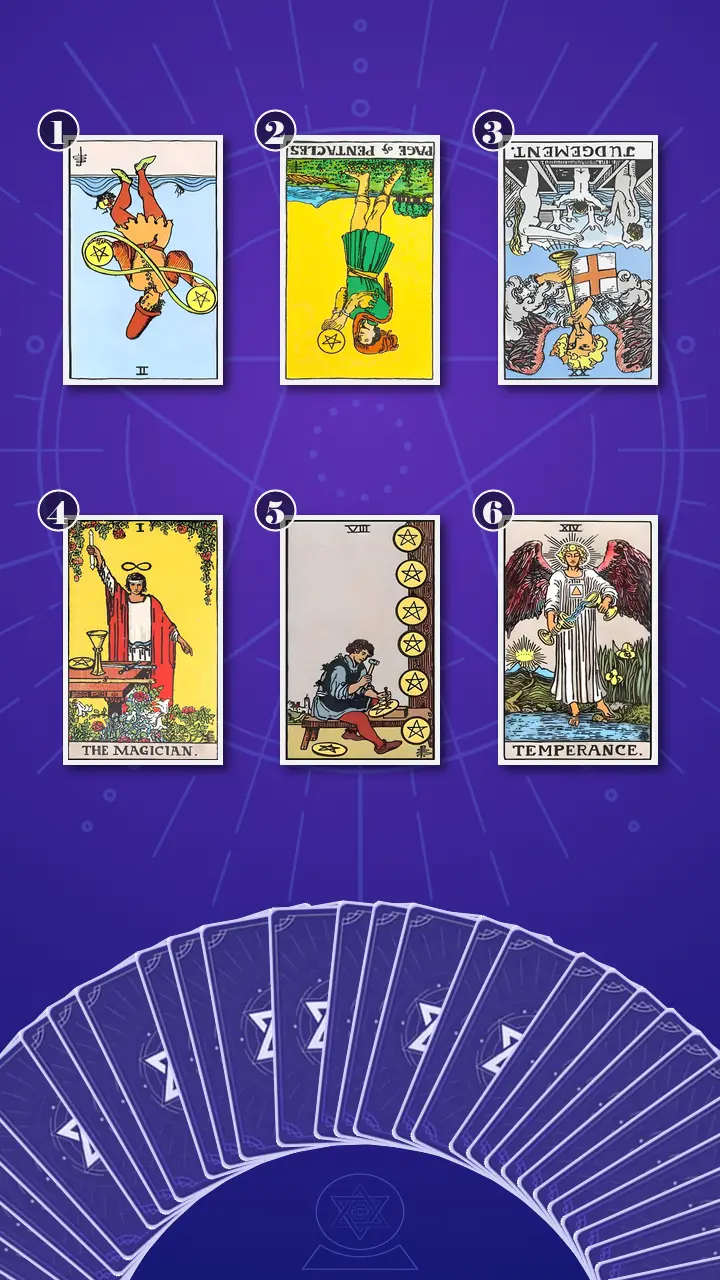
I chose the six-card Transformation Path Grid · Context Edition. I want to be clear about how tarot works in my practice: I use the cards as symbolic prompts, viewed through a Jungian psychological lens. Images can make an internal pattern visible enough to examine, but they do not diagnose a person, command a decision, or reveal a fixed future.
This spread suited Jordan's question because application procrastination was operating as a system. A shorter advice spread might have jumped from “problem” to “try harder” and missed the protective loop underneath. Here, the top row would show the visible deadline spiral, the immediate task-level blockage, and the deeper fear giving it force. The lower row would reveal the catalyst, the repeatable practice, and the sustainable rhythm that could follow.
I arranged the cards like a workbench: tangled parts above, usable process below. The first position would show Jordan switching among portals, trackers, and drafts. The third would examine whether admissions evaluation had become entangled with personal worth. Directly beneath the first card, the fourth would identify the shift capable of turning scattered capacity into a concrete application step.
The Infinity Loop That Looked Like Productivity
Position 1: Two of Pentacles Reversed and the Deadline Spiral
I turned the card in the position representing Jordan's current-state behaviour: switching among portals, trackers, and drafts while unfinished deadlines accumulated. It was the Two of Pentacles, reversed.
I pointed to the two pentacles joined by an infinity-shaped ribbon and the ships rising and falling behind the figure. In Jordan's modern version of the image, four portals, a Google Sheet, and several draft files remained in constant motion at 10:47 p.m. Each time a personal-statement sentence began to feel consequential, attention transferred to another date or document. The evening was busy, but no single requirement reached shore.
Reversed, I read this as an excess of reactive movement combined with a deficiency of completion. The resulting blockage was not a lack of capability. Jordan's capacity was being consumed by keeping every demand active, as if moving calendar blocks around like Tetris could prevent the same unfinished application from dropping into tomorrow.
“I have been working for hours,” I said, voicing the loop back to them, “so why can I not point to what is done?”
Jordan gave a short, bitter laugh. Their shoulders rose before they answered. “That is too accurate. It is almost cruel.”
I did not rush to turn that recognition into a lesson. “Then let us be precise and kind about it. The activity was real. It simply served a different function from completion. When you last closed the laptop, what one requirement was more complete?”
Jordan looked across the open tabs. “None of them.” Their fingers stopped tapping. The answer seemed to separate busyness from progress without turning either into a moral failure.
Position 2: The Page Studying While the Field Waited
I turned the card representing the immediate task-level blockage: preparation or research replacing the draft or decision that would close the intention-to-action gap. It was the Page of Pentacles, reversed.
The Page held one pentacle at eye level while a workable field waited behind them. I connected that image to Jordan's seventh program FAQ, another admissions breakdown video, and a carefully improved Notion dashboard while a 300-word short-answer box remained blank. Jordan could explain every module and requirement. The future student identity was vivid; the deliberately rough first artifact was still withheld.
This was blocked earth energy: genuine interest and practical intelligence that had not yet landed in a document the portal could receive. There was also a deficiency of beginner permission. Jordan seemed willing to be an impressive future graduate student, but not yet willing to produce the ordinary, imperfect work of an applicant beginning on a weeknight.
I used a lens I call Draft Paralysis Deconstruction. Instead of treating perfectionism as proof of high standards or low discipline, I traced its protective job. A rough answer could attract criticism. More research preserved the idea that the excellent answer still existed somewhere in the future. The defence offered short-term relief, but it kept the application hypothetical.
“One more piece of information, then I will be ready to write,” I said. “That thought sounds responsible, but in this moment it is a side quest away from exposure. An unfinished draft protects your potential, but it cannot carry it anywhere.”
Jordan's eyes moved from the card to the blank box on their screen. Their thumb rubbed the edge of their mug. “I do this at work too,” they said. “If a manager will review something, I suddenly become very interested in formatting.”
Position 3: When an Application Became a Verdict
I turned the card in the position examining the psychological root beneath the delay: whether anticipated evaluation had become linked with worth and with the loss of control that follows submission. It was Judgement, reversed.
I showed Jordan the trumpet calling the figures to rise from their closed boxes. In the application portal version of that threshold, Jordan reached a nearly usable answer, pictured an admissions reader inspecting every sentence as evidence of whether they deserved the future they wanted, and returned to editing. An unfinished application could not yet reject them, but it also could not move them forward.
Here I saw an excess of self-judgment and a deficiency of proportion. A contextual admissions decision had expanded into an imagined global rating of intelligence, belonging, and potential. The card did not prove that this fear was objectively true. It gave us a clean way to ask whether the fear was steering the workflow.
“When you imagine an admissions reader opening the submitted application, what is the most painful thing you fear their decision would say about you beyond this application?” I asked. “You do not have to answer if it feels too exposed.”
Jordan's breath caught. Their gaze rested on the cursor as if it had become a replay button. Then they said, very quietly, “That I was never as capable as people thought. That wanting this was embarrassing.”
I let the refrigerator's low hum fill the pause. I remembered how differently words such as merit and potential had been measured across the cultures, classrooms, and workplaces I had encountered while travelling. Evaluation was never context-free, even when fear presented it as universal.
“You are not avoiding the dream,” I said. “You are avoiding the moment the dream becomes judgeable. That makes the delay understandable, but it does not make the feared verdict accurate. A decision can evaluate an application without defining the applicant.”
When The Magician Reorganised the Infinite Loop
Position 4: One Tool, One Visible Step
The room seemed to become quieter when I reached the card beneath the reversed Two of Pentacles. I turned the position representing the key shift from waiting for readiness to directing an available resource toward one concrete application step. It was The Magician, upright.
The same infinity shape appeared again, but its function had changed. In the first card, it tied competing demands into endless reactive juggling. Above The Magician, it rested over a centred figure with every necessary tool already on the table. One hand reached upward; the other directed energy toward material ground.
I read this as balanced, available agency. The Magician did not promise a perfect essay or an acceptance. The card asked what Jordan's current time, prompt, writing skill, and support could produce before another search for readiness began. It was the difference between letting an algorithmic feed choose the next input and using a search box for one deliberate query: the capacity was already present, but attention needed an instruction.
I brought Jordan back to 10:47 p.m.: another date moving across the colour-coded tracker, the same paragraph untouched, the laptop warm, the fridge humming, their jaw held tight. I could see the old conclusion forming again: if readiness had not arrived, perhaps one more system was still missing.
I used Performance Anxiety Decoupling to separate what fear had fused together. On one side, I named what an application could reasonably reveal: selected experiences, preparation, writing under constraints, and possible fit with one program. On the other, I named what it could not measure in full: Jordan's worth, future capacity, intelligence across every context, or right to pursue a meaningful direction. The goal was not to guarantee a favourable outcome. It was to return an admissions decision to its actual size.
Do not wait for perfect readiness; use one available tool on one visible step, as The Magician turns intention into action.
I stopped speaking and let the sentence remain between us.
For one beat, Jordan's breathing stopped. Their fingers froze above the trackpad, and their eyes lost focus as if several late-night application sessions were replaying at once. Then their brow tightened.
“But does that not mean I have been doing it wrong this whole time?” they asked, with a flash of anger that seemed aimed partly at the lost evenings and partly at the simplicity of the card.
“No,” I said. “It means your strategy protected you from evaluation until its cost became larger than its relief. We can respect why it developed without continuing to let it run the session.”
Jordan's jaw loosened first. Their shoulders dropped a moment later, and one long breath left their chest with a slight tremor. Relief arrived, but not as uncomplicated confidence. I also saw the small blankness that can follow clarity: if readiness was not required, Jordan now had the vulnerable responsibility of choosing a step.
“Now, with this new perspective, think back to last week,” I invited. “Was there a moment when this insight could have made you feel different?”
“Tuesday,” Jordan said. “I opened the motivation prompt, decided it had to represent my entire career, and spent forty minutes on Reddit reading whether other people's statements were good enough. I could have closed the threads and written 150 bad words.”
That answer marked the breakthrough: not the disappearance of doubt, but movement from mounting deadline dread and self-criticism toward focused agency. Jordan had changed the question from “How do I become ready enough to represent my whole potential?” to “What can one tool already within reach make visible tonight?”
Craft Without Crisis
Position 5: Eight of Pentacles and the Visible Artifact Queue
I turned the card representing the practical action plan: a repeatable application practice built from bounded tasks, visible outputs, and completion standards chosen in advance. It was the Eight of Pentacles, upright.
The craftsperson worked on one pentacle while completed pieces remained visible nearby. I translated the image into separate application outputs: a 150-word draft, one reference request, a checked transcript, an updated CV, and a final portal review. Each work block would hold one active piece. Progress would be measured by the artifact that moved into a Complete column, not by hours spent near the work.
This was balanced earth energy: focused practice replacing stalled preparation. It answered the reversed Page directly. Jordan did not need to become a flawless applicant in a single session; they needed to complete one reviewable piece, then repeat the process.
“The deadline does not create your focus; it removes your remaining escape routes,” I said. “If we define one output before the panic arrives, we can test whether focus belongs to you rather than to the crisis.”
Jordan nodded, then hesitated. “But I work all day. Sometimes I genuinely do not have another twenty-five minutes in me.”
“That is a real constraint, not a character flaw,” I replied. “The practice must include an eight-minute version, or it will become another perfectionistic demand. The measure is repeatability, not intensity.”
Position 6: Temperance and the Week That Leaves Room to Breathe
I turned the final card in the position showing the integrated result: a sustainable rhythm in which ambition, discomfort, paid work, rest, and application deadlines could coexist without crisis. It was Temperance, upright.
I drew Jordan's attention to the steady flow between two cups and to the figure standing with one foot on land and one in water. In daily life, I saw two or three bounded application sessions around full-time work, at least one application-free evening, and a shorter block when available energy was low. Doubt could remain in the room without deciding whether the session happened.
Temperance represented balance, not relentless productivity. It coordinated the practical deadline with emotional tolerance. The test was not whether one heroic weekend could clear the backlog; it was whether the pace could be repeated next week without stealing sleep, destabilising work, or requiring recovery from an all-night sprint.
I asked, “Can this session produce one artifact and still leave enough of you for tomorrow?”
Jordan looked at the six cards, then closed three browser tabs. Their shoulders softened. “That feels less impressive than finishing everything,” they said, “but much more possible.”
The One-Tool, One-Output Path
I gathered the cards into one coherent story. Past last-minute sprints had taught Jordan to confuse adrenaline with capacity. In the present, the reversed Two of Pentacles showed attention circulating among deadlines, while the reversed Page showed preparation substituting for exposed beginner work. Beneath both, reversed Judgement revealed the inner conflict: Jordan wanted the future badly, but submission seemed to hand an institution the authority to judge far more than an application.
The lower row did not erase that fear. It reorganised the same resources. The Magician changed the infinity loop from reactive repetition into deliberate direction. Eight of Pentacles gave that direction a visible product. Temperance protected the process from becoming another exhausting standard.
I named the cognitive blind spot plainly: Jordan had been treating productive activity as evidence of application progress and deadline panic as the source of focus. More deeply, they had been treating an unfinished draft as preserved potential and a submitted draft as exposed worth. The transformation direction was not from imperfect to perfect. It was from waiting to feel ready to completing one time-boxed component with a good-enough finish line.
“One tool. One field. One visible finish line,” I said. “Here is how I would test that shift without asking you to overhaul your life.”
- Run the Inner-Critic Mute Protocol. On your next available evening, choose the nearest viable deadline and name one component that would reduce the pile. Before opening it, write two sentences: one thing the admissions process can assess, and one thing it cannot define about your worth. Put your phone on Do Not Disturb, keep only the prompt and draft open, and set an eight-minute timer for a heading plus three rough bullets or up to 150 unedited words. If the exercise feels too activating, use the minimum version: name the field, close the unrelated tabs, and write only the two verdict-separation sentences. Stopping there still counts as interrupting the loop.
- Build a Visible Artifact Queue. Break one application into separate rows for the statement, short answers, reference requests, transcript, CV, fee, and final review. Schedule one 25-minute production block on Tuesday and one on Thursday. Assign exactly one row to each block, define “complete for this stage” before starting, and finish with a one-line handoff for the next session. Use one production pass and one scheduled review pass instead of unlimited polishing. Leave at least one evening application-free; when energy is low, reduce the block to ten minutes rather than borrowing time from sleep.
I reminded Jordan that these were experiments, not commandments. They could change the times, pause an application, or decide that a program was no longer worth its fee or energy. Tarot had clarified the pattern, but the boundaries and choices remained theirs.

A Week Later, the Quiet Proof
Six days later, I received a message from Jordan. They had used the Inner-Critic Mute Protocol after work, chosen the nearest deadline, and defined one finish line: “150 rough words, no editing.” Eight minutes produced 164 words. They stopped, ate dinner, and completed a review pass two days later.
Jordan marked the short answer complete and closed the laptop at 9:38. The next morning, “What if it is not good enough?” returned. They sat with the thought, smiled at its persistence, and did not reopen the finished section.
The applications were not all submitted. One deadline still needed reprioritising, and Jordan chose to move a lower-fit program out of the active queue. That was not failure. It was focused agency replacing the fantasy that every option had to remain equally alive.
I think of this consultation as a Journey to Clarity because no card supplied Jordan with certainty. The cards made the protective structure visible; Jordan created the evidence of change. One bounded action began shifting the rhythm from crisis-dependent momentum toward a process they could trust and repeat.
If a nearly finished application makes your chest tighten, I want you to remember how easily it can feel as though you are choosing between the future you want and the safety of never letting anyone decide whether you are good enough for it. Simply noticing that false choice means you are no longer standing at the beginning of the loop.
If doubt were allowed to sit beside The Magician's workbench without touching the tools, which one prompt, field, email, or upload would you be curious to make visible next?