Planning Instead of Studying: One Block Shaped the Next Step

The 7:32 p.m. Setup Loop: Structure-Dependent Procrastination in Self-Directed Postgraduate Study
If you are a self-directed postgraduate student in London who can spend an entire evening preparing to study without opening the reading, structure-dependent procrastination may already have taken over the session.
Maya (name changed for privacy), a 24-year-old postgraduate student, brought that exact pattern into our video consultation. At 7:32 p.m. on a Tuesday, I could see her at the small desk in her shared London flat, fingertips moving between Moodle, Notion, and Google Drive. Through my headphones, I heard the laptop fan beneath six open tabs and the faint clink of her spoon against a mug whose steam had already disappeared.
She renamed a folder while she spoke. The assigned article remained open to page one behind a polished dashboard.
“Why do I keep waiting for structure before I start studying?” she asked. “I need a plan, but making the plan has become the whole task.”
Her online programme supplied broad learning outcomes, long reading lists, and flexible deadlines, but no weekly sequence. She wanted to touch the actual material, yet because no one had defined the correct order, she kept building systems that protected her from the risk of choosing the wrong first step. She wanted to start studying while waiting for structure to exist first.
I watched her shoulders climb towards her ears each time she glanced at the unread PDF. Her frustration looked less like a cloud and more like a song trapped in an endless count-in: every click promised the first note, but the music never began. Underneath it sat guilt, uncertainty, and the private suspicion that everyone else had received an instruction manual she had somehow missed.
“This makes sense as a control strategy,” I told her. “It gives you something organised to hold when the course feels open-ended. But it is also costing you the feedback that could make the work less open-ended. What looks like a planning problem may be a permission problem.”
I explained that I would not use tarot to predict her grades or declare whether she was disciplined enough. I would use it as an external map of the loop she had already begun to notice. Our Journey to Clarity would be practical: identify where preparation became suspension, locate the rule maintaining it, and find one action small enough to produce real evidence.

Choosing a Four-Card Ladder Through the Fog
I invited Maya to place both feet on the floor, let one full breath leave her chest, and hold one question in mind: What happens between intending to study and touching the material? I shuffled slowly, using the brief ritual as a transition from tab-switching into sustained attention rather than as a performance of mystery.
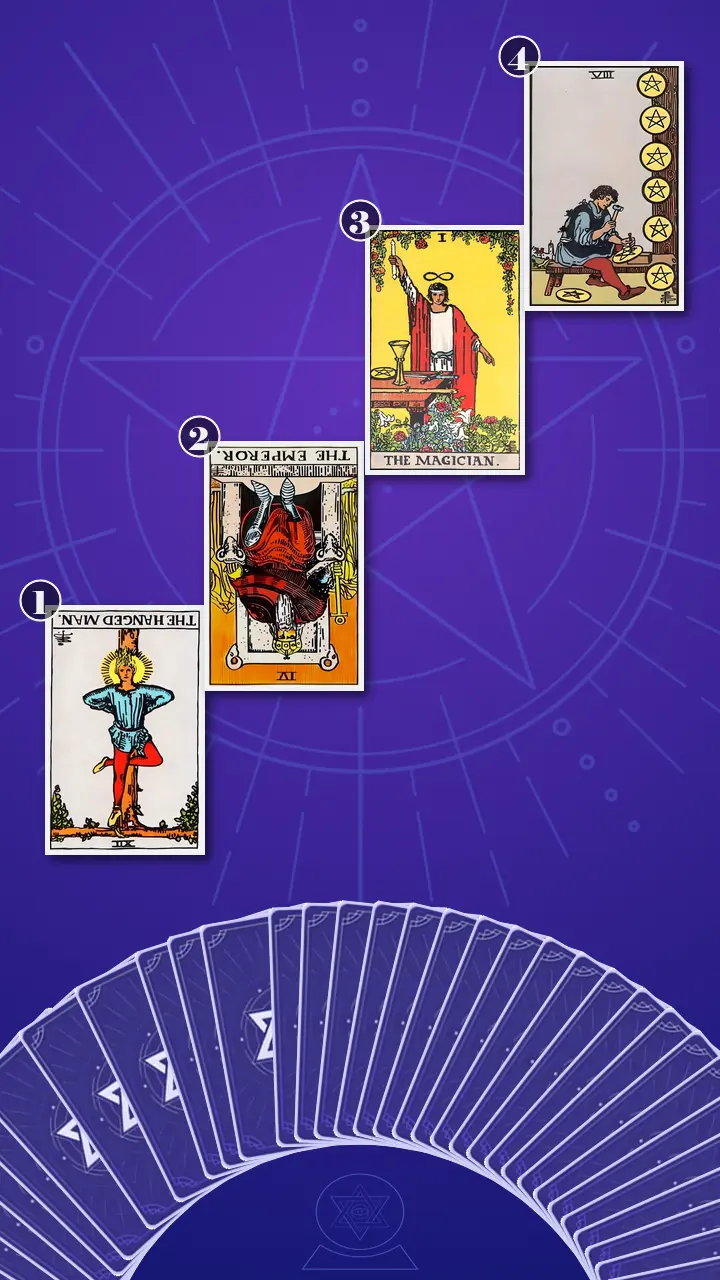
I chose the Four-Layer Insight Ladder, arranging its cards as an ascending diagonal. I left a slightly wider gap between the second and third cards so the layout itself showed where the old pattern could give way to a different response.
This is how tarot works for me in a practical consultation: the spread separates a tangled experience into distinct functions, and the card meanings in context help me test a pattern against observable life. The Four-Layer Insight Ladder suited Maya because her procrastination was a feedback loop, not a single shortage of motivation. A larger spread would have added noise, while three cards would not have clearly separated the hidden dependence on external authority from the repeated practice needed to replace it.
I told Maya what I would examine. The first position would show the observable delay: organising, researching systems, and waiting while the material remained untouched. The second would reveal the hidden rule that kept that delay running. The third would hold the pivotal shift towards one bounded study experiment, and the fourth would show how to turn that experiment into a sustainable next step.
The cards were not going to install an entire route at her unmarked trailhead. They were going to help us see why she had been waiting there and what kind of first foothold she could place herself.
The Lower Rungs: Where Preparation Became Permission
The Hanged Man Reversed: Motion Inside Suspension
I turned over the card representing the observable study delay: The Hanged Man, reversed.
I pointed to the figure suspended by one foot. The other leg remained free, and the halo suggested that thought and capacity were present, but the reversed orientation showed a pause that had hardened into blockage. Reflection was no longer preparing movement. It had become another condition Maya believed she had to satisfy before movement was permitted.
In Maya's evening, the card was almost literal. At 7:30 p.m., she opened the postgraduate course portal intending to read. By 9:00, she had renamed six folders, rebuilt a dashboard, and watched two note-taking videos while the article remained on page one. Her attention had been active for ninety minutes, but none of that activity had brought her into contact with the argument she was supposed to learn.
“I always tell myself it still counts because it is study-related,” she said. “Then I get to the end and think, I have been busy for ninety minutes, so why do I have nothing I can explain?”
I described the energy as blocked rather than absent. Maya was not doing nothing; she was directing a great deal of mental energy into setup. Like an app trapped in its setup wizard because every preference must be configured before the workspace appears, her study process could not reach its actual function.
“You are not failing to plan,” I said. “Planning has become the permission slip.”
She gave one short laugh, then pressed her lips together. “That is so accurate it is almost brutal.”
I let the humour take some pressure out of the room before answering. “The card is not accusing you of laziness. It is distinguishing useful preparation from indefinite suspension. The important point is not that you made folders. It is the precise moment when the next folder became safer than the first paragraph.”
Her eyes moved towards the tabs at the top of her screen. One hand rubbed the cooling mug while the other stopped reaching for the trackpad. I saw recognition arrive with a trace of embarrassment, so I kept my voice matter-of-fact: a protective strategy can make sense and still have a cost.
I asked, “During your last planning-heavy evening, where did setup stop helping?”
“Probably when I opened YouTube to compare note-taking systems,” she said. “The PDF was already there. I just did not want to choose how to read it.”
The Emperor Reversed: The Dashboard as a Stone Throne
I turned over the card representing the underlying rule that maintained the procrastination cycle: The Emperor, reversed.
The upright Emperor usually offers boundaries, order, and usable authority. Reversed, that energy can show an excess of rigidity alongside a deficiency of internal authority. Structure becomes so complete, official, and externally located that a provisional personal choice feels illegitimate.
I connected the image to Maya's course platform. The brief listed outcomes and resources but gave her no official weekly order. She searched Moodle, Discord, and classmates' schedules for a definitive sequence, then discounted her own simple choice because it did not feel authoritative enough. The Emperor reversed did not say she lacked discipline. It showed that she had appointed an absent external framework as the authority that must approve her action.
I compared the polished Notion dashboard to the Emperor's stone throne: imposing, finished, and too rigid to help at a desk where the immediate need was one readable page. A perfect dashboard could display intention; it could not produce learning evidence.
Maya's shoulders rose again. She glanced at the course guide as if it might have changed while we were talking.
“If the tutor has not named the correct first step, who am I to choose one?” I asked, giving her hidden rule a voice.
Her expression tightened. After a pause, she said, “Exactly. If I choose wrong, I feel like I have wasted the session. Or proved I cannot manage independent study.”
I used a Focus Disruption Audit, one of the tools I have developed through years of studying rhythm and attention. I asked her to identify the specific dissonant chords breaking the flow rather than treating the whole evening as one vague failure. The external chords were easy to hear: Discord comparisons, template videos, the course guide, and a desk used for everything from coursework to streaming. The internal chord was quieter but more disruptive: My choice is not valid unless a complete system authorises it.
The audit changed the question. Maya did not need to remove every distraction or build a silent, flawless study environment. She needed to protect one short interval from the few disruptions that repeatedly pulled her back into system design. Any accessibility tool, necessary reference, or notification she personally needed could remain. The aim was focused choice, not punitive control.
“The plan is not the doorway,” I told her. “Contact with the work is.”
Outside her window, rain sharpened against the glass. The course dashboard still looked immaculate on her screen, but I could now see her looking past it towards the narrow strip of the article tab.
When the Magician Gave the Evening Its First Beat
The Magician Upright: The Tools Already on the Table
I turned over the card representing the key shift from waiting for a complete framework to running one deliberate, bounded study experiment: The Magician, upright. The room seemed to become quieter around it; even the rain against Maya's window separated into distinct, countable beats.
I showed her the raised wand, the hand directing energy downwards, and the four suit tools already arranged on the table. The Magician did not promise that every resource was equally useful or that Maya could control every outcome. The card showed balanced agency: choosing one available tool, giving attention a direction, and allowing intention to become a material act.
In Maya's real life, that meant closing the template search, keeping the article already open, writing one answerable question such as What is this section's main claim?, and setting a 25-minute timer with a finish line of five pages and one question. She would not be claiming to know the correct sequence for the whole course. She would be using one resource to produce feedback from which the next choice could be made.
I brought her back to the familiar setup: at 7:30 p.m., the laptop was open but the article was not. Folder names became cleaner, the tea went cold, her shoulders inched upwards, and tomorrow began to sound like the only sensible time to start properly.
This was where I applied Cognitive Tempo Calibration. I do not use that phrase as a medical label; I use it as a diagnostic lens for the rhythm between a person's attention and the demands being placed on it. Maya had been presenting herself with an enormous opening command: understand the course, select the correct sequence, design the term, and study effectively. Her workable entry rhythm was much smaller: receive one concrete cue, make brief contact, notice friction, and use that information to choose the next cue.
For a moment, I remembered a waveform from my early sound-energy research: a signal overloaded with competing frequencies until the original pulse became impossible to follow. Maya's attention was not silent. It was crowded. Each new planner, classmate's dashboard, and productivity video added another frequency while the simple downbeat of the article disappeared underneath them.
“Your task demand and your natural starting tempo are out of sync,” I said. “The answer is not an even more elaborate score. It is one clear beat you can actually enter.”
I asked her to move her hand from the trackpad to the edge of the laptop beside the open article. The visual shift echoed the cards: the Hanged Man's concealed hands had become the Magician's directed hands.
Structure is not always the condition for starting; sometimes it is the evidence left behind by one deliberately bounded act.
Then I gave her the sentence at the centre of the reading.
You do not need a finished system to prove you can study; begin with the tools already on the table, as The Magician turns intention into one concrete act.
For one beat, Maya's inhale stopped. Her fingers hovered above the laptop, and her eyes lost focus as if she were replaying several evenings at once: the cold tea, the renamed folders, the same task dragged into tomorrow. Her brow tightened before her eyes began to shine. Then resistance arrived before relief.
“But doesn't that mean I have been doing it wrong this whole time?” she asked. The words came out sharper than anything she had said earlier. Her shoulders were still high, but her hands had opened flat on the desk.
“It means planning protected you from the discomfort of choosing under uncertainty,” I replied. “That protection worked briefly. It gave you control for an hour. It also prevented the feedback you needed. Recognising the trade-off is not a verdict on your past; it gives you a different choice tonight.”
Her jaw loosened first. Then her shoulders lowered, almost unevenly, and she released a breath with a small tremor in it. Relief crossed her face, followed by the exposed look that can come when a familiar excuse falls away. I could see that clarity brought responsibility with it: if she did not need the whole map, she could no longer wait for someone else to install the first step.
I asked, “Now, using this new perspective, think back: was there a moment last week when this insight could have made you feel different?”
She stared at the article tab. “Wednesday. I spent forty minutes deciding whether to start with the article or the lecture. I could have read one paragraph and found out whether I even understood the topic.”
That answer marked the real crossing in the spread. Maya had moved from frustrated, guilt-heavy stagnation towards experimental self-trust. She did not suddenly trust every decision. She had begun to trust that a small action could generate information, and that information could support the next decision.
Structure could be an output of study, not just an input.
The Eight of Pentacles Upright: Evidence One Block at a Time
I turned over the card representing practical integration through repeated, visible study units: the Eight of Pentacles, upright.
I drew Maya's attention to the craftsperson's tool touching the pentacle currently in progress. Completed pieces were visible nearby, but the figure was not attempting to carve all of them simultaneously. The energy here was balanced earth: patient contact, a bounded unit of work, and competence accumulated through repetition.
I translated the scene into the end of Maya's next timer. After one block, she could record: Completed pages 1-5. Got stuck on sampling terminology. Next, open the glossary and answer question two. At the following session, she could use that note instead of rebuilding the entire week. Like the craftsperson shaping one pentacle at a time, she would create a usable study pathway from finished units, observed friction, and specific next actions.
“This block does not have to solve the course,” I said. “It only has to leave one piece of evidence. One finished block gives the next block something real to work with.”
Maya reached for a plain sheet of paper rather than opening another app. She wrote three headings: Completed. Got stuck. Next. Her pen paused after the third line, then she nodded slowly, with recognition and uncertainty still sharing the same expression.
“That feels almost too basic,” she said.
“Basic is useful here,” I replied. “Complexity has been one of the hiding places. We are looking for a structure small enough to survive an imperfect evening.”
The final card did not demand intensity, a six-week timetable, or an aesthetic routine worthy of StudyTok. It asked for repeatability. Missing a day would not erase previous blocks. A difficult session would not require a new system. Even one paragraph could provide data about vocabulary, concentration, or the size of the next task.
Building a Study Structure From the Work Itself
I read the four cards back to Maya as one continuous story. The Hanged Man reversed showed where useful preparation had become productive-looking suspension. The Emperor reversed explained why: she had outsourced valid authority to a complete structure that did not exist. The Magician returned authority to a deliberate act using the tools already available. The Eight of Pentacles grounded that act in repetition, allowing each completed block to shape the next.
The pattern reminded me of standing on a Tube platform comparing every possible route while several workable trains leave. Maya had treated the discomfort of choosing a train as evidence that she lacked route information. In reality, no amount of platform analysis could provide the information available after travelling one stop and checking where she was.
I named her cognitive blind spot directly: she had been treating uncertainty about the first choice as proof that the choice was invalid. She had also been comparing her private, unfinished process with classmates' polished outputs, mistaking their visible destination boards for a recording of every wrong turn they had made.
The transformation direction was therefore precise. She did not need to become someone who never planned. She needed to shift from designing the whole study system before beginning to running one bounded block and allowing its feedback to design the next one. Planning would return to its proper role: supporting contact with the material rather than replacing it.
The Syncopated Study Session: A 25-Minute Feedback Scaffold
I translated the Four-Layer Insight Ladder tarot spread paired with a 25-minute feedback scaffold into my Syncopated Study Session. I called it syncopated because the rhythm leaves room for variable concentration, interruptions, and low-energy days. It does not require every beat to land with machine-like regularity. It only needs a recognisable return to the work.
- Run one minimum viable study session.At Maya's desk during one evening this week, she would cap planning at 10 minutes, keep the article, lecture, or problem set already open, and write one question with one finish line, such as Read pages 1-5 and note the main claim. She would then study for 25 minutes, or five minutes on a low-energy day.Treat the block as a trial, not a contract. If one paragraph is all she can manage, that paragraph still supplies information. Opening another template is not the third option: she can begin the smallest version or consciously stop.
- Leave a three-line handoff for the next block.Before closing the laptop, she would write Completed, Got stuck at, and Next open action. She would leave the named page, question, or file visible. After two sessions, she would review only those two logs and make one adjustment, such as shortening the reading section or keeping a glossary nearby.Record facts rather than grading the session as good or bad. A missed day does not erase the log, and an awkward block does not require a new system. The minimum handoff is one sentence: Next time, open X and do Y for five minutes.
I also suggested a narrow version of the Focus Disruption Audit for the timer. Maya could close the Notion gallery, Discord, and comparison videos while keeping any genuinely necessary reference or accessibility support available. She could place her phone out of reach or use a personally configured Focus mode, without turning the exercise into a test of deprivation.
“I can do one block,” she said, then immediately frowned. “But what if I pick the wrong article and lose twenty-five minutes?”
“Then the block tells you why that article was the wrong size, level, or sequence,” I said. “That is usable feedback, not wasted time. The only experiment that cannot teach you about the material is the one that never reaches it.”
I asked her to define success for the coming week. She did not choose finishing the module or creating the perfect routine. She chose two blocks, two short reviews, and one adjustment made from evidence. The scale mattered because her old pattern could easily disguise itself as an ambitious recovery plan.
Nothing in the spread promised permanent freedom from procrastination. It offered actionable advice and a testable alternative to the loop. Maya remained the person deciding what to study, what support she needed, when to stop, and what the evidence meant.

A Week Later: The Quiet Proof on Page Five
Six days later, I received a message from Maya. She had closed the template tabs, written What is this section's main claim?, and started with the article already open. She read four pages rather than five, discovered that the unfamiliar sampling terms were the real obstacle, and left herself one next action: open the glossary before page five.
“It was not an amazing study session,” she wrote. “But it was the first time the next step felt more obvious after studying than it did after planning.”
The following morning, she still woke with the thought, What if I chose wrong? This time she smiled, opened the glossary, and used the question instead of obeying it.
I did not read that message as proof that tarot had fixed her habits. I read it as proof that Maya had used tarot as a cognitive map, made an autonomous choice, and produced her own evidence. Her Journey to Clarity was not a leap from uncertainty to perfect confidence. It was a shift from waiting for guaranteed control to trusting one grounded experiment.
I want to leave you with what I watched Maya discover. When no one tells us what comes first, our shoulders can creep upwards and every open tab can begin to sound urgent. We want to start, but choosing for ourselves can feel like a test of whether we ever had control. Noticing that planning has become the permission slip is already the first change in rhythm.
If one small study block were allowed to become the Magician's first beat and give you the next clue, which already-open article, lecture, or problem set would you be curious to touch first?