Why Won't the Draft Move?

Explore the stalled drafting process, related tarot cards, and reading examples shaped by feedback loops, chapter dependencies, and deadlines.

Thesis Drafting Bottleneck
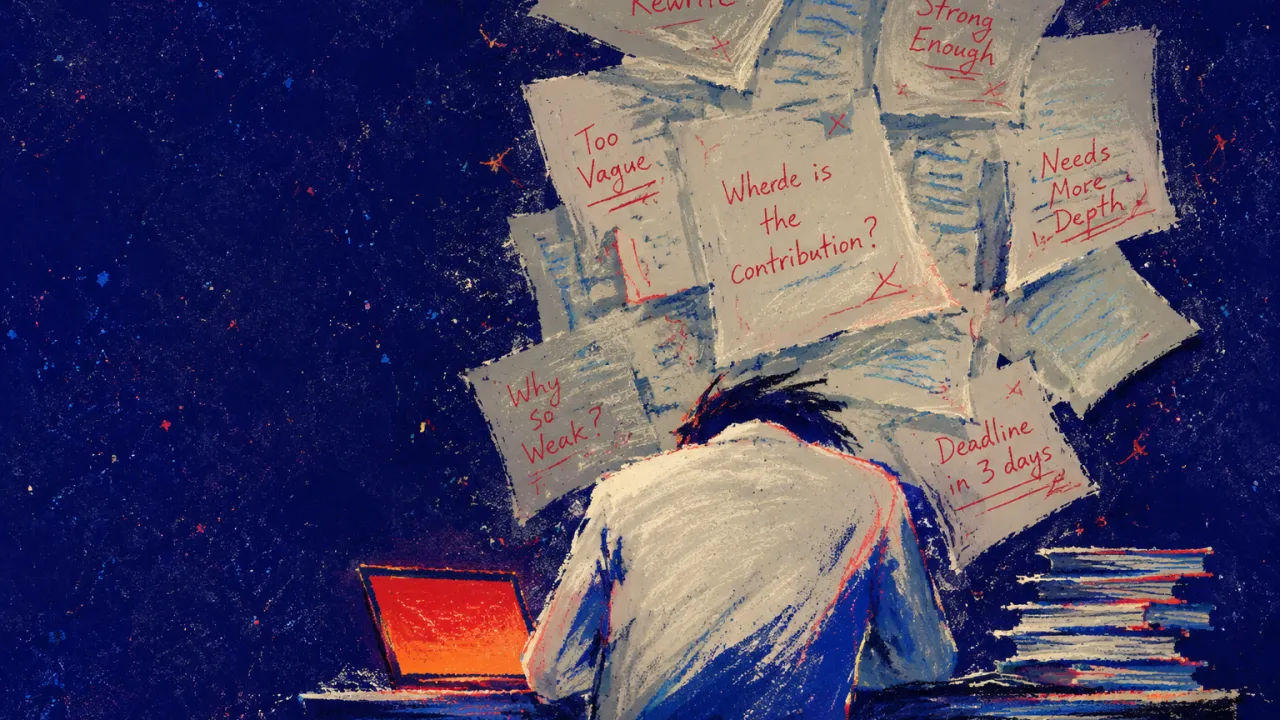
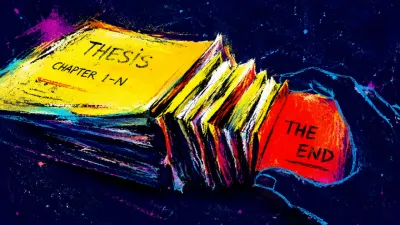
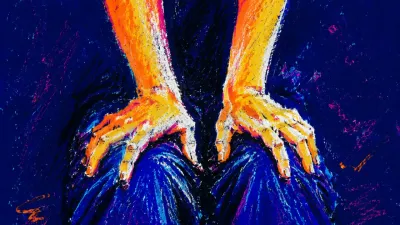
A figure leaning over a desk, shoulders beneath stacked pages as red margin notes crowd a narrowing indigo workspace.

What is this situation?

Thesis Drafting Bottleneck: you sit down to turn months of research into a chapter, but the document is already crowded with competing demands before you write a new sentence. Your supervisor's latest comments ask for a clearer argument, the department template requires sections that do not fit the material cleanly, and a citation gap in one paragraph sends you back into databases for another afternoon. When you revise the introduction, the literature review no longer matches it; when you fix the review, the methods chapter needs new framing. Drafts move between your desk, tracked changes, email threads, and scheduled meetings, while approval remains with people who can request another round but are not working inside the same deadline. A note marked "expand" sits beside another marked "cut," and feedback that arrives days or weeks apart keeps reopening decisions you thought were settled. The calendar advances through ordinary mornings, late library sessions, and weekends planned around word counts, yet much of the time is spent reformatting, cross-checking, waiting, and rebuilding transitions rather than moving forward. By evening, your shoulders are held high over the same pages, and the thesis feels less like one piece of writing than a stack of requirements being carried at once, much like the figure on the Ten of Wands, bent beneath a bundle that blocks the road ahead.

Why it's not you?

The bottleneck is not evidence that you lack discipline; the drafting process itself is forcing one document to satisfy shifting feedback, evidence standards, formatting rules, chapter dependencies, and a fixed deadline at once. When approval is fragmented and each revision can reopen settled work, stalled progress is built into the workflow.

Thesis Drafting Bottleneck in Tarot Cards

In a Thesis Drafting Bottleneck, progress keeps circling between supervisor comments, citation requirements, chapter dependencies, and a fixed submission date. The shoulders held high over the same pages register an environmental and structural dynamic built around repeated approval gates and reopened decisions. The Tarot Cards below mirror the outline of that stalled, externally constrained process.

The Hierophant
Reversed
The seated teacher between two pillars raises a hand above two kneeling figures, with formal robes and a ceremonial setting making the lesson institutional rather than personal. Reversed, that authority scene becomes a department template and supervisory process that demands compliance without necessarily fitting the shape of your research. Your thesis has to satisfy inherited section rules, citation standards, academic conventions, and approval rituals at the same time. Because the authority can request another round without working inside the same deadline, the formal system keeps defining what counts as acceptable while leaving you to absorb the cost of integrating every requirement. The reversed structure names the friction between academic legitimacy and a document still trying to find its coherent architecture. The obstacle is not that you refuse rigor; it is that the institution's prescribed form and the study's actual logic are pulling against one another.
Justice
Reversed
The seated figure's sword and scales place a document under formal judgment, but reversed the scales feel uneven rather than clarifying. In your thesis workflow, citation gaps, template compliance, and supervisor comments become separate tests whose criteria can conflict across revision rounds. Because the sword and scales are held by an authority outside your writing desk, you can be accountable for every defect without controlling when approval arrives or whether a settled decision stays settled. The result is a review process that expands the document's obligations faster than it resolves them. Reversed Justice makes the bottleneck legible as procedural imbalance. The draft is not simply unfinished; it is being assessed through fragmented standards that transfer the cost of uncertainty to the person responsible for integrating the whole study.
The Hanged Man
Upright
The figure hangs by one foot from a living tree, with a halo bright around his head while his body remains suspended above the ground. That still, inconvenient position mirrors a thesis held between draft and approval: you can prepare another section, but the next decisive move is partly dependent on feedback that arrives days or weeks later. The suspension changes the cost of time. The calendar advances through ordinary mornings and weekends, yet the document cannot settle because a later comment may redraw the framing; waiting is active academic labor, but it does not look like progress in a word-count system. Upright, the scene does not promise that delay is meaningful by itself. It shows a timing structure in which pause and reframing are built into the study process, so deciding when to push forward is inseparable from knowing which decisions are still externally held.
Two of Pentacles
Upright
The juggler keeps two pentacles inside a looping ribbon while rough waves and ships move behind him. The visible balancing act mirrors a thesis session divided between drafting, citation verification, template compliance, email, tracked changes, and supervisor scheduling, with each demand returning as soon as your attention moves elsewhere. The sea turns the scene into an unstable workload rather than a simple checklist. You can keep the document technically alive through constant switching while no section settles, because every local task is connected to another chapter, another source, or another approval point. The upright posture shows adaptability, but it also shows the cost of treating every requirement as equally immediate. The bottleneck is the study system's dependence on perpetual balancing, which makes activity visible while coherent drafting remains deferred.
Three of Pentacles
Reversed
The three figures stand around an architectural plan inside a half-built cathedral, but the reversed orientation turns coordinated construction into misaligned specifications. The plan evokes your thesis architecture, while the builders represent the supervisor, department, and writer trying to shape one document through different standards and timelines. You remain responsible for joining the pieces even when feedback arrives asynchronously and approval stays outside your desk. A change to the introduction can alter the literature review, a citation requirement can reopen the argument, and a formatting rule can force another pass through material that had seemed settled. The reversed scene does not portray a lack of craft. It exposes a collaboration and governance mismatch inside the study workflow: the document depends on shared expertise, but the process does not provide one stable blueprint for integrating that expertise.
Seven of Pentacles
Upright
The worker leans on a hoe beside a row of pentacles, looking at a crop that has taken time but is not yet ready to harvest. The image maps to months of thesis research and revision effort that have produced substantial material, yet not a chapter able to move cleanly through approval. Your study calendar can be full while the return on that labor remains deferred. Each citation check or reframing task protects the future thesis but postpones a finished section, creating a visible gap between how much work has been invested and how little can be marked complete. Upright, the cultivated row keeps the work connected to a real yield; it does not erase progress. It names the timing question inside the drafting process: whether additional labor is building the argument or extending a cycle whose criteria keep moving.
Ace of Swords
Reversed
The crowned sword rises from a cloud, but reversed it no longer cuts a clean line through the page. That image matches a thesis whose central argument is present in the research yet loses definition as the introduction, literature review, methods, and supervisor comments pull in different directions. The blade's promise of precision becomes a drafting problem when every sentence must carry evidence, framing, and approval at once. You return to databases and rewrite transitions because the document cannot maintain one stable through-line across chapters, even when each individual edit appears reasonable. Reversed, the card locates the blockage in argument architecture and communication, not intelligence. The study task is overloaded with competing definitions of clarity, so a local edit keeps producing a new global mismatch.
Two of Swords
Upright
The blindfolded figure holds two crossed swords against a still waterline. That physical stalemate mirrors the thesis moment where one comment says expand, another says cut, and choosing either revision risks reopening the introduction, literature review, or methods framing. The blindfold does not imply a personal defect; it shows that the decision is being made without a shared view of the full consequences. You are asked to commit while feedback is partial, delayed, and distributed across people, emails, tracked changes, and scheduled meetings. Upright, the crossed swords name a suspended choice that keeps the draft intact but motionless. The structure becomes visible: until the competing criteria are reconciled, more writing can become another way of postponing the decision that controls the chapter.
Eight of Swords
Upright
The blindfolded figure stands bound inside a ring of swords, with a castle behind her and water at her feet. The scene mirrors a draft enclosed by supervisor comments, template rules, citation gaps, and chapter dependencies, where every route appears to require returning to another unfinished section. The bindings are visible, but the surrounding swords show why simply trying harder does not create room. You can have the research, the notes, and the time invested while still lacking a clear next move when feedback arrives in fragments and each local fix threatens the alignment of the whole thesis. Upright, the card holds the experience of constrained visibility rather than claiming that the limit is imaginary. It identifies a study process in which responsibility sits with you while the route through the document is obscured by external conditions and interdependent requirements.
Five of Wands
Upright
Five figures raise wands in a crowded field, each motion colliding with another while no shared direction is visible. The scene mirrors a thesis draft receiving competing demands from supervisor comments, departmental formatting, citation standards, and chapter logic, where every attempt to advance creates friction elsewhere. The conflict is procedural rather than personal. You are coordinating several legitimate academic requirements that do not arrive in one synchronized conversation, so the document becomes the arena where incompatible priorities compete for space and each new revision can undo the alignment created by the last one. Upright, the card shows active contest rather than total incapacity: work is happening, but effort is being dissipated across competing instructions. The study bottleneck is therefore a coordination problem whose visible output is revision churn.
Ten of Wands
Upright
The bent figure's bundle of ten wands fills both arms and blocks his view of the road. That physical arrangement mirrors a thesis draft crowded by evidence checks, chapter dependencies, template rules, tracked changes, and supervisor requests: each item may be manageable alone, but together they obstruct the next visible move. You are still walking, yet the posture shows effort being spent on carrying rather than on seeing where the load belongs. A study day can therefore contain long library sessions and serious research while the document barely advances, because the same person is acting as writer, citation checker, formatter, project manager, and approval-seeker. The upright scene also preserves an important fact: the material exists and can be moved. The bottleneck lies in the way too many academic obligations have been bundled into one drafting process, not in a verdict about your capacity to do scholarly work.

Thesis Drafting Bottleneck in Tarot Card Reading Insights

When thesis drafting keeps returning to the same blocked chapter, other students have brought that stalled process into readings as well. The articles below collect Tarot Reading Insights shaped by shifting feedback, revision loops, and approaching deadlines.
Psychological Contexts Related to Thesis Drafting Bottleneck