Closing the New Course Tab: Three Rough Versions Became Evidence
The New Tab Before the Rent Notification: Finding Clarity in the Course-Collecting Loop
I recognized the pattern before Alex had finished sitting down. “You are a Toronto junior product designer with a dozen saved tutorials, and the moment a data-visualization exercise stops matching the example, your hand opens a new course before the rent notification has even disappeared from your phone.”
At 10:40 p.m. in Alex’s apartment, a data-visualization exercise had stopped resembling the YouTube walkthrough. I could almost hear the laptop fan through the speaker of our video call, while the radiator answered with dry metallic clicks; Alex held a warm phone in one hand and moved between the blank canvas and a new behavioral-science course with the other.
“I understand the framework, so I should probably move on,” Alex told me. Their workplace learning trial encouraged research methods, data visualization, basic coding, and behavioral science, but nobody had defined what independent competence should look like. A manager’s praise for cross-functional fluency made breadth sound sensible, even while one unfinished portfolio project waited for a decision that could not be copied from a tutorial.
I saw the contradiction clearly: Alex wanted one practical skill to take root through sustained practice, yet reached for a new subject the moment early recognition gave way to repetition, awkwardness, or a blank page. Impatience moved through their hands like a drummer tapping against a locked door, while self-doubt whispered that the locked door might be evidence of a personal defect.
I did not call the pattern laziness, and I did not ask Alex to abandon curiosity. “This is a learning loop we can observe,” I said. “We can separate recognition from mastery, find the point where your rhythm breaks, and make the next test small enough to be useful. Let’s draw a map through the fog together. That is our Journey to Clarity today.”

Choosing a Ladder Through the Learning Loop
I asked Alex to place the phone face down, take one unforced breath, and name the question without trying to solve it. I shuffled slowly while they focused on the unfinished visualization, using the pause as a psychological transition from collecting explanations to examining one lived pattern.
For readers wondering how tarot works in a practical consultation, I use the cards as a structured recognition tool rather than a verdict about the future. Today I chose the Four-Layer Insight Ladder · Context Edition, a custom tarot spread designed to move from observable symptom to maintaining mechanism, then to a leverage point and an integrated next step.
The wording of Alex’s question described a self-reinforcing sequence: early familiarity felt like progress, difficult practice interrupted that feeling, and a fresh syllabus restored it. That is why I used a compact form of systemic deconstruction. A larger spread might add interesting context, but it could blur the narrow learning cycle we actually needed to see.
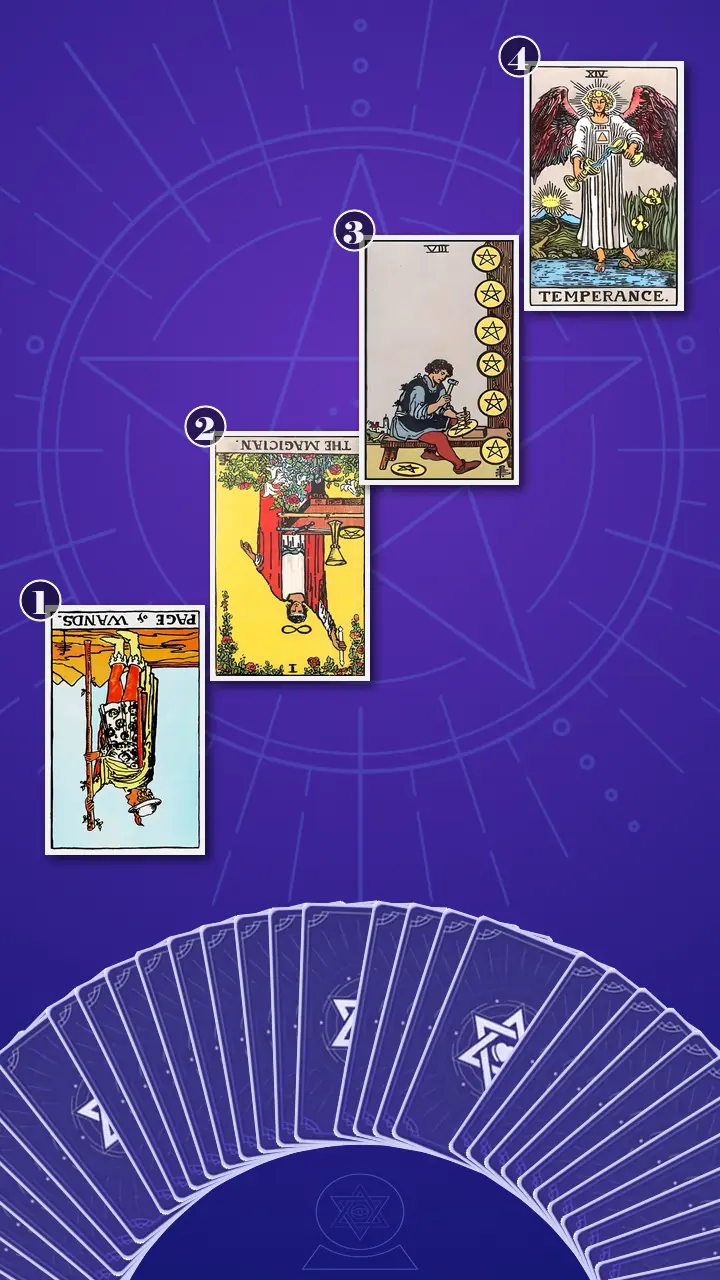
The diagonal layout climbed like a staircase. The first position would show the visible habit, the second would reveal the hidden mechanism that kept it active, the third would identify the corrective practice, and the fourth would translate that shift into a sustainable rule for interdisciplinary learning. The wider space between the second and third cards marked the point where choice could return.
The First Spark That Would Not Take Root
The Page and the First Drop in Novelty
I turned over the card for this position first. This position shows the observable symptom in the diagnosis: opening a new subject when current practice becomes repetitive, difficult, or less exciting. In the standard present-state layer, it reveals the behavior through which the question is currently expressing itself.
The card was the Page of Wands, in reversed position.
I asked Alex to look at the sprouting wand instead of the figure’s face. The Page is absorbed by the promise of growth, but the ochre landscape around them is barren. In the reversed position, the image became Alex at the first boring or technically awkward exercise: the new subject felt more alive than the current repetition, so behavioral science went onto the Toronto learning dashboard while the original data-visualization drill remained untouched.
This was an excess of Fire and a deficiency of grounding. Curiosity was not missing; it was igniting again and again before it could be carried through the repetitive middle of practice. The Page’s beginner energy had become repeated starts, and the YouTube Watch Next sidebar offered a fresh hit of recognition at precisely the moment the current tab asked for retrieval without prompts.
I watched the reaction arrive in three small movements. Alex’s breath caught, and their hand froze above the trackpad. Their eyes flicked from the blank canvas to the second tab, as if replaying the exact moment the switch usually happened. Then they gave a short, bitter laugh. “Damn,” they said. “That is exactly what I do when the tutorial stops holding my hand. I call it curiosity, but my body knows I’m trying to get away from the test.”
I let the honesty stand without turning it into shame. “The spark is still valuable,” I said. “We are only giving it a temporary container. A new idea can go into a Curiosity Parking Lot while you complete one small unaided drill. That is a pause between interest and action, not a ban on becoming a broad thinker.” Alex’s fingers slowly left the trackpad and rested beside the notebook.
The Magician’s Crowded Table
I moved to the second position, the one that reveals the maintaining mechanism behind the symptom: mistaking recognition, vocabulary, and access to tools for independent competence. The standard root layer identifies the belief, fear, or feedback mechanism that keeps the present condition in place.
I turned over The Magician, in reversed position.
The four suit tools on the table gave me the modern translation immediately. I saw Alex’s Figma files, spreadsheet formulas, bookmarked frameworks, software links, saved tutorials, and neatly tagged course folders gathered like impressive equipment. The problem was not a lack of access. In the reversed position, the tools created the appearance of readiness while no single tool was being directed through a small independent act.
Alex could explain hierarchy and behavioral patterns in a design conversation, but a blank file still sent them back to the example. The vocabulary was fluent; the hand had not yet learned to make the vocabulary into a verb. Recognition is a preview, not proof. A polished explanation was the product demo, while an unaided artifact was the shipped feature that showed whether the system actually worked.
I used my Focus Disruption Auditing lens here. In sound-energy research, I listen for the dissonant chord that keeps breaking a person’s flow. With Alex, the chord was not one single notification or course. It was the repeating combination of the blank canvas, the fear of looking clumsy, comparison with polished LinkedIn projects, and the quick relief of a beginner lesson that supplied the next step.
“I have access to everything, so why does the blank page still make my shoulders tense?” Alex asked, almost as if I had given the words to them. I saw their jaw tighten, then release by a fraction. The recognition landed without demanding an overhaul of the entire curriculum.
I placed one finger beside the four tools. “Maybe I do not need more input; maybe I need one clean test of what is already here,” I said. “Close three tabs. Choose one concept. Make one rough artifact from memory. The test is not whether it proves your worth. The test is what information becomes visible when one resource is finally directed.” Alex closed the course tab, then paused before closing the tutorial.
“You can keep the reference available for later,” I added. “The point is to create a small gap between looking equipped and using one tool. That gap is where the pattern can begin to loosen.”
When the Workbench Replaced the Promise
The Eight of Pentacles and the Unaided Test
I left the second card in place and turned to the third position. This position identifies the leverage point that interrupts the Forced Blooming Trap: replacing the feeling of fluency with repeated, observable performance evidence. In the standard transformation layer, it reveals the corrective practice capable of changing the established pattern.
The card was Eight of Pentacles, in upright position.
The artisan on the card did not display every possible tool. They worked one pentacle while finished pieces remained visible nearby. I translated the image into Alex’s world: close the tutorial, recreate one chart from memory, save the rough result, repeat it twice more, compare the versions, and ask for one specific piece of feedback. The workbench was not a grand curriculum. It was one focused file.
Upright, the Eight of Pentacles brought Earth into the reading. It offered balance through repetition, retrieval, correction, and tangible craft. It did not promise that practice would become exciting every minute. It suggested a more reliable measure: what can be made, seen, revised, and made again?
This was where I brought in my signature skill, Cognitive Tempo Calibration. I have spent ten years researching sound energy, and I know the difference between asking someone to become a different kind of learner and adjusting the task so their actual rhythm can meet it. Alex’s thinking moved quickly through associations and possibilities, while the exercise demanded sustained retrieval and tolerance for small errors. That severe mismatch could sound like burnout or paralysis, but it did not mean Alex lacked ability. It meant the task needed manageable micro-beats rather than a command to slow down and endure.
At 10:40 p.m. in that Toronto apartment, the exercise had stopped matching the tutorial. The laptop fan was loud, the radiator clicked, and Alex’s hand had opened behavioral science in a new tab. The skill felt unfinished; the syllabus felt like relief. I could see the old loop preparing to call itself curiosity.
I then said the message in its simplest form: You do not need another subject to feel capable; you need one completed, unaided repetition that turns familiarity into evidence.
Progress is not the feeling that you already understand; make one pentacle at a time through an unaided repetition, and let the work on the bench replace the promise of the next subject.
For a moment, Alex’s breath stopped halfway in. Their fingers hovered above the trackpad, still poised to open the next tab, and their face went completely still. Their pupils widened; then their gaze lost focus, and I watched the blank canvas, the dashboard, and a dozen clean introductions seem to pass behind their eyes. Their jaw worked once. “But doesn’t that mean I’ve been doing it wrong?” The question arrived with a flash of anger at the hours already spent. I let the silence stay kind. “It means the old measure protected you from an uncomfortable test. It does not make you foolish, and it says nothing final about your worth.” Alex looked down at the card. Their closed hand loosened finger by finger, their shoulders dropped, and a long breath came from low in their chest. “Ah,” they said, almost annoyed by the relief. I saw the new vulnerability arrive with it: if evidence, not novelty, became the measure, the next choice belonged to them. “Now use this new perspective to recall last week. Was there a moment when one unaided attempt could have felt like information rather than a verdict?”
That was the first visible crossing in the emotional transformation: from novelty-driven subject switching and self-doubt toward grounded, evidence-based confidence through repetition. The cards were not asking Alex to become certain before acting. They were showing how patient self-trust could be built from a sequence of small, honest attempts.
The Two Cups and the Anchor Skill
I turned to the fourth and final position. This position translates the shift into an interdisciplinary learning rule: stabilise one anchor skill and add another subject only when it serves a defined application. In the standard action layer, it shows how a corrective practice can be integrated and sustained through a proportionate next step.
I revealed Temperance, in upright position.
The narrow stream between the angel’s two cups offered a precise answer to Alex’s fear that depth would require giving up breadth. The water did not flood one cup with an entire second curriculum. It moved in a measured flow. One foot rested on land and one in water; practical grounding and curiosity could coexist.
In Alex’s life, data visualization remained the anchor. One behavioral-science principle could enter a completed project only to improve one clearly defined design decision. The main skill would do most of the work, and the adjacent subject would have a specific job. That was proportion, not restriction; integration, not escape.
“Curiosity can stay wide without making practice shallow,” I said. “The question is not whether you are allowed to learn behavioral science. The question is whether it is serving a demonstrated visualization skill or rescuing you from the moment that skill needs evidence.” Alex wrote the phrase anchor plus one in the margin and left the behavioral-science course bookmarked, rather than deleting it in an overcorrection.
Before Expansion, Leave One Piece of Evidence
I gathered the four cards into a single story. Page of Wands reversed showed the spark that kept restarting whenever the repetitive middle arrived. The Magician reversed showed why: a growing collection of tools, terminology, and frameworks offered reassurance while the blank page still demanded independent performance. The Eight of Pentacles supplied the missing ground through repeated attempts and feedback. Temperance preserved Alex’s interdisciplinary identity, but gave each new interest a measured relationship to an anchor skill.
The core contradiction was not curiosity versus discipline. It was sustained practice versus the quick relief of early familiarity. Alex had been repotting the seedling every time a new leaf appeared, then wondering why the roots never had time to hold. The cognitive blind spot was assuming that more input would solve a performance gap that only application, correction, and feedback could reveal.
I named the transformation direction plainly: move from building a curriculum to feel capable toward building evidence that makes confidence more trustworthy. The Four-Layer Insight Ladder tarot spread had answered the question without predicting Alex’s future. It had made the loop visible, located the leverage point, and returned the decision to the person who would actually open the file tomorrow night.
The Syncopated Study Session
Because Alex studied in short evening blocks after a full-time design job, I translated the reading through my Syncopated Study Session. I designed it as a rhythm protocol of small, frictionless beats: notice the urge, park the new idea, attempt one tiny task, compare the evidence, and choose what happens next. It was not a productivity identity or an exhausting study marathon. It was a way to let the task meet Alex’s natural tempo without letting novelty make every decision.
- Open the Curiosity Parking LotBefore the next evening study block, create a plain Notion note titled Curiosity Parking Lot. When a new-course urge appears, write the course name and one reason it interests you, then return to the current data-visualization exercise.Call the note Later, not never. Capture only enough to preserve the idea, and keep the rule voluntary and time-limited.
- Make One Unaided OutputSet a ten-minute phone timer, hide the tutorial, and create one tiny data-visualization choice from memory in the existing Figma or spreadsheet file. At the timer, choose freely whether to continue, stop, or consult the reference, and record what you attempted.If ten minutes feels too large, recreate one button, label, or chart element. The artifact can stay private and disposable; it is information, not a verdict.
- Save Three Honest VersionsOn three separate days this week, repeat the same small visualization for twenty minutes in the same file or in clearly named copies: v1, v2, and v3. After each attempt, note one decision that became easier and one that still needed a reference.Ask a trusted coworker for one targeted feedback point after the second or third version, then apply that feedback once instead of redesigning the entire learning plan.
I asked Alex to keep one anchor skill in a four-week practice cycle and to use the Unaided Output Rule before expansion: before adding a new subject, leave one piece of evidence. This was actionable advice with room to stop, shrink the task, or change the timing. The Anchor Skill Cycle did not require certainty; it required a visible next step.
Once the anchor produced a usable artifact, Temperance offered the integration rule. Alex could bring in one behavioral-science idea for one defined decision inside that same project. That was the practical meaning of finding clarity: not a perfect schedule, not a final identity, but a calmer sequence of choices grounded in work.

A Week Later, the Quiet Proof
Five days later, I received a message from Alex while I was making tea between readings. “I made three versions of the same chart,” they wrote. “I still want to take the behavioral-science course, but I put it in the Curiosity Parking Lot. Version three is less embarrassing than version one, which is apparently data.”
Alex told me the third version was still rough, but they could now name the exact place where the tutorial had been necessary and the place where their own decision had improved. They had sent one focused question to a coworker instead of adding another credential. The portfolio project was not finished, and the learning loop had not vanished, but one small skill had finally been asked to do something without being held up by a prompt.
That night, Alex slept through the night, then woke with the old thought, “What if I’m wrong?” It stayed for a minute. This time, they smiled, opened the saved v3, and made coffee before deciding anything.
I saw the change as a first proof, not a grand resolution. Tarot had not chosen Alex’s subject, guaranteed mastery, or removed the awkwardness of practice. It had helped us hear the rhythm beneath the switching: ignite, scatter, ground, blend. Alex remained the author of the next attempt, and their confidence now had somewhere real to stand.
When the blank page makes your shoulders rise, opening another syllabus can feel safer than risking the discovery that recognition is not the same as being able to do the thing. Noticing that protection is already a quiet act of self-trust.
If one small unaided repetition could be information rather than a verdict, what might you be curious to make before opening the next subject?