Twelve Journal Tabs, Three Headings: The First Claim Takes Shape
Researching Instead of Writing at 10:40 p.m.
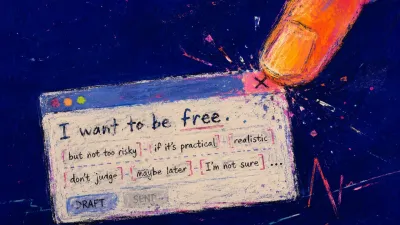
Maya was a 26-year-old master’s student in London whose Zotero library looked ready for submission while her thesis document still contained the same three headings. At 10:40 p.m. on a Tuesday, she joined our video call from the small desk in her shared flat and showed me the productive procrastination loop she had been calling progress: twelve journal tabs glowing behind a blank paragraph.
Her laptop fan whined beneath the sound of traffic on wet pavement. A forgotten mug of tea sat beside the trackpad; when she lifted it, she grimaced at the cold taste. Her fingers kept switching between Google Scholar, Zotero, and the unfinished sentence, while her shoulders rose toward her ears and her jaw held as if it were clamping the whole argument in place.
“Why do I keep researching instead of starting my thesis draft?” she asked. “I keep finding reasons why the next source has to come first. My notes are detailed, but the chapter still doesn’t exist.”
I could see the contradiction clearly. Maya wanted to become the author of a credible argument, yet every attempt to write one provisional claim sent her back into the safer identity of the careful researcher. Her apprehension felt less like ordinary nerves and more like trying to type while an invisible examiner stood behind her chair, ready to turn one rough sentence into a verdict on whether she belonged at postgraduate level.
“You’re not failing to care about the thesis,” I told her. “You care so much that your mind has built a very respectable-looking shelter out of research. I’m not going to tell you to stop reading or just force the words out. I want us to find the exact point where responsible scholarship turns into protective delay. We’ll make a map of the fog, then identify one piece of ground you can actually stand on.”
Choosing the Staircase Through the Research Loop
I asked Maya to put both feet on the floor, loosen her grip on the mug, and take one unforced breath while holding the question in mind. I shuffled slowly, using the small ritual as a transition from reacting to the problem toward observing it.
“The cards are not going to predict whether you submit on time, and they are not going to declare whether you are capable,” I said. “They can give us an external structure for examining a pattern that is difficult to see while you’re inside it. You remain the person who decides what to test, keep, revise, or reject.”
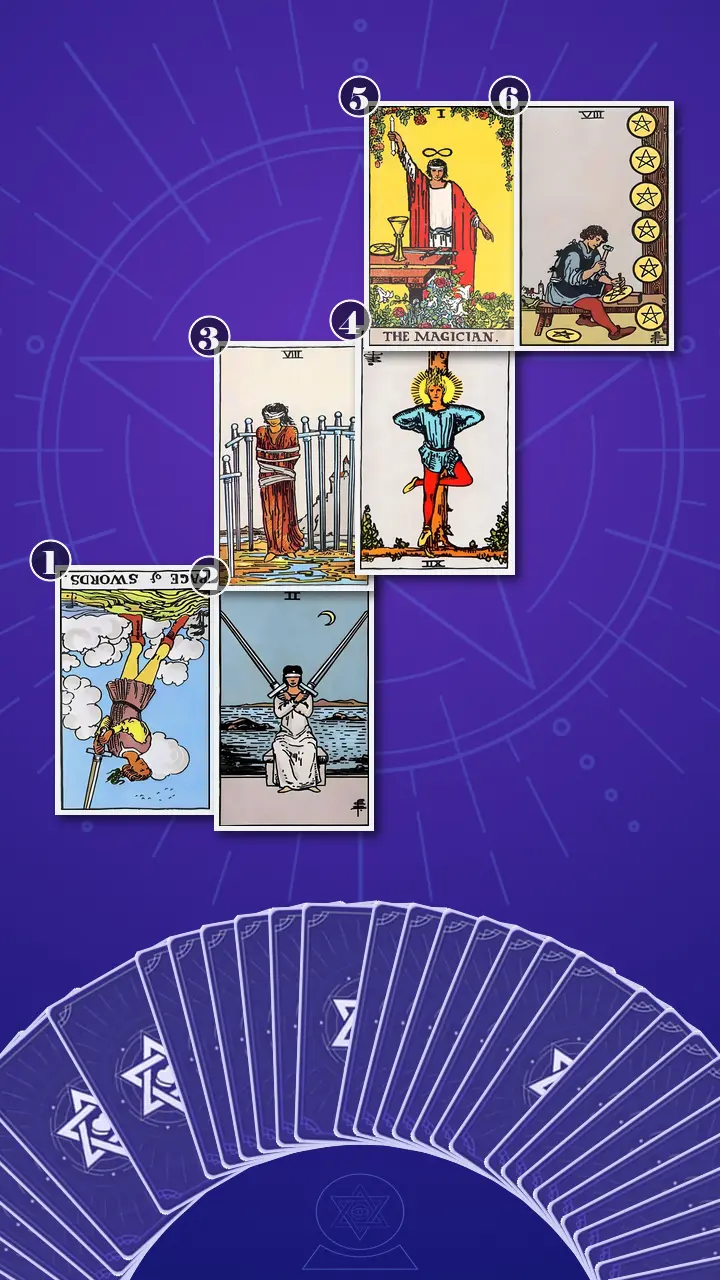
I chose the six-card Four-Layer Insight Ladder · Context Edition, arranging the cards as an ascending zigzag staircase. This is how tarot works best in my practice: not as a verdict machine, but as a visual model that separates a tangled experience into observable parts. Maya’s problem was not merely a lack of motivation. An uncertain sentence triggered more research; research provided short-term relief; the missing prose increased uncertainty; and that uncertainty triggered another search. I needed a spread that could keep every link in that feedback loop visible.
The first two positions would show the observable bottleneck and the protection it provided. The next two would reveal the readiness rule beneath the behaviour and the cost of remaining in suspension. The fifth card would identify the leverage point, while the sixth would translate that insight into an ordinary writing practice. The staircase mattered: I wanted Maya to see that finding clarity would not require one heroic leap from blank page to completed chapter. It could happen one deliberate riser at a time.
When Curiosity Turned Into Weather
Position 1: The Cursor and the Crosswind
I turned over the card representing the present layer: the visible thesis bottleneck in which Maya redirected attention whenever writing required a claim. It was the Page of Swords, reversed.
The Page normally carries curiosity, intellectual alertness, and the urge to communicate. In reverse, that Air energy had become excessive and scattered while communication itself was blocked. The figure’s sword was raised, but the body and gaze pointed in different directions. I saw the same split on Maya’s desktop: the cursor was ready for language, while her attention kept turning toward another browser tab.
“At the library, you begin a paragraph and reach one uncertain phrase,” I said. “You open Google Scholar for a legitimate reason. One search becomes twelve tabs, several abstracts get highlighted, and the sentence that triggered the search remains unfinished. Your curiosity is real. The problem is where that curiosity is being directed at the moment authorship feels exposed.”
I described her workflow as a recommendation algorithm trained on uncertainty. Every uncomfortable sentence acted like another click. The algorithm learned that discomfort should produce more papers, and every newly opened paper taught it to recommend still more research. The system could look highly academic while quietly optimising for one result: never leaving a provisional argument visible long enough to be examined.
Maya gave a short laugh, but there was no amusement in it. Her eyes dropped to the cold tea and her thumb rubbed the mug’s chipped rim. “That’s exactly my screen,” she said. “It’s so accurate it’s almost cruel.”
“Then let’s be precise without being cruel,” I replied. “The Page is not accusing you of fake work. The sources may be useful, and your scholarly curiosity is a strength. We’re only asking whether opening them at that exact moment serves the argument or regulates the discomfort of writing it.”
I asked what she had opened the last time a sentence became uncertain. She named an article, then another paper cited in its literature review, then a Zotero folder she had reorganised after downloading both. When I asked whether she had finished the original sentence, she shook her head.
Position 2: The Safety of Two Unchosen Arguments
I turned over the card representing the second part of the present layer: the short-term protective payoff Maya received from continued research. It was the Two of Swords, upright.
The blindfolded figure held two blades crossed over her chest, keeping both sides equally armed. In Maya’s working life, this appeared as two chapter arguments maintained in parallel outlines. Before a supervisor check-in, she gathered support for both rather than choosing one as the provisional route. Neither could be criticised while neither had been placed on the page.
The card’s upright energy can express a useful pause and balanced judgment. I did not want to pathologise that capacity. A researcher sometimes needs time to compare interpretations. Here, however, balance had been held beyond its useful duration and turned into blockage. The immediate relief of not choosing prevented the feedback that could show Maya which argument was stronger.
“When you keep both versions open,” I asked, “what do you avoid for the next hour?”
Her fingers stopped moving. She looked past the webcam for several seconds before answering. “Someone telling me I chose the weaker one. Or seeing it myself.”
I nodded. “So the research is not only collecting evidence. It is preserving a temporary neutrality. That makes sense as protection, but it charges interest: the longer neither argument is tested, the harder each one becomes to synthesise.”
The Fence Made of Browser Tabs
Position 3: The Rule That Looked Like Academic Responsibility
I turned over the card representing the root layer: the fear-based rule that Maya had to guarantee a credible result before she was allowed to write. It was the Eight of Swords, upright.
The figure was blindfolded and loosely bound within an incomplete enclosure of swords. In context, the image did not deny genuine academic requirements. Maya still needed accurate citations, a defensible method, and evidence appropriate to her discipline. The card showed something narrower: she was reading the sentence “I do not know enough yet” as though it were an institutional prohibition against drafting.
I asked her to picture the swords as the tabs surrounding her blank document. Inside that fence, the inner monologue kept adding conditions: “I could write, but first I have to read the opposing school. I could write, but first I have to check whether my supervisor expects a different framework. I could write, but first I have to anticipate every objection. I could write, but first I have to know the claim will survive.” Each condition sounded responsible in isolation. Together, they defined readiness as total certainty, a standard no draft could ever reach because no draft yet existed to test it.
“The rule sounds responsible: know enough first. Its cost is that ‘enough’ never becomes testable,” I said. “Responsible scholarship asks you to support and revise a claim. It does not require you to eliminate every uncertainty before a working claim can exist.”
Her breath caught first. Her index finger remained suspended above the trackpad, then slowly curled into her palm. Her gaze lost focus as if she were replaying recent nights in the library. Finally, she pressed her lips together and let out a low breath through her nose; her shoulders moved down by a fraction.
“I thought I was being responsible,” she said. “But I’ve made ‘responsible’ mean that nobody can ever catch me not knowing something.”
“That distinction matters,” I replied. “The card is not saying you can walk away from evidence. It is showing that one constrained action remains available inside uncertainty: you can write from what you currently know and label the precise point where support is missing. The bindings are loose, and the enclosure has a gap. Agency begins there, not after the whole landscape becomes risk-free.”
Position 4: When the Pause Stopped Producing Insight
I turned over the card representing the second root layer: the long-term cost of remaining inside the research loop. It was The Hanged Man, reversed.
Upright, the Hanged Man honours a willing pause, reflection, and the changed perspective that can emerge when action is suspended. Reversed, the same energy can become an excess of suspension and a blockage of participation. The halo still respected the insight Maya had genuinely gained through research; the reversal asked whether the pause was continuing after that insight had stopped changing her position.
I brought her back to a recent Sunday afternoon in the university library. She had saved a sixth paper that reached the same conclusion as the previous five, renamed her outline chapter_plan_final_v4, and moved drafting to Monday. Rain had ticked against the window while fluorescent light sharpened the ache behind her eyes. She had still been working, but she could not identify a single way her central argument had changed.
“Maybe this is incubation,” I said, voicing the kinder version of her defence, “but what has actually shifted since yesterday?”
Maya was quiet. At my end of the call, rain brushed the dark Cambridge window behind my desk, repeating the rhythm of the scene she had just described. She finally answered, “Nothing. I had more citations, but I was making the same point.”
“The pause stopped being preparation when it stopped changing the claim,” I said.
I use Research Bottleneck Analysis for moments like this. Instead of treating a creative block as a character flaw, I ask what information the stalled process can no longer produce. Maya had excavated plenty of material. Her bottleneck was no longer source discovery; it was conversion. Only prose could now reveal whether the evidence connected, where the reasoning jumped, and which gap genuinely required another search.
Her hand tightened once around the mug, then released it. “So I’m not being told that all the research was pointless,” she said. “I’m being asked whether it’s still answering a question.”
“Exactly. Thoughtful reflection deserves time. Protected suspension does not earn indefinite control merely because it looks scholarly.”
When the Magician Opened the Workshop
Position 5: The Table of Tools Already Present
The next card occupied the transformation layer, the point where Maya could shift from seeking complete readiness to using present resources for one provisional claim. As I turned it over, the laptop fan at her end of the call dropped into silence. For a moment, the room seemed to make space around the image.
It was The Magician, upright.
The Magician stood with eyes open before a table holding the four suit emblems. One hand lifted the wand; the other pointed downward, translating potential into material form. On Maya’s desktop, those tools became her outline, current notes, existing citations, and language. The card did not claim that her research was complete. Its balanced energy gathered scattered thought, acknowledged the vulnerability beneath it, restored enough Fire to initiate, and directed everything toward visible work.
“This is your desktop after the unnecessary tabs close,” I said. “You keep three notes beside the document and type, ‘My current claim is...’ The paragraph remains deliberately provisional. It may contain a [SOURCE NEEDED] marker. Its purpose is not to prove that you were already ready; its purpose is to reveal the next question worth researching.”
I felt the old professional association rise before I spoke again. On archaeological digs, I had watched boxes fill with carefully labelled fragments. The catalogue mattered, but a larger pattern became visible only when those fragments were placed within a working layer and their relationship was tested. More fragments could not substitute forever for interpretation.
“I call this Academic Stratigraphy,” I told her. “Your notes are not a failed thesis scattered across folders. They are evidence from different layers. The provisional claim is the first structural line through them. Once you place that line, you can see which pieces support it, which belong elsewhere, and where the ground truly is missing. You are not inventing certainty. You are building a framework sturdy enough to be revised.”
I returned her attention to the 10:40 p.m. scene: twelve journal tabs, three unchanged headings, one more highlighted abstract, and a jaw tightening around the promise that the paragraph would begin after this final source. She had been waiting for the research to grant permission that only authorship could create.
You are not waiting for the final missing source; place the tools already on the Magician's table in service of one imperfect paragraph.
I left the sentence alone for several seconds. Then I gave her the distinction at the centre of the card:
The draft is not proof that you were ready; it is the tool that reveals what readiness actually requires.
Her breath stopped. Both hands froze above the keyboard, and her pupils widened before her gaze slipped away from the screen. I watched recognition move through her in layers: first the late nights replaying behind unfocused eyes, then a sharp pull between her brows, then anger. “But doesn’t that mean I did all of this wrong?” she asked, her voice suddenly louder. “That I wasted weeks hiding?” I told her no. Her research had created real material, and the strategy had protected her when exposure felt too costly; it had simply reached the point where it could no longer do the next job. Her fist opened one finger at a time. Her shoulders dropped, her eyes reddened, and a small, uneven breath escaped as something between a laugh and a sob. Then came the new vulnerability. “If I already have enough to begin,” she said softly, “I can’t keep saying I’m not allowed.”
“Now, with this new perspective, think back to last week,” I said. “Was there a moment when this insight might have made you feel differently?”
She returned to the Sunday session and the sixth paper that had not changed her position. “I could have written the claim after the third one,” she said. “Not the final claim. Just the claim I actually had.”
I asked her to name it aloud. She hesitated, corrected herself once, and produced a two-sentence version. It was not polished, but it was specific enough to expose one real evidential question. The shift was modest and decisive: from apprehensive perfectionistic paralysis toward grounded confidence built through revision. She did not suddenly feel certain. She had discovered that self-trust could be expressed as an action before it arrived as a feeling.
“A provisional claim is not a verdict on your worth,” I said. “It is material for revision.”
One Pentacle, One Paragraph, One Visible Result
Position 6: Turning Persistence Into Craft
I turned over the card representing the action layer: the bounded routine through which Maya could test and integrate the shift. It was the Eight of Pentacles, upright.
The craftsperson worked on one pentacle while earlier pieces remained visible nearby. The card’s Earth energy was balanced, focused, and repeatable. It reframed thesis writing as a practice made of drafting and revision cycles, not a single performance expected to prove Maya’s competence in one attempt.
I gave her a split-screen image. On one side, repeated sessions added papers to a citation folder while the chapter remained empty. On the other, the same persistence added 150-word blocks to the draft, each block carrying a precise marker where evidence was missing. The repeated number eight linked the blockage and the solution: Maya did not lack discipline. Her capacity for repetition already existed. The question was whether that repetition built a fence or built a chapter.
“Complete a writing block first,” I said. “Mark one unsupported sentence, record the next sentence before you stop, and search for the specific missing evidence only after the paragraph exists. This paragraph does not have to prove the thesis. It only has to become the next piece you can inspect.”
Maya reached for her phone, then stopped. “Twenty-five minutes sounds reasonable when you say it, but on research-assistant days I get home late, and the shared flat is noisy. I know myself. I’ll miss one block and decide I’ve failed the whole system.”
“Then twenty-five minutes is not the entrance,” I replied. “Set an eight-minute timer. Keep only the thesis document, outline, and three existing notes visible. Begin with ‘My current claim is...’ Mark uncertainty as [CHECK] or [SOURCE NEEDED]. Stop when the timer ends; continuing is optional, and you can pause earlier if the exercise becomes too activating. The boundary matters more than the duration: no database search until a sentence has shown you what to search for.”
She entered an eight-minute block into her calendar for Thursday morning. I saw her type the event title: Draft before search.
The Thesis Stratigraphy Framework for Finding the Real Gap
I drew the six cards together as one coherent story. Maya’s research-assistant work had trained her to find and organise sources with care, so an uncertain sentence naturally sent her toward the skill that felt familiar and measurable. The Page of Swords showed that curiosity scattering away from communication. The Two of Swords revealed the relief of keeping competing arguments unchosen. The Eight of Swords exposed the deeper rule that incomplete knowledge meant writing was unavailable. The Hanged Man reversed showed the cost: research had continued after it stopped changing the claim.
The Magician and Eight of Pentacles did not ask Maya to abandon academic standards. They redirected her existing strengths. Her careful reading, persistence, detailed notes, and ability to spot missing evidence were already on the table. She had built a larger library beside an unopened workshop; now the workshop needed one imperfect object so that the next round of research could serve something concrete.
I named the cognitive blind spot plainly: Maya had been treating a rough paragraph as an assessment of her worth rather than as a diagnostic instrument. Because of that, uncertainty looked like a stop signal. The transformation direction was to draft one claim from current notes, mark the genuine fractures, and research only the gaps that prose made visible. Research would become a targeted response to the thesis rather than a condition that had to be completed before the thesis could begin.
I translated that direction into my Thesis Stratigraphy Framework. The working claim would form the structural layer. Three existing notes would provide the first supporting material. [CHECK] and [SOURCE NEEDED] markers would identify fractures without forcing immediate repair. Revision would test the structure. The goal was not to bury uncertainty beneath polished language; it was to give uncertainty an exact location.
Draft the Gap Before You Research the Gap
- Run the Limited-Tools Draft On one weekday at the library or the desk in the shared flat, set a 25-minute phone timer and keep only the thesis document, outline, and three existing notes open. Beneath one subsection heading, type “My current claim is...” and continue until one provisional claim and its current evidence are visible. Add
[CHECK]beside uncertain wording and[SOURCE NEEDED: specific question]beside a real evidence gap before opening any database. Treat this as a drafting experiment, not a submission standard. If 25 minutes feels too exposed or does not fit the day, use eight minutes or write one claim plus two evidence bullets. Maya keeps the right to revise, discard, or stop. - Build Two Draft-Gap-Research Cycles Schedule two cycles in the coming week: 25 minutes of writing, five minutes of gap marking, then up to 20 minutes of targeted research. During the research phase, paste the exact
[SOURCE NEEDED]question into the database rather than searching the broad topic. End by recording only three data points: words added, one gap found, and the next sentence to begin. Count completed cycles, not impressive chapters. If time or energy is limited, use ten minutes of drafting and five minutes of gap review. Stop the search when the marked question has been answered; nonessential gaps can remain unresolved for now.
“These are tests, not commandments,” I told her. “If the limited source set exposes a genuine problem, that is useful data. If it produces a workable paragraph, that is also useful data. Either way, you learn more than you can learn from another evening of asking whether you feel ready.”
That is the practical value I want tarot to provide. The cards made the feedback loop visible and gave Maya language for its moving parts, but they did not possess the power to change her thesis. Maya would create that change by choosing which claim to test, which gap deserved research, and which version she was ready to show another human being.
A Week Later, the First Visible Layer
The following Tuesday morning, I received a message from Maya. It included a photograph of her laptop beside a fresh mug of tea. Morning light lay across the keyboard, and the thesis document now contained 186 words beneath the first heading. One sentence ended with [SOURCE NEEDED: evidence on participant retention].
“I did the eight-minute version and kept going for twelve,” she wrote. “The first two sentences are genuinely ugly, but the gap is much smaller than the panic around it. I searched the exact question afterward and found what I needed in a paper I had already saved.”
She had also sent the paragraph to her supervisor. The reply did not pronounce it brilliant or disastrous; it asked her to define one term more precisely. That question became the next item in her draft-gap-research cycle. Feedback had entered as information rather than a verdict.
Maya told me she slept through the night, then woke with the thought, “What if the argument is wrong?” The doubt was still there. This time, she laughed, opened the paragraph, and wrote [CHECK] beside it.
I did not mistake one paragraph for a solved thesis or one calmer morning for the end of perfectionism. I saw something quieter and more durable: the first evidence that Maya could move from fear of an imperfect argument into active authorship. The cards had offered a patient excavation of the pattern. She had placed the first enduring layer with her own hands.
When the cursor blinks beside a claim that could be wrong, the jaw may still tighten, and another article may still feel safer than allowing one imperfect paragraph to seem as though it says what you are worth. If that scene is familiar, remember what the Magician’s table revealed: noticing the impulse to acquire more is already different from obeying it, and a provisional sentence can be an instrument rather than a verdict.
If one sentence only had to expose the next real layer in your thesis, rather than prove that you deserve to write it, what provisional claim would you be curious to place on the page today?