A Half-Written Grad Statement Became 148 Words Before Deadline Panic

The 9:40 p.m. Spiral Before a Grad Application Deadline
If you can explain six graduate programmes but cannot finish one paragraph about why you belong in any of them, you may be facing grad school decision paralysis rather than a lack of ambition.
At 9:40 p.m. on a Tuesday, Jordan joined my call from a small Toronto apartment. A cool kitchen light flattened the colour from the room. Through the microphone, I could hear the radiator clicking beneath the laptop fan while Jordan shared a screen divided between an unfinished personal statement and a colour-coded Google Sheet.
I watched them move two deadline cells, reopen an admissions page they had already highlighted, and place the cursor at the end of a sentence that stopped halfway across the document. Their shoulders folded towards the keyboard. The dread looked less like a dramatic crisis than a wet winter coat worn indoors: heavy behind the eyes, irritating against the skin, and difficult to justify taking off when another task could be completed instead.
“Once it feels urgent, I can finally stop debating and just do it,” Jordan said. “I keep calling it research, but I am mostly moving dates between spreadsheets. I want the application to prove I have a direction before I have chosen one.”
I recognised the pattern. The portal countdown had become an external product manager, assigning priorities only when everything turned critical. Every successful last-minute submission trained the same recommendation loop: serve more panic because panic appeared to work.
“You are not avoiding the degree; you are avoiding the moment one possible future becomes visible,” I said. “That does not make you lazy or unserious. It tells us where the work has become emotionally expensive. Let us use the cards to map the system, then find one place where you can take the decision back from the deadline.”
Choosing the Compass: A Four-Layer Insight Ladder
I asked Jordan to put both feet on the floor and take one unforced breath while holding the question in mind. I shuffled slowly, not to summon a fixed answer, but to mark the transition from circling the problem to examining it.
I chose the Four-Layer Insight Ladder · Context Edition, a focused four-card tarot spread for graduate application procrastination. For anyone wondering how tarot works in a consultation like this, I use the cards as an organised set of symbolic prompts. They do not predict whether an admissions committee will say yes. They help us separate observable behaviour, the belief maintaining it, the leverage point for change, and the practice that could make that change repeatable.
A broad Celtic Cross would have introduced questions Jordan had not asked, while a past-present-future spread would have shown sequence without isolating the feedback loop. This ladder was narrower and more useful. The first card would show the productive-looking delay. The second would uncover the protected indecision beneath it. The third would identify the bridge back to self-directed movement. The fourth would turn that movement into a realistic working rhythm.
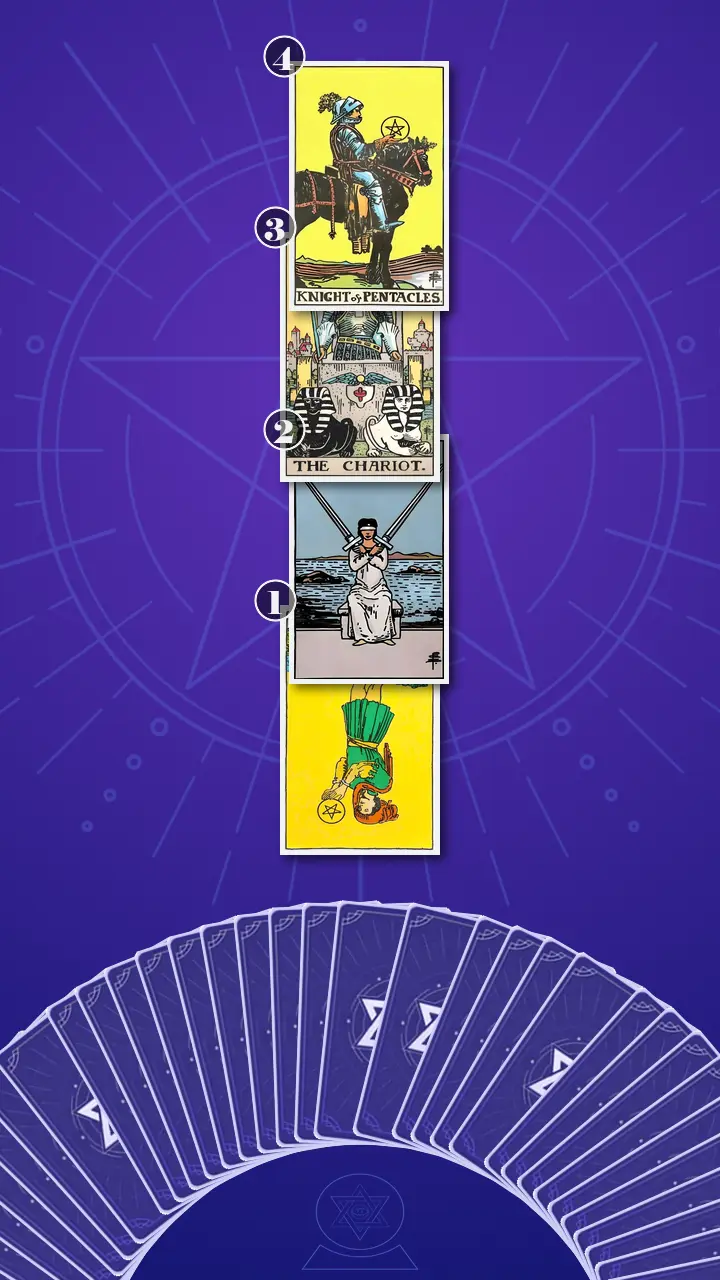
I placed the four cards in a vertical line, like a short staircase. The lower pair held the diagnosis; the upper pair held the route out. The space between the second and third cards marked the exact point where waiting could become choosing.
Reading the Lower Layers of Productive Procrastination
Position 1: The Field Behind the Spreadsheet
I turned over the card representing the diagnosis-level symptom: replacing concrete drafting with repeated preparation until the deadline becomes urgent. It was the Page of Pentacles, reversed.
The Page normally studies a tangible opportunity with patient, practical interest. Reversed, that practical energy is blocked. I pointed to the pentacle held at eye level and the cultivated field waiting behind the figure. Jordan was giving the idea of graduate school intense attention while making inconsistent contact with the field where an application could actually grow.
At 9:40 p.m., this looked exactly like the shared screen in front of me: a programme page studied with the concentration of someone already building an academic future, an application system polished down to file names and upload formats, and a statement still missing the 150 rough words that would create visible evidence. The preparation was real, but it was also providing just enough relief to avoid the riskier work.
I sometimes call this Research Bottleneck Analysis. A creative block is not automatically a personal failure; it can be a signal that the next task contains a question the surrounding research cannot answer. Jordan did not need another supervisor profile to discover how their current interests sounded in a paragraph. Only contact with the draft could provide that information.
Jordan gave a short, bitter laugh. “That is too accurate. It is almost rude.” Their fingers tightened around the mug, then loosened. I smiled, but I did not soften the distinction: meaningful preparation and visible drafting were both valid tasks, yet only one was currently missing.
“The useful question is not whether you worked tonight,” I said. “It is which action would leave evidence of progress after twenty-five minutes.”
Position 2: The Two Futures Held Still
I turned over the card representing the fear and protective belief beneath the delay: the conviction that certainty must come before a direction can be written. It was the Two of Swords, upright.
The figure's blindfold and crossed blades hold two defensible possibilities in perfect balance. In Jordan's application season, that balance appeared as three possible graduate narratives kept in separate notes. More faculty research promised to reveal the strongest one, but drafting any single narrative would make it visible, provisional, and open to evaluation.
Jordan described the previous Sunday at a library desk. They had typed two sentences about a research direction, imagined an admissions reader questioning whether it was credible, deleted the second sentence, and opened another supervisor's publications. The fluorescent lights had buzzed above their headphones while the desk edge pressed into their wrists.
The Two of Swords showed air in excess and feeling held at a distance. Analysis was being used to preserve a stalemate rather than test a choice. The private bargain was simple: If I do not choose an angle, I cannot choose the wrong one. It offered temporary safety, but it left the portal countdown responsible for eventually making the choice.
Jordan's breathing paused. Their gaze slipped away from the card as if replaying the library scene; then their jaw tightened and a long breath left their chest. I asked what choosing the wrong angle would seem to prove.
“That I do not actually have control of where I am going,” they said. “And maybe that everyone else has a coherent story except me.”
“An application cannot provide permanent control over every future version of you,” I said. “It can only express what you can honestly test now. A draft can be a test of direction, not a contract with your future.”
When the Chariot Faced Forward
Position 3: Progress Before Certainty
The room became unusually quiet as I reached for the card above the midpoint. Even the radiator seemed to pause. I turned over the position representing the leverage point that could restore movement before certainty was complete: The Chariot, upright.
I drew Jordan's attention to the black and white sphinxes. They did not need to merge, agree, or disappear. They needed a shared heading. The charioteer held no visible reins; direction came from conscious coordination. In modern terms, this was setting one GPS destination while retaining the right to reroute, or running one A/B test instead of debating every possible application narrative in theory.
For Jordan, balanced Chariot energy meant choosing one programme before the deadline became urgent, scheduling one drafting block, and writing beneath the heading My current working direction. Competing interests could remain present. The completed paragraph would become feedback about fit, not proof that Jordan had permanently fixed their identity.
I could see Jordan still caught in the demand to make the correct decision. If they could not name a final career before drafting, even a provisional sentence felt like false evidence. They were asking certainty to arrive before the experiment that could produce it.
My mind went to the clean wall of an archaeological trench, where apparently confused ground becomes legible once each layer is distinguished. I use the same lens in Academic Stratigraphy. Jordan's polished spreadsheet was the visible topsoil. Protected indecision lay beneath it. Deeper still was an enduring intellectual interest that did not need a complete career map to be real. Deadline panic was not bedrock; it was the latest layer deposited by a repeated cycle.
Deadline panic is not your only engine; choose one direction, make one scheduled move, and let the Chariot's aligned sphinxes represent progress before certainty.
I let the words remain between us for a moment.
Clarity does not always start the work; sometimes one deliberately imperfect piece of work produces the clarity.
For one beat, Jordan stopped breathing. Their right hand hovered above the trackpad, and their pupils widened before their brow pulled tight. “But does that not mean I have been doing this wrong all season?” they asked, with a flash of anger sharper than anything I had yet heard. Then their gaze lost focus, as if several late-night sprints were replaying at once.
I kept my voice level. “It means urgency has been a tool available to you. It worked at a cost, and now you have enough evidence to test another tool.” Their jaw unclenched first. Their shoulders dropped next, and the fist resting near the mug slowly opened. Their eyes reddened slightly as they released a shaky breath. Relief was there, but so was the exposed feeling of realising that the next start time would belong to them.
“Now, with this new perspective, think back: was there a moment last week when this insight might have made you feel different?” I asked.
Jordan returned to Thursday evening, when they had spent forty minutes comparing programmes after deleting a directional sentence. “I could have left the sentence there as data,” they said. “I did not have to defend it forever.”
I offered a deliberately small experiment: keep the spreadsheet closed, set a timer for no more than ten minutes, type My current working direction is..., and add three rough bullets. The heading could be labelled provisional. Jordan could keep it, delete it, revisit it later, or stop entirely if the exercise felt too exposing.
This was the first crossing from muted dread and deadline-driven panic towards grounded clarity and self-directed momentum. It was not certainty. It was the willingness to produce one piece of evidence before certainty arrived.
The Knight's Ordinary, Dependable Evening
Position 4: One Component, Then Stop
I turned over the card representing the repeatable practice through which that new direction could become sustainable: the Knight of Pentacles, upright.
The Knight held one pentacle steadily while prepared fields stretched behind him. Unlike the reversed Page, this figure was not absorbed by the possibility of the work. He had a dependable relationship with its next unit. The energy here was balanced earth: bounded, methodical, and resistant to drama.
In Jordan's life, the card looked like two ordinary calendar appointments, each naming one programme, one component, and one endpoint. They would work for the planned period, record what now existed, leave a one-line handoff such as Next time, draft the 100-word methods example, and stop instead of turning a productive evening into another exhausting sprint.
“One programme, one component, one timed block, then stop,” I said. “You do not have to finish the application season tonight. You have to leave one visible piece of work for your future self.”
Jordan opened their calendar, but their mouth tightened. “After a full day in the research office, even twenty-five minutes can feel like there is no room left in my head.”
“Then we do not argue with the evidence of your actual workday,” I replied. “Use ten minutes. The boundary matters more than the impressive duration. A missed block is information about timing, not a verdict on your discipline.”
I watched Jordan create a modest appointment rather than an aspirational one. The Knight's lesson was not speed. It was reliable return.
Replacing the Deadline Loop With a Draft-to-Clarity Loop
Seen together, the cards told a coherent story. Repeated crisis sprints had taught Jordan's body that urgency was the starter pistol. The reversed Page showed the visible result: substantial application activity without sustained contact with the statement. The Two of Swords uncovered the reason: keeping several futures unresolved protected Jordan from making one imperfect direction public. The Chariot restored authorship by choosing a provisional heading, and the Knight converted that choice into a cadence that could survive ordinary fatigue.
The cognitive blind spot was the belief that drafting should report clarity already achieved. In reality, drafting could help create clarity. More comparison data could refine a decision, but it could not replace the lived evidence produced by trying one angle on the page. Every time panic got the application moving, panic got rehired. Jordan's transformation direction was to make small completion, rather than approaching crisis, the trigger for the next move.
To make the insight usable, I adapted my Thesis Stratigraphy Framework for a personal statement. Instead of treating the essay as one polished declaration, I asked Jordan to build three visible layers: the bedrock of one concrete research experience, the interpretive layer of what they noticed, and the forward layer of what they currently wanted to investigate. The structure could endure even while the exact career story developed.
- Run the Provisional Direction Test. On one evening this week, choose one programme and schedule a 25-minute block with the statement link inside the calendar event. Keep the comparison spreadsheet closed. Add the heading My current working direction, then write one research question, one reason it matters, and the sentence: Right now, I am applying because I want to investigate... Treat the heading as a draft label, not a permanent identity. On a depleted evening, use ten minutes and three bullets, then stop when the timer ends.
- Build a One-Component Cadence. Schedule two realistic appointments, such as Tuesday and Thursday from 7:30 to 7:55 p.m. Give each block one programme, one component, and one visible output. Before closing the document, leave a one-line instruction for the next session. Stop at the planned endpoint even when momentum arrives. If a block is missed, reschedule it once and reduce the next task instead of abandoning the structure.
I reminded Jordan that these were experiments, not obedience tests. The spread had revealed a pattern and offered actionable advice, but the cards would not write the paragraph, choose the programme, or own the consequences. That authority remained with Jordan.
A Week Later: The Quiet Proof
Six days later, I received a message with a screenshot of 148 rough words beneath the provisional heading. Jordan had completed the first block, stopped on time, and used the handoff note to return two evenings later. The paragraph was still uneven, but it existed early enough to teach them something.
Jordan added: “I slept properly, but my first thought this morning was still, What if this is wrong? This time I smiled, kept the paragraph, and went to work.”
I did not read that as a life solved. I read it as the first durable evidence of self-trust: uncertainty had travelled with Jordan, but it had not been allowed to drive the block. The tarot had provided a clear structure for seeing the loop; Jordan had supplied the movement.
When choosing one possible future feels like losing control of all the others, I know how easy it is to remain folded over a glowing draft and wait for the deadline to make the choice unavoidable. Simply noticing that bargain, with curiosity rather than shame, means the portal countdown is no longer the only voice in the room.
If one imperfect paragraph only had to test your current direction, which route would you let the Chariot take for twenty-five minutes, and what might you let that paragraph say before the deadline has to speak for you?