The 11:47 p.m. Checkout Hover
You’re a late-20s city renter with an IKEA cart full of “basics,” but you keep tab-switching to reviews and your bank app at midnight like it’s a personality trait—classic analysis paralysis.
That’s the first thing I said to Taylor when their video call connected—because I could see the glow on their face, that specific laptop-light sheen that only happens when you’ve been “researching” for too long.
It was 11:47 p.m. in their Toronto rental. Their laptop was balanced on their knees on the couch, a measuring tape abandoned on the coffee table like courtroom evidence. The overhead light buzzed with that faint, irritating electrical whine. Outside, the last of the TTC hum faded into the kind of city-quiet that makes your thoughts louder.
On the shared screen: an IKEA cart. A Notes app titled, with brutal honesty, “Don’t get trapped.” And their cursor hovering over Checkout the way people hover over “Send” on a text that might change something.
Taylor’s hands were restless—fingers tapping, then flattening on the trackpad, then tapping again. “I can afford the shelf,” they said, voice low like they didn’t want their own apartment to overhear. “But the second it looks like a real adult purchase, my chest does this… clamp thing. And I start thinking, if I buy it, I’m basically agreeing to a whole life. The one I promised I wouldn’t repeat.”
The unease wasn’t abstract. It sat in them like they’d swallowed a small motor that wouldn’t stop vibrating—tight chest, keyed-up hands, and a mind that kept revving at red lights.
I nodded, slow and careful. “I’m really glad you named the body part of it. Because that means we’re not dealing with ‘you can’t decide,’ we’re dealing with a nervous system trying to protect you.” I let my voice soften. “Let’s make a map through this. Not to force a purchase—just to find clarity about why a bookshelf feels like a verdict.”

Choosing the Compass: The Four-Layer Insight Ladder
I asked Taylor to put both feet on the floor and take one breath they could actually feel. No crystals. No theatrics. Just a clean transition from spiraling to noticing.
“Before we pull cards,” I said, “we’ll do what I call a pre-meeting 3-minute cosmic breathing. Think of it like stepping into a planetarium show: the lights dim, the outside noise fades, and your brain stops trying to multitask the universe.”
When their shoulders dropped a millimeter, I shuffled.
“Today, we’re using a spread I designed for this exact kind of ‘small choice, big meaning’ problem: the Four-Layer Insight Ladder · Context Edition.”
If you’ve ever googled things like tarot spread for decision paralysis and overthinking or Two of Swords meaning in real life, this method is built for you. Because this case isn’t really about buying a thing—it’s about a meaning conflict rooted in an inherited story about what stability costs. The Ladder goes from the observable behavior (the IKEA-tab stalemate), into the protection strategy (control, withholding), down to the root script (the “settling” rule), and then back up into a reframe and a micro-action that’s actually doable.
I laid six cards in a vertical column like rungs: bottom to top. “We’ll read it like a climb,” I told Taylor. “Card 1 is the stuck moment you can point to. Card 3 is the deeper rule running the whole scene. Card 5 is a one-week experiment—small enough to try without turning your life into a before-and-after montage.”
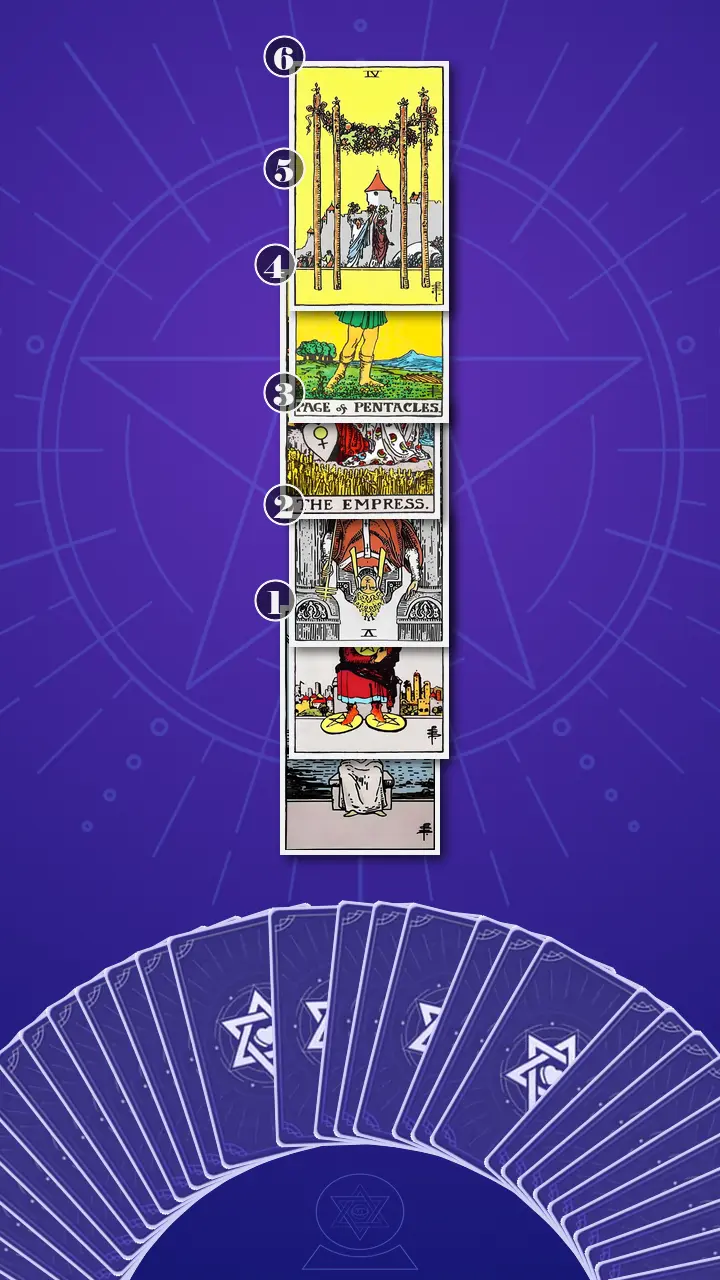
Reading the Map: When Overthinking Poses as Practicality
Position 1: The observable stuck moment
“Now flipped over,” I said, “is the card representing the observable stuck moment: what you do with the IKEA tab and what the paralysis protects.”
Two of Swords, upright.
I didn’t even have to reach for symbolism; their screen was already living it. “This is that late-night freeze,” I said, “where the cart is ready… but your body locks. So you open three new tabs—reviews, price comparisons, your bank app—until the decision disappears into ‘I’ll do it tomorrow.’”
In the Two of Swords, the energy isn’t missing—it’s blocked. The swords are held firm across the chest like a barricade, and the blindfold is the perfect metaphor for deciding without letting yourself feel what you want your home to support. The water behind her is calm, but only because it’s being kept at a distance.
I leaned in a little. “And here’s the part that stings but helps: A cart you never check out is still a decision—just one that chooses discomfort by default.”
Taylor let out a quiet laugh—sharp, almost bitter. “Okay,” they said. “That’s… literally me. It’s accurate in a rude way.” Their eyes flicked to the top of their browser like they could see their open tabs judging them.
Position 2: What you’re holding onto for safety
“Now we’re looking at what you’re holding onto for safety: the concrete protection strategy around money, space, and control.”
Four of Pentacles, upright.
“This is the card that says, ‘I can afford it, but spending feels like losing my grip,’” I told them. “You keep your space temporary on purpose—folding things, mismatched storage, nothing that anchors you—because not investing feels like staying mobile.”
The Four of Pentacles energy is excess control. A tight grip that started as self-protection and turned into a lifestyle tax. I watched Taylor’s jaw set slightly as I spoke—like their body wanted to argue before their mind did.
“But I am being responsible,” they said quickly, defensive in that familiar way overthinkers get when their coping mechanism is exposed. “Like… it’s just budgeting.”
“Totally,” I said, because it is responsible to care about money. “But here’s the nuance: this card isn’t about budgeting; it’s about using the bank app like an emotional thermostat. If you don’t spend, you feel ‘in control.’”
I could see the micro-behavior echo in real time: their thumb started scrolling faster, not even on anything useful—just movement to discharge tension. Shoulders tightened. Then, a tiny softening. “Oh,” they said, quieter. “Yeah. It’s… control.”
Position 3: The inherited script (Key Card)
“Now,” I said, and I let the room go a touch quieter, “we’re turning over the card that represents the inherited script: the belief about ‘settling’ you learned growing up that still runs the decision.”
The Hierophant, reversed.
This is the moment in a reading where I always feel like I’m back in the planetarium, right when the star field snaps into focus—because you can almost hear someone’s inner story click into view.
Reversed, The Hierophant is the old institutional template turned upside down. The “adulting checklist” you didn’t subscribe to, but the notifications keep popping up anyway. It’s that internal voice that says, “This is what grown-ups do,” and your whole system flares with Absolutely not—even if the thing would genuinely help you.
Here’s what I said to Taylor, as plainly as I could: “You’re not rejecting furniture. You’re rejecting a script. The one that equates stability with conformity. Or silence. Or being stuck.”
They went still in a three-step chain I’ve learned to trust: first a tiny freeze—breath paused mid-inhale; then their gaze unfocused like a memory reel started playing behind their eyes; then a slow exhale, like something heavy was finally allowed to have a name.
And I delivered the core sentence of the whole spread—because this card was our hinge point, the place where meaning changes and behavior finally can.
Not ‘I can’t buy this because it means I’m stuck,’ but ‘I choose what stability means,’ and that choice starts by turning the old rulebook upside down in The Hierophant reversed.
I didn’t rush the silence after. Taylor’s face tightened—then not in fear, in something closer to anger. “But if that’s true,” they said, voice sharpening, “doesn’t that mean I’ve been letting this… rulebook run me? Like I’ve been reacting this whole time?”
“That’s such an honest reaction,” I told them. “And no—this doesn’t mean you ‘failed.’ It means your nervous system learned a strategy in a home where ‘stable’ had a cost. You kept yourself safe by staying provisional. That was smart then. It’s just outdated now.”
I watched their shoulders lower like a backpack strap finally loosened. Their eyes went a little glassy, not dramatic—more like the body’s quiet ‘oh’ when it realizes it’s allowed to choose. Their hands, which had been jittering near the trackpad, rested flat for the first time in the session.
“Now,” I said gently, “with this new lens—self-authorship instead of inherited rules—think back to last week. Was there a moment you hovered over checkout, felt that chest clamp, and thought, ‘If I do the adult thing, I’m signing up for the life I watched growing up’? What would have shifted if you’d treated that feeling as data, not a verdict?”
This was the breakthrough line in their emotional arc: from tight, control-driven avoidance of “settling” to self-authored comfort that still preserves agency. Not comfort as a cage—comfort as a choice they could revise.
And because I’m me, my brain did a quick astronomy flashback: spacecraft don’t get free by never entering orbit; they get free by choosing their trajectory. Avoiding every gravitational pull doesn’t make you independent—it just leaves you drifting.
“There’s a technique I use in both star navigation and tarot,” I added. “I call it Dark Matter Detection. The point is to look for the invisible force shaping the whole system. Your ‘dark matter’ here isn’t the shelf. It’s the hidden belief: stability equals losing your voice. Once we see that, the whole orbit of the problem changes.”
Position 4: The medicine reframe
“Now we climb,” I said. “This card represents the medicine reframe: what a self-authored version of home could mean for you now.”
The Empress, upright.
“This is the card that says: comfort can be chosen. That’s not the same thing as settling,” I told them, and I watched their eyes soften on the word chosen.
The Empress energy is balanced nourishment—supportive, embodied, practical. Not luxury for Instagram. Not a ‘now you’re a Real Adult™’ badge. It’s the difference between harsh overhead lighting and a lamp you actually like. Between eating on the couch because there’s nowhere else and having one clear surface where your body doesn’t brace.
“If your apartment could support your nervous system, not your image,” I asked, “what would you change first—light, storage, a place to sit, a smoother morning routine?”
Taylor exhaled—the kind that makes your whole chest widen. “Light,” they said immediately. “The overhead light makes everything feel… temporary and kind of sad.”
Position 5: A one-week experiment
“Now flipped over,” I said, “is the card representing a one-week experiment: the smallest grounded step that builds self-trust without demanding certainty.”
Page of Pentacles, upright.
This is my favorite kind of card for overthinkers because it doesn’t ask you to transform your personality. It asks you to practice. Page energy is beginner energy, and here it’s in balance: steady, small, willing to learn by doing.
“Make it a one-week experiment, not a forever identity,” I said. “You’re a UX designer—you already know how to do this. You ship a small change, collect feedback, iterate. You don’t redesign the whole app at midnight because one button feels scary.”
Taylor smiled for real this time—small, but present. “Okay. I can do one thing,” they said.
Then their expression flickered. “But I genuinely feel like I can’t even do five minutes sometimes,” they admitted. “After work I’m fried. And then I’m doing this at midnight, and it’s… chaos.”
“That’s not a character flaw,” I said. “That’s a workload plus a nervous system pattern. So we’re going to prep your mind like a spacecraft preparing for a course correction.”
I named my tool out loud because it mattered: “This is Spacecraft Attitude Adjustment—tiny alignment before a sudden change. We don’t need hype. We need stabilization.”
Position 6: Integration
“And finally,” I said, “this card represents integration: what changes when you act from values, and how ‘settling’ can become belonging instead of a trap.”
Four of Wands, upright.
This card always looks like a decorated threshold to me—a doorway you step through willingly. Not a cage. A base.
“This is you coming home from work and feeling a tiny drop of relief instead of that placeholder sadness,” I said. “Maybe you make tea and sit down without balancing everything on your lap. Maybe you invite a friend over without apologizing for the mismatch.”
Fire energy here is warm integration. The payoff isn’t perfection; it’s pride without cringe. “Stability hits different when you’re the one writing it,” I added, and Taylor nodded like their body understood before their brain tried to argue.
From Insight to Action: A Small Orbit Change You Can Feel
Here’s the story the whole ladder told, in one clean line: you start in Air—overthinking at checkout (Two of Swords). You protect yourself with control-as-safety (Four of Pentacles). Underneath, an inherited rulebook keeps labeling comfort as a trap (Hierophant reversed). The medicine is permission to nourish your actual daily life (The Empress). The method is a small test you can evaluate like data (Page of Pentacles). And the integration is a home that feels like a chosen threshold, not a sentence (Four of Wands).
The cognitive blind spot I named for Taylor was simple but sharp: they were treating “not choosing” as freedom, when it was really a borrowed definition of stability steering their life in the background. Doing the opposite of the script was still letting the script drive.
“So we’re shifting direction,” I said. “From treating comfort as a life sentence… to treating home-making as a reversible experiment you get to author.”
I offered next steps that were small on purpose—because small steps are how you build trust without demanding certainty.
- The 3-minute Cosmic Breathing ResetBefore you open IKEA tonight, sit on the couch with both feet on the floor. Inhale normally, then do three slower exhales (longer out than in). Open your cart only after the third exhale.If your hands get jittery, that’s data—your system thinks this is a life contract. Keep breathing until your fingers stop “buzzing.”
- The Rulebook Flip (8-minute timer)Open your IKEA cart. Pick ONE item you’ve needed for at least a month (a friction-reducer, not a vibe item—lamp, shelf, hooks, hamper). In your Notes app write: (1) “Buying this serves my values because ____.” (2) “Buying this doesn’t trap me because ____.” Then set a timer for 8 minutes to decide: check out, or move it to a “Later (Date)” list with a specific revisit date.If your brain tries to escalate into a full apartment project, cap browsing at 30 minutes total. This is practice in authorship, not a makeover.
- The One-Item Friction Reducer PurchaseChoose one daily-life pain point and buy one item that directly reduces it (for Taylor: a lamp to replace harsh overhead lighting). Treat it as a one-week product experiment: live with it for seven days, then note what changed in your body (jaw, chest, shoulders) when you got home.Keep it reversible: pick something with easy returns or decent resale. Remind yourself: changing your mind is allowed.
To make it stick, I used my other favorite frame—decision-making as interstellar navigation. “You don’t need a perfect destination,” I told Taylor. “You need a next coordinate you can verify. In spaceflight, we do small burns and course-correct. That’s not indecision; that’s competent navigation.”

A Week Later: The Quiet Proof
Six days later, Taylor messaged me a photo: a warm little lamp glowing beside their couch, the overhead light off. Nothing influencer-perfect—just a softer corner, a charger tray, and a book that wasn’t balancing on their knee. “I checked out,” they wrote. “My chest tightened for like thirty seconds, then it… didn’t. And coming home feels less like a waiting room.”
I sat with that for a moment—the way small changes create big internal evidence. Their life didn’t become permanent overnight. They didn’t “settle.” They ran a test, gathered feedback, and proved to their own body that agency still existed inside stability.
When a basic purchase makes your chest go tight, it’s usually not about the item—it’s that old fear that comfort equals a life you didn’t choose, and you’re trying to keep control by keeping everything provisional.
If you treated one small comfort as a reversible experiment you get to author, what’s the first tiny upgrade your space—and your body—would actually say yes to?
This story is adapted from psychological research, written so that those in a similar struggle can see their own pattern in it — and find their next step clearly.These insights are not a substitute for professional psychological, medical, legal, or financial advice.
Learn more about our Journey to Clarity.
How did this insight land for you?
🫂 This Resonates Deeply
🌀 Living This Story
✨ Now I See Clearly
🌱 Seeing New Possibilities
🧰 Useful Framework
🔮 The Confirmation I Needed
💪 Feeling Empowered
🚀 Ready for My Next Step
Author Profile
 AI
AI“After a decade of guiding people through the stars, I’ve come to see life much like the orbits of planets: everything has its inevitable cycles. When you feel lost, please don't blame yourself; you might just be in a natural low tide. I’m here to sit under the night sky with you, offering a gentle cosmic perspective to distinguish temporary pain from the beautiful breakthroughs just around the corner.”
In this Choice Tarot Reading :
Core Expertise
- Decision Timing Calibration: Assessing whether your current cyclical environment is structurally optimal for making a high-stakes crossroads choice.
- Cyclical Variable Filtering: Stripping away temporary situational friction to lock in the critical variables that will actually impact your long-term orbit.
Service Features
- The Orbital Pause Strategy: A calculated 72-hour delay tactic to prevent impulsive choices driven by temporary macro-friction, allowing the true optimal path to naturally emerge.
Also specializes in :
Explore Related Patterns:
Reactive OvercorrectionThe Notes app titled 'Don't get trapped' and the fear that a shelf means repeating 'a whole life' show the old rulebook still in the room. Taylor is not simply resisting furniture; they are resisting an inherited version of stability that once felt like conformity, silence, or being stuck. You can see the reversal in the line that doing the opposite of the script is still letting the script drive. Avoiding every anchor may feel like freedom, but it keeps the family template as the hidden reference point. The old story still decides what comfort is allowed to mean. Reactive Overcorrection fits because the protective move has overshot its target. The work is not to submit to the old checklist or rebel against it forever; it is to author a definition of stability that belongs to you now.
Analysis ParalysisThe cursor hovering over Checkout while the reviews, price comparisons, and bank app stay open gives this pattern its shape. The decision is technically small and affordable, but the nervous system treats the click as an irreversible threshold, so more information becomes a way to delay contact with the actual want. You are not just comparing shelves; you are using research to keep the emotional meaning of the purchase suspended. That is why the loop feels productive while quietly choosing discomfort by default. The tabs create motion, but they do not change the fear that a basic item might become a life verdict. Seeing the loop as Analysis Paralysis gives you a cleaner lever. The task is not to find the perfect product; it is to notice when data gathering has stopped serving the decision and has started protecting you from the identity meaning attached to choosing.
Commitment AvoidanceThe folding things, mismatched storage, and refusal to buy anything that anchors the apartment show a commitment conflict playing out through space. Taylor keeps the home provisional because not investing feels like staying mobile, even when the lack of support makes daily life worse. You are avoiding more than a shelf; you are avoiding the symbolic commitment to a version of home that might make you feel trapped. The defense protects agency by refusing permanence, but it also turns every comfort upgrade into evidence that you might be settling. Commitment Avoidance fits here because the commitment is practical and identity-based, not necessarily romantic. A one-item experiment matters because it proves commitment can be partial, revisable, and chosen without becoming a cage.
Control CopingThe bank app sitting beside the IKEA cart is the clearest behavioral tell. Taylor can afford the shelf, but checking the numbers becomes a way to regulate the chest clamp. Money caution is real, yet the story shows the app being used less as budgeting and more as an emotional thermostat. You keep control by keeping the apartment provisional: folding storage, mismatched fixes, no anchor purchases, and nothing that makes the place feel chosen. The defense makes sense because it preserves mobility, but it also taxes daily life by turning comfort into something that must be withheld to feel safe. Control Coping names the moment when reasonable responsibility starts carrying a hidden psychological job. The useful question is no longer whether you can justify this purchase, but whether you are using control to protect agency or to avoid testing whether agency can survive comfort.
CatastrophizingThe sentence 'if I buy it, I'm basically agreeing to a whole life' turns a shelf into a verdict. A reversible purchase gets mentally scaled into a permanent identity outcome, and the body responds as if Checkout were a binding contract. You are not making a random budgeting mistake here; the mind is compressing object, home, adulthood, and inherited fear into one catastrophic meaning. Once comfort becomes a life sentence, avoidance starts to feel logical, even though the actual decision is small, testable, and reversible. Catastrophizing is the useful label because it separates the size of the item from the size of the story attached to it. The moment you can name that escalation, you can treat the chest clamp as data rather than a verdict.
Values-Based Decision MakingThe shift from 'I can't buy this because it means I'm stuck' to 'I choose what stability means' is the hinge of the whole case. Taylor stops treating the old rulebook as the judge and starts asking whether a specific item serves their actual values and daily nervous system. You see the pattern become concrete in the one-week lamp experiment: one friction-reducer, easy to revise, evaluated by bodily feedback instead of midnight panic. The decision is no longer about proving adulthood or escaping it; it is about testing what supports the life you are actively authoring. Values-Based Decision Making fits because clarity comes from reconnecting action to chosen meaning. Buying the lamp is not surrender to settling; it is a small behavioral vote for agency inside stability.
Explore Related Struggles:
Comfort EntrapmentTaylor's chest clamps when the shelf stops looking like a shelf and starts looking like an agreement to a whole life. The object becomes charged with the fear of settling, repeating an old template, and accepting a version of adulthood they promised themselves they would not reenact. You are watching comfort turn into a cage in real time. The basic act of making a home more livable gets pulled into an inherited rule that says stability costs you your voice, your mobility, or your ability to leave. Under that rule, even support starts to look suspicious. Comfort Entrapment fits because the struggle is not about whether a lamp or shelf is worth buying. It is about whether ease can exist without becoming confinement, and whether a stable corner of your life can be authored by you rather than treated as evidence that the old story has won.
Oppositional Identity LockThe Notes app titled 'Don't get trapped' sits beside the IKEA cart like a second decision screen. Taylor is not only choosing between checkout and delay; they are trying to prove they have not become the life they watched growing up. That proof has its own trap. Rejecting the adulting checklist can still keep the checklist in charge, because every choice has to pass through the old rulebook before it can be felt as yours. Doing the opposite of the script is still a way of orbiting the script. Oppositional Identity Lock names the point where freedom gets defined mainly as refusal. You are not simply avoiding furniture; you are trying to protect a self that was built against an inherited model of stability, and that self needs a new reference point before home can become a chosen base instead of a reaction.
Performative IndependenceThe apartment stays temporary on purpose, with folding things, mismatched storage, and no object that makes the room feel too anchored. On the surface, that preserves mobility. In the body, it also means coming home to a space that feels more like a waiting room than a place that actively supports you. You can sense the performance in the way discomfort becomes evidence of freedom. If nothing is settled, nothing can trap you; if nothing anchors you, nothing can claim you. But the cost is that independence has to be proven through withholding, and the proof keeps taking rest, warmth, and ease out of daily life. Performative Independence fits because the story shows agency being acted out as perpetual provisional living. The deeper move is not to become more attached to objects; it is to stop using under-supported living as the main evidence that you are still free.
Resource Control BindThe bank app keeps appearing in the checkout spiral even after Taylor says they can afford the shelf. That detail matters because the app is no longer just checking a number; it becomes the place where the body looks for proof that nothing has slipped out of control. You can see the bind in the apartment itself. Folding things, mismatched storage, and the absence of anything anchoring the room all preserve the feeling of mobility, but they also keep daily life paying a tax in friction and discomfort. Not spending feels like keeping your grip, while the space quietly absorbs the cost. Resource Control Bind names the struggle between responsible stewardship and control as self-protection. The issue is not reckless spending versus good budgeting; it is the moment money, space, and agency collapse into one tight fist, making comfort feel like a loss of leverage instead of a choice you can still revise.
Analysis ParalysisThe cursor hangs over Checkout at 11:47 p.m. while you cycle through reviews, price comparisons, and the bank app, even though the cart is full of basics and the shelf is affordable. The action is not absent; it is scattered across tabs, taps, and checks that create the feeling of movement without letting the decision land. You get caught because the search for certainty is doing two jobs at once. It looks like practical research, but it also keeps the purchase suspended long enough to avoid the question underneath it. A cart you never check out still shapes your life, because the room stays uncomfortable while the decision keeps pretending it has not been made. Analysis Paralysis fits here because the story shows a choice becoming heavier every time more information is added. You are not failing at adulthood; you are trying to make a reversible object carry an irreversible verdict, and that overload freezes the checkout moment before it can become a small, testable act.
Explore Related Emotions:
Commitment ClaustrophobiaThe folding things, mismatched storage, and refusal to anchor the room are not random renter habits in this story. They keep the apartment light enough to leave emotionally, even when the lack of support makes daily life harder. Commitment Claustrophobia fits because the shelf represents more than an object. It feels like an anchor that could shrink your options, mute your voice, or make stability resemble the version of adulthood you did not choose. The claustrophobic charge softens when commitment becomes bounded: one useful item, one week of evidence, and the right to revise.
Home Safety LongingThe buzzing overhead light, the laptop balanced on Taylor's knees, and the later photo of a warm lamp create a clear before-and-after in the body of the story. The room moves from temporary glare toward one small corner that can actually hold daily life. Home Safety Longing fits because the desire underneath the resistance is not about having a perfect apartment. It is about wanting a place where your body does not have to brace the second you come home. The longing becomes healthier when comfort is chosen on your terms, as support rather than surrender.
Verdict DreadThe cursor hovering over Checkout, the Notes app titled "Don't get trapped," and the chest clamp around an affordable shelf all point to the same inner moment. A small purchase stops being small because your body reads it as a ruling on what kind of life you are agreeing to. Verdict Dread fits because the fear is not about whether the shelf is useful. It is about the button feeling too final, as if comfort would lock you into a version of adulthood you worked hard not to repeat. Naming that dread gives the decision its real scale again: one reversible choice, not a total sentence on your future.
Cautious Self-TrustThe one-week experiment, the single lamp, and the note to track jaw, chest, and shoulders keep the change deliberately small. Taylor does not have to become a different person overnight; they only have to gather one clean piece of evidence. Cautious Self-Trust fits because confidence arrives here as proof, not hype. The chest tightens for about thirty seconds and then does not take over. That matters because your body learns from the outcome: a chosen comfort can exist without becoming a trap.
Choice Paralysis OverwhelmTaylor's hands keep tapping, the cart is ready, and the browser keeps opening more reviews, price comparisons, and bank checks. Every extra tab looks practical on the surface, but the decision keeps getting bigger, louder, and harder to touch. Choice Paralysis Overwhelm names the feeling of being trapped under too much meaning at once. You are not lacking information; you are carrying too many consequences inside one click. The emotional work is to separate useful data from the fear that one shelf has to solve, prove, or define an entire life.
Grounded AgencyThe line "I choose what stability means" changes the whole emotional geometry of the purchase. The shelf is no longer a pledge to an inherited life; it becomes a small act you can define, test, and revise. Grounded Agency fits because Taylor's power returns through contact with the practical world. One item, one week, one body response, and one later photo create evidence that stability can include choice. You are not proving that you will stay the same forever; you are proving that you can make a grounded move without handing over authorship.
Rulebook ShameTaylor goes still when the inherited rule is named, then asks whether they have been letting the rulebook run them this whole time. That question carries a sharp sting because the pattern suddenly looks less like freedom and more like reaction. Rulebook Shame fits the moment when you realize a script you rejected may still be organizing your choices from the background. The point is not to blame yourself for learning a protective strategy. The point is to notice that doing the opposite of an old rule can still keep the old rule in charge, and that awareness gives you a way to author a different one.
Control FatigueAfter work, Taylor is already fried, but the IKEA loop restarts at midnight with reviews, comparisons, and the bank app. The quiet apartment does not bring rest; it makes the control cycle easier to hear. Control Fatigue names the cost of using constant checking as a safety strategy. You can keep proving you have options, keep proving you are not trapped, and still end up drained by the effort of never letting one choice land. The way out begins when control becomes smaller and cleaner, not louder and more repetitive.
Scarcity AnxietyTaylor says they can afford the shelf, but the bank app keeps becoming the place they go to feel steadier. The numbers are not only numbers here; they are being used as a grip point when the purchase starts to feel emotionally slippery. Scarcity Anxiety fits because available money still feels unsafe to use. Not spending creates a temporary sense of control, while spending on comfort feels like losing ground. The useful distinction is that budgeting can stay responsible without making deprivation the only proof that you are safe.
Explore Related Contexts:
Adulting Performance PressureTaylor calls the shelf a real adult purchase, and that phrase carries more weight than the price tag. The cart is full of basics, but the checkout button starts behaving like a public test of whether Taylor is becoming the kind of grown-up they never wanted to copy. Adulting Performance Pressure shows up when ordinary life infrastructure becomes a stage for social proof. The pressure is not only to buy a shelf or lamp; it is to perform a recognizable version of adulthood, complete with a tidy apartment, responsible spending, and the appearance of being settled. In this case, the route back to agency is to separate adult functioning from adult performance. You can make a home work better without auditioning for someone else's version of maturity, and that distinction is what keeps a useful purchase from becoming a compliance ritual.
Life Script PressureTaylor keeps an IKEA cart open at 11:47 p.m., with a Notes app titled 'Don't get trapped' and a cursor hovering over Checkout as if a shelf could authorize an entire future. The object in the cart is small, but the meaning attached to it is not: buying a basic item is treated as agreeing to the kind of life Taylor watched growing up. That is the structure of Life Script Pressure. A practical home decision gets pulled into a prewritten social template about what stability, adulthood, and belonging are supposed to look like. You are not just weighing price and function; you are being asked, by an old rulebook, to decide whether comfort means conformity. The useful shift is that the script becomes visible as a script. Once the rule is named, the shelf stops being a verdict and becomes one possible tool inside a life you are allowed to define, revise, and test on your own terms.
Waiting Room LimboTaylor's rental has the props of a life paused: a buzzing overhead light, a laptop balanced on their knees, a measuring tape abandoned on the coffee table, and storage that stays deliberately mismatched. The place is occupied, but it has not been allowed to become a base. Waiting Room Limbo is the external stage created by keeping everything provisional. The apartment remains usable enough to get through the week, but not supportive enough to signal that Taylor is allowed to arrive inside their own life. Avoiding the anchor prevents the old script from winning, but it also keeps daily comfort on hold. The lamp photo six days later shows why this context is central. Nothing dramatic changes, yet one corner stops behaving like a placeholder. You can see the difference between being trapped by permanence and being supported by a space you chose to improve.
Analysis ParalysisTaylor's screen already contains the loop: IKEA cart, reviews, price comparisons, bank app, and a cursor that keeps hovering without closing the decision. The measuring tape is on the coffee table, the item is affordable, and the action still gets deferred into another round of checking. Analysis Paralysis is the external decision environment here, not a personality flaw. The digital setup gives Taylor endless ways to look responsible while avoiding the one action that would test whether the apartment can support them better. More information keeps entering the system, but no material support reaches the room. The point of naming this context is to locate the stall in the process, not in your character. When the research loop is mapped, you can choose a smaller decision container, such as one item, one timer, and one week of feedback, instead of letting the tabs expand until action disappears.
Bounded Commitment TrialTaylor's breakthrough comes through one lamp, not a full apartment transformation. The purchase is framed as a one-week experiment with feedback, limits, and reversibility, which changes the decision from a life contract into a testable next step. Bounded Commitment Trial fits because the story does not ask for certainty before action. It gives the decision a container: one needed item, one short timer, one practical reason, and enough room to revise if the result does not work. That structure lets action happen without pretending the choice has to define the rest of Taylor's life. For you, this context turns buying into authorship rather than surrender. A bounded trial lets stability become something you can sample, evaluate, and adjust instead of something that swallows your agency whole.
Scarcity Lifestyle Lock-InTaylor says they can afford the shelf, but the bank app keeps becoming a grip check. The money exists, the need exists, and the purchase is still withheld from the daily life it would improve. Scarcity Lifestyle Lock-In appears when not spending becomes the proof of being in control, even when the result is a harsher, less functional home. The cost is paid through the body of the apartment: overhead lighting that grates, storage that stays mismatched, a book balanced on a knee, and a couch doing the work of a desk, table, and landing zone. This context matters because the issue is not reckless consumption versus responsibility. You are deciding whether available resources are allowed to become support, and whether control can include letting your space carry a little more of the load.