When Plans Become Cages

A clear look at rigid plans, related tarot cards, and reading insights from fixed timelines that no longer fit.

Rigid Planning Lock-in
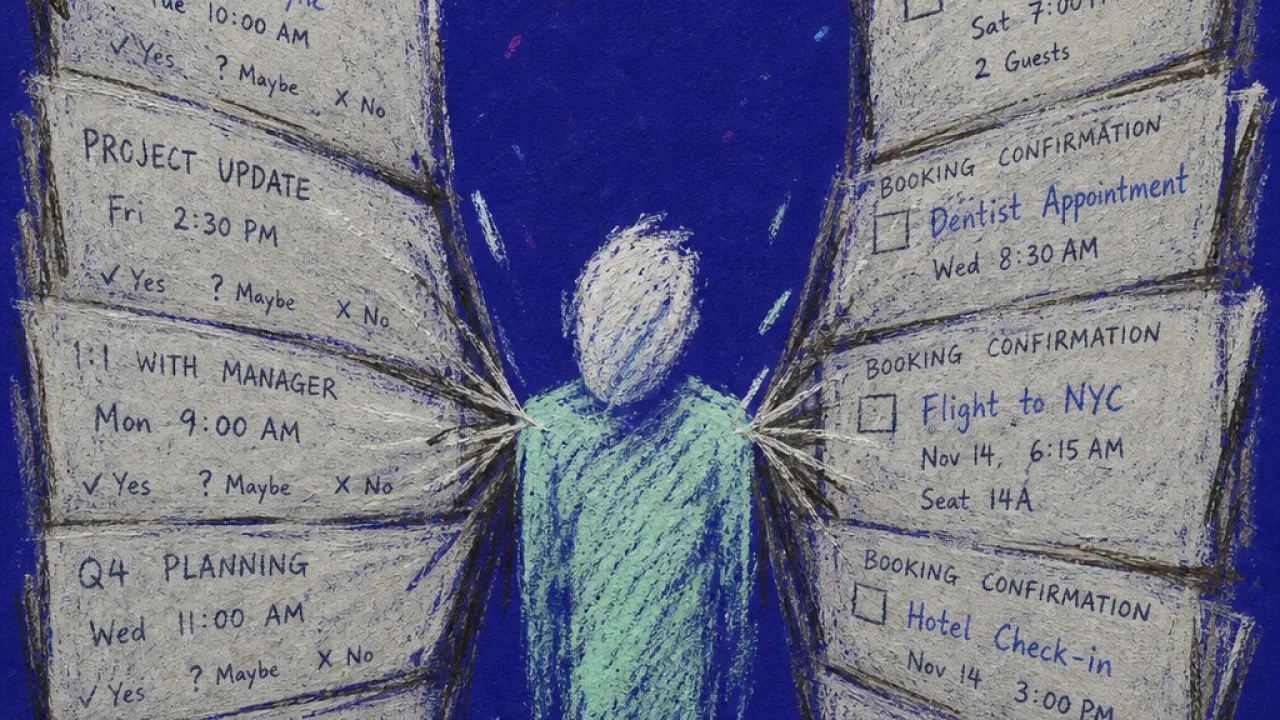
A solitary figure with pinned shoulders inside folding calendar pages, paper edges leaving sharp marks in deep indigo space

What is this situation?

Rigid Planning Lock-In — you enter a project, trip, move, semester, or shared commitment thinking the plan is just a way to coordinate, and then the first version starts acting like law. At the beginning, everyone agrees on dates, budgets, roles, routes, deliverables, or who will be where by when; the spreadsheet looks clean, the calendar invites are accepted, the deposits are paid, and the group chat goes quiet because the decision is supposedly done. Then circumstances change: a deadline shifts, someone's schedule slips, the cost goes up, your workload changes, or one detail that seemed small becomes the thing everything depends on. When you try to adjust, the room tightens around the old plan — someone points to the original message, another person says it's too late to change, a manager treats the roadmap as proof, a friend treats the booking as a promise, and the shared document becomes harder to argue with than the situation in front of you. Your jaw tightens and your shoulders pull in before you even ask the question, because you already know the response will be framed as inconvenience, flakiness, or lack of commitment rather than new information. So you keep showing up inside a plan that no longer fits: overexplaining, rearranging your week, covering gaps, absorbing extra costs, and pretending the route still makes sense because too many people have organized themselves around it. The exhaustion comes from moving through a corridor that was drawn before the current facts arrived, much like the figure on the Eight of Swords, bound in place while sharp boundaries narrow the space around them.

Why it's not you?

The problem isn't that you can't adapt; the setup treats the first plan as more legitimate than the facts that arrive later. Fixed calendars, paid bookings, public commitments, and people quoting the old version back at you create a lock-in that makes adjustment look like disruption. That pressure belongs to the structure around the plan, not to your ability to handle change.

Rigid Planning Lock-in in Tarot Cards

Rigid Planning Lock-In is the point where a shared plan stops being a map and starts acting like a corridor everyone expects you to keep walking through. The jaw-tightening pause before asking for a change belongs to an environmental and structural dynamic: calendars, deposits, deadlines, and public commitments make adjustment costly. Here are the Tarot Cards that mirror the fixed path, the narrowed options, and the pressure to keep moving when the route no longer fits.

The Emperor
Reversed
The armoured ruler sits on a stone throne backed by bare mountains, holding symbols of authority inside an environment built for control rather than responsiveness. Reversed, that stabilising structure hardens into managerial inflexibility, and the roadmap becomes a command that subordinates current project evidence to the leader's need for consistency. You may be required to deliver against assumptions that nobody below the decision-maker is authorised to revise. The blocked authority structure names the career constraint clearly: execution responsibility travels downward, but permission to incorporate changed facts remains concentrated with a manager who treats adjustment as a challenge to control.
Wheel of Fortune
Reversed
The great wheel is crowded with movement, with figures rising and falling around its rim while four observers hold their positions at the edges. Reversed, the schedule attempts to resist that visible cycle, making the original date appear stable while costs, availability, dependencies, and external conditions continue turning underneath it. You may be pressured to preserve timing because the group has invested money or reputation in calling the date settled. The inverted wheel reveals that immobility is itself an active choice with consequences: refusing to update the plan does not stop the cycle, but transfers the resulting delay and compression onto the people expected to keep up.
Justice
Reversed
The scales, raised sword, and formal seat create a scene in which evidence is supposed to be weighed before a decision is enforced. Reversed, that process becomes mechanically selective: the approved roadmap, original estimate, or meeting record is treated as binding proof, while updated capacity and risk data are characterised as excuses. You may spend more time defending the existence of changed facts than solving the project problem those facts reveal. The inverted scales name a workplace accountability failure in which adherence is easy to measure but adaptation is not, allowing the organisation to protect its earlier decision by transferring the consequences to execution teams.
The Devil
Upright
Two figures stand chained to a raised pedestal, yet the collars are visibly loose enough to show that not every part of the bond is physically enforced. The image maps closely onto deposits, public promises, accepted bookings, and reputational pressure that make an obsolete plan feel contractually total even when the actual terms leave more room. You may experience revision as betrayal because material cost and social judgement have been fused into one binding story. The loose chains keep the analysis practical: cancellation fees, dependent schedules, and genuine obligations can be separated from shame, sunk-cost reasoning, and the threat of being labelled uncommitted.
The Tower
Reversed
Lightning has already struck the crowned tower, flames have entered its windows, and figures are falling from a structure whose claim to stability has visibly failed. Reversed, the disruption is held in suspension: the group tries to preserve the old architecture because acknowledging its failure would trigger costs, embarrassment, and widespread replanning. You may be asked to keep moving through a route built on assumptions that no longer stand, with every workaround presented as proof that collapse has been avoided. The blocked fall reveals that resisting a structural update does not restore the plan; it prolongs exposure to a design that can no longer organise the current reality.
Eight of Cups
Reversed
Eight cups are carefully stacked in the foreground while a cloaked figure moves toward a difficult mountain path beneath an eclipsed sky. Reversed, access to departure is obstructed by the investment represented in that organised stack, matching a plan that no longer fits but feels impossible to leave after money, time, and other people's expectations have accumulated. You may remain because exiting would make the sunk costs visible and force the group to reorganise around your absence. The blocked path reveals that the decision is not simply stay or go; the old arrangement has become a repository for prior effort, and that stored investment is being mistaken for evidence that continued participation still makes sense.
Two of Pentacles
Reversed
The two pentacles circulate inside a single ribbon while the sea behind the student-like juggler remains visibly unstable. Reversed, the loop cannot incorporate new assignment dates, group delays, employment hours, or changing course difficulty, leaving the original study plan overloaded rather than adaptive. You may move study sessions later, stack deadlines, and surrender recovery time because every planned output is still treated as mandatory on its first schedule. The blocked loop reveals an educational structure that records missed execution but does not legitimise replanning when the assumptions beneath the semester calendar change.
Three of Pentacles
Reversed
Three people stand around a visible design inside a building that depends on coordinated specialist work. Reversed, the shared academic plan persists after reciprocal coordination fails, leaving assignment roles or research tasks frozen even when availability, understanding, and actual progress have diverged. You may carry an absent classmate's section or force your own work into an outdated division because reopening roles is framed as creating conflict. The inverted scene exposes a study structure where the group is graded collectively but lacks a legitimate method for changing the plan that distributes responsibility.
Knight of Pentacles
Reversed
The knight and horse remain stationary while the pentacle is held with concentrated attention above cultivated fields. Reversed, procedural care becomes a blocked work path: the team continues executing the same approved steps after project conditions change because method compliance is safer than reopening the roadmap. You may be judged on whether you followed the process even when the process no longer produces the intended result. The halted figure reveals a career structure that rewards visible consistency and assigns the cost of adaptation to individual workers, leaving no recognised route for disciplined revision.
Two of Swords
Upright
A blindfolded figure holds two swords crossed firmly over her chest while a shifting sea and crescent moon remain behind her. The posture protects an earlier decision from incoming information, matching a group that treats the first plan as final because reopening it would reactivate conflict, cost, and responsibility. You may be offered only the old false binary: comply with the plan or prove yourself unreliable. The upright stillness creates a usable pause, however, because the swords can be lowered and the changing background can be brought back into the decision process, revealing revision as a distinct option rather than a disguised form of abandonment.
Six of Swords
Reversed
A small boat carries passengers, a guide, and six upright swords toward a distant shore, with the cargo occupying the same vessel needed for transition. Reversed, the passage is obstructed: bookings, possessions, dependent schedules, and the original route become weight that prevents a move or trip from adapting to new conditions. You may remain caught between departure and arrival because changing one part of the transition would force several other commitments to be reopened. The blocked boat reveals that the destination itself may still be valid while the current passage has become overdetermined by arrangements made before the latest facts arrived.
Eight of Swords
Upright
The figure's blindfold hides the open ground between the swords, while her loose bindings show a restriction maintained partly through what she has been taught to regard as permissible movement. The image aligns with a belief system in which adapting to new facts is confused with failing to honour a commitment. You may judge revision as weakness even when the original plan no longer serves its stated purpose. The visible exits support a cognitive upgrade that does not erase responsibility: commitment can be reconstructed as responsiveness to the goal and the people affected, rather than obedience to the first logistical version.
Two of Wands
Reversed
A figure holds the world while standing behind a battlement between two wands, looking across land and sea from within a protected structure. Reversed, the map and vantage point cease to expand possibility and instead confine direction to the first route that was selected, booked, or publicly announced. You may still be able to imagine alternatives while lacking social permission to convert them into a revised plan. The enclosing wall reveals that the lock-in comes from commitments built around the initial forecast, making the known route institutionally accessible and every new route appear personally risky.
Three of Wands
Reversed
A figure stands above the coast between three planted wands, watching ships move through the route he has prepared. Reversed, the overlook no longer provides strategic reach: changed conditions at sea cannot update the land-based plan, leaving the first route to govern movement after its assumptions fail. You may remain tied to an itinerary, relocation sequence, or project direction because other people have built dependent plans around it. The obstructed horizon reveals that the directional problem is not a lack of ambition; the planning position has become too fixed to receive information from the environment it is supposed to navigate.
Ten of Wands
Upright
The worker advances under ten bundled wands, carrying the entire load toward a destination he can barely see. In a rigid project, the same structure appears when scope, staffing, or deadlines change but leadership protects the roadmap by allowing additional work to accumulate on the most dependable person. You may become the evidence that the original plan is still feasible precisely because your extra labour keeps its failure out of view. The visible town clarifies the distinction between finishing the work and preserving the first delivery model, exposing how professional commitment has been converted into a subsidy for missing replanning.

Rigid Planning Lock-in in Tarot Card Reading Insights

Other people bring Rigid Planning Lock-In into readings when the first version of a plan keeps overruling the situation in front of them. The focus shifts from the card list to what showed up when they sat with that fixed timeline. Tarot Reading Insights from sessions shaped by rigid plans, paid bookings, and narrowed options.
Four Self-Help Tabs, One Criterion, and a Seven-Day Direction Test

Four Self-Help Tabs, One Criterion, and a Seven-Day Direction Test

Topic:Introspection Tarot Reading

Struggle:Inner Compass Overload

Context:Values Alignment Crossroads
An Empty Inbox, Three Citation Fixes, and One Thesis Claim Tested

An Empty Inbox, Three Citation Fixes, and One Thesis Claim Tested

Topic:Study Tarot Reading

Struggle:Internal Authority Collapse

Context:Productivity Theater

Nobody Asked for Friday: How a Promise Became a Twenty-Minute Test

Nobody Asked for Friday: How a Promise Became a Twenty-Minute Test

Topic:Timing Tarot Reading

Struggle:Capacity Misalignment

Context:Undefined Role Scope
Career Transition Paralysis: Turning an Unsent Message Into Evidence

Career Transition Paralysis: Turning an Unsent Message Into Evidence

Topic:Personal Growth Tarot Reading

Pattern:Catastrophizing

Context:Minimalist Career Transition

Rebuilding the Week at 11:40—Then Making Room for Real Life

Rebuilding the Week at 11:40—Then Making Room for Real Life

Topic:Lifestyle Tarot Reading

Struggle:Pleasure-Structure Split

Context:Lifestyle System Overhaul

The Check-In Was a Cue, Not Motivation: Choosing a Ten-Minute Start

The Check-In Was a Cue, Not Motivation: Choosing a Ten-Minute Start

Topic:Study Tarot Reading

Struggle:Internal Authority Collapse

Context:Authority Approval Bottleneck

Sunday Night Google Calendar Dread—and the 12-Minute

Sunday Night Google Calendar Dread—and the 12-Minute "Mine" Block

Topic:Direction Tarot Reading

Struggle:Boundary Control Strain

Context:Always On Availability

From Being Thrown Off by Small Plan Changes to Steadier Evenings

From Being Thrown Off by Small Plan Changes to Steadier Evenings

Topic:Family Tarot Reading

Struggle:Freedom-Structure Conflict

Context:Routine Reset Trial

Life Admin Burnout by Friday—and How One Closed Loop Changes the Week

Life Admin Burnout by Friday—and How One Closed Loop Changes the Week

Topic:Personal Growth Tarot Reading

Struggle:Mental Bandwidth Depletion

Context:Life Admin Backlog

Stuck in Setup Mode? A 7-Day Draft Week to Start Using One Notebook

Stuck in Setup Mode? A 7-Day Draft Week to Start Using One Notebook

Topic:Study Tarot Reading

Struggle:Aesthetic Self-Management Trap

Context:Productivity Theater

The Planner Gift That Felt Like a Verdict—And the Week I Stopped Restarting

The Planner Gift That Felt Like a Verdict—And the Week I Stopped Restarting

Topic:Family Tarot Reading

Struggle:Freedom-Structure Conflict

Context:Dating App Performance Loop

Psychological Contexts Related to Rigid Planning Lock-in