Drop, Stay, or Fall Behind?

Map the academic pressure point, the tarot cards that mirror it, and reading insights from similar reduced-load questions.

Reduced Course Load Crossroads
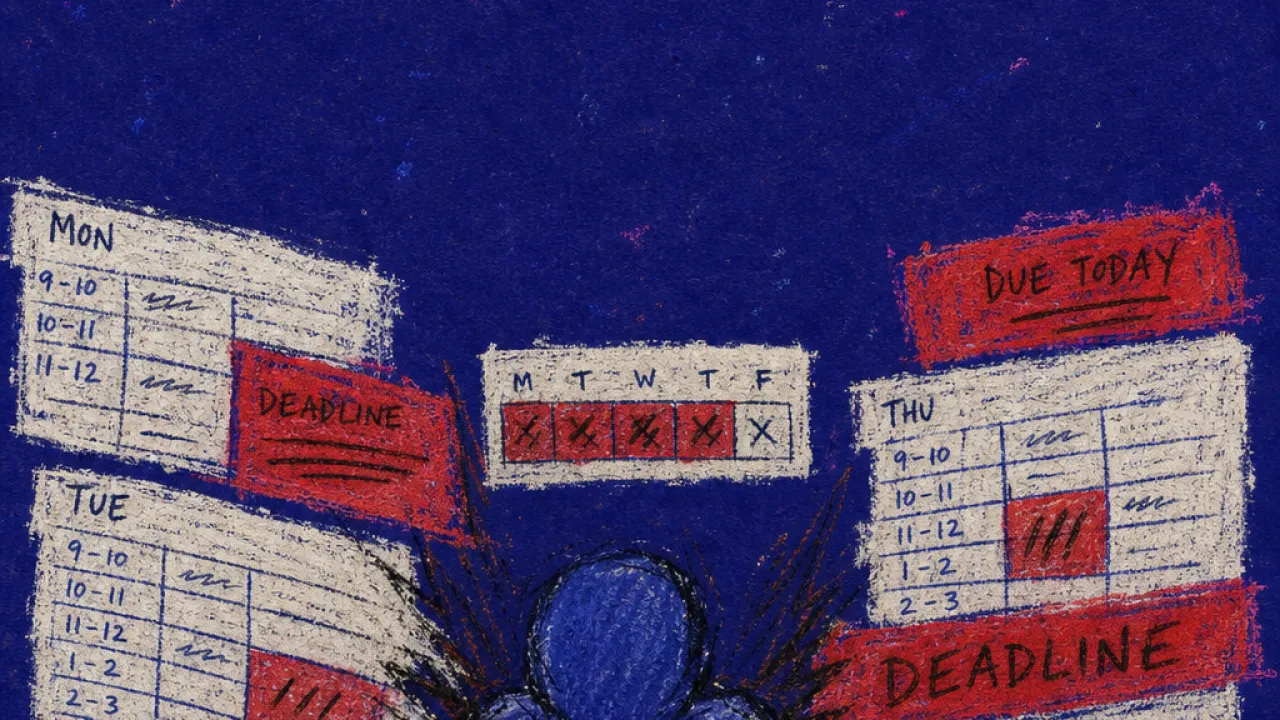
A solitary figure with shoulders drawn inward as calendar blocks and stacked pages press around the body in indigo space

What is this situation?

Reduced Course Load Crossroads — you start the term thinking you can carry the schedule you registered for, then the first two weeks turn into overlapping syllabi, lab times, discussion posts, group chats, and exam dates that all land on the same page. You open the campus portal between classes and see the add/drop deadline sitting there like a gate: keep the full load and risk falling behind in every class, or reduce the credits and deal with the chain reaction that follows. One professor says the missed quiz cannot be made up, another says the group project depends on your section, an advisor asks you to book an appointment before the deadline, and financial aid, housing, scholarship, or graduation rules sit in separate tabs with language that sounds clear until you try to apply it to your life. The power of the situation is that every office owns one part of the answer, but you are the one expected to assemble the whole map while lectures keep happening and assignments keep stacking. Your days become a rotation of email threads, course pages, calendar blocks, and mental arithmetic: what counts as full-time, what happens if you drop below it, which class is salvageable, which one is pulling the rest under. By the time you sit with the form, your neck is tight from staring at the screen, and the choice no longer feels like one clean academic adjustment; it feels like holding two sharp options across your chest, much like the blindfolded figure on the Two of Swords, seated at the edge of water with no easy path opening in front of her.

Why it's not you?

The issue is not that you cannot handle college or uni; the issue is that the system turns a course decision into a stack of policy consequences. Deadlines, credit minimums, aid rules, prerequisites, and office-specific answers make this crossroads heavy before you even choose. This is an institutional bottleneck, not a personal failure.

Reduced Course Load Crossroads in Tarot Cards

In a Reduced Course Load Crossroads, the pressure comes from policies, deadlines, and overlapping classes all asking for a decision before the semester has settled. The tightness in your neck at the portal screen is the body-level signal that this is more than a simple schedule tweak. It is an environmental, structural dynamic built from credit rules, grading calendars, and consequences arriving from different offices at once. The Tarot Cards below reflect the shape of that crossroads without telling you which option to choose.

The Hierophant
Upright
The robed authority sits between pillars while two students face him and crossed keys rest at the threshold. This institutional scene mirrors the adviser appointments, faculty rules, and office-specific permissions that determine how a reduced load is classified. The upright structure indicates that authorised knowledge and procedural access do exist, but they are channelled through defined roles. You are being asked to assemble guidance from a system that recognises separate jurisdictions more readily than it recognises the whole lived impact of the decision.
The Chariot
Reversed
The armoured driver stands in a stone chariot between two sphinxes facing with different energies, and no visible reins coordinate them. Reversed, the vehicle reflects a degree plan pulled between full-time status, actual learning capacity, financial conditions, and the expected graduation schedule. The blocked route does not mean the destination has disappeared. You are encountering a steering problem created by competing institutional demands, where reducing speed may alter the timetable but maintaining the current configuration may prevent meaningful forward movement altogether.
Wheel of Fortune
Upright
The central wheel turns while figures rise and descend around its rim and four observers hold open books at the corners. The image mirrors a term calendar in which course status, refund rules, transcript treatment, and approval requirements change as the add/drop phase rotates into the next administrative stage. The upright motion makes the present window usable but temporary. You are not choosing in timeless conditions; you are evaluating workload while the institution is actively changing which exits remain available and what each exit will cost.
Justice
Upright
The scales, sword, and square-seated authority form a scene of formal evaluation rather than informal preference. They mirror a university system in which the academic merit of dropping a course must be reconciled with written thresholds controlled by separate departments. The upright card makes records, criteria, and explicit consequences available as resources, even when they are fragmented. You are carrying the integration work that the institution has distributed, which explains why the administrative decision is consuming attention that would otherwise support learning.
The Hanged Man
Upright
The figure hangs by one ankle from a living wooden frame, with one leg folded and a halo around his head. The suspension mirrors a possible reduction in academic pace, while the stable frame reflects the degree structure that remains even if one course is postponed. The upright pause makes a different view of progress accessible: speed, credit count, and successful continuation are not necessarily the same measure. You are confronting whether a bounded delay can protect the wider academic path more effectively than maintaining a timetable that is already pulling every class under.
The Devil
Upright
The two figures are chained to a pedestal beneath an imposing authority, yet the loops around their necks are visible and not fused to their bodies. Those chains mirror the policy links connecting course credits to aid, housing, scholarships, prerequisites, and the social status of being a full-time student. The upright card makes the attachment points concrete, which prevents the predicament from being reduced to weak will or poor planning. You are encountering institutional lock-in: dropping one class may release workload while simultaneously threatening resources that the academic system has made conditional on staying enrolled at a particular level.
The Moon
Upright
The winding path runs between two towers under reflected moonlight, while a dog, a wolf, and a creature emerging from the water respond differently to the same uncertain landscape. The scene mirrors separate offices interpreting one course change from different institutional positions, leaving you with partial answers rather than a unified map. The upright path remains present even though its later stages cannot yet be seen. You are deciding under policy ambiguity, where uncertainty is produced by fragmented authority and a closing deadline rather than by an inability to recognise your own workload.
Judgement
Reversed
The angel's trumpet sounds above figures rising from open coffins toward a formal call. Reversed, that public summons has no secure landing and mirrors the way an add/drop form can become an internal verdict about whether you count as a capable or legitimate student. The blocked response reveals a category error between academic identity and administrative load. You are facing a system that measures progress through credit thresholds, while the actual crossroads concerns whether the present configuration supports learning, resources, and continued movement through the degree.
Two of Pentacles
Reversed
The juggler's pentacles are bound into a continuous loop while the ships behind him navigate an uneven sea. Reversed, the image reflects courses that never stop circulating through the portal even when the available study time can no longer stabilise them. The blocked rhythm clarifies why catching up in one class can immediately create a deficit in another. You are not facing one difficult assignment; you are facing a portfolio-level capacity mismatch in which the full load prevents sustained knowledge absorption across every active course.
Four of Pentacles
Upright
The seated figure presses one pentacle to his chest, balances another on his head, and pins two beneath his feet while the city stands behind him. The posture mirrors holding tightly to every credit because full-time classification may protect aid, housing, scholarships, prerequisites, or a planned graduation date. The upright card shows that something real is being preserved, but it also makes the cost of immobility visible. You are weighing whether retaining institutional security through the full load leaves enough flexibility to learn, recover, and keep the wider degree plan viable.
Two of Swords
Upright
The blindfolded figure holds two swords across her chest while water and distant land remain behind her. The crossed blades mirror the two sharp options on the portal, while the blindfold reflects how separate offices hold different pieces of the consequence map and leave you to decide without a single authoritative view. The upright scene contains a real decision structure rather than a verdict that both paths are doomed. You can see that the conflict is not evidence that you cannot handle university; it is the friction of comparing workload capacity against institutional thresholds before a fixed gate closes.
Eight of Swords
Upright
The blindfolded and bound figure stands inside a loose enclosure of swords, with open ground between some blades and a distant structure behind her. The image mirrors a student surrounded by credit minimums, deadline rules, group dependencies, and financial conditions that make movement feel materially dangerous. The upright scene acknowledges genuine restriction while preserving the fact that the swords do not form a sealed wall. You may have fewer workable choices than the portal implies, but the bottleneck comes from incomplete policy visibility and linked consequences rather than from personal incapacity.
Nine of Swords
Upright
The figure sits upright in bed with her face covered while nine swords remain mounted across the dark wall. The scene mirrors the course portal, policy tabs, unanswered messages, and deadline calculations continuing to occupy mental space after there is no further administrative action available that night. The upright image gives the pressure a visible external architecture: the swords are present and countable rather than fused with the figure. You are carrying a finite set of unresolved institutional questions, but their accumulation can feel like a total verdict on your ability when the system leaves every consequence open at once.
Five of Wands
Upright
Five figures raise staffs that cross in the same crowded space, with no central coordinator establishing order. The scene mirrors separate professors, course pages, and group chats placing valid demands onto one calendar without accounting for the other classes already there. The upright conflict is visible and active rather than hidden, which makes the source of the overload identifiable. You are dealing with a coordination failure across courses, not a private deficit in motivation, and the reduced-load question emerges from that system-wide collision.
Eight of Wands
Reversed
Eight staffs cross the open sky in rapid parallel motion above a river and distant buildings. Reversed, their movement becomes poorly coordinated, mirroring assignments, office replies, appointment availability, and the add/drop cutoff arriving on incompatible timelines. The blocked motion is not simple procrastination; it is a response system that cannot deliver a complete answer at the speed demanded by its own deadline. You are caught between waiting for essential policy information and preserving the final moment when the portal still permits a change.
Ten of Wands
Upright
The ten wands are carried as one dense stack, forcing the figure to lean forward while his destination remains only partly visible. The image mirrors a term in which every class looks manageable in isolation but becomes obstructive when quizzes, labs, posts, and group obligations occupy the same calendar. The upright movement shows that effort and academic engagement are still present. You are encountering the structural limit of cumulative load, where preserving every registration can reduce actual learning across the whole schedule and turn progress into burden management.

Reduced Course Load Crossroads in Tarot Card Reading Insights

When the question is whether to drop, pause, or keep pushing through, people often bring this same academic bind into readings. The section below moves from card patterns into how a Reduced Course Load Crossroads can appear inside a session. Explore the Tarot Reading Insights connected to this situation.