Stuck Between Full and Reduced Loads: Testing What Supports Learning

The 8:47 p.m. Course-Load Crossroads
I am Juniper Wilde, and I often meet a Toronto university student who keeps rebuilding the full-load and reduced-load versions of their term instead of registering. For Jordan, the registration-deadline banner on Quercus had stopped feeling like a reminder and started feeling like a verdict waiting to be delivered.
At 8:47 p.m. on a Sunday, Jordan sat in a small apartment with the course planner glowing blue across their laptop. The kettle clicked off and went cold beside them while the fan hummed; their thumb moved one class between two tabs, full schedule, reduced schedule, full again. The screen made their eyes ache, and the tightness in their chest arrived before either timetable was complete.
They had finished a demanding week with enough readings, messages, and deadlines checked off to justify pushing ahead, but not enough space to feel connected to what any of it meant. I asked what brought them in, and Jordan said, “I want the term to feel meaningful, not merely full. Why am I torn between a full load and slowing down?” They wanted momentum, yet slowing down seemed dangerously close to falling behind.
I heard the conflict as more than a timetable question. Jordan was holding two browser tabs open because closing either one felt like deleting a possible future, and the effort of holding both had become its own kind of exhaustion. I said, “You can want momentum and still have a capacity limit. We do not have to make the cards choose your life. Let us make a map of what each path is asking you to carry, and see what meaning needs in order to stay alive.”

Choosing the Compass: The Decision Cross
I invited Jordan to put the phone face down, take three unhurried breaths, and name the actual question once. I shuffled slowly while they watched the cards, treating the ritual as a transition from scrolling and comparison into focused observation, not as a supernatural test.
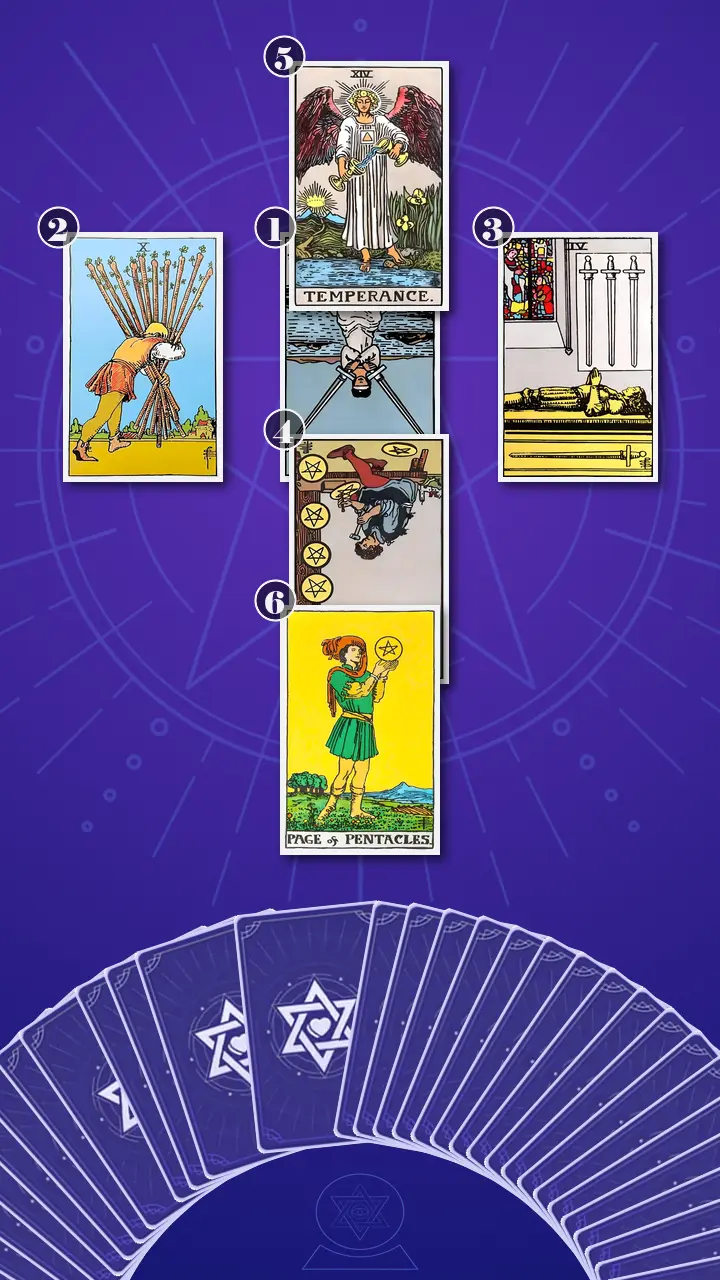
Today I would use the Decision Cross spread. For anyone wondering how tarot works in a course-load decision, this is a reflective comparison method: it gives two competing options equal room, then traces the hidden cost, the integrating principle, and one practical experiment. I read card meanings in context, not as fixed predictions. The cards can clarify patterns and criteria; Jordan remains the person with authority to choose, review, and change course.
The centre, position one, would reveal the observable decision loop. The left arm, position two, would explore what a full course load represents and demands, while the right arm, position three, would explore what slowing down could make possible. Below them, position four would uncover the hidden belief loading both options with emotional weight. Above the centre, position five would offer the balancing principle, and position six would bring the reading down into an observable next step.
I chose this six-card layout because the question was explicitly a two-path trade-off. A Celtic Cross could have expanded the history, but it might have invited another round of analysis. The Decision Cross was more economical: enough structure to compare the full and reduced schedules, expose the shared self-worth story, and finish with actionable advice rather than another pile of opinions.
Reading the Map: The Choice Behind the Choice
The Still Water Behind Two Open Tabs
First, I turned to the card whose position role was this: it reveals the observable decision loop: rebuilding both schedules, postponing commitment, and experiencing the Inner Conflict that keeps fulfillment static.
The card was the Two of Swords, in reversed position.
The blindfold and crossed swords looked exactly like the two course-planner tabs on Jordan’s laptop. On Sunday night, they kept a full-load schedule and a reduced-load schedule open side by side, moving one class between them while the registration deadline approached. Each tab represented a different story about the future, so more comparison felt safer than naming a personal capacity criterion. The reversed Two of Swords turned the frozen crossroads into a recognizable loop: uncertainty created more research, research created temporary relief, and the registration page remained untouched.
This was blocked Air, not a lack of intelligence. The blindfold protected Jordan from the immediate pain of choosing, but it also limited the view to two imagined futures. I asked what concrete fact would help them decide without demanding perfect certainty. I also asked them to finish two sentences: If I choose the full load, then... If I slow down, then... The unfinished endings mattered. Jordan was not only seeking information; they were using comparison to postpone a personal definition of enough.
Jordan gave a small, bitter laugh. “That is painfully accurate. I am not researching anymore; I am trying to avoid being wrong.” I told them the card was not accusing them of weakness. It was showing the short-term relief created by keeping both options open, and the longer stagnation that relief maintained.
Their fingers stopped moving over the trackpad. They looked from the cooling kettle to the untouched registration page, then rubbed one thumb along the edge of their phone. The laugh had loosened the first layer of defence, but the weight in their chest was still there.
The Backpack That Hid the Destination
Next, I turned to the card whose position role was this: it explores what a full course load represents and demands: the pull toward visible progress, momentum, and the fear of falling behind identified in the underlying psychological pattern.
The card was the Ten of Wands, in upright position.
The bundled wands became every class, reading list, deadline, commute, meal, and ordinary responsibility Jordan was trying to carry at once. The full-load path looked like a packed Google Calendar with every available block coloured in. Like the bent figure carrying the wands toward a town they could barely see, Jordan could point to the workload as proof of momentum while losing sight of whether the destination still felt meaningful.
This was Fire in excess. The commitment was genuine, and the desire to keep moving was real, but endurance had become the visible evidence Jordan expected to submit as proof of progress. I asked, “When you picture a demanding Wednesday under the full load, what does that schedule promise you, and what would it demand from your sleep, attention, and connection to the work?”
Jordan’s shoulders rose before they answered. Their eyes moved to the calendar, where the density of colour looked impressive from a distance. I said, “A full calendar can show how much you are carrying; it cannot, by itself, show what the term means to you.” Jordan nodded, though their hand remained curled around the phone as if putting it down might release too much at once.
The Evening That Looked Suspiciously Empty
Then I turned to the card whose position role was this: it explores what slowing down this term could make possible: space for clarity and fulfillment, alongside the guilt and self-worth story attached to a reduced pace.
The card was the Four of Swords, in upright position.
The reclining figure translated into a protected evening with no scheduled study block. The three swords displayed above the figure kept thought present, while the single sword below suggested that intention had not disappeared simply because immediate performance had paused. In modern life, this could be one quiet night with warm food, an unhurried shower, or enough room to notice whether a class still felt alive after the pressure to produce had eased.
This was a deliberate pause, not a command to slow down and not a moral argument against a full course load. A reduced schedule might create useful space, but that space would only become meaningful if Jordan used it to observe capacity and engagement rather than turning it into another identity test. I asked, “If an open evening did not mean that you were falling behind, what might you notice in it?”
Jordan took a longer breath. Their jaw softened for a moment, then tightened again when they imagined classmates’ packed calendars. I could see the two truths standing beside each other: the open space might restore attention, and the guilt might still arrive when the space became visible.
The Hidden Grade Beneath Every Task
At position four, I turned to the card whose position role was this: it uncovers the hidden belief and fear that keep the choice emotionally loaded, especially the idea that workload proves worth and that uncertainty must be solved before action.
The card was the Eight of Pentacles, in reversed position.
The solitary worker at the bench and the repeated pentacles behind them looked like Jordan’s repeated schedule revisions and task counts. Beneath both workload options was a study pattern that could turn effort into a self-worth score. Jordan added another study block, checked another task, and reread work past the point of usefulness, yet could not always name what had felt meaningful that day. A full schedule could intensify mechanical output, while a reduced schedule could still feel empty if fulfillment was never observed directly.
This was blocked Earth. Practice had become disconnected from satisfaction, and perfectionism was keeping the question of meaning out of reach. I said, “Do not make one term carry the job of proving your worth.” The sentence landed more heavily than I expected. It named the hidden bargain: if Jordan could carry enough, perhaps they would finally feel safe about their future; if they could not, the workload might be treated as evidence against them.
As an artist, I know what it means to stay in a painful scene too long because finishing it feels like admitting that the scene mattered. I saw the same impulse in Jordan’s planning. They were trying to perfect the schedule before allowing themselves to enter the term. Their eyes went unfocused, as though a familiar Sunday night were replaying behind them, and then they wrote one word in the margin of the planner: meaning.
When Temperance Mixed the Two Futures
The Bridge Between Ambition and Capacity
The room became quieter as I reached above the centre of the spread. I turned to the card whose position role was this: it names the balancing criterion that challenges the all-or-nothing frame and supports the key shift from maximum enrollment to a sustainable way of engaging with the term.
The card was Temperance, in upright position. This was the Bridge, the catalyst of the reading. Its invoked energy was measured pacing, self-trust, patience, and the ability to integrate ambition with available capacity. The angel poured between two cups, with one foot on land and one in water. Nothing in the image demanded that one element defeat the other.
I translated the two cups into two Google Calendar views. Ambition and capacity were not enemies; they were inputs that could be reviewed together. The question was no longer which schedule proved the most. It became which arrangement created the conditions for meaningful engagement with learning. I heard Jordan say, almost under their breath, “Maybe I do not need one option to cancel out the other.”
At this point I used my signature diagnostic lens, Narrative Fork Analysis. I treated the full-load and reduced-load options as competing plotlines rather than competing identities. The full-load plotline might tell a story of visible momentum and impressive endurance. The reduced-load plotline might tell a story of making room for attention and fulfillment. Neither plotline was automatically the authentic one. I asked which one genuinely served Jordan’s ultimate character-growth arc, and what evidence would show that on an ordinary week.
Then I applied Safe-Choice Sabotage Recognition. A seemingly logical option can sometimes be a defence mechanism that avoids the necessary inciting incident. Taking the full load could protect Jordan from the fear that slowing down meant falling behind. Slowing down could also become avoidance if it were chosen without any plan to reconnect with meaningful learning. The useful question was not Which choice is safest? It was Which choice lets me enter the next honest scene and observe what happens?
The Sentence That Changed the Question
I asked Jordan to picture Sunday night again: two course schedules open, the kettle cold, a thumb switching tabs, and the deadline drawing closer. The problem was not a lack of ambition. It was trying to make one workload prove that the future was safe, the choice was perfect, and Jordan’s worth was intact.
A workload can describe your current capacity without passing judgment on your worth. Meaningful progress is the pace at which you can stay in contact with the learning, not the number of courses that makes your calendar look impressive.
You do not need to force a binary verdict to prove that you are moving forward; like Temperance blending two cups, combine ambition with a sustainable pace and let direct experience clarify what fulfillment requires.
Jordan’s thumb froze above the phone. Their breath stopped halfway in, and the muscles around their mouth tightened as if they had been caught trying to cheat an exam. For a few seconds, their eyes stayed on Temperance but did not seem to see the card; I could almost feel the old Sunday-night tabs reopening behind them. Then their fingers curled around the phone. “But if I have already spent weeks trying to get this right, does that mean I was wrong?” they asked, with a flash of anger that was really grief for the certainty they had wanted. I told them no. It meant the decision had been carrying an impossible job. Their fist loosened, their shoulders dropped, and a long breath left their chest with a small, unsteady ah. The refrigerator clicked off, and the apartment became quiet enough for that breath to be heard. I invited them to set a ten-minute timer, write one capacity criterion and one meaningful-engagement criterion, and compare both schedules once. “Now,” I said, “use this new perspective to remember last week. Was there a moment when this distinction might have changed how the choice felt?”
Jordan saved the sentence in their phone before answering. This was the first movement from workload-based guilt, peer comparison, and decision paralysis toward capacity-based self-trust and meaningful academic progress. The cards had not selected a term. They had helped Jordan separate a practical workload choice from the identity verdict attached to it.
One Pentacle, Not the Whole Future
Finally, I turned to the card whose position role was this: it translates the insight into a small, observable next experiment for testing capacity and fulfillment without asking the cards to decide for Jordan.
The card was the Page of Pentacles, in upright position.
The Page held one pentacle at eye level and looked at it carefully, surrounded by a cultivated field. This was grounded Earth restored. The whole term did not need to be judged in advance. Jordan could observe one course session, one study block, or the effect of one open evening, then record what happened to energy, attention, and meaningful connection.
I asked, “What is one real part of the term you could observe this week, and when would you feel ready to review what that experience actually showed you?” Jordan wrote down a seminar and a review date. Their handwriting was still uneven, but the pen was moving in one direction now.
From Enrollment Proof to a Workable Week
When I placed the cards back into their cross, the story became clear without becoming absolute. The reversed Two of Swords showed the browser-tab loop and the temporary relief of not choosing. The Ten of Wands showed why a full course load looked like visible progress, while the Four of Swords showed that a reduced course load could create room for attention without erasing ambition. The reversed Eight of Pentacles revealed the shared root: both plans had been asked to prove worth and guarantee fulfillment. Temperance offered proportion, and the Page of Pentacles made that proportion testable.
The blind spot was not that Jordan lacked enough information. It was that they were treating enrollment as a referendum on who they would become. The key shift was from proving progress through maximum enrollment to testing which workload allowed sustainable engagement with learning and fulfillment. That did not mean a full load was wrong, and it did not make slowing down automatically wiser. It meant the decision could be reviewed against capacity, engagement, and meaning instead of against classmates’ pace or an imagined standard of worth.
I gave Jordan the pen back in the form of my Protagonist Pivot Action, a 24-hour creative mandate. The point was not to force the most comfortable plotline. It was to complete one micro-action aligned with the most daunting yet authentic plotline: letting lived evidence matter more than perfect certainty. The next steps were intentionally small.
- Write My Workable TermWithin the next 24 hours, open a private note on the phone before reopening the registration portal. Write one capacity criterion, such as realistic room for sleep, meals, commuting, or recovery, and one engagement criterion, such as enough attention to participate meaningfully in one class. Compare the full-load and reduced-load schedules against those two criteria once, for ten minutes, and then stop.This is an observation tool, not a final commitment. If ten minutes feels too exposed, make a five-minute version or begin with one sentence: A workable week would leave room for...
- Run the One-Pentacle Evidence LogChoose one course, project, or ordinary study session and observe it for one week. Afterward, record three quick signals in the phone: energy before, engagement during, and how connected the work felt afterward. Set one review point on the same day the following week and compare lived evidence with what each schedule promised.Keep the log to three words or one sentence so it does not become another productivity test. If the session does not happen, record that as information rather than failure.
- Close the Comparison LoopFor one day, mute or hide three academic-calendar, internship, or productivity triggers on Instagram, TikTok, LinkedIn, or a group chat. Keep one schedule as the working version and move the other into an archive folder. When the urge to reopen both returns, write the question underneath the urge and check whether the two personal criteria already address it.Return to the decision at the planned review point, not every time uncertainty asks for reassurance. A boundary around comparison is a way to protect attention, not a promise that doubt will never return.

A Smaller Measure of Moving Forward
Five days later, Jordan texted: “I used the two criteria, kept the schedule with a recovery margin, and logged one seminar. I slept through the night, then woke thinking, What if I am wrong? I checked the review date instead of reopening every tab.”
I held onto the smallness of that message. Jordan had not solved the future or turned uncertainty into a clean success story. They had made a capacity-based choice, gathered evidence, and left room to revise it. The remaining question no longer sounded like a courtroom sentence. It sounded like something a curious person could investigate.
That was Jordan’s first evidence of the Journey to Clarity. The Decision Cross had not predicted the correct course load; it had helped Jordan notice the difference between carrying more and staying meaningfully connected to what they were learning. The authority had remained where it belonged, with the person living the term.
When the course planner leaves your chest tight and the fullest schedule starts to look like the only proof that you count as moving forward, remember that you can still want momentum while asking for enough room to feel why you are moving. Even noticing that tension is a small mark of self-trust.
If this term did not have to prove your worth, what small sign of meaningful engagement would you be curious to notice in one ordinary week, perhaps by holding one pentacle of evidence instead of reopening both tabs?