Refusing a Lighter Course Load: From Proving Worth to Learning Well

When a Lighter Course Load Feels Like a Verdict
If you are an undergrad in Toronto who has calculated three times that there are not enough hours for your course load, but still treats the withdrawal button like a verdict on your intelligence, I know the scene before you explain it. When Maya (name changed for privacy) came to my reading, I watched her open the course-change portal beside a colour-coded Google Calendar and then leave both untouched.
It was 11:40 p.m. on a Tuesday on the silent floor of a campus library. Fluorescent lights hummed above us; the laptop fan pushed warm air across her wrists, and her eyes had the bright, stinging look of someone who had reread the same paragraph without keeping it. I watched her add two 7:00 a.m. study blocks, close the withdrawal page, and return to an assignment she was too tired to absorb.
I heard the contradiction clearly: Maya wanted the relief and deeper focus of a lighter course load, but feared that accepting it would disprove her competence. She had five courses registered, several deadlines converging, and a calendar packed so tightly that the blocks looked like bundled staves in front of her face. She wanted more space to learn, but she also needed the crowded schedule to prove she deserved the space she occupied.
Her performance anxiety did not arrive as a vague mood. It lived in a tight jaw, raised shoulders, shallow breaths, tired eyes, and the metallic aftertaste of cold tea. Beneath the planning were shame, defensiveness, and exhaustion, all braided into one thought: if I were genuinely capable, I would be able to make this work. I placed my hand flat on the table, not on the cards, and said, It makes sense that this feels loaded. We do not have to decide your future tonight. Let us use the cards to draw a map of the meaning attached to this choice, so you can decide from clearer ground.

Choosing a Map for the Question Beneath the Question
I asked Maya to take three ordinary breaths and name the question without trying to make it sound organised. Then I shuffled slowly. The preparation was not a supernatural test; it was a small transition from defending a position to observing one. I wanted her attention in the room, in her body, and in the actual question: What am I trying to prove by refusing a lighter course load?
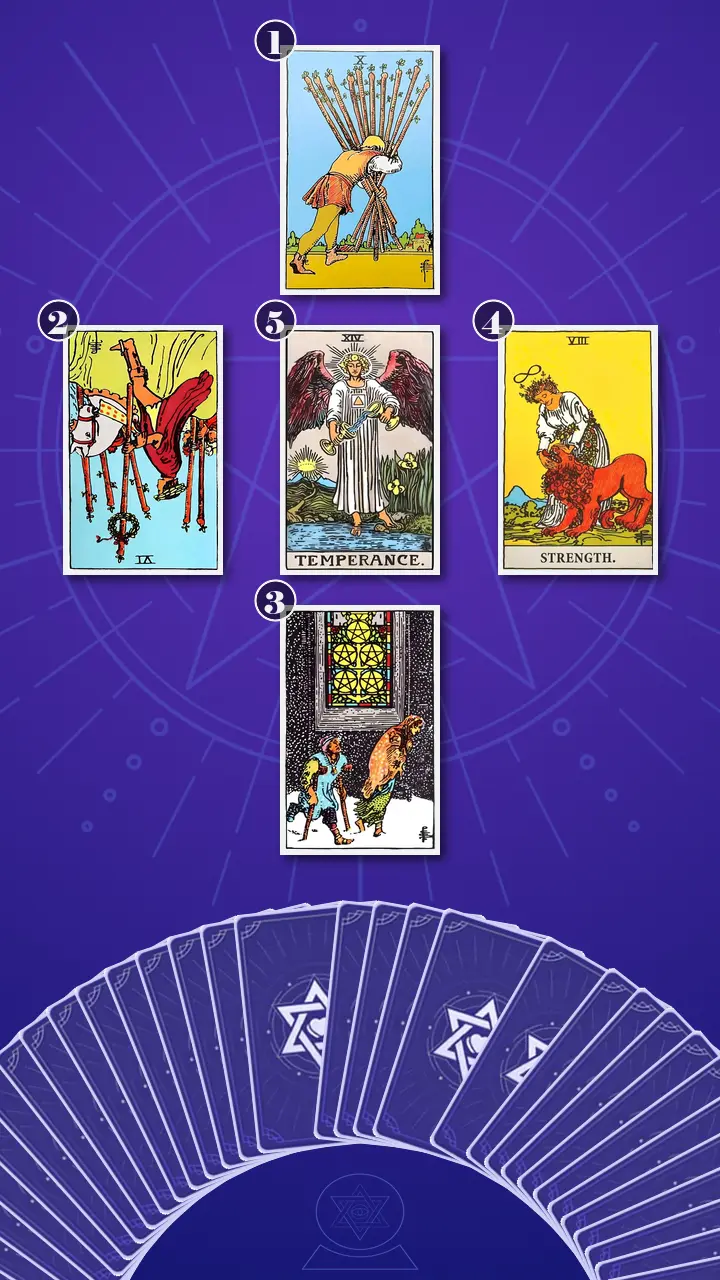
For this reading, I chose the five-position Shadow Spread. A conventional decision spread could compare the apparent pros and cons of a full and reduced schedule, but it might miss why one practical adjustment had begun to feel like an identity threat. The Shadow Spread is useful here because it follows a symptom-to-root-to-resource-to-action chain: it shows the visible overloading behaviour, the hidden need for recognition, the fear that overwork protects, the strength available beneath that fear, and the practice that can bring the insight into everyday course planning.
I explained the structure to Maya and to anyone reading along with us. The first position would reveal the presenting symptom: the behaviour already visible in the crowded calendar. The second would expose what the refusal was trying to prove. The third would name the vulnerable fear underneath. The fourth would reclaim a constructive form of strength. The centre would integrate everything into a practical way to review the course-load crossroads. I placed the cards in a cross, with Temperance waiting at the centre, where four points of pressure would eventually have to meet.
Tarot works best in a conversation like this as a reflective language, not as an authority that makes a registration decision for someone. The cards could help Maya notice a pattern, test a belief, and ask better questions. They could not tell her what her university policy meant, replace an academic adviser, or turn one semester into a fixed statement about her ability.
The Calendar With No White Space
The Ten of Wands and the Burden Blocking the View
Now I turned over the card for the position that reveals the presenting symptom: retaining every course, overloading the calendar, and carrying the schedule as visible evidence of capability.
It was the Ten of Wands, upright. In this context, its modern scene was precise: Maya was in the library at 11:40 p.m. with five courses still registered, several deadlines stacked into the same week, and a calendar so full that she could no longer see where focused learning could happen. She responded to visible overload by adding early-morning blocks, so carrying the schedule became the achievement even while the burden fragmented the attention the courses required.
The upright energy was not a lack of effort. It was effort in excess, a Fire that had become contracted around proof. The bundled staves blocked the figure's view in the card, just as Maya's edge-to-edge Google Calendar blocked her view of the purpose of studying. I asked her to notice the difference between carrying a lot and learning well. A full load might be a valid choice; the card was asking whether the weight had become evidence she felt compelled to display.
I used the inner sequence I often hear in this pattern: I can carry it. Carrying it proves I belong. I no longer have enough attention to see what I am learning. Endurance can look like competence while quietly reducing mastery. The issue was not that Maya was too ambitious. It was that ambition had been assigned the job of hiding a capacity problem.
Maya gave a short, bitter laugh. I saw her thumb stop moving against the edge of her phone, and then I saw her glance toward the calendar as if it had just become evidence in a case she had been building against herself. That is uncomfortably specific, she said. I keep moving the same reading instead of admitting the hours do not fit.
I nodded and kept my voice level. That response matters. We can respect your ambition without asking it to carry every course, every deadline, and your entire self-worth in one bundle.
The Reversed Six of Wands and the Badge No One Can See
Now I turned over the card for the position that exposes what the refusal is trying to prove: that Maya deserves recognition and can preserve self-respect only by appearing able to manage the full load.
The card was the Six of Wands, reversed. I brought in the scene I had heard from her week: at 2:15 p.m. outside a tutorial room, a classmate casually listed five courses, an internship, and a society role. Maya laughed and said, Same, it is hectic but fine, while her shoulders rose toward her ears. On the TTC home, she opened the course portal not to assess what she was learning, but to reassure herself that her course count still placed her among the students who appeared to be keeping up.
The rider, wreath, and crowd of the Six of Wands had become an imagined audience around Maya's student portal. Reversed, the public badge no longer supplied stable confidence. It gave her a few minutes of relief, followed by another comparison: a polished #StudyTok routine, a LinkedIn achievement post, a group-chat message about surviving five courses, or a university subreddit thread asking whether the workload was manageable. The full load had become a badge, but badges cannot measure attention.
Here the energy was a deficiency in inward recognition and an excess of public checking. I asked, Who is imagined to be watching when you consider a reduced schedule? Then I asked the more practical question: If no classmate, tutor, or future employer could see the number of courses you took at once, what would count as competence today?
Maya's jaw tightened again. She looked toward the window, went quiet, and pressed her tongue against her teeth. I could see the defensiveness arrive before the words. I want a workload that fits, she said, but I need my workload to look unimpeachable. If I drop one, people might decide I could not keep up.
I let the silence hold for a moment. That is the shadow motive, not a verdict about your character. We are separating public legibility from private evidence. Competence might be the ability to explain one core concept without notes, complete thoughtful work without an all-nighter, or participate with enough attention to remember what you actually studied.
The Five of Pentacles and the Door She Thought Was Closed
Now I turned over the card for the position that reveals the underlying fear protected by overwork: that reducing the load would mean being less capable, less worthy, or outside the expected academic path.
The card was the Five of Pentacles, upright. I saw its modern scene in the dark kitchen of Maya's apartment two nights before the course-change deadline: rain ticking against the window, the radiator clicking, a notification vibrating on the table, and the withdrawal banner glowing blue on her laptop. She did not merely see fewer credits. She imagined standing outside the group of students who were capable, on schedule, and moving forward. The sentence underneath was painfully simple: If I need a different pace, maybe I was never one of the capable ones.
The card's cold path and injured gait represented felt scarcity and vulnerability, not a prophecy of actual exclusion. The illuminated window containing the five pentacles mattered just as much: support, academic belonging, advising, and alternative routes could be nearby while fear made them difficult to recognise. A reduced course load might have policy, funding, transcript, immigration, scholarship, or progression implications that required official information, but none of those facts should be guessed from a card or inflated into a judgment about worth.
I asked Maya to finish the sentence without editing it: If I submitted the lighter-load option tonight, this would mean I am... She began to answer, stopped, and looked down at her hands. For a few seconds, her breathing paused; then her eyes lost focus as if she were replaying every classmate's course count and every graduation timeline she had treated as a ranking. Finally, she let out a low, uneven breath and rubbed the space beneath her ribs.
Outside, she said. Not officially. Just... outside the version of university I thought I was supposed to be having.
I told her, A route change on the transit map is not removal from the whole network. You would still be a student, still learning, still able to make an informed decision about your pace. The fear is real as an experience, but it is not proof that the feared exclusion is real.
When Strength Met the Lion Without a Crowd
The Quiet Authority of Strength
The room grew still when I reached the fourth position. I turned over the card for the position that reclaims the resource hidden inside the struggle by redefining strength as measured self-command rather than the forced acceleration of growth.
It was Strength, upright. The woman in the image does not defeat the lion by overpowering it. Her hands meet its jaws with steady contact, and the infinity symbol above her head suggests continuity rather than spectacle. For Maya, this became the moment before adding another early-morning study block: noticing the urge to make her capability impossible to question, naming both ambition and exhaustion, and using accurate capacity instead of force to decide what kind of challenge she could engage with well.
This is where I used my signature lens, Performance Anxiety Decoupling. I separated Maya's core self-worth from the number of registered courses, from peer comparisons, and from imagined mentor evaluations. Then I separated the academic question from the identity question. How many courses can I carry without losing sleep? is a capacity question. What would a lighter load prove about me? is a self-worth story. They can feel fused, but they are not the same fact.
At 11:40 p.m., the withdrawal page was still open while Maya added another early-morning block to a calendar that already had no white space. For a moment, planning felt safer than asking what the schedule was meant to support. The optimisation loop offered control, but it also postponed the one question that could change the meaning of the whole decision.
You do not have to prove competence by overpowering your limits; choose a sustainable level of challenge, as Strength guides the lion through steady contact rather than force.
For a second, Maya stopped breathing. Her fingers remained curled around the phone, suspended above the screen, while her face went completely still. I did not rush to fill the silence. I watched her eyes move from the card to the calendar, as if the two images were finally occupying the same frame. Her shoulders lowered by a fraction; then her hands opened against the table. A small tremor passed through her exhale, and her eyes grew bright, not with a dramatic release but with the shock of hearing an old rule described without contempt. But does that mean I have been doing it wrong? she asked, and there was anger beneath the fear. I said, No. It means the strategy may have protected you once, and you are allowed to update it now. Her mouth tightened, softened, and then she breathed out again, longer this time. Now use this new view to remember last week, I invited. Was there a moment when separating your worth from your workload might have let you respond differently?
Maya looked at the late-night reading she had carried from Monday to Tuesday, then at the two 7:00 a.m. blocks she had added as proof. I could have treated the lack of time as information instead of an accusation, she said. That was the first movement from performance anxiety, shame, and defensive overwork toward cautious self-trust grounded in realistic capacity and meaningful learning. It was not a final answer. It was a different measuring stick.
The Ambitious Part Does Not Need to Be Exiled
I asked Maya to place both feet on the floor. The ambitious part of me is real; the frightened part is real; neither has to insult the other, I said. Strength does not ask her to become less driven, mute every difficult feeling, or choose the lighter option automatically. It asks her to guide ambition with accurate information rather than making her body absorb an argument it never agreed to carry.
I told her about the way I had once watched people treat every difficult decision like a performance review, including myself in earlier work. I remembered the clean logic of a spreadsheet that could still conceal a human cost. A schedule can be optimised and remain unlivable. Evidence is kinder and more rigorous than a verdict.
The Two Cups That Let the Week Breathe
Temperance at the Centre of the Cross
Now I turned over the card at the centre, the position that integrates the reading into the course-load crossroads by asking Maya to choose and review a pace according to learning quality, capacity, and sustainability.
It was Temperance, upright. I translated the water moving between two cups into two visible schedule drafts: Current load and Lighter load. For each, Maya could record realistic weekly hours for lectures, commuting, paid or social commitments, sleep, and focused study. She could add one learning-quality measure beneath each option, such as being able to explain the week's central concept without notes or complete an assignment without an all-nighter.
Temperance carried balanced Water rather than passive moderation. It did not say that one schedule was destined to win. It asked Maya to allocate attention, observe the result, and adjust without turning the result into a grade on her character. Choose the pace that lets you meet the work, not just display it, I said. Which mix lets you attend, retain, participate, and recover?
Maya opened a blank note on her phone. The motion was small, but I recognised it: the first time that evening she had used a digital tool to gather evidence rather than build a defence. She wrote the headings down and stopped before trying to make the page beautiful.
Temperance also gave us a way to search responsibly. I reminded her to bring the two-column comparison to an academic adviser, registrar, or programme contact for the actual deadlines, fees, funding, transcript, and progression details. Tarot could clarify the emotional pattern; an institution could clarify the policy. Together, they could support a decision that belonged to Maya.
From Insight to Action: Two Schedules, No Character Verdict
When I held the five cards together, the story became coherent. The Ten of Wands showed effort arranged so densely that it blocked perspective. The reversed Six of Wands revealed why the burden remained: course volume had become a public badge for a private fear. The Five of Pentacles showed the deeper fear of being outside the capable group. Strength reclaimed ambition without letting it dominate, and Temperance gave that reclaimed strength a repeatable form.
Maya had been trying to force a flower open by pulling at its petals. She had interpreted pressure as evidence that growth was happening fast enough. The blind spot was not a lack of discipline; it was the assumption that the urge to optimise the calendar proved the calendar could work. It might instead be evidence that the identity question had taken over the practical one.
The key shift was clear: move from measuring competence by how much pressure you can tolerate to measuring it by how deliberately and effectively you can learn. Course volume is a workload setting, not a character reference. The Shadow Spread had not chosen a registration status for Maya. It had returned the decision to the person who would live inside its consequences.
I introduced my Inner-Critic Mute Protocol as the first action framework. It was not a command to silence ambition forever. It was a short pre-study exercise for interrupting performance anxiety long enough to collect objective information. We kept the next steps deliberately small.
- Run the seven-minute capacity checkBefore adding another study block at her desk, Maya would set a seven-minute phone timer, put both feet on the floor, and write two headings: Available attention and Registered demands. She would list only fixed weekly hours and the next major deadlines, without redesigning Google Calendar or Notion. Before the first line, she would complete: I am trying to protect myself from the possibility that...The minimum version is one fixed-hour estimate and one honest sentence. Stopping after seven minutes is allowed; naming capacity does not obligate Maya to reduce the load, disclose anything, or accept anyone else's judgment.
- Make the Two-Cup Schedule CalibrationWithin the week, Maya would spend no more than ten minutes making two columns labelled Current load and Lighter load. She would round realistic hours to the nearest hour, include sleep and commuting, add one observable learning measure to each option, and take the sheet to a 15- to 20-minute appointment with an academic adviser, registrar, or programme contact.She would review the evidence at a point already on her calendar, such as Friday at 4:00 p.m., recording hours studied, material retained, and sleep lost as information rather than a grade. Official academic, financial, immigration, scholarship, or accessibility effects should be checked with the relevant institution.
Maya looked at the list and then raised a practical objection. What if I cannot even find seven minutes? I already feel behind.
Then use the smallest version while the portal is open, I said. Three breaths, one sentence, one fixed-hour estimate. The exercise is not another performance to pass. It is a way to stop the inner critic from making a capacity decision through force.
I also suggested a 24-hour mute for one comparison source, such as a #StudyTok account, a LinkedIn feed, or a group chat that turned course counts into a leaderboard. If someone asked about her schedule, she could say, I am working out the pace that fits my learning goals, so I am not comparing course counts right now. Maya did not owe anyone a public explanation of her registration status.

A Quiet Proof of Learning
A week later, I received a message from Maya. She had made the two schedule columns, checked the official implications with an adviser, and chosen the option that gave her more focused time. The message did not sound triumphant; it sounded present. She had slept through one full night, and in the morning her first thought was still What if I am wrong? She smiled, made coffee, and opened one reading without rearranging her entire life.
That was the small proof I had hoped for: not that the decision had erased uncertainty, but that uncertainty no longer had automatic control of the calendar. Maya was beginning to evaluate her course load through attention, retention, participation, and sustainable engagement. She was learning to let evidence speak before comparison did.
Nothing in the cards forced that choice. The Ten of Wands helped her see the burden, the reversed Six of Wands helped her question the badge, the Five of Pentacles helped her name the fear, Strength helped her meet ambition without violence, and Temperance helped her build a reviewable plan. That was Maya's Journey to Clarity: not certainty handed down from a deck, but cautious self-trust built through a more honest conversation with herself.
When the course-withdrawal page is open and your jaw tightens before you touch a single button, the hardest part may not be choosing a workload; it may be fearing that the space you need will expose you as less worthy of belonging. I hope you remember that the space can also become the place where meaningful learning is finally visible to you.
If your capability did not need to be visible through maximum pressure, what small sign of deliberate learning would you be curious to notice this week: one concept you can explain without notes, one night of sleep, or one uncrowded square on your calendar?