The Sunday Portal Glow: When Returning to School Feels Like a Verdict
I knew the pattern as soon as Jordan appeared on my screen: their Sunday Scaries had begun with checking the same student-portal page, building another catch-up schedule, and still not contacting academic advising. This was not a lack of care. It was return-to-school paralysis after academic leave, where waiting for perfect readiness had turned one email into a test of capability and belonging.
At 2:16 p.m. in their Toronto apartment, Jordan sat at the kitchen table with the university return page open and a half-finished coffee cooling beside the laptop. Through my headphones, I heard the fan hum and the radiator click. Their phone glowed with a former classmate's new course schedule while their restless hands hovered over an Outlook draft.
“I keep thinking I'll email them when I feel like myself again,” they said. “But then I start wondering about course loads, deadlines, work shifts, the TTC commute, whether I'll fall behind again... and suddenly the email feels ridiculous. Like I should know all of that before I ask.”
At twenty-two, Jordan wanted the structure and momentum of university back. They also feared that returning before they felt fully recovered would expose an inability to cope, confirming the private suspicion that everyone else had moved forward while they had somehow lost their place. Apprehension sat under their sternum like a bass note played too loudly through a wall, vibrating through every ordinary administrative task until a simple question sounded like an alarm.
I watched them close one policy tab and immediately open another. “You're not avoiding school because you don't care,” I said. “You're making one email carry the weight of proving you can cope. I don't want the cards to decide whether you return. I want us to map what happens between wanting to return and becoming unable to press Send. Then we can look for a next step that belongs to you.”

Choosing the Lower Track on the Station Map
I invited Jordan to place both feet on the floor, take one unforced breath, and hold the practical question in mind: How do I return to school after taking academic leave? I shuffled slowly, using the pause as a transition from mental rehearsal into focused observation. Nothing about this needed to be mystical. The point was to give an overloaded mind a visible structure it could examine.
I chose the Transformation Path Grid (6) · Context Edition. A decision spread would have implied that Jordan needed to choose immediately between returning and staying away. A broad Celtic Cross could have scattered our attention across too many themes. This six-card tarot spread was better suited to academic re-entry anxiety because it could trace a specific self-reinforcing system: waiting, preparing, receiving temporary relief, gaining no new information, and then feeling even less ready.
For anyone wondering how tarot works in a situation like this, I use the cards as an objective pattern map, not a fixed prediction. Card meanings in context can give shape to habits, fears, resources, and choices that are already present. The cards do not own the route. Jordan does.
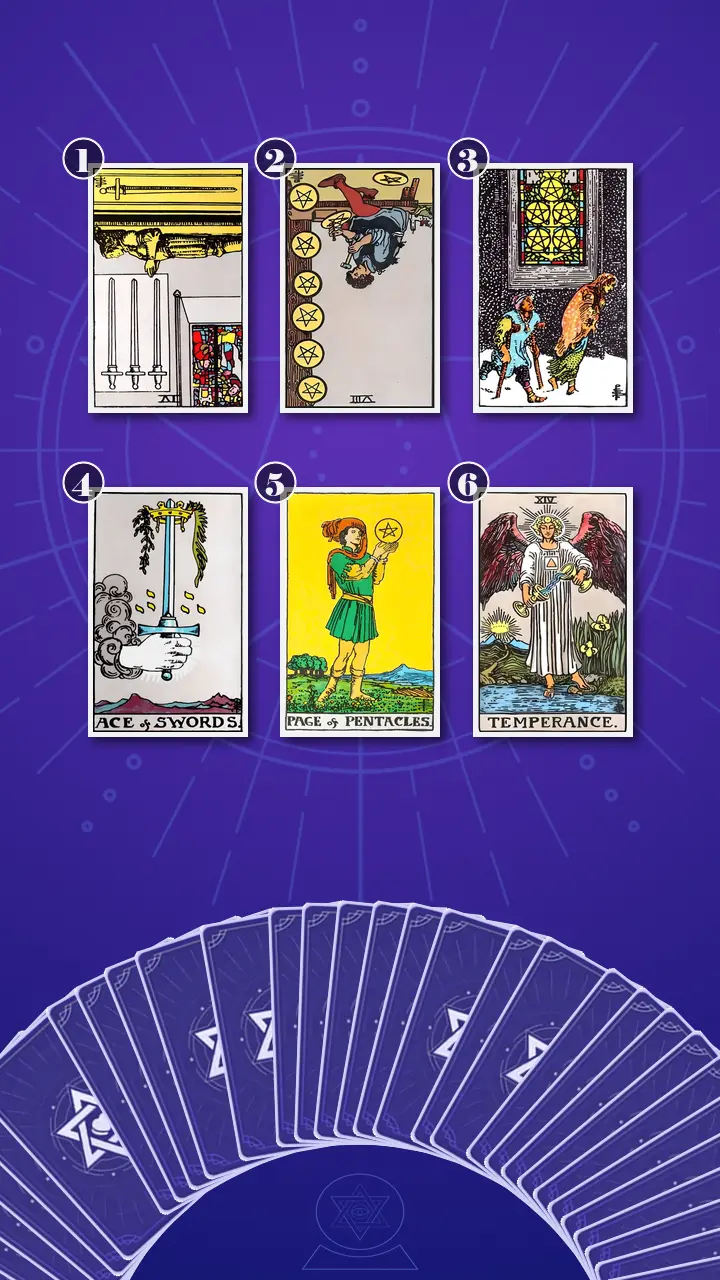
I arranged three cards across the top and three beneath them, like a TTC map with a stalled line and a lower track opening underneath. The upper row would show the visible delay, the blocking mechanism, and the underlying fear. The lower row would reveal a catalyst, a learner-sized action, and an integrated rhythm in which recovery and school did not have to compete for permission.
The Upper Track: Where Rest Became Rehearsal
Position 1: The Pause That Stopped Restoring
I turned the card representing Jordan's current pattern and visible symptom. It was the Four of Swords, reversed.
In its upright form, this card can represent deliberate retreat and recuperation. Reversed here, it showed a Blockage: a Deficiency of genuine restoration combined with an Excess of mental rehearsal. On Sunday afternoon, Jordan opened the return-to-school page, drafted an advisor message, and then closed the laptop to reorganize old lecture notes. The pause looked like rest from the outside, but the unanswered decision stayed active in their body. The portal tab had become like a browser tab left in sleep mode: technically available, quietly consuming energy, and never turning into a real route.
I pointed to the single sword beneath the resting figure. “The question hasn't disappeared during your leave. It has been lying underneath the pause. Waiting to feel completely recovered may protect you from immediate exposure, but it also keeps the return theoretical. What would a bounded step look like if it were allowed to exist beside genuine rest?”
Jordan's breath caught. Their fingers stopped against the coffee mug, their gaze drifted toward the open draft as if replaying several identical Sundays, and then a small, bitter laugh escaped. “That's so accurate it feels a little cruel.”
“The card isn't accusing you,” I said. “It's distinguishing rest from unresolved waiting. Taking leave was not the mistake. The question is whether the current form of waiting is still serving the recovery it was meant to protect.”
Position 2: The Notion Board Beside the Unsent Email
I turned the card representing the blocking mechanism: the way preparation had become a safer substitute for action. It was the Eight of Pentacles, reversed.
The modern scene was almost exact. Jordan could spend an evening formatting a color-coded return plan in Notion, watching study-strategy videos, renaming Google Drive folders by course code, and rebuilding a study system. The digital workbench looked busy, yet the advisor email remained unsent in the next browser tab. The reversed Earth energy showed an Excess of activity with a Deficiency of directional completion. Effort was real, but it was circulating inside a closed loop.
“Preparation can lower anxiety without moving the return forward,” I said. “Your inner monologue sounds like: I am doing everything except the thing that would give me information. The planning brings short-term relief because no vulnerable contact has happened. But without contact, the unknowns multiply, so the next planning session has even more material to organize.”
This was where I used what I call a Focus Disruption Audit. I asked Jordan to identify the dissonant chords that kept breaking the moment between intention and action. We found three: seeing a classmate's update, opening several policy pages at once, and deciding the email needed to explain the entire leave. Each chord shifted attention away from one answerable question and back toward the impossible project of proving total readiness.
Jordan rubbed their thumb over the edge of the mug. Their shoulders were still high, but their voice had softened. “The planning makes me feel responsible for about twenty minutes. Then I feel worse because nothing is actually different.”
“That distinction matters,” I replied. “The problem is not that you lack discipline. Your diligence has been recruited by avoidance. We do not need to destroy that diligence. We need to give it a smaller, clearer target.”
Position 3: The Warm Window Across the Snow
I turned the card representing the underlying fear beneath the practical delay. It was the Five of Pentacles, upright.
I asked Jordan to look at the two figures moving through the snow beneath an illuminated stained-glass window. The image echoed what happened when they saw former classmates posting internships, placements, course schedules, and graduation countdowns. Jordan could feel genuinely happy for them while imagining that everyone else had continued inside the academic community and that they alone no longer knew which door to use.
In this position, the card showed an Excess of imagined exclusion and a Deficiency of tested support. The fear was not irrational nonsense; taking leave had disrupted Jordan's sense of continuity and belonging. But the mind had converted that emotional gap into an unverified conclusion: If I need help finding the entrance, I must no longer belong inside.
“When you imagine walking back into class,” I asked, “what is the scene you fear most?”
Jordan's jaw tightened before they answered. “Someone asks where I've been. I don't know how much to say. Then I can't keep up, and everyone realizes I came back too early.”
I let the silence remain for a moment. “That explains why an administrative message feels emotionally enormous. You aren't only asking about deadlines. In your nervous system, you're approaching that lit window and waiting to learn whether the door is locked. But the actual university may have several doors, support desks, reduced course-load options, and people whose job is to explain them. Contact does not guarantee a particular path, but hiding the gap guarantees that your imagination has to supply every answer.”
When the Ace of Swords Changed the Question
Position 4: The Clear Sentence Inside the Fog
The laptop fan settled into silence just as I reached for the card representing the key catalyst. The room seemed to lose one layer of background noise. I turned over the Ace of Swords, upright.
Jordan was still caught in the belief that they had to make the correct return decision before they were allowed to ask for information. The Sunday scene compressed around that rule: the blue portal light, the classmate's update, the heavy limbs, the polished draft, and the hope that one more plan would make re-entry safe.
The Ace introduced clarified Air: not an Excess of explanations, but the Balance of one precise question. The hand in the card held the sword upright, transforming the inactive blade beneath the Four of Swords into an instrument of communication. I pictured the practical version beside it: after opening the registrar page and three policy tabs, Jordan could write, Could you tell me what steps, timelines, and course-load options are available for returning after academic leave?
My mind flashed to waveforms I had studied during ten years of sound-energy research. When a system is overloaded, adding more volume does not restore coherence; a clean reference tone can. I call this Cognitive Tempo Calibration. Jordan's mind had been demanding an instant jump from the irregular tempo of recovery to the full tempo of a semester. The Ace did not demand that leap. It offered one tuning note: ask for the facts before trying to perform the whole future.
You are not required to wait for perfect readiness, so take one truthful, bounded step and let the Ace of Swords separate concrete facts from imagined verdicts.
I left the sentence in the quiet between us. Then I added, “A question is not a confession, and information is not a verdict. You do not need a full recovery verdict to ask one clear question. You also do not owe an advisor your complete personal history in the first message. You can ask about options, request a meeting, ask about privacy, save the draft, or decide that today is not the day to send it. The point is to let information become available without turning contact into a promise.”
Jordan's breathing stopped for a beat. Their fingers remained suspended above the keyboard, and their eyes lost focus as if the last several weeks were replaying behind the screen. Their pupils widened; then their eyebrows drew together, and a quick flash of anger crossed their face. “But doesn't that mean I've wasted all this time making plans when I could have just asked?” Their voice was sharper than before, then cracked at the final word. They folded their arms, unfolded them, and pressed both palms flat against the table. I watched their shoulders descend by a fraction. Their eyes reddened, not with dramatic relief but with the sting of seeing how hard they had worked to avoid feeling exposed. A long breath left their chest. For a second they looked lighter and almost disoriented, as though clarity had removed a heavy backpack and left them unsure how to stand without it.
“It means the planning was trying to protect you,” I said. “Now you have better information about what it protects you from. That is not wasted time, and it is not proof that you were wrong. It is evidence that the strategy has reached its limit.”
I invited them back into a real memory. “Now, using this new perspective, think about last week. Was there a moment when knowing that a question was not a verdict might have changed how the situation felt?”
Jordan looked toward the portal. “During my break at work. I was checking my rota, my bank balance, and the course page like I had to solve all three by myself. I could have asked whether a reduced course load was even an option before designing the rest of my life around a guess.”
I nodded. That recognition marked the first real movement from stagnant, shame-tinged waiting toward fact-based clarity, learner-sized momentum, and balanced self-trust. It did not settle whether Jordan would return this term, later, through a different program, or at all. It restored their ability to investigate those possibilities without treating uncertainty as a verdict on their worth.
The Learner, the Two Cups, and a Pace That Could Bend
Position 5: One Pentacle, Not an Entire Semester
I turned the card representing the action bridge: one practical, bounded learning or administrative step Jordan could test while continuing recovery. It was the Page of Pentacles, upright.
The Page held a single pentacle at eye level. In Jordan's life, that pentacle could be one course outline, one re-enrollment form, one advisor response, or one twenty-minute study block. It was not a demand to rebuild an entire academic identity overnight. The card's Earth energy was in Balance: focused, curious, limited, and willing to learn from actual experience.
“Make the first step learner-sized, not identity-sized,” I said. “A twenty-minute review is not a declaration that you're ready for a full course load. It is an experiment that may tell you what concentration feels like now, what support you might need, and where your current limits are. Beginner status is not evidence of failure. It is an honest role within a new phase.”
Jordan glanced at the stack of old notes beside the laptop. “So I don't have to catch up before I start figuring out how to come back?”
“Exactly. You cannot catch up to a route you have not confirmed. First identify the next stop. Then decide whether you want to travel toward it.”
Position 6: Recovery and School in the Same Calendar
I turned the final card, representing the integrated return and the pacing principle that could hold academic preparation and recovery together. It was Temperance, upright.
The angel poured between two cups, with one foot on land and one in water. I translated the image into a modern weekly calendar: one container held protected recovery time; the other held a limited school contact or study commitment. Part-time work and open buffer remained visible instead of being squeezed out by an imaginary perfect semester.
Temperance was the spread's clearest expression of Balance. It challenged the binary in which Jordan had to be either completely recovered or completely back. Its message was quieter and more credible: not all school or no school, but a rhythm they could observe and revise. An adjustment would be data, not failure.
“Recovery and school can share a calendar without competing for permission,” I said. “The sustainable question is not, Can I prove I am the student I used to be? It is, What combination of rest, information, work, support, and limited academic contact can I test without abandoning myself?”
Jordan leaned back for the first time in the session. Their shoulders did not drop all the way, and I did not expect them to. But their hands were no longer hovering over the email. One rested beside the trackpad; the other turned the coffee mug slowly, as if they were finally listening for a rhythm instead of forcing a countdown.
The One-Question Re-entry Plan
I read the full grid as one connected story. The Four of Swords reversed showed a leave that had stopped feeling restorative because the return question remained unresolved. The Eight of Pentacles reversed showed Jordan converting that tension into polished but misdirected effort. The Five of Pentacles revealed why the loop was so persistent: behind every policy tab was the fear of no longer belonging. The Ace of Swords interrupted the loop with direct information, the Page of Pentacles brought that clarity into one concrete experiment, and Temperance made room for a paced return instead of an all-or-nothing comeback.
The central blind spot was not simple procrastination. Jordan had been treating a request for information as a public demonstration of readiness. Their timetable was open, but they believed they had to prove they could complete the journey before boarding or even asking where the next train went. The transformation was to replace I must feel fully ready before I contact school with I can gather one piece of information and take one bounded step while recovery continues.
- One-Question Re-entry. Within one ten-minute window this week, open Gmail or Outlook and write to the relevant academic advisor, registrar, or student support contact: “Could you tell me what re-enrollment steps, deadlines, and course-load options are available for returning after academic leave?” Jordan could send it, save it, or ask a trusted friend to review it without taking over. When the timer ended, the portal had to close for the day. Tip: use a factual subject line and leave out personal details you are not ready to share. The smallest valid version is one sentence saved in your notes.
- The Syncopated Study Session. Place one twenty-minute school block beside a protected rest block in Google Calendar. Use four micro-beats: two minutes to open one course outline, form, or advisor response; twelve minutes to review only that item; four minutes to write what is known, what is unknown, and who could answer it; two minutes to notice how the task felt in the body and close the file. Run the session once before revising the rhythm. Tip: if twenty minutes feels too large, use five. Stop at the defined ending even if motivation rises; the aim is usable evidence, not a new catch-up marathon.
I reminded Jordan that these were options, not commands. Sending an email did not commit them to re-enrollment. Reviewing a course outline did not prove that they should return. Pausing, shortening the exercise, seeking qualified support, or choosing a different path would remain available. Tarot had made the loop visible; Jordan would decide what to do with that visibility.

A Week Later: The Quiet Proof
A week later, Jordan messaged me from a quiet cafe near campus. They had sent the one-question email, received information about deadlines and course-load options, and booked nothing yet. Their coffee still went cold while they read the reply, but this time the open tab contained facts, not a private trial.
They had also placed one rest block beside a five-minute review of a course outline. The next morning, their first thought was still, What if I cannot do this? The difference was that the thought no longer had the authority of a final answer. Jordan noticed it, smiled faintly, and returned to the information they actually had.
I did not see a life solved by six cards. I saw a person reclaim the right to move at their own tempo. Our Journey to Clarity had not produced certainty about Jordan's academic future; it had changed the quality of the next choice. The cards offered the map, but Jordan supplied the movement, the limits, and the meaning.
Sometimes the heaviest part of returning is not the course list. It is the tightness in the chest when one email seems capable of revealing that you no longer belong, even while another part of you still longs for structure, learning, and momentum. Noticing that hidden weight is already a change in rhythm: the alarm begins to separate into individual notes.
If one honest question could become a tuning note rather than a verdict, what small part of returning would you feel curious enough to listen to, in your own time?
This story is adapted from psychological research, written so that those in a similar struggle can see their own pattern in it — and find their next step clearly.These insights are not a substitute for professional psychological, medical, legal, or financial advice.
Learn more about our Journey to Clarity.
How did this insight land for you?
🫂 This Resonates Deeply
🌀 Living This Story
✨ Now I See Clearly
🌱 Seeing New Possibilities
🧰 Useful Framework
🔮 The Confirmation I Needed
💪 Feeling Empowered
🚀 Ready for My Next Step
Author Profile
 AI
AI“Through ten years of sound energy research, I’ve found that when we struggle, it's usually just our internal rhythm falling out of sync under pressure. I know firsthand the frustrating helplessness of wanting to move forward but feeling paralyzed. Without overwhelming theories, I want to be the soothing background track that helps you recalibrate, turning your heavy burdens back into a light, effortless, and harmonious melody.”
In this Study Tarot Reading :
Core Expertise
- Cognitive Tempo Calibration: Diagnosing study burnout as a severe mismatch between task demands and your natural neurological rhythm.
- Focus Disruption Auditing: Pinpointing the specific 'dissonant chords' (internal or external) that continuously shatter your deep-work flow state.
Service Features
- The Syncopated Study Session: A customized rhythm protocol that breaks overwhelming academic tasks into harmonious, frictionless micro-beats.
Also specializes in :
Explore Related Patterns:
Competence TrapJordan says the email feels ridiculous because they believe they should already know how course loads, deadlines, work, and commuting will fit together before they ask. During a break, they check their rota, bank balance, and course page as if competence requires solving every connected problem alone. The Competence Trap turns help-seeking into evidence that you are not capable enough. You then try to prove readiness before accessing the information required to become ready, creating an impossible test. Asking a bounded question breaks the trap because competence becomes the ability to use available resources, not the performance of already knowing everything.
Analysis ParalysisJordan begins with one email but quickly expands the problem into course loads, deadlines, work shifts, commuting, finances, and the possibility of falling behind again. Opening more policy pages feels like responsible preparation, yet every added variable makes the first action harder to identify and complete. Analysis Paralysis develops when your mind tries to eliminate uncertainty before allowing movement. Because no amount of private planning can supply information held by the university, the analysis cannot reach closure. The useful interruption is not a complete plan but one question that reduces the number of unknowns you are carrying alone.
Boundary DiscernmentJordan is invited to ask about re-enrolment steps and course-load options without explaining the entire leave or promising to return. A friend can review the message without taking over, and an advisor can provide information without acquiring authority over the final decision. A week later, Jordan has read the response and booked nothing yet. Boundary Discernment separates contact from commitment and support from control. You can decide what to disclose, what question to ask, and what action follows after receiving an answer. That distinction makes help available without requiring you to abandon privacy, pace, or ownership of the academic decision.
Perfectionism-Driven AvoidanceJordan repeatedly opens the return page, rebuilds catch-up plans, and leaves the advisor email unsent until they can feel fully like themselves again. The problem is not a lack of care or effort. A standard of complete readiness has turned a limited request for information into a test of whether they can already manage the whole semester. When you require yourself to feel certain, recovered, and fully prepared before taking a vulnerable step, preparation can become a defence against being evaluated. Perfectionism-Driven Avoidance keeps the possibility of returning theoretically intact, but it also prevents you from gathering the facts that would make a realistic return plan possible.
Reality TestingJordan sends a single factual question and receives concrete information about deadlines and course-load options without booking anything. The university response does not decide whether they should return, but it replaces several imagined outcomes with facts that can be examined at Jordan's own pace. Reality Testing means checking a fear-based interpretation against available evidence while preserving your right to choose. You do not have to eliminate apprehension before acting; you only need to stop giving an untested prediction the status of a final answer. Direct information creates a clearer distinction between what is known, what remains uncertain, and what decision is actually required now.
Black-and-White ThinkingJordan treats the return as a choice between being completely recovered and fully back, or returning too early and proving they cannot cope. Even an information request starts to feel like a commitment to the whole semester, leaving little psychological room for reduced loads, later timelines, or exploratory contact. Black-and-White Thinking removes the middle steps that make re-entry manageable. When you divide the situation into total readiness and total failure, uncertainty feels like a verdict rather than a normal part of planning. Restoring intermediate options allows one email, one meeting, or one short study test to remain information rather than identity proof.
Explore Related Struggles:
Clarity-Exposure SplitJordan keeps the advisor draft open while their hands stop above the keyboard. Sending it could produce the concrete facts needed to plan a return, yet the same contact feels capable of exposing the leave, the uncertainty, and the possibility that current capacity differs from what it once was. The clearest route forward is therefore also the point of greatest visibility. You can become stuck when a practical question feels less like information gathering and more like presenting yourself for evaluation. The tension is not between caring and not caring. It is between wanting reality-based clarity and wanting control over what another person might infer from your need to ask, leaving you close enough to the answer to see it but not yet able to receive it.
Access-Belonging FusionJordan watches former classmates post schedules, placements, internships, and graduation countdowns while the university return page remains open but unused. Other people appear to know where they are going, and needing an advisor to explain the entrance is converted into evidence that Jordan may no longer belong on the inside. The support route becomes inseparable from the membership question. You lose access when asking for directions feels like admitting that your place has already been revoked. Support cannot be tested because the need for support itself appears disqualifying, leaving imagined exclusion to answer questions that only real contact could settle. The structure begins to loosen when information can be requested without requiring you to prove belonging first, allowing access to become a route toward participation rather than a reward for already feeling secure.
Identity Verdict LockJordan makes one advisor email carry the weight of proving they can cope, and the imagined return carries the further risk of confirming that they came back too early. An administrative action no longer stays limited to its practical function. It becomes a trial in which asking, returning, struggling, or changing pace could all be interpreted as evidence about who Jordan is. You become structurally locked when a small action is allowed to issue a total judgment on capability and legitimacy. There is no neutral way to gather evidence because every possible outcome has already been attached to identity. Separating inquiry from commitment and adjustment from failure restores scale to the decision, giving you room to learn what is workable without forcing each new fact to define your worth.
Perfect Readiness TrapJordan repeatedly decides to email when they feel like themselves again, then adds course loads, deadlines, shifts, commuting, and the risk of falling behind to the list of things that must be resolved first. A limited inquiry is forced to wait behind an imagined state in which recovery is complete and the whole semester has already been mentally solved. You remain locked when readiness is treated as proof you must produce before taking the actions that could actually reveal what readiness requires. Every unanswered question becomes another reason to wait, while waiting prevents new evidence from entering the picture. The threshold keeps moving because it is built from unknowns, making careful preparation function as a gate that no realistic version of you can fully satisfy.
Recovery-Action SplitJordan wants the structure and momentum of university back while also trying to protect the recovery that academic leave was meant to support. Each possible step toward school therefore carries two legitimate demands at once. You want movement, learning, and renewed direction, but you do not want progress to require abandoning the limits that made leave necessary. That friction becomes visible when even contacting an advisor appears to compete with rest. You are not simply choosing between returning and staying away. You are trying to find an academic action small enough to coexist with your present capacity, so that recovery and movement can inform each other instead of waiting for one to grant permission to the other.
Explore Related Emotions:
Capability ShameJordan wants university structure back but believes the advisor message should wait until they feel like themselves again and already understand every relevant detail. Asking a basic question becomes dangerous because it could reveal uncertainty, unfinished recovery, or the need for a reduced course load before Jordan can present a fully prepared version of themselves. You may feel Capability Shame when needing guidance seems to expose a personal deficiency rather than mark a normal stage of learning. The resulting sting can make silence feel safer, even though the silence prevents you from receiving the information that would let you assess your actual capacity more fairly.
Conditional Belonging FearJordan sees former classmates posting schedules, placements, and graduation countdowns while imagining themselves outside the illuminated academic space, unsure which door to use. The possibility of asking for guidance is interpreted as evidence that everyone else belongs naturally and Jordan must prove their right to come back. You may experience Conditional Belonging Fear when inclusion seems available only if you can return without visible uncertainty, adjustment, or support. That feeling turns ordinary help-seeking into a membership test. Recognizing the condition you have placed on belonging allows you to examine whether the institution has actually imposed it or whether the rule remains untested.
Verdict DreadJordan's hands hover over the Outlook draft because the message has stopped being a request for deadlines and course-load options. It has become a test that seems capable of revealing whether they returned too early, whether they can cope, and whether they still count as a legitimate student. You may feel Verdict Dread when a reversible act of contact is experienced as a final ruling on your worth or readiness. The imagined judgment arrives before any advisor has responded. Separating a question from a confession restores the possibility that information can inform your next choice without owning it.
Academic DreadJordan opens the same return page on successive Sundays, builds another catch-up schedule, and watches an ordinary email expand until it seems to contain course loads, deadlines, work shifts, commuting, and the possibility of falling behind. The whole academic future presses into one administrative moment, so approaching school feels physically louder than the task itself. You may experience Academic Dread when education stops feeling like a collection of navigable steps and starts feeling like a total judgment of your capacity. Naming that inner weather helps separate the real questions that require information from the imagined conclusion that uncertainty proves you cannot return.
Agency ReliefJordan sends the one-question email, receives information, and books nothing yet. The response presents deadlines and course-load options without forcing an immediate commitment, while later return dates, another program, a shorter experiment, and choosing not to return all remain available. You may feel Agency Relief when gathering information no longer seems equivalent to surrendering control. The easing comes from recognizing that contact is one choice among several, not a contract with a predetermined future. You remain able to set limits, protect privacy, pause, and decide what the evidence means for you.
Cautious Self-TrustJordan's first thought the morning after the review is still, What if I cannot do this? They notice the thought, return to the information they actually have, and allow their own pace, limits, and observations to influence the next choice. Their hands no longer remain suspended over the email as though certainty must arrive first. You may feel Cautious Self-Trust when confidence is incomplete but your inner voice is no longer the only source of authority. Trust develops through asking, testing, stopping, and interpreting evidence without abandoning yourself. It is quiet because it does not promise success; it confirms your ability to remain present and make another choice.
Clarity ReliefJordan hears the advisor message reduced to one precise question, presses both palms against the table, and eventually releases a long breath as their shoulders descend. A week later, the open tab contains actual deadlines and course-load options rather than a private trial assembled from guesses. You may feel Clarity Relief when separate facts finally emerge from a mass of imagined consequences. The release does not require certainty about returning. It comes from discovering that you can ask, receive information, and let reality carry part of the cognitive weight that you had been carrying alone.
Flexible CalmJordan places protected recovery time, work, open buffer, and one limited school task in the same calendar. The review has a defined ending, can shrink from twenty minutes to five, and does not become a catch-up marathon. Jordan leans back and turns the coffee mug slowly, listening for a sustainable rhythm. You may feel Flexible Calm when structure supports observation without demanding rigid performance. The steadiness comes from knowing that a plan can bend in response to what you learn. Rest, contact, work, and study can occupy distinct spaces, allowing you to adjust the route without treating every adjustment as failure.
Standby Mode AnxietyJordan closes the laptop, reorganizes old notes, and returns to the same portal on another Sunday, while the unanswered question remains active beneath the apparent pause. It also enters a work break, where the rota, bank balance, and course page are checked together as though the whole future is still running in the background. You may experience Standby Mode Anxiety when you are not moving forward but cannot fully disengage either. The suspended state keeps consuming attention without producing resolution. Naming it makes room to distinguish restorative rest from waiting that repeatedly reactivates the same unfinished threshold.
Cognitive OverwhelmJordan moves from policy tabs to schedules, from a work rota to a bank balance, and from course-load questions to the TTC commute as though every variable must be solved simultaneously. Because none of those questions has been tested through direct contact, each one generates further possibilities for the mind to hold. You may feel Cognitive Overwhelm when separate practical concerns collapse into one undifferentiated mental load. The internal pressure does not show that every problem must be solved now; it shows that the questions need boundaries, sequence, and access to information outside your own mental rehearsal.
Optimization FatigueJordan spends evenings formatting a color-coded Notion board, watching study-strategy videos, renaming folders, and rebuilding a study system while the advisor draft remains open in the next tab. The planning briefly creates the sensation of being responsible, then leaves Jordan more depleted because the route itself is still unknown. You may experience Optimization Fatigue when every attempt to become ready produces another system to maintain. The exhaustion comes from applying real diligence to a closed loop. Identifying that loop does not dismiss your effort; it allows that effort to be redirected toward a smaller action capable of producing new evidence.
Timeline ShameA former classmate's new schedule glows on Jordan's phone while the return email remains unfinished, and later images of internships, placements, and graduation countdowns make other students' progress appear continuous. Academic leave is measured against those visible milestones until time away begins to look like evidence of being behind. You may feel Timeline Shame when another person's pace becomes a standard against which your interruption is judged. The pain is not simply wanting what someone else has; it is the sense that your current position requires explanation. Seeing that comparison clearly can help return timing to the category of personal evidence and choice rather than public worth.
Explore Related Contexts:
Academic Outreach ParalysisJordan repeatedly opens the return page, hovers over an Outlook draft, and closes the laptop without contacting academic advising. Because the message never enters the university's communication channel, deadlines, course-load options, and re-enrollment steps remain unknown while the draft acquires the weight of an admission test. You are facing a concrete access bottleneck between private preparation and institutional information. The paralysis is maintained by making outreach responsible for proving that the whole return will succeed, even though the actual function of the first message is only to open an exchange and establish what choices exist.
Academic Planning ParalysisJordan builds catch-up schedules, formats a Notion plan, watches study-strategy videos, renames folders, reorganizes old notes, and opens multiple policy tabs while the advisor email remains unsent. The work is substantial, but it circulates inside a closed planning system because none of it confirms which deadlines, loads, or return procedures actually apply. You are dealing with a planning environment in which effort cannot produce resolution until it connects with an external source of information. Distinguishing tasks that generate facts from tasks that only reorganize uncertainty can show where diligence is being consumed without changing the available route.
Academic Recovery WindowJordan places a protected rest block beside a five-minute course-outline review and stops at the defined endpoint. Academic leave remains an active recovery interval while limited contact and study experiments begin producing information about present capacity. You do not have to spend this window proving that recovery is complete or recreating a full student schedule. It can support small, reversible tests that reveal what concentration, administration, commuting, and workload look like now while preserving the boundaries that made leave necessary.
Reduced Course Load CrossroadsJordan repeatedly names course load alongside work shifts, the TTC commute, recovery time, and the possibility of falling behind. The advisor's response confirms that workload options are part of the formal return process, turning an imagined all-or-nothing semester into a concrete institutional choice. You are evaluating more than the number of courses on a timetable. A reduced load changes how study, income, travel, rest, and access to support can coexist, so the relevant question is which configuration can be tested without requiring an immediate return to full academic tempo.
Work Life Study JuggleJordan checks the work rota, bank balance, course page, possible deadlines, and TTC commute as though all five systems must be solved together before university contact is allowed. A return is therefore constrained by employment schedules, available money, travel time, recovery needs, and the unknown demands of the eventual course load. You are not facing a study problem in isolation. Any workable academic route has to fit the material structure of your week, and planning from an unverified full-load scenario can make every other commitment appear impossible before the university has clarified the actual options.