Stuck Between Taking Leave and Staying in School: A Reviewable Choice

The Two Tabs at 11:40 p.m.: Academic Decision Paralysis Between Taking Leave and Staying in School
If you are a Toronto undergrad switching between a leave-of-absence form and next-term registration whenever the deadline gets close, you may be living a very specific kind of academic decision paralysis.
I watched Alex sit at a small desk in their Toronto apartment at 11:40 p.m. The university leave policy glowed in one browser window and a next-term course schedule in the other; the radiator clicked, the laptop fan hummed, and their phone felt warm against their palm as they rewrote an email to an academic adviser for the fourth time.
When I asked what had brought them in, Alex said, "Why am I stuck between taking a leave of absence and staying in school? I can make a case for either option, which is exactly the problem. If I leave, I am afraid I will lose momentum. If I stay, I am afraid I will keep going without knowing why."
I recognized their confusion as a physical weather system: a tight chest, restless shoulders, and a fatigue so heavy it felt like trying to read two departure boards through rain-streaked glass while every train announced itself as the only safe one. Relief, dread, guilt, and longing for a quieter week had all been compressed into one saved email.
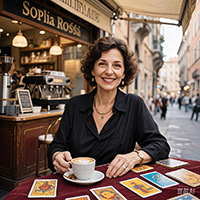
I am Sophia Rossi, and for twenty years I have listened to decisions unfold over the warm aroma of coffee. I did not offer Alex a prophecy or a verdict. I said, "More tabs are not the same as more clarity. Let us use the cards to organize the reality in front of you, then you will decide what to do with it. Our Journey to Clarity starts with giving this choice a map."

Choosing the Compass: The Decision Cross Tarot Spread
I invited Alex to put the phone face down, take one slow breath, and name the question once without adding a second question underneath it. I shuffled slowly while they focused on the leave deadline, next-term registration, and the feeling that either choice might become a permanent statement about who they were.
For this consultation, I chose the five-card Decision Cross. It fits a direct leave-or-stay decision because it compares both visible paths while also showing the present blockage, the fear beneath it, and the principle that can integrate the evidence. It is a compact classic spread, so it gives the question enough structure without burying it under ten more layers of information.
This is how I use tarot as an objective cognitive tool: the cards provide an organized set of prompts, while Alex's circumstances, official university information, and own judgment provide the evidence. The Decision Cross cannot replace an academic adviser, registrar, financial-aid office, health support, or accessibility support, and it does not predict which option will succeed. It helps us read card meanings in context, so a vague feeling can meet a specific question.
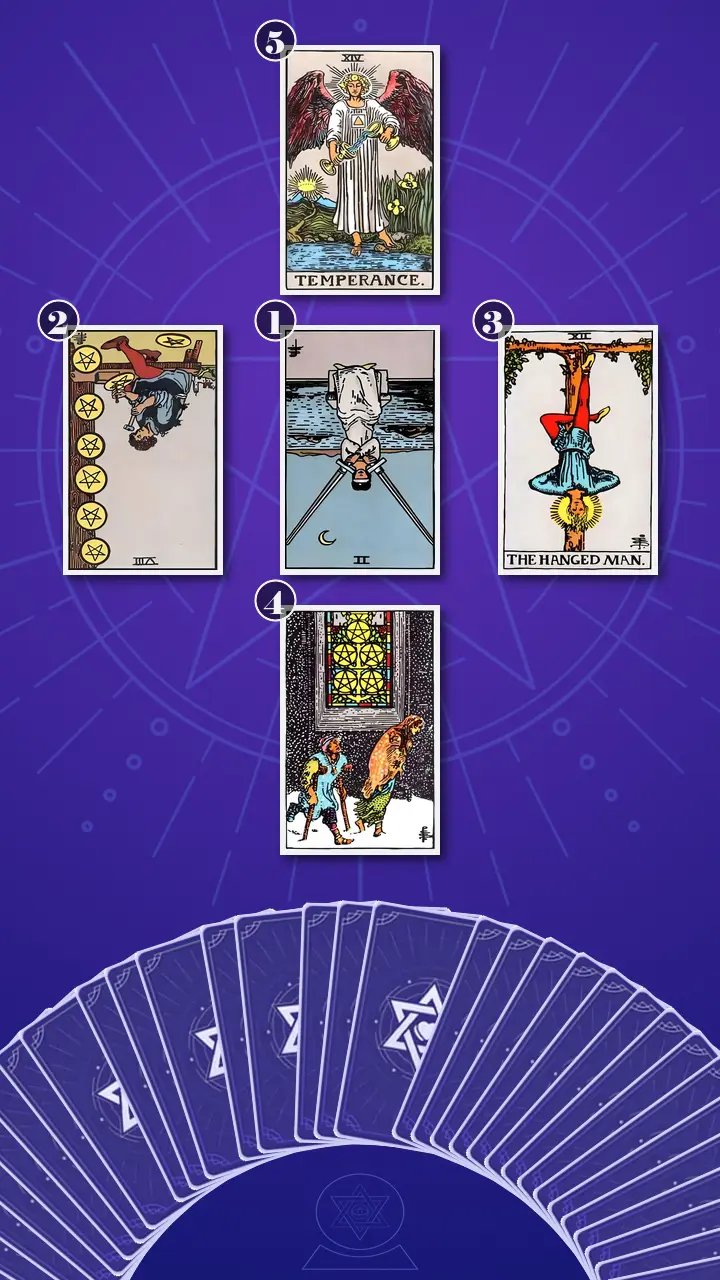
The centre would show the observable decision paralysis. The card on the left would examine what staying in school actually requires; the card on the right would examine what taking leave would require. Beneath the centre, I would look for the hidden fear, and above it, the integrating guidance that could turn the crossroads into a reviewable next step.
Reading the Map Without Choosing for You
The Crossed Tabs of the Present
I began at the centre. This position depicts the observable decision paralysis identified in the diagnosis: repeatedly researching both academic paths without completing either process. Its standard meaning is the central issue or present state surrounding the decision.
The card was the Two of Swords, in reversed position.
In the Rider-Waite-Smith image, a blindfolded figure holds two swords crossed over the chest. The posture looks controlled until I notice how much effort it takes to keep both blades in place. Behind the figure, the rocky water has not disappeared simply because the eyes are covered; emotion remains present beneath the intellectual defence.
In Alex's life, the crossed swords became two browser windows held open defensively: the leave application and the registration portal. They checked the university policy, opened the degree planner, asked friends for opinions, rewrote the adviser email, and then closed everything without completing one process. The activity looked responsible, but no new fact was being gathered. More tabs were becoming an autoplay feed, offering one more consequence and no actual stopping point.
The reversed energy was an excess of Air, with thought moving so quickly that it had become circular rather than discerning. It created a temporary sense of safety by keeping both futures hypothetical, but the blockage quietly consumed planning time and increased deadline pressure. I told Alex, "The card is not saying that you will choose badly. It is showing that comparison has become the place where the discomfort goes to hide. Let us identify the one factual question that would genuinely change the picture."
I used the inner-OS structure from my notes: "If I choose this, I could regret that. If I choose that, I could regret this." I asked Alex what happened immediately before they closed the adviser email.
Alex gave a short, bitter laugh and rubbed the heel of one hand against their sternum. "That is almost rude," they said. "I keep calling it research because research sounds productive. Really, I am waiting for one option to feel completely right."
I did not argue with the reaction or rush to make the card comforting. I let the recognition stand, then asked Alex to send only one targeted factual question before opening another comparison tab. Their shoulders stayed lifted, but their thumb moved away from the social media icon.
The Workbench That Forgot the Window
I moved to the card on the left, the path of staying enrolled. This position examines what staying in school would require from Alex, including whether continued effort can be connected to a clear purpose and sustainable conditions. Its standard meaning covers the qualities, demands, benefits, and trade-offs attached to the first option.
The card was the Eight of Pentacles, in reversed position.
The Rider-Waite-Smith craftsperson bends over one pentacle after another, building skill through repetition. In the reversed position, the image can show effort that has become unfocused, perfectionistic, or disconnected from meaningful development. The row of finished pieces resembles an academic checklist that keeps growing while the wider town, and the wider life, remain in the distance.
I connected it to Alex's late-night routine: one reading, one submission, one polished set of notes, and then another study block added to the calendar. Staying was not automatically the wrong path. The question was whether Alex would stay under the same draining pattern, using extra hours and an unnecessarily heavy course load to prove responsibility, or whether staying would include a changed workload, a clear learning purpose, and conditions their body could actually sustain.
Here the Earth energy was depleted in purpose and excessive in output. More effort could temporarily protect Alex from asking what the work was for, but exhaustion would then be mistaken for evidence that school itself was impossible. I asked, "If you stayed for another term, what would need to change in your workload, purpose, support, or schedule for registration to feel like an active choice rather than default momentum?"
Alex's finger traced the edge of the course schedule. After a long pause, they said, "I would need fewer courses, a reason for each one, and permission to stop treating every assignment like a test of whether I belong here." I watched their jaw release slightly. The card had not condemned staying; it had made the conditions visible.
The Pause with a Calendar Entry
I moved to the card on the right, the path of taking leave. This position examines what taking a leave would require from Alex, including whether the pause would be intentional, structured, and used for perspective rather than indefinite postponement. Its standard meaning covers the qualities, demands, benefits, and trade-offs attached to the second option.
The card was The Hanged Man, in upright position.
The suspended figure in the Rider-Waite-Smith image hangs by one foot from a living wooden frame. Their body is inverted, but their face is calm and a halo surrounds the head. I read this as voluntary suspension, a release from forced momentum, and the possibility of seeing the same problem from a different orientation. Stillness here is a tool only when it is consciously held.
For Alex, a structured leave would need a purpose, a support contact, practical information, and a review point. It might be time to restore capacity, investigate a direction, reconsider the course load, or address a need that constant academic output had made difficult to hear. An empty calendar could quietly become indefinite drift; a calendar entry that named the purpose and review date could make the pause intentional.
I placed my pen beside a blank calendar line and said, "A leave is not automatically an escape, and staying is not automatically commitment. The useful question is not whether time away magically solves everything. It is what this pause would be for, who would support it, and when you would review what you learned."
Alex's hand tightened around the pen, then slowly opened. They looked from the upside-down figure to the empty calendar line and said, "I do not need to disappear; I need to know what this pause is meant to clarify." A small breath left their chest. It was not certainty, but it was the first shape of a bounded, purposeful pause.
The Lit Window Beneath the Fear
I turned to the card below the centre, the psychological root. This position reveals the underlying fear that either choice could threaten Alex's sense of direction, belonging, and control. Its standard meaning is a hidden influence, fear, need, or assumption shaping the decision beneath the visible pros-and-cons analysis.
The card was the Five of Pentacles, in upright position.
In the Rider-Waite-Smith image, two figures move through falling snow beside a church window lit with five pentacles. Crutches and worn clothing show reduced capacity and material strain, but the window is illuminated. The image holds both experiences at once: the cold is real, and support may still exist even when fear makes it difficult to turn toward it.
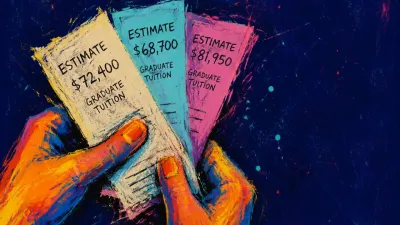
I saw that fear in Alex's Toronto commute. On the TTC, a classmate's LinkedIn internship announcement or graduation countdown could make a possible pause look like a locked door. At home, tuition statements, rent, student benefits, and financial-aid pages became one undifferentiated threat. Alex had not actually been excluded, but the mind was treating falling behind, losing belonging, wasting time, and losing control as if they were already settled facts.
The upright Earth energy was not an omen of hardship. It was a blockage created by bundling material reality with feared meaning. I said, "Let us separate the factual questions from the story attached to them. Re-entry, financial aid, course timing, and advising belong in specific emails. The thought that leave proves you could not handle the path is an assumption. It deserves care, but it is not evidence."
Alex stared at the small pool of lamplight beneath the card. Their eyes moved to the university support page still open on the laptop, and they whispered, "I have been walking past the lit window because I assumed it was not meant for me." I let the silence remain long enough for that assumption to become visible without turning it into a new accusation.
When Temperance Turned Two Cups into a Workable Flow
The room changed when I reached for the card above the centre. The radiator clicked once, the laptop fan seemed suddenly loud, and the light from the two browser windows no longer looked like two competing verdicts.
This position provides an integrating decision principle that can move Alex from all-or-nothing analysis toward a sustainable and reviewable next step. Its standard meaning is guidance or an integrating principle for approaching the decision with proportion, patience, and a workable next step.
The card was Temperance, in upright position.
The Rider-Waite-Smith angel moves water between two cups, keeps one foot on land and one in water, and faces a path leading toward light. The card does not erase either terrain. It shows measured integration, sustainable pacing, and self-trust built through practical experimentation. The opposing needs can interact without one having to invalidate the other.
The modern translation was precise: define what a sustainable semester and a useful leave would each contain, then compare those concrete arrangements through capacity, purpose, support, practical impact, and reversibility. This was not a command to choose the safer identity. It was a way to stop comparing imagined extremes such as another unbearable semester and falling permanently behind.
This is where I used my signature Analysis Paralysis Deconstruction. I stripped away the abstract what-ifs and kept only the grounded realities and immediate constraints: How many courses could Alex sustain? What purpose would the term or pause serve? Which support was available? What practical impact needed confirmation? What could be reviewed or adjusted later? Then I used Complexity Reduction to make the comparison clean without pretending it was simple. I asked, "What would make this option workable?"
At 11:40 p.m. in the Toronto apartment, the leave policy and next-term timetable were open beside the fourth saved adviser email. Relief and panic arrived together: leave seemed to pause the pressure, while staying seemed to protect momentum. Alex was still asking certainty to make the choice for them.
You are not failing because a binary answer will not appear; test a sustainable arrangement one step at a time, as Temperance turns two opposing cups into one workable flow.
Alex's fingers stopped above the phone. For one beat, their breath paused, and the hand holding the mug hovered over the saucer. Then their eyes went unfocused, replaying the leave policy, registration portal, classmates' updates, and fourth draft in the laptop's reflection. Their brow tightened; their mouth opened without sound. The old thought, I must find the risk-free choice, met the new question, What would make this option workable? Their shoulders lowered. The fist around the phone loosened, tightened once as if guarding the grief of losing a perfect guarantee, then opened. I asked them to set a ten-minute timer and write two lists: A sustainable semester would need... and A useful leave would need... Only capacity, purpose, and support could go on the page. Alex highlighted sustainable conditions and reviewable decision, then laughed on a trembling exhale. Their eyes shone; the relief carried a little vertigo because a clear path still required responsibility. I said, "Do not decide tonight. If this raises distress, stop and close the document." Then I asked, "Now, using this new lens, think back to last week: was there a moment when this insight could have made things feel different?"
I named the crossing carefully. This was not a final answer delivered by Temperance; it was a step from confused, fear-driven postponement toward grounded self-trust. The key shift was from waiting for complete certainty to defining three decision criteria, gathering only the missing facts, and testing both real arrangements by a fixed review date.
The Same Questions for Both Futures
Once I had laid out all five cards, I saw a simple sequence. The reversed Two of Swords showed information without a stopping rule. The reversed Eight of Pentacles showed why staying would feel heavy if it repeated effort without purpose. The Hanged Man made leave useful only when held as intentional suspension. The Five of Pentacles explained why either route felt like a threat to belonging and security. Temperance connected the pieces through shared criteria, support, and proportion.
At the beginning, I had seen Alex with one foot on each platform while both trains began to move. By the end, the cards had not produced a third magical platform. They had changed the question from "Which future is safest?" to "What would make this option sustainable?" The crossed swords became two columns connected by the same questions, not two identities fighting for permission to exist.
My cognitive blind spot reading was this: Alex was asking one decision to guarantee an entire future before allowing any action. Then the exhaustion caused by endless consequence-mapping was being used as proof that self-trust was impossible. The real problem was not a lack of discipline or a missing eleventh opinion. It was a decision process that had no boundary between useful research and postponement.
My mind briefly returned to a crowded cafe shift from years ago, when adding another order slip had never made the first order clearer. Someone had to sort what was fixed, what could change, and what was noise. I brought that same grounded instinct to the reading. A decision can be real without being irreversible, and practical experimentation can create evidence that overthinking cannot.
I told Alex that tarot could help organize the reflection, but official policy would have to answer the practical questions. An academic adviser could clarify course timing and re-entry. A registrar or financial-aid office could address enrolment and money. Alex remained the decision-maker, not the cards, and not the deadline.
The One-Page Reviewable Choice for Finding Clarity
I turned the reading into actionable advice and small next steps. I kept each one optional, time-bounded, and specific enough to begin without solving an entire degree.
- Run the Coffee Bean Filter ProtocolFor the next 24 hours, write every new decision variable on one page and physically sort it under Absolute Must-Haves or Emotional Noise. At the end of the day, make two columns in Notes, Google Docs, or Notion, one for staying and one for taking leave, using the same five headings: capacity, purpose, support, practical impact, and reversibility. Circle the three criteria that matter most instead of ranking every possible consequence.Keep the first comparison to 20 minutes and do not turn it into another endless spreadsheet. If the exercise raises distress, stop, close the document, and return only if and when you choose.
- Send One Missing-Fact MessageWithin the next 48 hours, identify the single fact that would change the comparison most, such as return eligibility, course timing, financial-aid impact, or available advising support. Send one plain-language email to the appropriate academic adviser, registrar, or financial-aid contact. A subject line can be: Question about leave of absence and next-term registration. Include one question, the relevant deadline, and nothing that requires a life story.Use one message, one contact, and one calendar reminder for the follow-up date. If sending feels too large, use the university appointment template and paste in the question exactly as written.
- Write the Structured Pause HypothesisWithin 20 minutes before the review date, complete the sentence, A leave would be useful to me only if it gave me time and support to ______. Add one possible structure, such as a reduced routine, a support appointment, work planning, or a scheduled re-entry review. Write down the two factual questions that must be answered before treating leave as viable, then place a provisional review point on the calendar within seven days.Call it a hypothesis, not a commitment. A useful leave is neither a magical reset nor an undefined disappearance, and you can revise the plan or decide not to use it.
I watched Alex write the first question without reopening Reddit, Instagram, or another policy tab. That was the small introduction of Fire the spread had been missing: not a dramatic leap, just one deliberate action that could produce new evidence. The goal was not to make the uncertainty vanish. It was to make the next decision more honest, more supported, and more adjustable.

A Week Later, the First Usable Setting
Four days after our session, I received a message from Alex: "I sent the adviser email. I still do not know whether I will take leave, but now I know the exact fact I need before I compare the plans again." I read it over my coffee and pictured the fourth draft finally becoming a real conversation.
Alex had made two one-page plans and set a review date. They had not turned staying into proof of maturity or leave into proof of failure. They had simply given both options the same questions and allowed the answers to arrive in their own time.
Alex slept through the night after the plans were clear, but woke with the old thought, "What if I am wrong?" They smiled, opened the adviser reply, and wrote down the next fact to check. The fear remained; it no longer held the keyboard.
I think of that as the first proof of the Journey to Clarity. The cards did not select a life for Alex. They made the hidden rules visible, and Alex reclaimed authorship by asking, checking, comparing, and choosing when they were ready. The person asking the question remains the master of the decision.
When the registration portal makes your chest tighten, you can crave relief from another semester and still fear that a pause will place you outside the student path. Trying to make staying or taking leave prove that you are in control is what makes both feel impossible; noticing the split is already the first change.
So, if staying and taking leave were two reviewable sets of conditions rather than verdicts about who you are, which small Temperance criterion, capacity, purpose, support, practical impact, or reversibility, would you want to notice first?