The Unsent Email: When Academic Re-entry Procrastination Feels Like a Verdict
I often meet the student who can explain every reduced-course-load option but still cannot press Send because one email feels like a commitment to an entire semester. Jordan had brought me the question, Why do I keep delaying my return after academic leave?
At 10:40 p.m. on a Tuesday in their small Toronto rental bedroom, Jordan reopened a half-finished email to student services and checked the same reduced-load page in three browser tabs. The laptop fan hummed against the quiet, cold tea tasted metallic, and blue light dried their eyes while their shoulders climbed toward their ears. They changed one sentence, moved the task to next Monday, and felt their chest loosen for thirty seconds.
Jordan said, 'I do want to go back, but I want proof that I can handle it first.' That was the contradiction in its most honest form: a planned return to university on one side, and the fear of re-entering before recovery felt certain on the other. Their anticipatory anxiety was not an abstract cloud. It was like waiting at a TTC station until I could guarantee that the entire journey would have no delays before I was willing to check which train was available.
I told Jordan that I did not see a lack of ambition. I saw a protective pattern that had become expensive. 'You are not postponing because the return means nothing,' I said. 'You are postponing because it has been made to mean everything. Let us use the cards as a map, not a verdict, and see whether we can make the next piece of reality small enough to examine.'
The Switchback Map for a Stalled University Return
I asked Jordan to place both feet on the floor, take one unforced breath, and name the question without trying to solve it. I shuffled slowly, treating the movement as a practical transition from mental rehearsal to observation, not as a supernatural test of what would happen next.
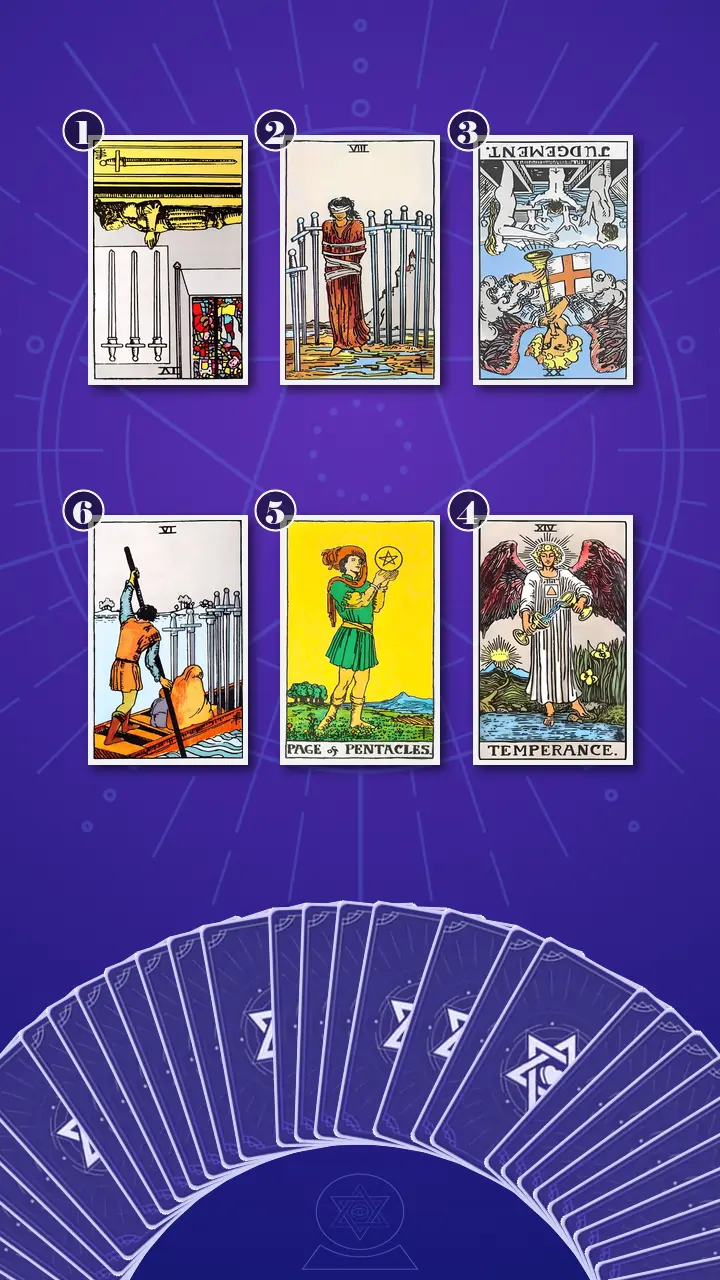
I chose the Transformation Path Grid · Context Edition, a six-card spread designed for a repeating delay. I explained to the reader as well as to Jordan why this structure fit: the phrase keep delaying points to a loop of trigger, preparation, temporary relief, and rising stakes. Six positions are enough to follow that loop from its visible symptom through its blockage and root, then identify a bridge, a concrete action, and a sustainable form of integration.
This is how tarot works in this reading. The Rider-Waite-Smith images provide an objective vocabulary for card meanings in context, while the position roles keep the interpretation connected to observable life. The first card would show the repeated behaviour operating now. The second would reveal how apparent barriers protect the delay. The third would expose the fear underneath. The fourth, the key bridge, would show what could change the pattern. The fifth would make that change practical, and the sixth would describe a supported return that could carry uncertainty rather than demand its disappearance.
Reading the Loop Beneath the Blue Light
Position 1: The Stillness That Was Not Rest
Now I turned the card representing the observable symptom: preparing return tasks repeatedly while remaining suspended between academic leave and re-entry. It was the Four of Swords, in reversed position.
The figure in the Rider-Waite-Smith image lies on a stone tomb beneath three suspended swords. I read the reversed energy as blocked restoration, an excess of monitoring, and a pause that has become difficult to leave. Jordan was physically outside university life, but the three swords had become policy tabs, calendar reminders, imagined workloads, and an unsent message hanging over every evening. Leave was no longer uncomplicated rest, while return had not yet begun.
The modern scene was exact. Jordan could spend forty minutes changing I am planning to return into I am considering my options, then call the session productive because planning had taken place. The energy was not laziness. It was a restless suspension maintained by an all-or-nothing recovery standard. Each low-energy day became evidence that the leave had not worked enough, so Jordan added another readiness milestone and postponed contact until all milestones could be met.
I asked, 'When the task moves to Monday, what do you receive for those first thirty seconds?' Jordan gave a small, bitter laugh. Their breath paused, their fingers stopped above the trackpad, and their eyes stayed on the same line of the draft as though it had suddenly become too accurate to read. 'It is relief,' they said. 'Then I wake up with the same email, only heavier.'
I let the silence hold that distinction. Rest restores contact with the self; monitored suspension keeps the university mentally present while withholding the real information that might make a return more manageable. Jordan slowly closed two of the three tabs, not as a commitment, but as the first visible separation between recovery and delay.
Position 2: The Eight-Tab Enclosure
Now I turned the card representing the primary blockage: the force that protects Jordan from immediate discomfort by turning assumptions about readiness into apparent barriers. It was the Eight of Swords, in upright position.
The blindfold, loose bindings, and incomplete ring of swords showed me a field that felt sealed without being fully sealed. In Jordan's browser, eight open tabs formed a similar enclosure: workload rules, reinstatement deadlines, financial aid, accommodations, course combinations, TTC commute time, relapse scenarios, and classmates' progress. They had opened policy pages and Reddit threads, but had not separated documented requirements from private predictions.
Jordan had been living by the sentence, 'Because I cannot guarantee a sustainable semester, I cannot even ask what a smaller return would involve.' The energy here was a cognitive blockage. The imagined risks were real enough to deserve careful questions, but they had been assembled into one solid wall before any adviser or student-services contact had tested which parts were institutional facts and which parts were worst-case forecasts.
I use a diagnostic lens I call Research Bottleneck Analysis. When a person keeps researching without reaching a decision, I do not treat the bottleneck as a personal failure. I excavate what the research is protecting. In Jordan's case, the missing information was not simply another course-load policy. The deeper problem was that no policy page could prove that Jordan would remain a capable student during a difficult week. Private research was being asked to answer a question that only paced contact and lived evidence could approach.
'Research can look responsible while quietly protecting you from the one answer you cannot generate alone,' I said. Jordan's chest tightened; their thumb moved toward the laptop lid, then stopped. They opened Notes and wrote two headings: confirmed requirement and untested forecast. The list did not solve the return, but it made one gap visible. Several barriers were questions for a real person, not permanent walls.
Position 3: The Trumpet They Heard as a Grade
Now I turned the card representing the underlying root: the fear that returning and struggling could become evidence of diminished worth as a capable student. It was Judgement, in reversed position.
The trumpet in the image calls figures to rise, review what has happened, and enter a renewed chapter. In its reversed form, the call had become blocked by self-condemnation. A neutral message such as Registration Window Reminder was no longer reaching Jordan as an administrative invitation. I saw it arriving in the kitchen beside the kettle at 9:08 a.m., while their body received it like a result notification: breath held, stomach dropping, thumb hovering over mute.
Jordan had turned return into a hidden grading rubric. Sleep, focus, energy, productivity, and concentration all had to earn top marks before they were allowed to ask what options existed. The energy was not an external judgement. It was a distorted review process in which struggling again would supposedly prove that the leave had failed and that Jordan was no longer the student they believed themselves to be.
I asked, 'If the next term contained one genuinely difficult week, what would Jordan fear that week would prove?' They looked away. Their breathing became shallow, their hand closed around the edge of the chair, and then their shoulders dropped with the force of recognition. 'If I ask and still struggle, they will know the leave did not work,' they said. 'So will I.'
I answered carefully. 'That is an imagined tribunal, not a fact. An adviser can explain an option without judging the whole person who asks about it. A difficult week can tell us that a load, support structure, timing, or environment needs adjustment. It cannot deliver a final verdict on worth.'
Jordan went quiet after that. The silence was not agreement or instant relief. It was the sting of seeing why the email had carried the weight of an examination, followed by the first hint that honest review could be different from self-condemnation.
When Temperance Made Readiness Adjustable
Position 4: The Bridge Between Rest and Re-entry
The room changed when I turned the key card. I was now reading the position that identifies the shift from all-or-nothing recovery standards to paced experiments combining restoration, information, support, and limited engagement. The card was Temperance, in upright position. Its strategic role in this spread was Bridge.
Water moved between two cups. One foot stood on land and one in water. I read the energy as balance through calibration, not balance as a permanent emotional state. For Jordan, the modern translation was an information-only question about reduced course loads or staged re-entry, followed by an evening that remained free. Contact and recovery could occupy the same day without one cancelling the other.
My signature skill is Academic Stratigraphy. Years at Cambridge and on archaeological digs taught me not to mistake the top layer of a site for the whole structure beneath it. I read Jordan's pattern in layers: the visible unsent email, the restless leave beneath it, the forecasts built around workload and commuting, and the deepest layer, the fear that being seen in uncertainty would expose a damaged academic identity. Beneath that fear was not a lack of desire. It was a missing middle layer: a modest, reversible form of participation that could produce evidence without demanding a declaration.
At 10:40 p.m., three copies of the reduced-load page sat beside the same unsent email. The laptop fan hummed, Jordan's shoulders crept upward, and moving the task to Monday brought relief. I could see the hidden rule beneath the click: no contact until recovery could be certified in private.
Readiness is not a perfect state you must reach in hiding; practise it through Temperance's careful pour, one manageable measure at a time.
For one beat, Jordan's breath stalled. Their eyes widened and fixed on the two cups; one hand hovered above the table, fingers curled as though Send had become a physical switch. Then their gaze went unfocused. I watched the late-night tabs, the Monday move, and the imagined adviser seem to replay across their face. Their jaw tightened, and the skin beneath their eyes warmed. 'But doesn't that mean I was wrong all this time?' they asked, with a brief flare of anger that was easier to hear than the grief beneath it. I kept my voice level. 'No. It means the rule you used to protect recovery has been asking for evidence no private checklist can provide.' Their fist opened one finger at a time. The radiator clicked, the rain thinned against the window, and their shoulders lowered, not into triumph but into the slight dizziness of having a path and responsibility at once. Their next breath shook on the way out. 'I could ask without saying I am back,' they said.
I asked Jordan, 'Now, use this new perspective to recall whether there was a moment last week when this insight might have made things feel different.' They remembered the registration reminder beside the kettle and saw a possible alternative: not answering the entire semester, but asking one person one bounded question.
This was the first movement in the emotional transformation from anticipatory anxiety, shame, and certainty-seeking toward grounded self-trust in a paced, adjustable return process. Temperance did not predict that Jordan would return, and it did not decide that returning was the correct outcome. It made the return smaller, reversible, and capable of teaching Jordan something real.
The One Question That Could Leave the Browser
Position 5: The Apprentice Task
Now I turned the card representing the practical behaviour through which the new perspective could be tested without forcing a final commitment. It was the Page of Pentacles, in upright position.
The Page holds one pentacle at eye level while the wider landscape remains present but secondary. The energy is grounded beginnerhood: one tangible task, complete attention, and a willingness to learn from material reality. I connected it to a 20-minute administrative session in which Jordan would close the schedule-comparison tabs, write three factual questions, and send one question to student services.
'Your job in that block is not to solve September,' I said. 'It is to learn one thing that cannot be learned alone from another browser tab.' The Page did not ask Jordan to perform as a fully restored student. It asked them to become an apprentice to their own re-entry process, capable of requesting basic information, noticing a body response, and recording what the answer changed.
Jordan reached for Notes. Their hand still trembled slightly, but they wrote a possible question instead of another readiness criterion. They stared at it for several seconds, then said, 'This is the first time the task has an ending that is not the whole semester.' I watched their attention narrow in a useful way. The distant mountain remained, but it no longer had to be climbed during the same 20-minute session.
The Boat That Could Carry the Doubts
Position 6: A Supported Crossing
Now I turned the card representing cognitive integration: the sustainable direction that emerges when the action is practised. It was the Six of Swords, in upright position.
The boat carries six swords across water that changes from rough to calm. The swords do not disappear, so the image does not promise a clean emotional reset. I read the energy as supported passage. Jordan could carry doubts, variable capacity, financial questions, and the possibility of changing course, provided those concerns were placed inside a plan rather than arranged into a stationary argument against movement.
The modern translation was a provisional crossing: one university contact, a reduced-load option to investigate, a trusted friend who could sit nearby during administration, and a date to review whether the arrangement still fit. A withdrawal or adjustment point could be part of the design. Support did not have to wait until Jordan had proved that independent effort was insufficient.
I said, 'The doubts can come with you; they do not get to design the whole journey.' Jordan looked at the boat for a long time, then wrote down one workload boundary and one person they might ask for quiet company. Their expression was still cautious, but the caution had changed function. It was no longer a locked gate. It was information to carry into the crossing.
A Return Plan Built in Layers
Once all six cards were face up, I read them as one causal story. The leave had created necessary space, but without a staged re-entry structure that space had become restless suspension. The Eight of Swords showed how research and rehearsal turned forecasts into barriers. Judgement reversed revealed why every ordinary contact had become a verdict on whether the leave had worked and whether Jordan still deserved the identity of a capable student. Temperance supplied the missing bridge, the Page of Pentacles gave it a finite form, and the Six of Swords showed how support could carry the remaining doubts.
I thought of an excavation where the most important discovery is often not the object at the surface but the structure that explains why the objects were arranged as they were. Jordan had not been waiting for motivation. They had been waiting for a perfect certificate of future performance. The delay-relief-stakes loop was an architecture, and architecture could be redesigned.
The cognitive blind spot was believing that more private analysis would eventually create the certainty needed for contact. In reality, readiness depended partly on information that only contact could produce: what reduced loads existed, how staged return worked, what support could be discussed, and which boundaries would remain available. The transformation direction was from waiting to feel completely recovered toward using one reversible, time-boxed return task each week as evidence about capacity and support.
I also reminded Jordan that the cards did not choose a return date. Student services, academic advisers, accessibility staff, health professionals, and financial-support teams could provide information relevant to the decision, while Jordan remained free to ask, pause, revise, extend leave, or choose another path. Empowerment meant keeping the decision in the hands of the person whose life and recovery were involved.
Three Small Pieces of Evidence
I offered Jordan three options. None was a test of motivation, and none required private health details or a promise to carry a full term. Each was deliberately small enough to stop.
- Sort one fact from one forecastOn Tuesday at 6:00 p.m., Jordan can sit at the kitchen table for ten minutes and make two Notes columns: What is confirmed by university policy and What is an untested prediction. They can choose one prediction that a real person could answer, such as whether reduced-load or staged re-entry options exist.Use the ten-minute version if resistance rises. The purpose is not to score readiness, but to create one useful question and stop before the task expands.
- Use the Thesis Stratigraphy FrameworkBefore opening more course-combination tabs, I asked Jordan to rebuild the message in three layers: the core question, the evidence boundary, and the next move. The core question could be, 'Could you tell me what reduced-load or staged re-entry options are available to a student returning from leave?' The boundary could say, 'I am gathering information and am not confirming a return term yet.' The next move could be a reply, a cancellable exploratory appointment, or a specific 24-hour review. The entire email can stay under 120 words and take no more than 20 minutes.An information request is not a declaration of readiness. If Send feels outside capacity, locating the correct contact and writing the subject line is the five-minute version.
- Build a support-first crossingJordan can ask one trusted friend or housemate to provide quiet company for 15 minutes while the information request is sent, then write a small scaffold with one university contact, one workload boundary, and one date for reviewing or changing a tentative plan.Support does not need to be earned by reaching a crisis point. A review date and an exit option make the plan adjustable rather than irreversible.
I told Jordan that these actions could lead to a return, continued leave, a changed programme, or simply better questions. The value was not in forcing one outcome. It was in replacing an imagined institution with an actual conversation and allowing reality to add information to the decision.
The First Proof Was Only a Reply
Four days later, Jordan sent me a message: 'I used the three layers. Student services replied with the reduced-load process and an advising link. I have not chosen a term. I booked the appointment as exploratory.' It was a modest change, but it was real. The academic return was no longer a private simulation with no outside evidence.
That night, Jordan slept through. In the morning, the first thought was still, 'What if I am wrong?' This time, they smiled, kept the appointment, and left the question open. The relief was not perfect, and the path was not guaranteed. The difference was that uncertainty now had a place in the plan.
I saw the Journey to Clarity as a movement from suspended rest, perceived restriction, and self-judgement toward calibration, practical learning, and supported transition. Jordan, not the cards, made the first contact. The cards simply helped reveal that a return could be a paced question rather than a single verdict.
When a registration email makes your chest tighten, the hardest part may not be the form itself but the fear that one uneven semester could turn a careful return into proof that you were never capable enough.
If returning were allowed to be a paced question instead of a verdict, what is the smallest reversible point of contact you can imagine making room for?
This story is adapted from psychological research, written so that those in a similar struggle can see their own pattern in it — and find their next step clearly.These insights are not a substitute for professional psychological, medical, legal, or financial advice.
Learn more about our Journey to Clarity.
How did this insight land for you?
🫂 This Resonates Deeply
🌀 Living This Story
✨ Now I See Clearly
🌱 Seeing New Possibilities
🧰 Useful Framework
🔮 The Confirmation I Needed
💪 Feeling Empowered
🚀 Ready for My Next Step
Author Profile
 AI
AI“Having spent a lifetime at Cambridge and on archaeological digs, I’ve witnessed the rise and fall of countless civilizations. Please know that your current struggles are not a permanent fate, but merely a necessary fracture before rebuilding. I won't lecture you; instead, I invite you to sit with me in the ruins, using a patient, historical perspective to gently dust off the true, enduring value hidden beneath your temporary doubts.”
In this Study Tarot Reading :
Core Expertise
- Academic Stratigraphy: Structuring fragmented knowledge points into a cohesive, enduring cognitive framework.
- Research Bottleneck Analysis: Treating creative blocks not as personal failures, but as signals requiring deeper intellectual excavation.
Service Features
- The Thesis Stratigraphy Framework: A structural methodology to rebuild your essay outline, ensuring core arguments pierce through intellectual clutter.
Also specializes in :
Explore Related Patterns:
Certainty SeekingJordan said they wanted proof they could handle a semester before returning and compared the entire journey to a transit route with no delays. You are seeing the mind demand predictive certainty from a situation that can only be clarified through staged contact. Private checking tries to purchase safety in advance, but the standard keeps moving because no policy page can guarantee energy, focus, or a difficult week. The result is a loop where the search for certainty delays the very conversation that could convert forecasts into facts. An exploratory appointment and a review date lower the demand from certainty to usable information. You do not have to decide the whole return to learn what one option would require.
Perfectionism-Driven AvoidanceJordan reopened the student-services email, changed one sentence, and moved it to Monday, then felt relief for only thirty seconds. You are seeing a readiness threshold that turns an ordinary information request into a test of whether the entire semester can be handled successfully. That threshold works as protective avoidance. By waiting for private proof that recovery is complete and future performance is guaranteed, you avoid the exposure of asking while also blocking the contact that could reveal a smaller, adjustable option. The delay is therefore not evidence that returning does not matter; it is a way of protecting yourself from an imperfect return by making action conditional on certainty. The later exploratory appointment shows that this pattern can be audited through a reversible step. A question can gather evidence without declaring a term, so readiness becomes something you measure in contact with reality rather than a certificate you must earn in isolation.
Shame-Driven DelayJordan described moving the email to Monday, feeling the chest loosen, and waking to the same message made heavier. Later, a registration reminder arrived like a result notification, and the possibility of struggling in one difficult week felt like proof that the leave had failed. You are seeing shame used as a warning system. The mind postpones contact to avoid being seen while uncertain, but the short relief reinforces the postponement and leaves the feared verdict untested. Each delay then becomes additional material for self-criticism, so the protective pause increases the weight of the next decision. An exploratory request changes the exposure. It allows you to ask for options without presenting a performance result, separating a difficult week or a revised load from a final judgment about your capacity. The pattern becomes visible as a loop rather than a character verdict.
Achievement-Based Self-WorthJordan turned sleep, focus, energy, productivity, and concentration into grades that had to be high enough before asking what options existed. They also feared that if they asked and still struggled, both the institution and Jordan would know the leave had not worked. You are seeing academic performance fused with the right to identify as capable. When capability is treated as something that must be proven under every future condition, a return question carries the weight of an identity trial. This belief converts useful feedback about workload, support, or timing into evidence about personal worth, making delay feel safer than learning. Keeping the decision with Jordan and using a review date restores a more accurate frame. Capacity can be observed and adjusted in context, while a request for information remains a request rather than a score. That distinction lets evidence update the plan without being forced to define the person.
Information HoardingJordan checked the same reduced-load page in three tabs, then built an eight-tab enclosure with workload rules, deadlines, aid, accommodations, commuting, setback scenarios, and classmates' progress. You are watching information gathering become a controlled environment where every new detail appears to promise the certainty needed to move. Because private research can be completed without being evaluated by an adviser, it protects you from the answer you cannot generate alone. The mechanism is not curiosity or responsible preparation by itself; it is the repeated accumulation of options and forecasts while the one real-world contact that could test them remains unsent. The browser becomes a substitute for a conversation. Sorting confirmed requirements from untested forecasts and sending one bounded question interrupts the hoarding function. The aim is not to stop thinking, but to let information become evidence with a stopping point.
Uncertainty ToleranceJordan sent an information request, booked an exploratory appointment, and kept the term undecided. The plan also included a workload boundary, support, and a review or adjustment point, allowing caution to remain present without controlling every next step. You are seeing uncertainty held through calibration. A small reversible action generates lived evidence while preserving agency, instead of asking feelings to become perfectly calm before movement is permitted. Caution becomes useful when it informs the next decision rather than designing a permanent stop. Here, tolerance does not mean ignoring capacity or forcing a return. It means giving unknowns a bounded place in the plan so each answer can update the decision. The first proof was only a reply, not a promise of a full semester.
Explore Related Struggles:
Identity Verdict LockA Registration Window Reminder reaches Jordan like a result notification, and the possibility of one difficult week becomes evidence that the leave failed. The return is no longer only a decision about timing, workload, and available support; it has been made to judge whether Jordan still qualifies as a capable student. When you experience re-entry as a verdict, ordinary information gathering exposes far more than a practical question. Sending an email seems to place your identity before an imagined tribunal where future difficulty could settle your worth permanently, so delay protects you from being judged while keeping the trial continually pending. Seeing the verdict structure makes room for uneven capacity to function as information about a plan rather than a final definition of you.
Evidence DisconnectionJordan keeps the reduced-load page open in three tabs and gathers rules, deadlines, course combinations, commute estimates, and other people's accounts while the student-services message remains unsent. The research supplies more material to evaluate, but it cannot establish how a paced return would work for Jordan or what support an adviser might actually describe. You can need evidence in order to move while staying disconnected from the channels that generate the evidence you need. More private analysis then increases the apparent size of the decision without testing its assumptions, leaving clarity permanently one search away. Recognizing that disconnection makes it possible to distinguish facts available on a page from information that only bounded contact and lived observation can produce.
Exploration-Commitment FusionJordan changes the email from planning to return to merely considering options because one click feels capable of committing them to an entire semester. A request for reduced-load information stops functioning as an inquiry and starts carrying the weight of registration, sustained performance, and every difficult week that might follow. When exploration and commitment become fused, you lose access to the low-stakes actions that normally help a decision take shape. You are asked to know the outcome before entering the conversation that could clarify it, so even a reversible question feels irreversible. Separating inquiry from declaration restores room to gather information without forcing the whole academic future through one threshold.
Perfect Readiness TrapEach low-energy day gives Jordan another reason to add a readiness milestone, while sleep, focus, concentration, and productivity are monitored as though they must all certify the return. The student-services email remains pending because the standard applies not only to today's capacity but to whether an entire future semester can be guaranteed. You are left trying to achieve readiness under conditions that prevent readiness from ever becoming observable in real life. Preparation cannot finish when every uneven day can revise the threshold upward, and postponement becomes the only action that consistently satisfies the rule. Naming the trap reveals that the barrier is not missing ambition but a proof standard that no private checklist can complete.
False Recovery LoopJordan remains outside university life, but the laptop tabs, reminders, imagined workloads, and unfinished message bring university into the bedroom and kitchen. The no-contact rule is meant to protect recovery, yet forty-minute editing sessions and nightly monitoring keep the return active without allowing it to begin. You can end up preserving the form of a pause after its restorative function has started to erode. Delay appears to guard your capacity, but the unresolved return keeps consuming attention, while the absence of real contact prevents the uncertainty from changing shape. Recognizing this loop does not invalidate the leave; it shows where protection has become suspension and where recovery needs clearer boundaries from ongoing rehearsal.
Recovery-Action SplitJordan is physically away from university, yet policy tabs, calendar reminders, and the unsent email keep re-entry active every evening. The leave cannot become uncomplicated rest, but pressing Send feels like ending the protection that leave is supposed to provide. You can become caught between preserving recovery and testing whether limited participation is possible. The harder you try to establish capacity before acting, the longer action remains unavailable as a source of real evidence, leaving both recovery and re-entry partially suspended. Seeing that split allows rest and a bounded administrative step to occupy the same process without making either one prove the other.
Explore Related Emotions:
Academic DreadAt 10:40 p.m., Jordan reopens the same draft, checks the reduced-load page in three tabs, changes one sentence, and moves the task to Monday. Their raised shoulders, dry eyes, and briefly loosened chest show how strongly the body has connected university contact with an approaching demand. You are not facing a neutral administrative task when every email seems to contain the semester, the workload, and the possibility of struggling again. Academic Dread names that pervasive sense of threat around re-entry, where postponement offers a short release but leaves the academic future heavier the next morning.
Backslide AnxietyJordan treats each low-energy day as evidence that the leave has not worked enough, then imagines a difficult week after returning as proof that recovery failed. The anticipated setback arrives emotionally before any course load, support plan, or return date has been tested. Backslide Anxiety is the sense that renewed difficulty would erase prior recovery rather than reveal a need for adjustment. You may postpone contact because returning seems to risk losing the progress you have made and confirming the exact conclusion you most want to disprove.
Capability ShameJordan says that if they ask about returning and still struggle, both the university and Jordan will know that the leave did not work. Sleep, focus, energy, and concentration have quietly become entrance requirements they believe they must satisfy before they are even permitted to ask about available options. Capability Shame appears when variable capacity feels like exposure of a deficient self rather than practical information about load, timing, or support. You may delay because being seen before you feel fully restored seems to threaten the identity of being competent, not because the academic goal lacks importance.
Cautious ReadinessJordan rebuilds the return as one question, one reply, and one exploratory appointment. A reduced-load option, a workload boundary, a review date, and the possibility of changing course give the process a provisional structure rather than forcing a permanent declaration. Cautious Readiness means you can approach the next stage without claiming total recovery or complete certainty. Readiness becomes a capacity to participate in a measured, revisable way, allowing real experience to inform what happens next.
Cautious Self-TrustJordan's hand still trembles when they write the question, and the next morning still begins with “What if I am wrong?” Even so, they send the information request, book the appointment as exploratory, and keep it without pretending the doubt has disappeared. Cautious Self-Trust develops when you rely on your capacity to notice, ask, review, and adjust rather than demanding flawless prediction. The confidence here is deliberately modest: it rests on your ability to respond to new evidence, not on a promise that every future week will be easy.
Certainty HungerJordan can explain reduced-course-load options in detail, yet still says, “I want proof that I can handle it first.” They keep adding tabs, readiness milestones, and forecasts because each new piece of research seems capable of supplying the guarantee the previous one could not provide. Certainty Hunger is the felt need to know that the whole journey will be sustainable before checking the first available route. You remain stuck because the proof being demanded concerns future performance, while the evidence needed to assess that future can only emerge through bounded contact, support, and lived testing.
Commitment ClaustrophobiaOne half-finished email feels to Jordan like a commitment to an entire semester. The moment Send becomes visible, their breath pauses and their fingers stop because the message no longer seems to have an edge, an endpoint, or a reversible meaning. Commitment Claustrophobia captures the felt enclosure created when asking, deciding, and committing collapse into one act. You delay because there appears to be no room between silence and full re-entry, even though an information-only message can preserve your ability to pause, revise, or choose another path.
Verdict DreadA registration reminder reaches Jordan beside the kettle like a result notification: their breath holds, their stomach drops, and their thumb hovers over mute. Later, the student-services draft feels as though pressing Send would submit the success of the leave and the legitimacy of their student identity for review. When an ordinary question is internally structured as a final judgement, you can feel condemned before anyone has answered. Verdict Dread captures the expectation that contact will reveal something irreversible about your worth, even though the actual adviser can only provide information about options, timing, and support.
Agency ReliefStudent services supplies a process and an advising link, but neither response chooses a return term for Jordan. The plan includes boundaries, review points, and exit options, while continued leave or another path remains available. Agency Relief arises when gathering information no longer feels like surrendering control. You can approach reality for evidence without handing the decision to an institution, an adviser, or a symbolic tool, which makes participation feel less like entrapment and more like an authored choice.
Cautious ReliefJordan closes two of the three policy tabs, writes one factual question, and later receives a concrete reduced-load process and advising link. Their shoulders lower without collapsing into certainty, and the appointment remains explicitly exploratory. Cautious Relief is the easing that becomes possible when the next action has boundaries and does not decide the whole future. You can let some pressure leave the body because contact now produces information while your right to stop, review, or change direction remains intact.
Explore Related Contexts:
Reduced Course Load CrossroadsJordan's bounded email receives a concrete reply describing the reduced-load process and providing an advising link, while no return term has to be chosen. The response changes the situation from a private simulation of an entire semester into a documented set of workload and timing options that can be examined separately. At a Reduced Course Load Crossroads, you are not choosing between full participation and no participation in a single move. You are evaluating whether an institutionally recognized smaller load, staged entry, review date, or adjustment point can match current capacity. The decision still carries real consequences, but the available path now has intermediate steps that preserve your authority to ask, pause, revise, or continue leave.
Academic Outreach ParalysisJordan repeatedly reopens the same student-services draft, changes one sentence, and moves the task to Monday. Meanwhile, policy pages and Reddit threads keep delivering general information, but the unsent message prevents any adviser from clarifying which requirements, accommodations, or reduced-load options apply to Jordan's actual case. When you are caught in Academic Outreach Paralysis, preparing to communicate can take the place of communication itself. The external bottleneck matters because the missing information is held inside a two-way institutional exchange: no amount of private research can generate an adviser response. Treating outreach as a bounded request rather than a declaration of return allows you to test the contact channel without surrendering control over the larger decision.
Readiness Mismatch CycleJordan wants to return, yet sleep, focus, energy, productivity, and concentration are all required to reach an undefined standard before they are permitted to ask about the return process. Each uneven day becomes another reason to add a readiness milestone, even though the university contact is precisely where information about a smaller or staged return could be obtained. A Readiness Mismatch Cycle forms when the evidence demanded before action can only be produced through the action being postponed. You may be waiting to prove that you can sustain a semester before asking what a sustainable semester could look like. The structural opening is to distinguish readiness for one reversible inquiry from readiness for full academic participation, giving real-world information a place in the decision.
Academic Planning ParalysisJordan can spend forty minutes revising one sentence while keeping tabs open for workload rules, reinstatement deadlines, financial aid, accommodations, commuting, course combinations, and classmates' progress. The session looks administratively active, but it ends with the task moved to Monday and no new information entering the return decision. Academic Planning Paralysis emerges when the planning environment has no enforced boundary between documented requirements, adjustable options, and forecasts about future performance. You can remain occupied by academic administration while the actual path stays motionless. A finite planning unit, such as identifying one unanswered institutional question, makes it possible to stop measuring progress by research volume and start measuring it by whether the external uncertainty has changed.
Recovery Infrastructure TrialJordan's proposed return structure includes one university contact, one workload boundary, quiet company from a trusted person, a review date, and an available adjustment or exit point. These elements distribute the work of re-entry across institutional information, practical limits, and social support instead of requiring private certainty to carry the entire semester. A Recovery Infrastructure Trial asks whether your current support structure can make limited academic participation workable before you make a larger commitment. The structure remains provisional: advisers can clarify options, another person can support a difficult administrative task, and review points can reveal when the plan needs revision. This gives you concrete conditions to evaluate rather than requiring readiness to be proven in isolation.