Always Asked To Prove It

A clear look at repeated competence checks, matching tarot cards, and reading insights from people bringing this pressure to the table.

Professional Legitimacy Scrutiny
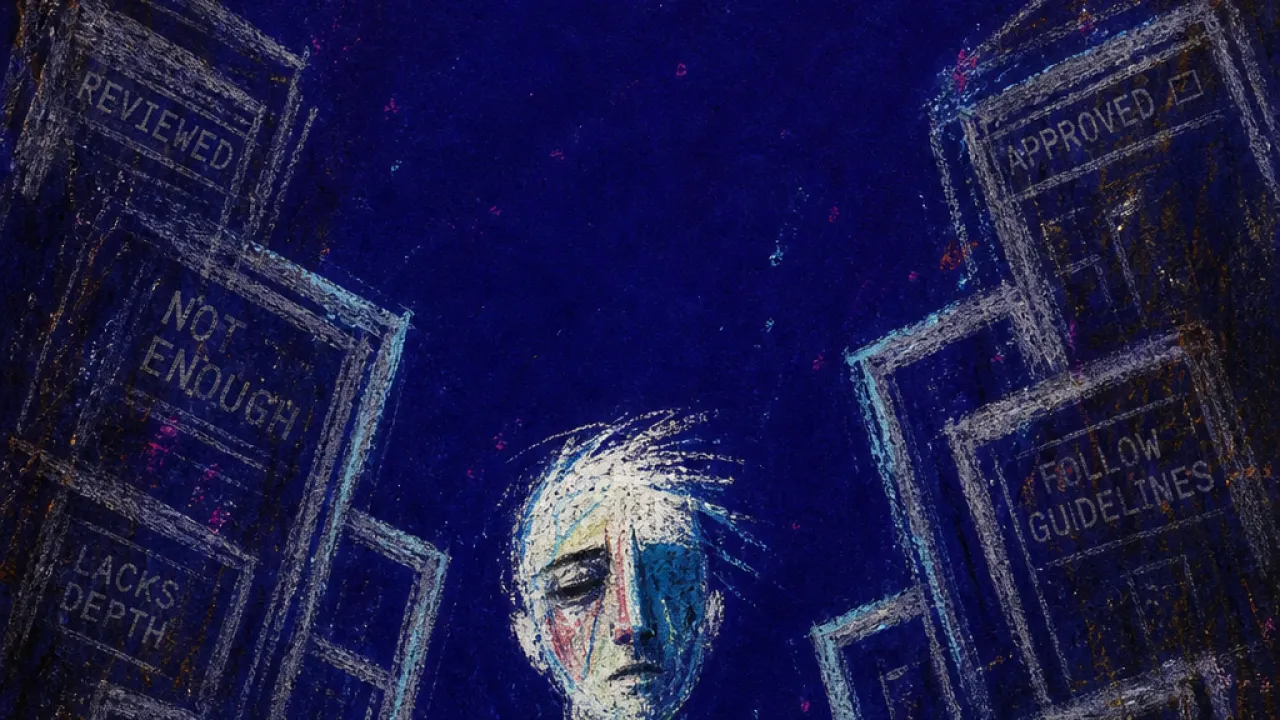
A solitary figure with raised shoulders as shifting doorframes press inward, leaving cold marks along the shoulder line

What is this situation?

Professional Legitimacy Scrutiny — you walk into the meeting already knowing the room will not just hear your work; it will inspect whether you have the right to be the person presenting it. The questions start as small checks: Where did you learn that? Who signed off on it? Are you sure that's within your level? A colleague with the same idea gets nodded through, while your version needs sources, slides, receipts, and a tone so careful it cannot be dismissed as too confident or too unsure. Your emails are reread for mistakes, your title is treated like a suggestion, and your age, accent, school, contract status, or identity become silent footnotes attached to every contribution. Praise arrives with qualifiers — surprisingly polished, mature for your level, good for someone new — and feedback circles back to proving you belong instead of improving the work. Over time, the job itself becomes two jobs: doing the work, then documenting, translating, and defending the fact that you were allowed to do it. You leave calls with your jaw locked and your shoulders held high, not because the work was impossible, but because the room kept moving the doorway after you had already stepped through it, much like the figure on the Seven of Wands, standing on uneven ground while six staffs rise toward them from below.

Why it's not you?

The issue is not that your work needs endless extra proof; it is that the room has made belonging conditional after you've already earned your place. Moving targets, uneven standards, credential-checking, and public second-guessing are features of the setting, not defects in you. When legitimacy is treated as something you must keep reapplying for, the scrutiny itself is the pressure.

Professional Legitimacy Scrutiny in Tarot Cards

Professional Legitimacy Scrutiny is the kind of situation where the work is no longer the only thing being reviewed; your permission to be in the room keeps getting reviewed too. The locked jaw and raised shoulders are signals from a setting that keeps asking for proof after the proof has already been shown. This is an environmental, structural dynamic built through moving standards, credential checks, and public second-guessing. The Tarot Cards below reflect the outline of that pressure without turning it into advice.

The Emperor
Reversed
The armoured ruler sits on a stone throne marked by rams, holding the symbols of formal command against a hard, controlled landscape. Reversed, authority remains structurally powerful but loses its stabilising function, becoming territorial, inconsistent, or invested in keeping another person's mandate provisional. At work, a manager or senior stakeholder may repeatedly override your remit, demand approval for decisions already assigned to you, or treat your title as negotiable whenever your authority becomes visible. The reversed throne identifies the bottleneck as positional gatekeeping. Your role is not unclear merely because a superior benefits from making it appear unclear.
The Hierophant
Reversed
The robed authority, crossed keys, and kneeling initiates depict a profession organised around recognised entry routes and approved knowledge. Reversed, those channels become unreliable: the institution may accept your labour while continuing to question whether your school, background, title, or career path grants the correct kind of legitimacy. This produces a career system in which competence cannot fully substitute for pedigree because pedigree is being used as a gatekeeping tool. You may repeatedly satisfy the practical demands of the role while being redirected toward fresh credential checks. The blocked institutional pathway reveals that the missing conversion is between demonstrated work and recognised professional standing.
Justice
Reversed
The sword and scales present judgment as a process that should connect evidence, criteria, and consequence. Reversed, the instruments remain authoritative while their calibration is compromised, creating feedback that feels official without necessarily being proportionate or neutral. When unequal professional scrutiny is repeated, its conclusions can enter your cognitive system as if they were objective measurements of ability. The reversed scales identify a critical gap between receiving an evaluation and receiving a valid evaluation. That gap allows workplace feedback to be examined as data produced by a power structure, rather than automatically installed as a final description of your competence.
Three of Pentacles
Reversed
A craftsperson stands beside two reviewing figures beneath a detailed architectural structure, with plans and completed work available for discussion. Reversed, the shared review space stops converting expertise into recognised contribution: role boundaries blur, collaboration loses mutual respect, and the worker's competence remains subject to basic revalidation. Your project conversations may therefore focus less on improving the output and more on whether you were authorised, senior enough, or properly credentialled to create it. The reversed workshop exposes a breakdown in professional recognition. The work is present, but the team cannot use it cleanly because it keeps reopening the question of your standing.
Five of Pentacles
Upright
Two figures pass directly beneath a glowing institutional window while remaining exposed outside. The workplace analogue is a role that places you close to authority, resources, and recognition without allowing that proximity to become secure professional membership. You may hold the job and perform its duties while sponsorship, presumed competence, or informal access remain unavailable. The upright scene makes this career exclusion concrete rather than personal: the institution is visibly present, and so is the uneven boundary governing who receives shelter from constant scrutiny.
Six of Pentacles
Reversed
The elevated distributor holds both the coins and the scales, combining resource allocation with the power to define fairness. Reversed, that position turns professional trust into a conditional grant: approval can be delayed, reduced, or attached to extra demonstrations that peers are not required to perform. Your career may remain dependent on someone repeatedly dispensing small amounts of credibility rather than recognising stable authority. Each assignment becomes another request for permission, and qualified praise keeps status differences intact. The reversed structure shows that the bottleneck sits with the allocator of trust, not with an endless shortage in your evidence.
Eight of Pentacles
Upright
A worker sits at a bench carving pentacles one by one, with completed pieces displayed in a visible sequence and the town set at a distance. Skill, repetition, and evidence are all materially present, making the record of work available for inspection. Under professional legitimacy scrutiny, that visible body of work can be converted from a portfolio into a permanent audition. You complete the task, archive the process, explain the method, and prepare to prove the same competence again because prior output does not generate lasting trust. The upright workshop preserves the reality of your craft while exposing how the organisation adds an unnecessary verification layer to it.
Five of Swords
Upright
One figure retains the swords while the others leave the field, and the uneven sky preserves the atmosphere of a conflict that produced dominance without repair. The available resource is clarity about the contest: this was not a neutral exchange in which everyone was trying to improve the result. Career scrutiny takes this form when reviews, meetings, or code and design critiques are used to discredit your standing rather than test the work consistently. You may leave with more tasks and less authority while another participant gains status by making you defend basics. The upright aftermath identifies an adversarial incentive structure that ordinary preparation alone cannot resolve.
Eight of Swords
Upright
A blindfolded figure stands loosely bound inside a partial ring of swords, with open ground, water, and a distant structure still present around the restriction. The barriers are real enough to shape movement, while their arrangement also narrows what the figure can safely perceive and attempt. Repeated professional scrutiny can move into your psychological cache as constant self-editing. You rehearse ordinary answers, downgrade clear statements, and treat every pause in a meeting as possible evidence that you exceeded your level. The upright image does not reduce the workplace barrier to imagination; it shows how an external credibility regime can become an internal communication constraint even when your underlying ability remains intact.
Reversed
The blindfold, loose bindings, and incomplete circle of swords organise restriction without fully sealing the landscape. Reversed, attention shifts toward the gaps in that arrangement: the workplace's repeated doubt may have shaped your self-concept, but its criteria do not define the total boundary of your competence. Professional legitimacy scrutiny often trains you to treat caution as accuracy and external suspicion as objective information. The reversed image opens a cognitive distinction between a real social penalty and an internalised verdict about capability. That distinction does not erase the workplace barrier; it prevents the barrier from becoming the sole author of how you understand your professional range.
Page of Swords
Reversed
The alert Page turns into the wind with a raised blade, scanning a landscape charged with movement. Reversed, this readiness becomes a blocked information culture in which messages are searched for mistakes, ambiguity is interpreted against the speaker, and small wording choices are elevated into professional evidence. Your emails, slides, or spontaneous comments can therefore receive forensic attention that comparable colleagues avoid. The reversed figure exposes how surveillance creates the error rate it expects: the workplace keeps looking for a reason to doubt your legitimacy, then treats the intensity of its search as proof that the scrutiny was necessary.
King of Swords
Reversed
The King sits frontally with an upright sword, occupying the position from which language, standards, and decisions acquire institutional force. Reversed, analytical authority remains available to the officeholder but becomes selective, coercive, or insulated from the standards it imposes on others. A boss or senior reviewer may use expertise vocabulary to make your competence permanently contestable, demand precision without offering clear criteria, or dismiss your evidence through positional certainty. The reversed throne reveals that the problem is not simply a difficult intellectual standard. It is decision power using the appearance of objectivity to keep your professional authority subordinate.
Six of Wands
Reversed
A mounted figure carries a laurel-topped staff through a public crowd, making achievement and collective recognition part of the same scene. Reversed, the work may still be visible, but the social conversion from achievement to standing is blocked: praise becomes qualified, credit becomes unstable, and recognition does not settle the question of legitimacy. You may hear that your work is surprisingly polished, strong for your level, or impressive for someone new. Those phrases acknowledge output while preserving the hierarchy that made recognition conditional. The reversed procession exposes a career system that can display your achievement without allowing it to mature into durable authority.
Seven of Wands
Upright
A lone figure holds higher ground against six staffs rising from below, with uneven footing and mismatched shoes making the defence physically awkward. The position has already been attained, yet the scene requires continued effort to stop others from contesting it. This directly mirrors a career in which your role, ownership, or expertise is formally established but socially challenged in every visible moment. You have to present the work and defend why you are the person presenting it. The upright stance keeps the distinction clear: repeated opposition can increase the cost of occupying the role, but it does not prove that the role was unearned.
Nine of Wands
Upright
The bandaged guard watches from in front of eight planted staffs, holding the ninth as both support and defence. Past encounters remain physically present behind the figure, so the next moment is processed through an accumulated record of challenge. Inside your emotional system, repeated legitimacy scrutiny can produce anticipatory bracing before routine calls, feedback, or questions. The upright posture shows that this vigilance has a rational source and usable protective function, while the bandage makes its cost visible. You are not simply overreacting to one meeting; your attention is carrying the memory of a pattern the workplace has repeatedly reinforced.
Ten of Wands
Upright
Ten staffs are carried in one bundle, obscuring the worker's forward view even though the destination is close and visible. The burden consists of individually manageable pieces that have become structurally excessive through accumulation. Professional legitimacy scrutiny adds the same cumulative load to your career: complete the assignment, preserve the receipts, translate the expertise, manage the tone, anticipate objections, and prove that the task was within your level. The upright route shows that you can deliver, but delivery under this burden should not be confused with a fair role design. Competence is carrying both the job and the organisation's refusal to trust the person doing it.

Professional Legitimacy Scrutiny in Tarot Card Reading Insights

Professional Legitimacy Scrutiny often shows up when people bring repeated competence checks, title doubts, and public second-guessing into a reading. After the cards, the next layer is seeing how this pressure appears across other readings. Tarot Reading Insights from sessions involving this kind of professional scrutiny.

After the Career Tabs Closed, a Purpose Idea Became a Prototype

After the Career Tabs Closed, a Purpose Idea Became a Prototype

Topic:Choice Tarot Reading

Struggle:Borrowed Purpose Lock

Context:Corporate Conformity Pressure
LinkedIn Headline Anxiety Becomes a Snapshot, Not a Contract

LinkedIn Headline Anxiety Becomes a Snapshot, Not a Contract

Topic:Direction Tarot Reading

Struggle:Self-Integration Strain

Context:Safe Visibility Trial
Sunday-Night Spreadsheet Spiral to One Small Test Beyond Degree Regret

Sunday-Night Spreadsheet Spiral to One Small Test Beyond Degree Regret

Topic:Direction Tarot Reading

Struggle:Sunk Cost Paralysis

Context:Sunk Cost Exit Dilemma

Blinking Cursor, Course Reviews, and the Moment Action Became Proof

Blinking Cursor, Course Reviews, and the Moment Action Became Proof

Topic:Personal Growth Tarot Reading

Struggle:Knowledge-Output Gap

Context:Launch Window Readiness

From Borrowed Legitimacy to a Current-Life Sentence

From Borrowed Legitimacy to a Current-Life Sentence

Topic:Direction Tarot Reading

Struggle:Internal Authority Collapse

Context:Portfolio Career Launch

A Birthday Dinner, One Work Question, and Learning Not to Disappear

A Birthday Dinner, One Work Question, and Learning Not to Disappear

Topic:Social Tarot Reading

Struggle:Social Exit Paralysis

Context:LinkedIn Performance Loop

Rewriting One LinkedIn Opener Four Times—and Sending Before Perfect

Rewriting One LinkedIn Opener Four Times—and Sending Before Perfect

Topic:Social Tarot Reading

Struggle:Analysis Paralysis

Context:LinkedIn Performance Loop

Saved Jobs List Anxiety—and the Shift From Verdict to Data

Saved Jobs List Anxiety—and the Shift From Verdict to Data

Topic:Career Tarot Reading

Struggle:Perfect Readiness Trap

Context:Safe Visibility Trial

Over-Editing for Interviews—and How to Show Up Without Disappearing

Over-Editing for Interviews—and How to Show Up Without Disappearing

Topic:Choice Tarot Reading

Struggle:Belonging-Authenticity Split

Context:Personal Brand Performance

Hiding the UX Tab at 8:43 PM—and Learning to Leave It Open

Hiding the UX Tab at 8:43 PM—and Learning to Leave It Open

Topic:Study Tarot Reading

Struggle:Visibility-Safety Split

Context:Career Transition Fog

When Open to Work Feels Like Failure: Leaving the Inner Courtroom

When Open to Work Feels Like Failure: Leaving the Inner Courtroom

Topic:Career Tarot Reading

Struggle:Social Self-Judgment Lock

Context:Career Transition Fog

Slack Status Panic, Fair Standards, and a Steadier Workday Rhythm

Slack Status Panic, Fair Standards, and a Steadier Workday Rhythm

Topic:Love Tarot Reading

Struggle:Visibility-Execution Split

Context:Productivity Theater

Psychological Contexts Related to Professional Legitimacy Scrutiny