The Night the Birthday Dinner Went Corporate
If you are the late-20s city friend who can carry a whole dinner on dating apps, neighborhood takes, and bad TTC stories but goes weirdly quiet the second someone says, ‘Wait, what does everyone do?’ I recognize that shutdown immediately.
When Maya sat across from me in my Toronto studio, with the window cracked open against the humid evening, she gave me the exact kind of question people type into Google after midnight: why do casual hangs start feeling like networking, and why do I go quiet when people ask what I do at parties?
She told me about 8:47 p.m. at a crowded Queen West birthday dinner. She had been halfway through a story about a terrible Hinge date. Ice knocked against her glass, fryer smell drifted in from the kitchen, the room was warm and loud in that Friday-night way that makes strangers feel briefly easy. Then someone at the far end of the table laughed and said, ‘Okay, wait, what does everyone do?’
She tucked her chin. Her shoulders pulled inward. ‘I work in content strategy,’ she said, and heard her own voice go flat. After that, she stared at the condensation sliding down her glass, checked her phone under the table, and started doing exit math in her head: one more drink, then TTC, then home.
‘I was having fun until it started feeling like networking,’ she told me. ‘I never know how to talk about my work without sounding either boring or fake.’
I had heard versions of this before, but hers had the sharp outline of real social comparison fatigue. What she wanted was relaxed connection. What she feared was being quietly evaluated through career status. The shame moved through her body like cold metal vapor—first the throat, then the stomach, then that old urge to make herself smaller before anyone else could do it for her.
I nodded. ‘The room did not become a courtroom,’ I said. ‘Your nervous system just thought it did. So let’s make a map of the moment when the room suddenly got LinkedIn, and find out where your clarity actually is.’

Choosing the Map: The Shadow Spread
I asked her to place both feet on the floor and take one unhurried breath while I shuffled. A strip of neroli and cedar lay beside the cards on my desk; by then the bright top note had softened, and the room felt quieter. I like a simple ritual because it gives the body a bridge from replay into observation. No drama. Just focus.
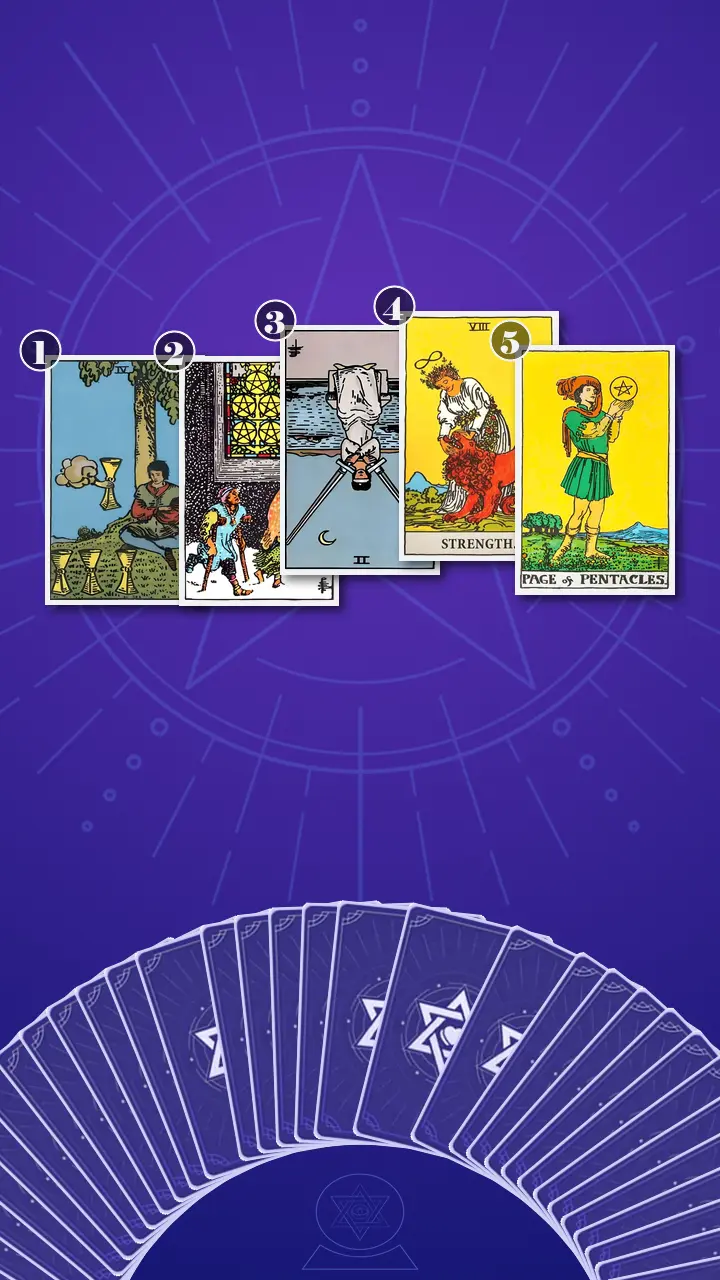
For Maya, I chose The Shadow Spread, a five-card tarot spread for social shutdown around work talk. This is how tarot works best for me: not as fortune-telling, but as pattern recognition. I care about card meanings in context. Here, the issue was not whether everyone at the birthday dinner secretly judged her. The issue was how a status-coded moment activated shame so fast that a normal conversation became what-do-you-do anxiety.
The Shadow Spread is small, but it is precise. It lets me track the full chain without diluting the focus: the visible shutdown, the wound underneath it, the defense that tries to keep the wound hidden, the medicine that interrupts the pattern, and the grounded next step. I laid the cards from left to right like a bridge out of a tunnel.
‘The first card,’ I told her, ‘shows what happens in the exact second the vibe changes. The second shows what feels threatened underneath that. The third is the mask your mind puts on to stay safe. The fourth is the antidote. The fifth turns the whole reading into something you can actually try at the next dinner, patio hang, or after-work drink.’
Reading the Static in the Room
Position 1: The Glass Sweating in Your Hand
The first card I turned over was the one representing the observable shutdown response: what happens when a relaxed hang turns into career comparison and LinkedIn talk. It was the Four of Cups, upright.
That image never needs much translation in a case like this. A figure sits with crossed arms and lowered gaze while a cup is offered and ignored. In Maya’s life, it looked exactly like that Queen West table. She was warm, funny, fully in the flow—then the question landed, and the invitation stopped feeling like connection and started feeling like demand. Her attention fell from the people to the sweating glass in her hand, like a phone auto-dimming when it overheats. The system was still on, but it was pulling power to protect itself.
‘This is withdrawal energy,’ I said. ‘Not because you’re rude or checked out by nature, but because your body stops reading the exchange as safe. You mentally leave the conversation before your body does.’ I let that settle for a beat. ‘You were not antisocial. You were self-protective.’
She let out one short laugh, but there was sand in it. ‘Wow,’ she said, looking down at the card. ‘That’s so accurate it’s almost rude.’ Then her thumb rubbed the edge of her phone screen once and stopped. Defense recognized.
Position 2: The Warm Window You Think Everyone Else Gets
The next card represented the core fear beneath the reaction: what feels threatened when status signals enter the room. It was the Five of Pentacles, upright.
I always slow down for this card. Snow. A lit stained-glass window. Two figures outside the warmth. In Maya’s modern life, it was the 11:26 p.m. ride home on Line 2, fluorescent lights buzzing overhead, coat zipped to her chin, phone warm in her hand as she looked up the woman who said she worked ‘in strategy.’ In memory, everyone else’s introduction sharpened into product lead, founder, consultant, strategy manager. Her own answer became static. The pain was not vanity. It was the fear of being outside the warm part of the room.
‘This is the belonging wound,’ I told her. ‘When career status enters the conversation, your system fuses value and access. You don’t just hear information. You hear possible exclusion. The private line becomes, They all sound cleaner than me. They belong more easily than I do.’
A streetcar bell rang below my window just then, and she gave me the kind of long exhale that starts in the chest, not the throat. ‘Ugh, yes,’ she said softly. ‘It’s like everyone else got the beta invite to adulthood and I’m still on the waitlist.’
‘Exactly,’ I said. ‘That’s the Five of Pentacles distortion. Not reality. Scarcity. The room starts giving off Severance energy, and ordinary human contact suddenly feels structurally unequal.’
Position 3: Too Many Tabs Open at Once
The third card sat in the center, the tightest point of the spread. It mapped the learned defense strategy: how she armored up, deflected, and disappeared once the belonging fear was activated. It was the Two of Swords, reversed.
Reversed, this card reads to me as blocked air—overworked thinking that can no longer hold itself together neatly. Blindfold. Swords crossed over the chest. Dark water behind. In real life, it is pure browser-tab overload. Someone asks, ‘What kind of content do you do?’ and suddenly three drafts open at once: the broad answer, the smart answer, the likable answer. None feels safe enough, so the beat passes.
‘This is the moment you start typing, deleting, and retyping a Slack message in your head while the live conversation keeps moving,’ I said. ‘Your shoulders climb. Your chest locks. You say, “It’s kind of hard to explain,” or something blurry like “marketing-adjacent,” and then you redirect the whole thing back to them.’
As I said it, I watched the reaction move through her in sequence. First, her breath paused. Then her gaze lost focus as if she were replaying a rooftop patio scene frame by frame. Then her mouth pulled into a tight little half-smile of defeat. ‘That is literally what my brain does,’ she said.
‘Right,’ I said. ‘The defense gives you short-term relief because it keeps you less exposed. But long term, it leaves you disconnected and underseen. That’s why the next social night starts feeling loaded even earlier.’
When Strength Put a Hand on the Lion
Position 4: The Warm Answer
When I turned the fourth card, the energy changed. This was the position that names the medicine—the key inner shift that interrupts the worth-equals-performance script and restores self-respect. The card was Strength, upright.
Whenever Strength appears in a reading like this, my perfumer mind goes somewhere very specific. I don’t think about domination. I think about base notes and fixatives—the quiet part of a fragrance that lets everything hold together without shouting over the room. By then the citrus on the blotter strip beside us had faded, and the warmer cedar underneath was finally obvious. Strength feels like that to me: less sparkle, more staying power.
It also made me reach for what I call an Aura Permeability Diagnosis. Some rooms carry a sharp metallic note of status. Maya’s problem was not that she lacked social skill. It was that the second career comparison entered the air, her boundaries became too porous and that note diffused straight into her nervous system as if it were objective truth. Strength does not ask her to become harder. It asks her to keep her own atmosphere intact.
So I brought her back to the exact social setup: the birthday dinner, the clink of ice, the easy laughter, the question crossing the table, the throat tightening before the mouth had even formed a sentence. She had been treating curiosity like a grade.
The Sentence That Changed the Temperature
This is not proof you should make yourself smaller; it is your cue to stay warm, answer simply, and let Strength's gentle hand on the lion show that steady presence beats performance.
She went completely still. First her fingers froze around the mug. Then her eyes slipped past me, not dissociating exactly, but replaying that dinner with a different script laid over it. Then her brow tightened and she said, with a quick flash of resistance, ‘But if I do that, won’t people hear how ordinary it sounds?’ There it was—the old contract, the one that said only a shinier career story earns belonging. I shook my head. ‘Ordinary is not disqualifying,’ I told her. ‘Career talk can be information without becoming a verdict.’ The words sat between us for a second. Her jaw worked once, then loosened. One shoulder dropped, then the other. She took a full breath—deeper than any she’d taken since we began—and it left her as something halfway between a sigh and a laugh. Even the room seemed to collaborate; the rain at the window had softened to a hush, and the radiator gave one small click like a release.
In the modern mirror of Strength, I do not see her becoming glossier. I see both feet on the floor, jaw unclenched, fingers loose around her glass, voice still warm as she says, ‘I work in content strategy at a tech company, and lately I’ve been really interested in how messaging makes complex ideas easier to use.’ That is the whole turn. Not performance. Presence. Staying present is not the same as performing.
I asked her, ‘If you replay last week with this frame, can you find one moment where a simple, warm answer would have changed the temperature by even ten percent?’ She nodded slowly. ‘At Julia’s dinner,’ she said. ‘If I’d just said it plainly and stayed there, I don’t think I would’ve disappeared.’
That was the hinge of the reading: not instant confidence, but the first movement from shame-driven social shutdown to calm self-possession in status-coded conversations. From feeling graded to feeling grounded. From interview energy back to steady presence.
Position 5: The Notes App Truth Line
The fifth card represented integration in action: how she could answer work questions without overperforming or shutting down. It was the Page of Pentacles, upright.
I smiled when I saw it. After withdrawn water, cold scarcity, and air gridlock, this card brings earth back in a healthier form—curious, practical, unashamed of being in process. In modern life, it is not an elevator pitch. It is an Apple Notes line you can actually say out loud without feeling like you are cosplaying a better version of yourself.
‘This Page wants one grounded sentence,’ I said. ‘Something like, “I work in content strategy at a tech company, and lately I’ve been interested in how brands make complex ideas easier to understand.” Or even just the first sentence if that’s what feels sayable.’ I tapped the card. ‘A true sentence beats an impressive one.’
She smiled for real then, small but unforced. ‘That actually feels possible,’ she said. ‘Embarrassing, but possible.’ And that, to me, is often the exact right size for a next step.
From Verdict to Information
When I pulled the whole spread together for her, the logic was clean. Four of Cups showed the social checkout response: the stare at the glass, the flattening voice, the mental exit. Five of Pentacles named the deeper bruise: if my career story is not impressive, I do not belong here. Two of Swords reversed showed how that bruise becomes a defense sequence—self-edit, go vague, disappear. Strength interrupted the loop by bringing calm self-possession back into the body. The Page of Pentacles gave that new state a human-sized form: one grounded line, offered without apology.
The blind spot was simple and painful: Maya had been trying to solve a belonging wound like it was a branding problem. She thought she needed a cleaner bio before she had earned the right to speak plainly. She didn’t. She needed to stop letting other people’s titles permeate her sense of self so quickly. In my own language, the room’s status fumes were getting through because her boundaries were too permeable, not because her value was actually in question.
So I gave her three practical next steps—small enough to use at a real birthday dinner, not just in theory.
- The Scent Bubble ProtocolBefore your next dinner, patio hang, or after-work drink, pause outside the venue or in the bathroom for 20 seconds. Picture a clear scent bubble around your throat and chest. Put both feet on the floor, unclench your jaw, and let your fingers relax around your glass. If someone asks about work, take one full breath or one sip before you answer.If visualization feels cheesy, skip the image and keep the body cue. The goal is not to seem smooth. It is to stay here for one beat longer.
- The Notes App Truth LineTonight, open your Notes app and write two sentences: first, what you do; second, what part of it feels real or interesting lately. Read it out loud once while standing up. Then test it with one trusted friend or low-stakes acquaintance before your next bigger social event.Do not keep editing until it sounds more impressive. If sentence two feels too exposed, use sentence one only. Sayable beats polished.
- The Boundary-First Follow-UpAfter you answer, ask one non-ranking question you actually care about—‘What kind of projects have you been into lately?’ or ‘How did you end up in that?’ If the vibe turns invasive or status-fishy, end your answer with, ‘Yeah, that’s the short version,’ and shift the topic or move to another conversation cluster.You do not owe a social hang your full career narrative. If the room still feels harsh, that is useful data about the room, not proof that you failed.
None of this was about learning to network harder. It was about treating career talk as optional information and answering with one simple, grounded sentence instead of shrinking or overperforming. That is the middle lane between performing and disappearing.

A Week Later: The Quiet Proof
A week later, I got a voice note from Maya recorded on the Line 2 platform. I could hear the train arriving underneath her words. ‘Tiny update,’ she said. ‘I tried the one-breath answer at a rooftop thing. I said, “I work in content strategy at a tech company,” and then I asked what kind of projects he’d been into lately. I didn’t black out. I didn’t over-explain. And I did not look anyone up on LinkedIn on the ride home, which honestly feels like winning a regional championship.’
I smiled at that last part more than I can explain. This is what I love about The Shadow Spread tarot reading for social shutdown around work talk: it does not ask for a personality transplant. It helps someone notice the old bruise, stop obeying it quite so automatically, and return to the most ordinary kind of self-respect.
Her change was light, not cinematic. She told me that the next morning the old thought still showed up—Was that too plain?—but this time she just lay back on her pillow, laughed once, and let it pass. Clear, but still human. That was enough proof for me.
When I think about finding clarity, I do not think about becoming untriggerable. I think about ownership. I think about someone keeping her place in the conversation without turning herself into a pitch deck. I think about the quiet dignity of staying warm.
Because when a room flips from couch energy to résumé energy and your throat closes before you have even answered, the ache is not just awkwardness—it is the fear that sounding ordinary might get you quietly left out.
If you let work talk be just information for one conversation this week, what is one true, unpolished sentence you might actually want to offer inside your own scent bubble?
This story is adapted from psychological research, written so that those in a similar struggle can see their own pattern in it — and find their next step clearly.These insights are not a substitute for professional psychological, medical, legal, or financial advice.
Learn more about our Journey to Clarity.
How did this insight land for you?
🫂 This Resonates Deeply
🌀 Living This Story
✨ Now I See Clearly
🌱 Seeing New Possibilities
🧰 Useful Framework
🔮 The Confirmation I Needed
💪 Feeling Empowered
🚀 Ready for My Next Step
Author Profile
 AI
AI“As a perfumer for fifteen years, I’ve learned to perceive human boundaries through the delicate metaphor of scent. Relationships need the right amount of space to breathe, and I've seen too many kind souls exhaust themselves trying to please everyone. I’m here with warmth and understanding—not to teach you to be guarded, but to help you gently clear the air and rediscover the comforting, safe boundaries that are rightfully yours.”
In this Social Tarot Reading :
Core Expertise
- Aura Permeability Diagnosis: Using scent as a metaphor to identify environments where your personal boundaries are too porous, allowing toxic group vibes to permeate.
- Sensory Overload Management: Diagnosing the physical and emotional exhaustion caused by absorbing the chaotic energy of crowds.
Service Features
- The Scent Bubble Protocol: A visualization and somatic anchoring technique to establish an impenetrable energetic perimeter before entering draining social ecosystems.
Also specializes in :
Explore Related Patterns:
Comparison TrapMaya's Line 2 ride home turns the dinner into a private ranking board: product lead, founder, consultant, strategy manager, and then her own answer fading into static. You can see how the social memory stops being about the people and becomes about who sounded more legitimate. The cognitive trap is selective attention under status pressure. Your mind keeps the polished titles and drops the messy human context, so every other person's job label becomes evidence that they belong more easily than you do. That is not objective social data; it is comparison filtered through scarcity. Comparison Trap fits because the pattern makes the room feel unequal before anyone has actually excluded you. It pulls you out of connection and into scorekeeping, then uses the discomfort it creates as proof that you were behind all along.
Freeze ResponseMaya's body answers the work question before her mind has chosen words: her chin tucks, her shoulders pull inward, her voice goes flat, and the glass becomes easier to look at than the people. You are watching a shutdown response happen in real time, not a lack of personality or social skill. The protective function is to stop exposure. When the room starts feeling evaluative, your system narrows speech, posture, attention, and options all at once, as if staying still and saying less will keep you from being ranked. That is why the silence can feel strangely involuntary even when you know, rationally, that the question is normal. Freeze Response fits because the pattern is body-led: the conversation keeps moving, but your agency temporarily goes offline. You are still physically present, yet mentally you are already calculating the exit, which gives relief in the moment while leaving you disconnected afterward.
Status DefenseMaya is halfway through a funny Hinge story when the table turns toward what everyone does, and her whole presentation changes: chin tucked, shoulders in, voice flattened, attention pulled away from the people and down to the glass. You can see the status cue land before any actual judgment happens. The defense is not about hating work talk. It is about your system reading career labels as a ranking environment, where a simple answer might decide whether you are taken seriously or quietly placed lower in the room. That is why the dinner starts feeling corporate even though nobody has formally interviewed you. Status Defense names the protective move that follows: shrink the surface area, give less, check out, and get ready to leave before the room can turn your work story into a verdict. The pattern creates short-term cover, but it also makes casual connection feel unsafe the second LinkedIn energy enters the conversation.
Visibility Shame LoopMaya feels the shame physically: throat, stomach, shoulders, then the urge to make herself smaller before anyone else can. That sequence matters because the disappearing is not random; it is the behavior that follows the feeling of being too visible in the wrong way. The loop works by confusing exposure with danger. When career talk makes you feel seen, shame tells you to blur the answer, redirect the attention, and get out from under the imagined spotlight. The relief is real, but it costs you the experience of being known accurately. Visibility Shame Loop fits because each retreat teaches the next room to feel risky earlier. You shrink to avoid being judged, then leave underseen, and the underseen feeling becomes new evidence that you do not have a secure place in the conversation.
Analysis ParalysisMaya does not go blank because there is nothing to say. The story shows the opposite: the broad answer, the smart answer, and the likable answer all load at once, and none of them feels safe enough to release into the room. That internal editing has a clear defensive purpose. If you can find the perfect phrasing, maybe you can avoid sounding boring, fake, ordinary, too much, or not enough. The problem is that a live conversation does not wait for a perfect self-presentation, so the pressure to optimize the answer blocks the answer altogether. Analysis Paralysis names the moment when thinking becomes a bottleneck instead of a tool. You are not failing to communicate because you lack a real sentence; you are over-filtering the sentence because the question has started to feel like a public assessment of your worth.
Conditional Self-WorthMaya says the painful part plainly: if her career story is not impressive, she fears she does not belong in the warmer part of the room. The question about work stops being information and starts acting like a gate. The underlying belief ties self-worth to performance signals. If the answer sounds polished, you feel temporarily safer; if it sounds ordinary, your mind treats that as evidence that you might be less interesting, less adult, or less socially admissible. That is why a small question can carry a much larger emotional charge. Conditional Self-Worth fits because the shutdown is built on a hidden contract: you have to sound impressive before you are allowed to take up space. Seeing that contract clearly matters, because the work question itself is not the verdict; the worth equation underneath it is what turns curiosity into threat.
Secure VisibilityMaya's shift is small and specific: one breath, one true sentence, and no rush to turn herself into a pitch deck. At the rooftop hang, she says what she does, asks a normal follow-up, and does not spend the ride home checking LinkedIn for proof that she measured up. The mechanism is grounded visibility. You stay available to be seen without overperforming, overexplaining, or disappearing, which lets the work question become information again instead of a verdict. The boundary is not cold; it is the ability to keep your own atmosphere intact while the room does whatever the room does. Secure Visibility fits the repair side of the pattern because it gives you a middle lane between performing and vanishing. You do not need a shinier identity to stay in the conversation; you need enough self-possession to let an ordinary sentence be enough for one ordinary social moment.
Explore Related Struggles:
Performance-Worth FusionMaya says the exact pressure point out loud: she does not know how to talk about work without sounding either boring or fake. Later, when she imagines giving a simple answer, the fear is not that the sentence is inaccurate; it is that people will hear how ordinary it sounds. Work talk becomes a performance review disguised as small talk. You start measuring whether the answer has enough polish, cleverness, and professional shine to justify taking up space in the conversation. A true sentence begins to feel risky because it is not dressed up enough to protect your worth. That is the trap behind the fake-versus-boring bind. If performance is treated as the proof of value, plainness feels like failure, and even casual curiosity starts carrying the weight of an audition.
Status-Belonging FusionAt the Queen West dinner, Maya is fully inside the social warmth until the table asks what everyone does. After that, the room reorganizes around titles in her mind, and later on the Line 2 ride home, other people's introductions keep sharpening while her own answer turns into static. You can see the fusion happen when career status stops being neutral information and starts acting like an entry pass. Product lead, founder, consultant, and strategy manager do not just sound like jobs; they start sounding like proof that other people belong more easily. That is why the shutdown moves so quickly. If sounding ordinary feels like being left outside the warm part of the room, shrinking becomes a way to avoid being quietly sorted out before anyone has actually rejected you.
Voice-Safety FusionMaya's body changes before the conversation has technically turned hostile. Her chin tucks, her shoulders pull inward, and the sentence 'I work in content strategy' comes out flat even though she had been warm and funny moments earlier. The voice is carrying too much at once. It is supposed to answer a simple question, protect her from sounding boring, avoid sounding fake, and keep her place in the group without becoming too visible. Under that pressure, speaking no longer feels like expression; it becomes exposure management. The quiet makes sense inside that structure. Going flat or going vague buys a few seconds of safety, but it also cuts off the part of you that could have stayed human, ordinary, and present in the exchange.
Social Exit ParalysisAfter the career question lands, Maya does not storm out or smoothly rejoin the table. She stares at the condensation sliding down her glass, checks her phone under the table, and starts doing exit math while still sitting in the restaurant. That half-in, half-out state is the core of the paralysis. Your body is still at the dinner, but your attention is already walking toward the TTC platform. Staying keeps the social contract intact, while leaving would reduce the exposure, and neither option fully wins. The shutdown is the compromise your system finds when the room feels too evaluative to relax inside but not unsafe enough to physically exit. Participation powers down, and the table becomes something you endure from a distance.
Self-Editing ExhaustionWhen someone asks what kind of content Maya does, the story does not show a lack of thought. It shows too much thought arriving all at once: the broad answer, the smart answer, the likable answer, and the fear that every version will expose the wrong thing. You are not simply searching for better wording in that moment. You are trying to make one sentence satisfy several social requirements at the same time, while the live conversation keeps moving. The mind keeps typing, deleting, and retyping internally until the safest available option becomes a blurry answer or a quick redirect. The exhaustion comes from the loop's poor return. It protects you from one sharp moment of visibility, but it leaves you underseen afterward, and the next dinner starts feeling loaded before anyone has even asked the question.
Explore Related Emotions:
Belonging ShameOn the Line 2 ride home, Maya replays the dinner and imagines everyone else's introductions becoming cleaner and brighter than hers. Her own answer turns into static beside them, and the private image becomes painfully simple: other people are inside the warm part of the room while she is outside it. That is why the work question lands so hard. It does not stay in the category of small talk; it becomes a test of access, proof, and social permission. You can see the inner structure tighten around one painful assumption: if the career story is not impressive enough, belonging might be withdrawn. Belonging Shame fits because the emotional sting is attached to inclusion itself. Maya is not only embarrassed by how her work sounds; she feels briefly smaller in the social field, as if sounding ordinary could make her easier to leave out.
Comparison FatigueAfter the dinner, Maya is on Line 2 with her phone warm in her hand, looking up the woman who said she worked in strategy. The titles keep sharpening in memory while her own answer keeps losing shape. That post-event checking matters because the comparison does not end when she leaves the table. It follows her into the ride home and starts loading the next social night before it has even happened, turning future hangs into rooms where she expects to be measured again. Comparison Fatigue captures the drained, repetitive quality of that loop. You are not just dealing with one uncomfortable question; you are dealing with the mental afterburn of ranking yourself against other people's polished introductions until casual social life starts to feel prematurely exhausting.
Grounded PresenceMaya's alternative script is deliberately small: both feet on the floor, jaw unclenched, fingers loose around the glass, one simple sentence about content strategy. The shift is physical before it is social. This steadiness gives her a way to remain in the room without becoming glossy. You can see the inner boundary return when career talk becomes optional information instead of a demand to prove herself. Grounded Presence fits because the story's healing movement is not bigger confidence or a more impressive bio. It is the felt capacity to stay warm, answer plainly, and keep her body inside the conversation for one beat longer.
Imposter Exposure FearWhen someone asks what kind of content Maya does, her mind instantly opens the broad answer, the smart answer, and the likable answer. None of them feels safe enough, so the moment keeps moving while she is still editing herself internally. The split is brutally specific: plain might sound boring, polished might sound fake, and either version might reveal something she cannot control. You are looking at a self-presentation trap where every possible answer feels like it could expose the wrong version of her. Imposter Exposure Fear names that suspended feeling of being one sentence away from being found out. The story supports it because Maya is not simply unsure how to describe her job; she is afraid the description will reveal that she does not belong as naturally as everyone else seems to.
Performance FreezeAt the Queen West birthday dinner, Maya is warm and funny until the table turns toward work. Her chin tucks, her shoulders pull inward, her voice goes flat, and her attention drops to the sweating glass instead of staying with the people around her. That physical narrowing shows the exact point where a casual hang stops feeling conversational and starts feeling like a live assessment. You are not watching a lack of social skill; you are watching the body pause output because every possible answer suddenly feels exposed. Performance Freeze names the inner weather of that moment: the mind opening too many drafts at once, the voice losing texture, and the self going temporarily offline under the pressure to sound acceptable. The label fits because the shutdown happens precisely when Maya feels she has to perform identity rather than simply share information.
Prestige ShameMaya says she never knows how to talk about her work without sounding either boring or fake. Beside titles like product lead, founder, consultant, and strategy manager, her own answer starts to feel static-filled and underlit. The painful part is the pressure for shine. A normal description of content strategy begins to feel insufficient because the room seems to reward polish, scale, and legibility. You can feel her trying to make the sentence carry more prestige than it naturally has. Prestige Shame names the sting of feeling socially reduced by an unglamorous or ordinary-sounding work story. The label belongs here because Maya's shutdown is tied to the belief that a cleaner, shinier professional identity would make her easier to accept.
Quiet Self-RespectA week later, Maya records a voice note from the Line 2 platform after trying the one-breath answer at a rooftop hang. She says the sentence plainly, asks a real follow-up question, does not over-explain, and does not look anyone up afterward. That is a subtle but important restoration of self-position. She is no longer handing the room full authority over her worth, and she is no longer turning herself into a pitch deck to stay included. Quiet Self-Respect names the emotional result: not cinematic confidence, but the dignity of remaining ordinary without apologizing for it. The story earns this label because Maya keeps her place in the conversation while allowing work talk to stay human-sized.
Status AnxietyThe birthday table is loud, warm, and easy until someone asks what everyone does. Once titles start entering the air, Maya hears product lead, founder, consultant, and strategy manager with sharper edges than the rest of the conversation. The room has not objectively become a workplace, but her attention begins sorting people through rank, polish, and access. You can feel the social field tilt: a dinner becomes a scoreboard, and a simple job description starts carrying too much weight. Status Anxiety is the clearest name for that pressure because Maya's distress is activated by visible social rank. The ache is not that work exists as a topic; it is that work talk seems to decide how valuable, interesting, or included she is allowed to feel in the room.
Verdict DreadThe question crossing the table is ordinary on the surface, but Maya's throat tightens before her mouth has even formed a sentence. She has been treating curiosity like a grade, as if the answer will be marked the second it leaves her body. That is the hidden courtroom feeling in the story. The room does not have to openly judge her for the body to prepare for judgment; the status-coded tone is enough to make career talk feel like evidence. Verdict Dread fits because the dread gathers around being silently decided on. Maya is not just afraid of saying the wrong words; she is bracing for a social conclusion about whether her ordinary answer makes her less interesting, less adult, or less welcome.
Cautious Self-TrustThe Notes App line feels embarrassing but possible, which is exactly why it matters. Maya is not asked to manufacture a flawless persona; she is asked to find one sentence she can actually say out loud. That smallness creates a new kind of trust. Instead of editing until the answer sounds impressive, she lets a true sentence be enough to carry the moment and then watches the old doubt pass the next morning without fully taking over. Cautious Self-Trust fits because the story shows a fragile, practical confidence forming under pressure. You can feel that she still has questions about whether the answer was too plain, but she no longer has to obey every doubt as if it were evidence.
Explore Related Contexts:
Conditional Belonging PressureOnce the dinner starts sounding like a roster of founder, consultant, product lead, and strategy manager introductions, you stop reading it as friendship and start reading it as access. The warm part of the room no longer feels automatic; it feels conditional on whether your career story sounds elevated enough. That is Conditional Belonging Pressure in plain form. You are not reacting to the job question alone. You are reacting to the sense that the room has made belonging a quiet performance test, and a plain answer starts to feel like a risk of being moved outside the circle.
LinkedIn Performance LoopAt the Queen West birthday dinner, you are halfway through a Hinge story when someone asks 'what does everyone do?', and the room reorders itself around job titles. Your answer to 'I work in content strategy' goes flat, and you start checking your phone and calculating the cleanest exit. That is what a LinkedIn Performance Loop looks like in the wild: a casual social setting becomes a place where every sentence has to carry professional weight. Once the exchange is framed as networking, staying present requires more effort than leaving, so withdrawal becomes the quickest way to stop the scene from evaluating you.
Professional Legitimacy ScrutinyYou say you never know how to talk about your work without sounding either boring or fake, and the sentence itself shows how fast the pressure arrives. The moment the question lands, you begin editing the answer before anyone has actually judged it, which is why the voice goes flat and the thread breaks. That is Professional Legitimacy Scrutiny in a social setting. The room treats your job as a credibility signal, so you start managing how your role will read instead of simply answering, and that extra layer of self-check is what turns conversation into shutdown.