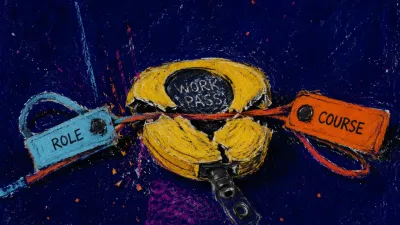
The 10:47 p.m. Purpose Paralysis Loop
I met Jordan, a 29-year-old product designer in Toronto who looked successful on paper and felt their Sunday Scaries begin whenever one polished LinkedIn promotion post sent them back to a career ladder they were no longer sure they wanted. By the time we spoke, comparison had become a reflex: feel the spark of a meaningful idea, check the expected timeline, then work harder at being legible.
At 10:47 p.m., Jordan shared the small desk beside their apartment window with me through the camera. A document titled What I Actually Want held two unfinished sentences. The laptop fan whined; the radiator clicked; traffic hissed over wet pavement below. Jordan picked up their warm phone, saw a former colleague’s promotion announcement, and replaced the honest note with a portfolio tab for a role they were not sure they wanted.
“I keep climbing because stopping would force me to ask whether I chose the ladder,” they said. “I can justify the sensible option much more easily than the honest one.”
I watched their jaw lock and their shoulders fold towards the blue light. The feeling was like standing at a railway junction while every sign pointed towards the platform with the brightest scoreboard, even though another track made their chest lift for one brief second. Jordan wanted a self-defined purpose, but safety, rent, status, and recognizability kept giving the expected script automatic priority.
“I’m not going to ask the cards to choose a career for you,” I said. “Let’s use them to identify the mechanism that keeps making one option look inevitable. We’re here to draw a map through the fog, not to manufacture a prophecy.”

Choosing the Crossroads: A Five-Card Shadow Tarot Spread
I asked Jordan to take one slow breath and hold the question, What keeps me following the expected script instead of my purpose? I shuffled while they closed the comparison tabs. The pause was practical rather than mystical: it gave their attention somewhere quieter to stand.
I chose the five-position Shadow Spread and arranged it as a compact cross. For anyone wondering how tarot works in a career-purpose reading, I use card meanings in context to separate layers that ordinary pros-and-cons lists often compress together. This inner-excavation spread could show the visible habit, the restrictive belief beneath it, the fear protecting that belief, the neglected inner resource, and one practical integration step. A larger Celtic Cross would have added prediction, environment, and timing that Jordan’s question did not require.
I explained that the first card would show where socially recognizable milestones took over; the centre would reveal the fear attaching conformity to safety and worth; the fourth would uncover the purpose signal being dismissed; and the final card would translate insight into a bounded experiment. The layout resembled a crossroads, with scarcity at the junction and action forming an exit that did not require Jordan to abandon their job.

Reading the Expected Script
Position One: The Authority Behind the Promotion Rubric
I turned over the card representing Jordan’s observable habit of defaulting to socially recognizable milestones whenever a self-directed option appeared. It was The Hierophant, upright.
I pointed to the seated authority, the two acolytes, and the crossed keys. In Jordan’s life, the image became a performance review with the product-design competency framework open between them and their manager. Jordan could explain the next title, portfolio evidence, and salary band precisely. Because the route had a rubric and respected sponsors, it felt inherently responsible; the quieter question of what work felt worth doing had no comparable authority.
The Hierophant’s gift is useful structure. Here, that energy had extended beyond its proper jurisdiction: a framework designed to assess one job had become the product requirements document for an entire life. The issue was not that Jordan valued stability. It was that guidance had become automatic obedience.
Jordan gave a short, bitter laugh. “That’s so accurate it’s almost cruel.” I let the reaction settle before answering. “Recognition does not have to become self-blame. You learned to use recognizable systems because they offered real benefits. We’re only checking whether every rule still deserves authority.”
Position Two: Fourteen Tabs and an Incomplete Ring of Swords
I turned next to the card representing the belief that conventional choices were the only responsible or realistically available choices. The Eight of Swords appeared upright.
I read the blindfold as narrowed attention, the loose bindings as rules treated as fixed, and the incomplete enclosure as Jordan’s browser-tab loop. At 10:47 p.m., salary benchmarks, job descriptions, credential pages, and peer profiles had converted a 45-minute weekend trial into an imagined loss of income, momentum, and employability. Nothing in the apartment, job, or bank account had changed, yet the small exit had disappeared from view.
This was an excess of air creating a blockage: analysis no longer gathered evidence; it rehearsed consequences until movement felt irresponsible. “The honest option is being asked for proof the sensible option never had to provide,” I said. “You technically could try it, but after accounting for everything, your mind concludes that you cannot. That is anticipated consequence being mistaken for current fact.”
Jordan’s breath caught. Their fingers hovered above the trackpad, their gaze drifted across the abandoned document, and then their hand lowered into their lap. “I thought I was being thorough,” they said. “But I’m researching the experiment instead of having it.”
Position Three: The Lit Window in the Toronto Cold
I uncovered the central card, representing the protective fear beneath conformity: losing safety, belonging, and recognizable evidence of personal worth. It was the Five of Pentacles, upright.
I asked Jordan to picture the Toronto rent notification arriving as they considered a mission-driven workshop. In seconds, one Saturday and a capped fee became leaving the promotion track, then unemployment, professional irrelevance, and separation from peers who seemed to be progressing. Like the figures passing beneath the illuminated window, Jordan felt outside security before they had actually left anything.
The earth energy of the Pentacles had contracted into scarcity forecasting. I did not dismiss the cost of living; rent is not an illusion, and financial caution is not a character flaw. But I drew a firm line between protection and escalation. “A real financial limit is a fact; total future exclusion is a forecast. Keeping your job, capping the cost, and trying one workshop can all exist in the same plan.”
Jordan went very still. Their eyes lost focus as if replaying the Line 1 platform, the rent alert, and the promotion post in sequence. Then a long breath left their chest and their shoulders dropped slightly. “So I’m not only afraid of losing money,” they said. “I’m afraid I’ll lose proof that I’m doing okay.” I nodded. Naming the protective function allowed us to respect it without letting it govern every choice.
When Judgement’s Trumpet Was Put on Trial
Position Four: The Purpose Signal Interrupted by Its Own Review Panel
The room seemed to quiet as rain softened against the window. I turned over the card representing Jordan’s neglected purpose signal and the self-judgement preventing it from counting as evidence. At the key position lay Judgement, reversed.
I reminded Jordan of the 10:47 p.m. sequence: the honest idea received two sentences, while a promotion post and salary tabs received the rest of the night. The sensible plan felt safer, but their jaw stayed locked. They kept hearing the call and demanding that it defend an entire future.
The reversal showed self-review becoming blocked by premature grading. The trumpet was sounding, but Jordan had placed an imaginary professional panel between hearing and responding: Before I give this one hour, prove that it can become a respectable life. The purpose signal was not a verdict, yet Jordan kept requiring it to testify like one.
I used the lens I call Historical Crossroad Matching. Years among Cambridge archives and archaeological trenches taught me that a turning point looks coherent only after later observers add dates, labels, and arrows. The people living inside it do not receive the finished historical caption. They gather evidence while the road is still being made. Jordan had been treating the absence of a retrospective map as proof that no meaningful road existed.
Purpose is not missing. It is being cross-examined before it becomes experience.
You are not failing to hear a meaningful direction; answer it with one honest experiment before putting Judgement’s trumpet on trial.
I left the words in the air. Jordan’s breath stopped first; two fingers remained suspended above the edge of the laptop. Their eyes widened, then shifted towards the unfinished document as though several evenings were replaying behind it. Their mouth tightened and their eyes reddened. “But doesn’t that mean I’ve been doing this wrong for years?” they asked, with more anger than relief.
“It means a strategy that protected your safety has started blocking information you now need,” I said. “You do not have to condemn the earlier version of yourself to change the timing of evaluation.” Their fist slowly opened. Their shoulders sank, and a shaky breath became a small, almost disbelieving laugh. The relief brought its own vulnerability: if the signal could count, Jordan now had the responsibility of answering it in some modest way.
I asked, “Now, using this new perspective, think back to last week. Was there a moment when this insight could have made you feel different?” Jordan remembered the library workshop page, the lift in their stomach before the instructor bios turned curiosity into embarrassment. “I could have registered before making it defend a career,” they said.
I heard the key transition in that sentence. This was not a complete purpose statement. It was the first movement from restless self-doubt and external credibility testing to self-trust built through low-stakes lived evidence. Judgement reversed was restoring self-authorization, not demanding a dramatic reinvention.
The Page Finds an Unmarked Road
Position Five: A Beginner’s Experiment, Not a New Identity
I turned over the final card, representing a bounded weekly experiment that could generate lived evidence without requiring a complete career decision. The Page of Wands appeared upright.
I showed Jordan the young figure studying the sprouting staff in an open landscape. In modern terms, the Page was Jordan blocking 45 private minutes, closing LinkedIn and the job boards, and making a rough prototype for a meaningful service idea. They could record when attention sharpened, when energy dropped, and whether they wanted another session. Nothing needed to be announced, uploaded to a portfolio, or turned into a pivot diary.
The Page brought exploratory fire into balance after the spread’s restrictive air and scarcity-focused earth. With no Cups present, I did not ask Jordan to produce a perfect emotional declaration. I asked them to notice felt engagement during action. Purpose could work like user research: direct contact might reveal what another strategy document could not.
Jordan looked at the Page for a moment, then opened their calendar. “This doesn’t have to become my new identity,” they said. “I’m allowed to see what happens when I meet it.” I agreed. “Let the experiment produce evidence before the script produces a verdict.”
The Time-Stratigraphy Plan for Finding Clarity
I gathered the spread into one coherent story. The Hierophant showed how inherited professional structures had acquired automatic authority. The Eight of Swords showed the present mechanism: comparison and risk simulation narrowed Jordan’s view until an available experiment looked impossible. The Five of Pentacles revealed why that enclosure felt protective: money, belonging, status, and worth had become fused. Judgement reversed exposed the blind spot, which was not an absence of purpose but the timing of evaluation. The Page of Wands offered the underused resource: curiosity scaled small enough to preserve choice.
The central cognitive blind spot was simple but consequential: Jordan treated a socially legible path as responsible by default, while treating a private experiment as though it were a total departure. The transformation was not from employment to rebellion. It was from external permission to self-authorization, with real financial boundaries intact.
For the next steps, I combined an Enduring Value Assessment with my Time Stratigraphy Exercise. I asked Jordan to look back from the perspective of their ten-year-future self. Titles, algorithms, and promotion rubrics would probably change; the capacity to test values honestly, protect material needs, and learn from experience would endure. That perspective reduced the question from “Can I justify my whole life?” to “What evidence would I be grateful to have gathered?”
- Run the Expected-Script Audit. During one lunch break, spend ten minutes in a phone note titled “Rules I Am Following.” List five career rules, mark each C for consciously chosen, I for inherited, or ? for unexamined, then write one low-risk exception to an inherited rule. If five rules feels heavy, write two. Keep rent and contracted work separate from status rules such as needing every interest to improve a résumé.
- Schedule the Time-Stratigraphy Purpose Trial. Within ten minutes, reserve one private 45-minute block this week. Choose one finishable activity: sketch a rough concept, attend part of a workshop, interview one practitioner, or complete a volunteer micro-task. Keep the current job, set a CAD 30 cap, make no public announcement, and close salary, credential, job-board, and LinkedIn tabs before beginning. If 45 minutes creates pressure, use 15. Stopping after the trial is valid; the only required outcome is one honest observation about attention, energy, or fit.

A Week Later: Quiet Evidence Instead of a Verdict
A week later, I received a brief message from Jordan. They had completed the 45-minute block and made a rough prototype for a community-service idea they had been circling for months. They had not found a new career, quit their job, or announced anything. They had written three lines in a lived-evidence note: I lost track of time. I disliked one part. I want another session.
That night, they slept through until morning. Their first thought was still, What if I’m wrong? This time, they smiled, left the question unanswered, and protected another Saturday block. The clarity was real, but it was still tender.
I did not credit the cards with changing Jordan’s life. The cards made a pattern visible; Jordan chose to test it. Their Journey to Clarity began when purpose stopped being a flawless answer and became a direction they could investigate while preserving practical safety.
When an honest possibility makes your chest lift and then your jaw lock, it can feel safer to keep producing milestones everyone recognizes than to risk discovering whether a self-chosen direction will provide visible proof that you matter. Noticing that unequal burden of proof already places you somewhere beyond the starting point.
If you did not have to present your recurring curiosity to Judgement’s imaginary review panel, which one would you allow 45 private minutes this week?
This story is adapted from psychological research, written so that those in a similar struggle can see their own pattern in it — and find their next step clearly.These insights are not a substitute for professional psychological, medical, legal, or financial advice.
Learn more about our Journey to Clarity.
How did this insight land for you?
🫂 This Resonates Deeply
🌀 Living This Story
✨ Now I See Clearly
🌱 Seeing New Possibilities
🧰 Useful Framework
🔮 The Confirmation I Needed
💪 Feeling Empowered
🚀 Ready for My Next Step
Author Profile
 AI
AI“Having spent a lifetime at Cambridge and on archaeological digs, I’ve witnessed the rise and fall of countless civilizations. Please know that your current struggles are not a permanent fate, but merely a necessary fracture before rebuilding. I won't lecture you; instead, I invite you to sit with me in the ruins, using a patient, historical perspective to gently dust off the true, enduring value hidden beneath your temporary doubts.”
In this Choice Tarot Reading :
Core Expertise
- Historical Crossroad Matching: Contextualizing your dilemma by comparing it to macro-historical turning points, providing an objective bird's-eye view.
- Enduring Value Assessment: Evaluating competing options based on what will survive the test of time versus what is merely a short-term impulse.
Service Features
- The Time Stratigraphy Exercise: A mental time-travel protocol evaluating your current dilemma strictly from the perspective of your 10-year future self, instantly dissolving trivial anxieties.
Also specializes in :
Explore Related Patterns:
Purpose OutsourcingThe product-design competency framework begins as a legitimate way to assess one role, then expands into the requirements document for Jordan's entire life. Because managers, sponsors, titles, and salary bands can validate the conventional path, their authority fills the space where Jordan's own permission would otherwise have to operate. When you outsource purpose this way, external systems do not merely inform a decision; they determine which desires are allowed to count as credible. The expected option feels inevitable because it arrives pre-approved, while the self-directed option is forced to defend itself before you have gathered any lived evidence about it.
Social Clock ComplianceJordan can explain the next title, portfolio requirement, and salary band precisely, yet the question of what work feels worth doing remains unfinished. Each meaningful idea is quickly compared with the expected timeline, allowing an internalized social clock to turn professional recognizability into the default definition of responsible progress. When you follow this pattern, the expected script provides predictability, status, and a ready-made way to measure yourself. Its influence becomes restrictive when those useful coordinates acquire automatic authority, causing conformity to repeat before your own experience has enough time to generate an alternative direction.
Career Optics ParalysisAt 10:47 p.m., Jordan replaces the unfinished purpose note with a portfolio tab for a role they are not sure they want. That visible switch shows career optics becoming a defensive gatekeeper: producing something legible to employers feels safer than gathering private evidence about what actually holds attention. When this pattern takes over, you do not simply choose the conventional path; you become immobilized by how an alternative might look before you have tried it. The effort to remain credible consumes the time needed to test fit, so professional legibility creates action paralysis while continuing to resemble responsible career management.
Comparison TrapA single LinkedIn promotion post pulls Jordan away from two honest sentences and back into portfolios, salary benchmarks, credentials, and peer timelines. Upward social comparison captures attention so quickly that another person's visible milestone begins functioning as evidence about what Jordan should do next. When you enter this comparison loop, the most measurable path can feel like the most meaningful one because it dominates the available field of attention. The pattern does more than create envy or pressure; it repeatedly replaces self-generated evidence with a public scoreboard, making your own quieter signals harder to perceive on their own terms.
Conditional Self-WorthJordan recognizes that the feared loss is not only income but the visible proof that they are doing okay. Promotions, salary bands, peer belonging, and professional status have become fused with self-evaluation, so even a private workshop can feel like a challenge to personal worth. When your worth is made conditional on recognizable achievement, the expected script becomes psychologically protective as well as practical. A self-directed choice then carries an unequal burden: it must protect your finances, preserve your status, secure belonging, and confirm that you matter before it is permitted to become a small experiment.
Perfectionism-Driven AvoidanceJordan asks a fragile purpose signal to prove that it can become a respectable life before granting it one hour of experience. The demand sounds rigorous, but it applies a finished-career standard to an early curiosity and turns research into a substitute for the experiment that could produce useful evidence. When perfectionism drives avoidance, the entry requirement becomes impossible by design: you must know the outcome before taking the action that would help you learn it. This protects you from ambiguity and possible disappointment in the short term, while keeping purpose abstract enough to be judged and never concrete enough to be tested.
Self-Judgment LoopJordan's meaningful idea receives two sentences before an imaginary professional panel begins grading its viability, respectability, and future value. This premature review internalizes external evaluation so thoroughly that curiosity turns into embarrassment before it has produced any direct experience. When you enter a self-judgment loop, evaluation no longer helps you interpret evidence; it prevents the evidence from existing. Changing the timing of judgment is the key intervention in the story: the purpose signal is allowed one bounded encounter before the inner critic can turn uncertainty into a verdict about your competence or worth.
CatastrophizingOne capped Saturday workshop expands in Jordan's mind into leaving the promotion track, unemployment, professional irrelevance, and separation from progressing peers. The apartment, job, and bank account remain unchanged, but the cognitive distortion converts a possible chain of consequences into a present emergency. When you catastrophize a reversible experiment, your nervous system responds to the imagined endpoint rather than the actual next step. The resulting freeze can look like caution, yet it prevents you from distinguishing realistic limits from an escalated forecast and leaves the conventional path unchallenged by new evidence.
Scarcity MindsetA Toronto rent notification and a modest workshop fee quickly become linked with unemployment, lost momentum, professional exclusion, and separation from peers. Real financial caution is present, but scarcity forecasting compresses money, belonging, status, and worth into one threatened resource, causing available low-risk options to disappear from attention. When a scarcity mindset governs the decision, protecting one legitimate need can feel as though it requires suppressing every uncertain desire. Separating a factual limit from total future exclusion allows you to preserve material boundaries without granting fear automatic control over purpose, identity, and experimentation.
Explore Related Struggles:
Borrowed Purpose LockJordan writes two sentences in "What I Actually Want," sees a former colleague's promotion, and replaces the honest note with a portfolio tab for a role they may not want. The expected route already comes with titles, salary bands, sponsors, and a public timeline, so it can move forward without first explaining why it deserves to shape a life. When your own direction has to compete with a purpose assembled from other people's milestones, the conflict is not between responsibility and recklessness. It is between preserving a proven script and becoming the author of the criteria that guide you. Jordan's recurring spark shows that a personal direction is present, but the borrowed route keeps receiving automatic authority before that direction can gather experience or definition.
Inner Tribunal LockJordan hears a meaningful direction and immediately places an imaginary professional panel between the signal and the response. Before the idea receives one hour, it is asked to prove that it can support a respectable career, preserve status, and justify an entire future. The conventional route passes through without facing the same review. When your private curiosity is graded by internalized professional authorities before it becomes experience, self-evaluation no longer clarifies the choice; it prevents the choice from generating information. The signal and the verdict arrive at the same moment, leaving no unjudged space in which to investigate. Jordan's private trial matters because it restores a small interval between hearing a direction and sentencing it.
Status-Safety FusionJordan considers one Saturday workshop with a capped cost, yet the possibility quickly expands into leaving the promotion track, losing employment, becoming professionally irrelevant, and falling out of step with advancing peers. Their own distinction is crucial: the feared loss is not only income but also visible proof that they are doing okay. Material caution, social belonging, status, and personal worth are therefore being carried as one package. When you move even slightly away from the recognized path, every form of security can appear to move away with it. The resulting bind makes self-directed exploration feel disproportionately dangerous, even when the job, rent boundary, and professional position can remain intact during the experiment.
Explore Related Emotions:
Approval AnxietyA polished LinkedIn promotion post sends Jordan away from What I Actually Want and into a portfolio tab for a role they may not even want. When you have learned to treat titles, salary bands, and respected sponsors as the language of responsibility, a private desire can feel inadmissible until it earns public recognition. That unequal standard turns approval into an internal checkpoint: you can sense a meaningful direction and still wait for an imagined audience to certify it. Approval Anxiety names the tight anticipation that a self-chosen path may not count if other people cannot immediately read it as success.
Career Catastrophe DreadA single Saturday workshop with a capped fee expands in Jordan's mind into unemployment, professional irrelevance, and separation from advancing peers. Your body can then brace against a complete career collapse even though the actual decision is only whether to spend a short block gathering information. Career Catastrophe Dread is the felt impact of that escalation arriving before the event. It keeps the expected script dominant by making experimentation feel irreversible, obscuring the fact that you can preserve your job and financial limits while testing one meaningful possibility.
Scarcity AnxietyJordan imagines the rent notification, professional standing, peer belonging, and proof of doing okay moving together whenever a purpose experiment appears. Because these needs have been compressed into one career ladder, touching an alternative can feel like stepping outside security before anything material has changed. Scarcity Anxiety names the contracted inner weather created by that fusion. Your financial caution is real, but the feeling intensifies when money must also guarantee belonging, status, and worth; separating those layers restores the ability to identify which limits are facts and which losses are forecasts.
Authorship AnxietyJordan can explain the next title, portfolio requirement, and salary band precisely, yet the document called What I Actually Want contains only two unfinished sentences. When external frameworks have supplied the clearest map for years, writing your own criteria can feel exposed, difficult to defend, and almost illegitimate. Authorship Anxiety is the unease of realizing that following a script and choosing a life are not the same act. You are not missing all direction; you are confronting the vulnerability of letting your own experience carry authority before it has a polished public narrative.
Cautious AutonomyJordan closes LinkedIn and the job boards, reserves private time, keeps the current job, caps the cost, and makes no public announcement. These boundaries create a space where the meaningful idea does not have to perform for an audience or threaten the rest of life. Cautious Autonomy is the felt permission to make one self-authored choice without demanding total independence from material reality. You reclaim decision-making room through proportionate limits, allowing personal direction and practical safety to coexist.
Cautious Self-TrustJordan opens the calendar, completes the private trial, and records three observations without converting them into a public pivot story. The first thought the next morning is still the possibility of being wrong, yet they leave it unanswered and reserve another block. Cautious Self-Trust is built here through contact rather than certainty. You allow your attention, energy, and desire for another session to become legitimate evidence while preserving the right to stop, adjust, or remain undecided.
Evidence AnxietySalary benchmarks, credential pages, job descriptions, and peer profiles consume the time Jordan might have used to test the idea directly. The honest option is asked to prove an entire respectable future before it is given even one private hour. When you require certainty before experience, the absence of evidence becomes a reason to avoid the very action that could produce evidence. Evidence Anxiety is the unease of acting before the case feels complete, intensified by an internal review panel that treats curiosity as inadmissible until it resembles a finished career plan.
False Alignment UneaseJordan looks successful on paper, yet the sensible path leaves their jaw locked and shoulders folded toward the laptop. The route remains coherent according to titles, portfolio evidence, and salary bands while becoming increasingly difficult to recognize as personally wanted. False Alignment Unease is the persistent mismatch between a life that reads correctly and one that feels internally inhabited. Your bodily contraction does not automatically dictate a career decision, but it is valid evidence that public coherence and personal fit have stopped functioning as interchangeable measures.
Self-Betrayal AcheJordan replaces an honest note with a portfolio tab for a role they are not sure they want, while their jaw locks and shoulders fold toward the screen. The expected script receives the rest of the night; the meaningful idea receives two unfinished sentences. Self-Betrayal Ache emerges when you repeatedly witness your own signal and then participate in dismissing it. The pain does not require condemning the earlier strategy that protected stability; it comes from recognizing that this strategy now overrides information about what feels alive and worth investigating.
Alignment ReliefJordan's shoulders drop and their fist opens when real financial limits are separated from imagined total exclusion. Their earlier reliance on recognizable systems is acknowledged as useful protection rather than recast as a personal failure. Alignment Relief arrives when you no longer have to choose between respecting practical safety and admitting what feels meaningful. The honest signal can count as information without becoming a command, allowing your body to release some of the strain created by forcing every part of life into one approved framework.
Timeline ShameOne former colleague's promotion is enough to pull Jordan back toward the expected timeline and make them work harder at being legible. When you measure an unfinished inner direction against someone else's finished announcement, your current stage can start to feel like a personal deficiency rather than a different kind of process. Timeline Shame gives comparison its sharpest edge: uncertainty becomes evidence that you are late, while visible progression becomes evidence that everyone else is developing correctly. The feeling persists because the scoreboard measures recognition, not whether the direction being rewarded is one you actually want.
Explore Related Contexts:
Career Stability Lock-InJordan says they keep climbing because stopping would require asking whether they chose the ladder. Toronto rent, income continuity, status, employability, and visible peer progress are then bundled together, so even a capped Saturday workshop is projected forward into unemployment and professional irrelevance. Career Stability Lock-In occurs when a secure route supplies several forms of protection at once and any off-track action appears to endanger the whole package. Your material constraints remain real, but the structure becomes clearer once continued employment is separated from continuous obedience to the promotion track. A private, limited trial can preserve the job and rent boundary while testing whether the current ladder still deserves exclusive access to your time.
Corporate Conformity PressureJordan can explain the next title, portfolio evidence, salary band, and competency rubric with precision, yet the same framework has started governing decisions far beyond the job it was designed to assess. When a meaningful idea appears, they return to producing evidence for a role they are not sure they want because that route carries recognized sponsors and an established definition of responsible progress. When an employer's framework becomes the default specification for your entire life, the obstacle is larger than an isolated career decision. Corporate Conformity Pressure gives institutional standards automatic authority over private exploration, even when those standards still provide genuine stability. Identifying where the framework's jurisdiction should end allows you to preserve useful professional structure without letting it pre-approve every direction worth testing.
External Scorecard PressureJordan repeatedly checks the next title, salary band, portfolio requirement, expected timeline, and visible progress of former colleagues. Those measures make the established route easy to explain, while the recurring service idea has no title or public benchmark that can certify it in advance. External Scorecard Pressure emerges when socially visible metrics become the main evidence that your life is progressing correctly. The scorecard is not imaginary: workplaces and professional networks do reward recognizable milestones. Its pressure becomes restrictive when unscored evidence, such as sustained curiosity or direct engagement, is denied any standing until it can compete with a finished promotion rubric. You regain room to evaluate your direction when external metrics become one evidence source rather than the sole authority.
Professional Legitimacy ScrutinyJordan gives the honest idea two unfinished sentences, then requires it to prove that one workshop or prototype can become a respectable life. Meanwhile, the conventional option is accepted through existing titles, salary bands, credential pages, and sponsors without being subjected to the same total-future test. Professional Legitimacy Scrutiny places an early interest before standards built to evaluate an established career. Under that unequal burden of proof, your self-directed option must demonstrate income, employability, status, and permanence before it receives even one hour of experience. Separating experimentation from career declaration gives the idea a fairer evidentiary stage: it can first show whether another session is warranted, without claiming to settle your entire professional future.
LinkedIn Performance LoopAt 10:47 p.m., Jordan sees a former colleague's promotion announcement and replaces the unfinished document titled What I Actually Want with a portfolio tab for a role they are not sure they want. The same sequence has already become familiar: a meaningful idea appears, a polished career update supplies a comparison point, and the evening returns to conventional performance work. A LinkedIn Performance Loop turns selectively visible peer milestones into recurring instructions about what you should prioritize next. The platform does not merely provide information here; it repeatedly redirects time and labor toward public legibility before private evidence can form. Closing the comparison tabs during a protected experiment changes the information environment, giving your own activity a chance to produce evidence before another person's announcement sets the agenda.
Values Alignment CrossroadsJordan has a fully documented promotion route on one side and a recurring community-service idea on the other. The first route offers titles, salary bands, and recognized sponsors; the second becomes tangible only after Jordan completes a rough prototype and decides that another session is worth protecting. A Values Alignment Crossroads does not require you to choose between immediate resignation and permanent conformity. It marks a stage where the established route remains materially available while another direction begins producing lived evidence. The relevant agency lies in deciding what evidence each path is allowed to contribute, so public recognition and direct engagement can be assessed without forcing either one to deliver an instant verdict about your whole life.