Why Must Home Be Earned?

See how renting becomes a recurring audition, the Tarot Cards that mirror its pressures, and what surfaced in related reading insights.

Rental Belonging Trial
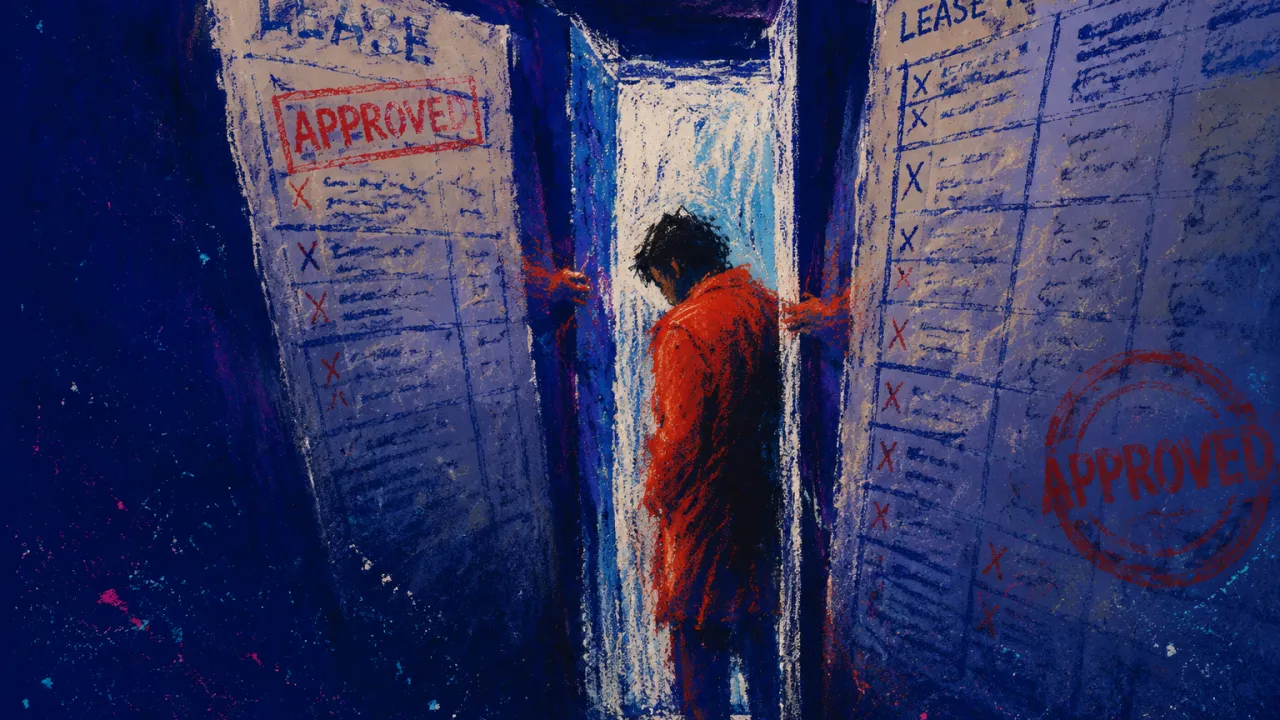
A solitary figure stands with shoulders angled inward as lease pages and inspection grids narrow the doorway from both sides.

What is this situation?

Rental Belonging Trial is the recurring audition that begins the moment you try to make a rented place feel like home. You arrive at an after-work viewing alongside a line of other applicants, while the agent moves quickly through rooms you are expected to assess before the next group comes in. Before you can be considered, a portal asks for photo ID, income records, employer details, previous addresses, and landlord references, turning ordinary access to a front door, bedroom, and kitchen into a file that other people score. If your application is accepted, the trial changes shape rather than ending: the inventory records every mark, the lease limits what you can alter, repair requests must be documented, and inspection notices require the rooms to be ready for someone appointed to assess them. You pay on schedule and maintain the place, yet decisions about pets, paint, wall hooks, guests, renewal dates, and future rent remain with the owner or agent. Each email marked inspection, lease update, or renewal tightens your shoulders before you open it, because the room can become provisional again through a deadline or changed term. Over time, unpacking never fully becomes settling; the boxes may be gone, but you still arrange your daily life around what can be approved, reviewed, or withdrawn. The result is a home that holds your routines while repeatedly asking you to prove your right to remain there, much like the Three of Pentacles, where a worker stands beneath a stone arch while two others hold the building plans.

Why it's not you?

This is not evidence that you are irresponsible, difficult, or unable to settle. Repeated proof requests, one-sided permissions, inspections, and renewal deadlines give owners and agents more control over whether your home continues on the same terms. The conditionality comes from the rental arrangement, not from your character.

Rental Belonging Trial in Tarot Cards

Rental Belonging Trial is the repeated requirement to qualify for a home you already pay for, maintain, and occupy. The moment your shoulders tighten before opening an inspection or renewal email belongs to that recurring uncertainty. It is an environmental and structural dynamic: access, permission, and timing remain weighted toward the people who control the property. The Tarot Cards below mirror the visible contours of conditional access, ongoing scrutiny, and provisional space.

The Emperor
Reversed
The stone throne, rigid armour, and commanding sceptre concentrate authority in one immovable seat. Reversed, that fortified position resembles a rental hierarchy in which the owner or agent can govern pets, paint, wall hooks, guests, repairs, and other details of a home they do not occupy. The hard enclosure around the throne reveals the structural split between paying for domestic space and having authority over it. You can maintain the property and organise your life responsibly, yet ordinary household decisions still travel upward for permission, keeping settlement conditional on someone else's approval.
Justice
Reversed
The scales, raised sword, and rigid pillars create a setting of formal measurement and enforceable standards. Reversed, those instruments resemble a rental process that documents every mark, payment, request, and tenant obligation without granting the tenant equivalent influence over rent changes, permissions, or renewal. The symmetry of the chamber promises procedural order, but the reversed structure exposes a mismatch between being thoroughly recorded and being equally protected. You may comply with the lease and preserve evidence of responsible upkeep while the owner retains broader discretion over whether the same home remains available on the same terms.
The Hanged Man
Reversed
The suspended body hangs from a fixed beam while the surrounding space offers no visible mechanism for setting him down. Reversed, that image resembles an application, repair, or renewal process in which your deadline is immediate but the owner or agent can leave the consequential decision open. The hanging posture turns time into an allocation of power rather than a neutral pause. You may have submitted every document, prepared every room, or responded before the stated cutoff, yet your next housing step remains stalled until someone outside the home acts.
Three of Pentacles
Upright
The worker beneath the stone arch is visible to two people holding the building plans, placing practical labour inside an architectural review. The scene directly mirrors a tenant whose income file, references, maintenance, repair records, and presentation of the rooms are assessed against standards held by an owner or agent. The carved pentacles show that competent work can be recognised and may keep the route to housing open, but the plans remain in other hands. You perform the daily labour that sustains the home while continued access still depends on external evaluation, so acceptance changes the form of the audition rather than ending it.
Four of Pentacles
Reversed
The seated figure locks one pentacle to the chest, balances another above the head, and pins two beneath the feet while the city remains at a distance. Reversed, that total grip becomes a housing gate: payment may open the property for use, but ownership keeps renewal, alterations, and household permissions immobilised under one party's control. The blocked posture reveals the difference between occupying a home and controlling its continuity. You fund the space and carry its daily responsibilities, yet your domestic security can still be tightened, repriced, or withdrawn by the person holding the asset.
Six of Pentacles
Reversed
The scales remain in the standing figure's hand while two lower figures wait for resources, making the distributor both evaluator and access point. Reversed, the exchange resembles a rental application in which ID, income, employment, address history, and references move upward for scoring while the applicant receives little equivalent visibility into how the decision is made. The unequal heights of the figures expose a paid relationship still organised through permission from above. You may provide complete records, pay reliably, and maintain the rooms, yet those contributions do not remove the owner's ability to attach conditions, revise terms, or reassess your right to remain.
Seven of Pentacles
Upright
The figure leans on a tool beside a cultivated crop, watching value already invested while the outcome remains uncollected. The scene resembles the period after you have submitted the rental file, paid what is due, maintained the rooms, or prepared for renewal but still cannot convert that effort into a definite answer. The pentacles growing on their own timetable reveal a mismatch between tenant deadlines and gatekeeper response time. You must prepare immediately for each application or renewal node, while certainty about the home arrives later and remains dependent on someone else's assessment.
Eight of Pentacles
Upright
The craftsperson repeats the same pentacle at the bench while completed pieces remain arranged on display. The scene resembles a rented home maintained not only for ordinary use but also for inventories, dated repair requests, inspection photographs, and recurring demonstrations of responsible care. The ordered row of work products reveals how private domestic labour becomes evidence for an evaluator. You clean, document, report, and preserve the rooms as part of living there, but the inspection system adds a second purpose: making your competence legible to the people who decide whether access continues.
Eight of Swords
Upright
The blindfolded figure, loose bindings, surrounding swords, and distant building form a visible perimeter between shelter and freedom of movement. The scene resembles the way enforceable lease rules can expand into continuous self-monitoring, leaving you inspection-ready even when no visit is scheduled. The gaps between the swords distinguish actual contractual restrictions from the wider behavioural boundary produced by repeated review. You may stop considering a pet, a wall hook, a guest, or a personalised room before checking whether permission is currently required, because the housing system has trained domestic imagination to anticipate an evaluator.
Nine of Swords
Upright
The figure sitting upright in bed places the pressure inside the room that should provide rest, while the stacked swords overhead resemble official notices that remain mentally active before they are opened. The bedroom setting directly echoes the way an inspection, lease update, or renewal email can make the rented home feel provisional again. The dark interior reveals an anticipatory cost attached to communications that can change access, price, or household rules. You are not reacting to an ordinary admin message; repeated exposure has taught you that a landlord subject line may reorganise your home, budget, and next few months at once.
Two of Wands
Reversed
The figure holds a globe behind a high parapet, with one wand fixed to the wall and the wider landscape visible beyond it. Reversed, those elements resemble long-range plans constrained by a home base whose rent, permissions, and availability can change at the next renewal. The wall provides shelter while also limiting the horizon, capturing the difference between having a room today and having enough tenure certainty to organise the future. You can build routines inside the rental, yet career moves, relationships, pets, purchases, and neighbourhood commitments may still be planned only as far as the current lease allows.
Four of Wands
Reversed
The garlanded threshold, four upright posts, and figures near the distant building present a recognisable scene of arrival and domestic welcome. Reversed, that threshold remains decorated but structurally conditional, like a rental that supports your routines without giving you dependable control over whether the welcome continues. The homecoming image exposes the unfinished transition from occupancy to belonging. You may unpack, host, rest, and care for the rooms, yet inspections, alteration rules, and renewal terms keep part of the household arranged for review or withdrawal rather than fully settled use.
Five of Wands
Upright
The five figures, intersecting staves, and crowded ground turn a shared space into a contest with no stable centre. The scene closely resembles a rushed viewing where several applicants move through the same rooms and must signal readiness before they have had enough time to assess the place themselves. The unresolved competition reveals how housing scarcity converts the first stage of home-making into a public audition. You are expected to appear decisive, organised, solvent, and easy to approve because access to the front door depends on outperforming other applicants rather than simply agreeing to pay for a suitable home.

Rental Belonging Trial in Tarot Card Reading Insights

Others facing repeated rental applications, inspections, and uncertain renewals have brought that conditional sense of home into their readings. The articles below gather Tarot Reading Insights from those sessions.
Psychological Contexts Related to Rental Belonging Trial