A Print on the Floor: From Bracing for a Move to Present-Tense Care

The 10:45 p.m. Print That Never Reached the Wall
Jordan, a 28-year-old non-binary project coordinator in Toronto, had already renewed their lease once and still called the apartment "just for now." When they sat across from me with both hands around a coffee mug, their question was direct: "Why do I keep postponing making my current place feel like home?" I recognized home-making procrastination shaped by permanent-temporary thinking, not a failure of taste or discipline.
They described the previous Tuesday at 10:45 p.m. I could almost see it as they spoke: the same framed print travelling from the bedroom floor to the living-room floor, three removable-hook tabs glowing on the laptop, and the phone growing warm in their palm. The radiator clicked against the quiet while blue screen light cut across the bare wall.
"I want it to feel like mine," Jordan said, "but I don't want to get too attached. What if I move next year?" They wanted a personal, calming home, but whenever that wish asked for one concrete choice, their mind produced a future move, another comparison, or a reason to wait. Their ambivalence felt like standing indoors with a winter coat still zipped, physically present but keeping the body prepared to leave.
"I don't hear laziness in that," I said. "I hear one part of you longing to arrive and another part trying to protect your freedom. Let's map the pattern without judging either part. We are not asking the cards to decide where you should live. We are looking for clarity about what keeps your hands still."

Choosing the Ladder Out of the Waiting Room
I invited Jordan to take one slow breath while holding the question in mind, then I shuffled. I use this small ritual as a transition for attention, not as mystical theatre. It gives the nervous system a moment to stop arguing with every possible future at once.
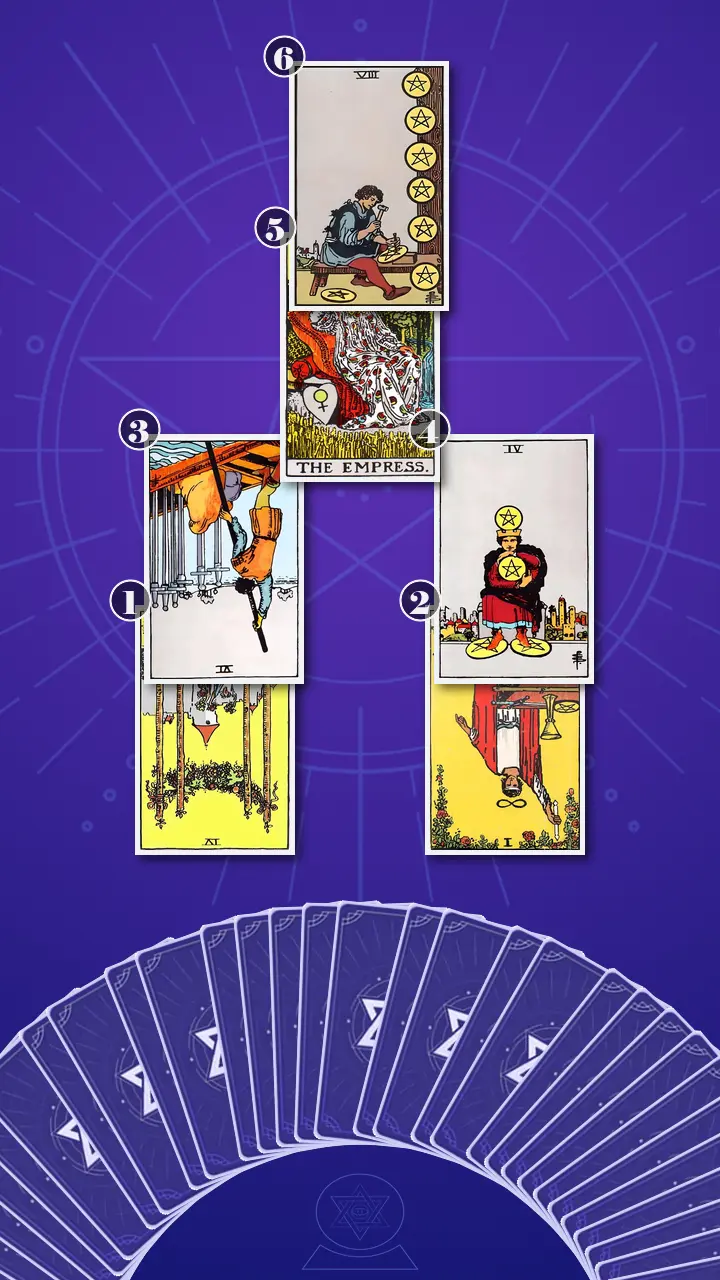
I chose the Four-Layer Insight Ladder · Context Edition, a six-card tarot spread designed to trace a repeating system. A Past-Present-Future spread would have made the issue seem chronological, while a Decision Cross might have invented an external either-or choice. Jordan did not need a prediction about staying or moving. They needed to see how an unfinished apartment, blocked action, an identity organised around departure, and a need for control were feeding one another.
I arranged the cards like an ascending ladder. The first pair would show the visible home and the fracture between desire and action. The second pair would uncover the hidden bargain and protective fear. The final two cards would offer transformational permission and a practical way to test it. This is how tarot works in my practice: card meanings in context become an objective map for a life pattern, while the person in front of me remains free to accept, revise, or reject what the map suggests.
What the Unfinished Room Was Saying
Position One: The Threshold Left Uncrossed
I turned the card representing the surface symptom, the visible condition of Jordan's home and the postponement behaviours attached to it. It was the Four of Wands, in reversed position. The flowered garland looked like an entrance prepared for arrival, yet reversed, its welcoming Fire was blocked. In Jordan's apartment, that blockage appeared as framed art on the floor, delivery boxes acting as storage, and a room that never felt ready enough for a friend to visit. The address functioned, but Jordan had not permitted one visible act to say, "I live here now."
Jordan gave a short, bitter laugh. "That's so accurate it's almost cruel." I let the laugh settle before answering. "The card is not accusing you. It is showing the cost of a strategy that once felt protective. We only need to ask which single surface could become complete, not whether the whole apartment deserves a makeover."
Position Two: The Tools Beside the Untouched Wall
I turned the card for the agency fracture, the point where wanting a home stops becoming home-making action. The card was The Magician, in reversed position. Its tools became Jordan's removable hooks, tape measure, saved tutorial, open shopping cart, and available twenty-minute calendar slot. Everything required for a first attempt was present, but the initiating energy was scattered into comparison. "Research can feel like progress while the wall stays bare," I said. "The problem is not that you don't know what would help. It is that you keep gathering more information before you begin."
I used a lens I call an Energy Extraction Audit. I asked Jordan to notice the micro-habit loop: see the print, open tabs, compare options, postpone, then feel a delayed return of guilt when the unchanged wall comes back into view. Each loop was a background app over-extracting a little baseline energy. Jordan's jaw tightened, and their fingers pressed into the mug. "That's the restless heaviness," they said. "I do a lot, but nothing in the room changes."
Position Three: The Moving Van That Wasn't Booked
I turned the card representing the hidden bargain, the belief that unfinishedness preserves mobility. It was the Six of Swords, in reversed position. Its blocked Air showed a transition that had happened physically but not psychologically. Jordan had renewed the lease, yet boxes remained packed, everyday objects lacked usable places, and rental listings became an escape hatch whenever the current space felt uncomfortable. The box beside the dining table was like a carry-on bag never put away, even though no trip had been booked.
"You are not waiting for a home," I said carefully. "You are waiting for permission to arrive." Jordan's thumb stopped moving along the mug's rim. Their gaze shifted to the cards as if they were replaying every time they had said "next apartment" without having any plan to move.
Position Four: When Protection Becomes a Grip
I turned the card for the protective fear, the control need that made money, effort, and attachment feel risky. The Four of Pentacles appeared upright. Here, its conserving Earth energy had moved into excess. A modest lamp was no longer only a lamp; it became evidence that Jordan had committed, spent incorrectly, or misjudged where they belonged. Holding resources close brought brief relief, but the figure's heart, head, and feet were all immobilised by what he was protecting.
Looking at that rigid posture, I thought of twenty years of conversations held over coffee, and of how often people save the good mug, soft blanket, or easier chair for a future version of life. Protection frequently arrives dressed as practicality. "I don't want to be stupid with money," Jordan said. I nodded. "That makes sense. But care and reckless spending are not the same thing. Which small improvement would still support your daily life even if you packed it next year?"
When The Empress Sat Down in the Unfinished Room
Position Five: Permission to Care Before Certainty
The rain against my window softened as I turned the card representing transformational permission. It was The Empress, upright, the bridge of the reading. A thin line of daylight reached the wheat at her feet. After the Four of Pentacles' clenched body, her cushioned seat, flowing water, fabric, and living greenery changed the physical language of the spread. Her energy was balanced and receptive: warm light for the dining table, clean bedding, an unpacked mug, or visible art could support the person living in the apartment today without deciding where that person must live next year.
At 10:45 p.m. in their Toronto rental, Jordan had moved the same framed print between rooms, compared removable hooks, and closed every tab. The apartment was usable, yet their body remained braced for a move that had never actually been planned.
You do not have to wait for permanent ground before you begin living; cultivate one nourishing corner now, as The Empress creates abundance by tending the place where she is already seated.
For one beat, Jordan's breath stopped. Their fingers remained suspended above the mug, then slowly curled into a fist. Their eyes lost focus as if the Tuesday-night scene were replaying behind them. When they looked back at me, their pupils had widened and a trace of colour had gathered around their eyelids. "But doesn't that mean I've made myself uncomfortable for a year for no reason?" Their voice came out sharper than before, with anger under the question. "Like I got all of this wrong?" I answered quietly, "No. Keeping things movable gave you a sense of control when commitment felt dangerous. We can respect why that protection appeared without requiring it to run the apartment forever." Their fist loosened first. Then their shoulders dropped, and a long breath left with a slight tremor. Relief crossed their face, followed by a brief blankness, almost a dizziness at realising that clarity also returned responsibility to their own hands. I asked, "Now, with this new perspective, was there a moment last week when this insight could have made you feel different?"
"Tuesday," Jordan said after a pause. "I thought hanging the print meant choosing the apartment. Maybe it could have meant choosing not to stare at a blank wall that night."
I offered the inner sentence I heard taking shape: "I thought caring meant committing. What if caring simply means noticing the person who lives here today?" A rental can be temporary without your comfort being temporary. Care is not a contract with the future.
This was where I applied my Daily Clutter Deconstruction lens. I do not treat physical disorder as a moral failure. I trace the psychological noise carried by particular unfinished objects. The print had become a low-volume notification that appeared every time Jordan entered the room: not yet, not settled, do not attach. Hanging it would not solve their life, but it could silence one repeating alert and return a small piece of mental bandwidth.
To keep that insight from turning into another full-apartment project, I gave Jordan a ten-minute version. Choose one visible surface, use only something already owned, and stop when the timer ends. If pressure rises, pause, make the action smaller, or abandon it. The experiment belongs to the person, not the apartment. That was the first real movement from detached ambivalence and future-oriented avoidance toward grounded belonging through present-tense care.
The Hand That Finished One Thing
Position Six: Belonging as a Weekly Practice
I turned the final card for practical integration. The Eight of Pentacles appeared upright. Its grounded Earth energy was moving in balance: the craftsperson works on one pentacle at a time while completed pieces remain visible nearby. In Jordan's life, that meant twenty-five minutes for one shelf, box, wall, drawer, or lighting spot, with a narrow finish line and permission to stop when that one piece was done.
"The card is not asking you to become an interior designer over the weekend," I said. "It is asking for repeatable craftsmanship. One finished task can replace one piece of evidence that says you never follow through. Belonging can leave evidence in small finished things." Jordan nodded, but this time the gesture was slow and deliberate rather than automatic.
The Corner That Became Evidence
Together, the cards described one coherent feedback loop. The reversed Four of Wands showed the visible result: an address that remained emotionally unclaimed. The reversed Magician showed intention diverted into research. The reversed Six of Swords revealed an identity still organised around departure, while the Four of Pentacles explained why withholding care felt like control. The Empress restored a neglected resource, the right to support the body in the present, and the Eight of Pentacles translated that permission into practice.
Jordan's cognitive blind spot was the belief that keeping every option open cost nothing. In reality, each undecided object, recurring comparison tab, and packed daily-use item quietly consumed attention. The transformation was not from renting to staying, or from uncertainty to perfect certainty. It was from living with a coat on to completing one small, reversible home-making action each week.
I offered two experiments, not prescriptions. Jordan could change them, postpone them, or stop. The purpose of these actionable next steps was to collect information from lived experience instead of demanding certainty from thought alone.
Two Reversible Acts of Present-Tense Care
- The 15-Minute Physical Anchor ExperimentWithin the next 48 hours, choose one minimal corner, such as the dining-table edge, one shelf, or the wall above the work chair. Use only objects already owned to clear it, place one personal item in view, and spend two quiet minutes noticing the light, texture, temperature, or ease of using the space.Set a fifteen-minute timer and stop when it rings. No purchase or permanent installation is required, and the arrangement can be moved or undone.
- The Twenty-Five-Minute Home CraftSchedule one weekly session for a single defined task: unpack one daily-use box, hang one print with removable hooks, clear one shelf, or improve one lighting spot. Write the finish line first, put the phone on Do Not Disturb, and record the completed task in a private phone note.If the task expands into a whole-room redesign, return to one tool and one finish line. Research another method only after the first attempt is complete.

A Week Later, the Wall Answered Differently
A week later, I received a photo from Jordan. The framed print was finally above the dining table, slightly lower than they had originally imagined. One end of the table was clear enough for a laptop and a plate. Two moving boxes were still visible in the hallway. Nothing in the image pretended that the whole apartment, or Jordan's housing future, had been solved.
That night they slept through, then woke with the old thought, "What if I move?" They looked at the removable hook, smiled once, and made coffee. The question remained, but it no longer got the whole room.
I did not see that photograph as proof that tarot had predicted an outcome. The spread had made an invisible system observable; Jordan had chosen the action that changed it. Their journey to clarity was not a promise to stay. It was the first grounded proof that they could care for themselves wherever the current chapter happened to be.
When a framed print stays on the floor and the shoulders remain ready for the next move, it is not necessarily because a person does not want a home. Sometimes part of them is trying not to care deeply enough to risk being wrong about where they belong. Simply recognising that protection means the room is no longer making the decision alone.
If caring for your current place did not have to sign a lease with the future, which object on your floor, inside a box, or trapped in a saved tab could become your one-corner evidence this week?