Home-Base Decision Paralysis at 8:42 p.m.
I knew the pattern before Jordan had finished explaining it. At twenty-nine, they were a remote UX designer in a Toronto sublet, flexible enough to work from almost anywhere, yet every Sunday Scaries spiral ended with three new city tabs and the same unanswered lease email.
At 8:42 p.m., I sat across from them at a narrow dining table while the radiator ticked against the quiet. Montreal, Lisbon, and Melbourne filled a spreadsheet on the second monitor; takeaway noodles smelled faintly of sesame, the laptop casing felt hot beneath Jordan's wrist, and a half-unpacked suitcase blocked the closet door. Their right leg bounced hard enough to tremble the water in their glass.
“I can tell you the rent, weather, time zones, queer scene, and coworking options in all three,” they said. “I just can't tell you whether I'm renewing the gym down the street. I keep thinking the next city will make my direction obvious.”
I heard the contradiction clearly: Jordan wanted the freedom to move, but they also wanted the routines and relationships that only had a chance to form when they stayed. Choosing a base felt less like selecting a place and more like deleting several possible versions of themselves. Restless uncertainty moved through their body like an airport departure board flipping behind the ribs, every new destination briefly lighting up before another one replaced it.
“You are not short of options,” I told them. “You may be short of enough ordinary Tuesdays inside one option to discover what it can become. I am not here to tell you where you must live. I want to help us draw a clear map of the loop, find where choice is still available, and identify one experiment that can produce evidence your spreadsheet cannot.”
Choosing a Map for Staying or Moving
I asked Jordan to place both feet on the floor, take one unforced breath, and hold the question in mind while I shuffled. I treat that small pause as a transition in attention, not as a mystical performance. It gives the nervous system a moment to stop solving and start observing.
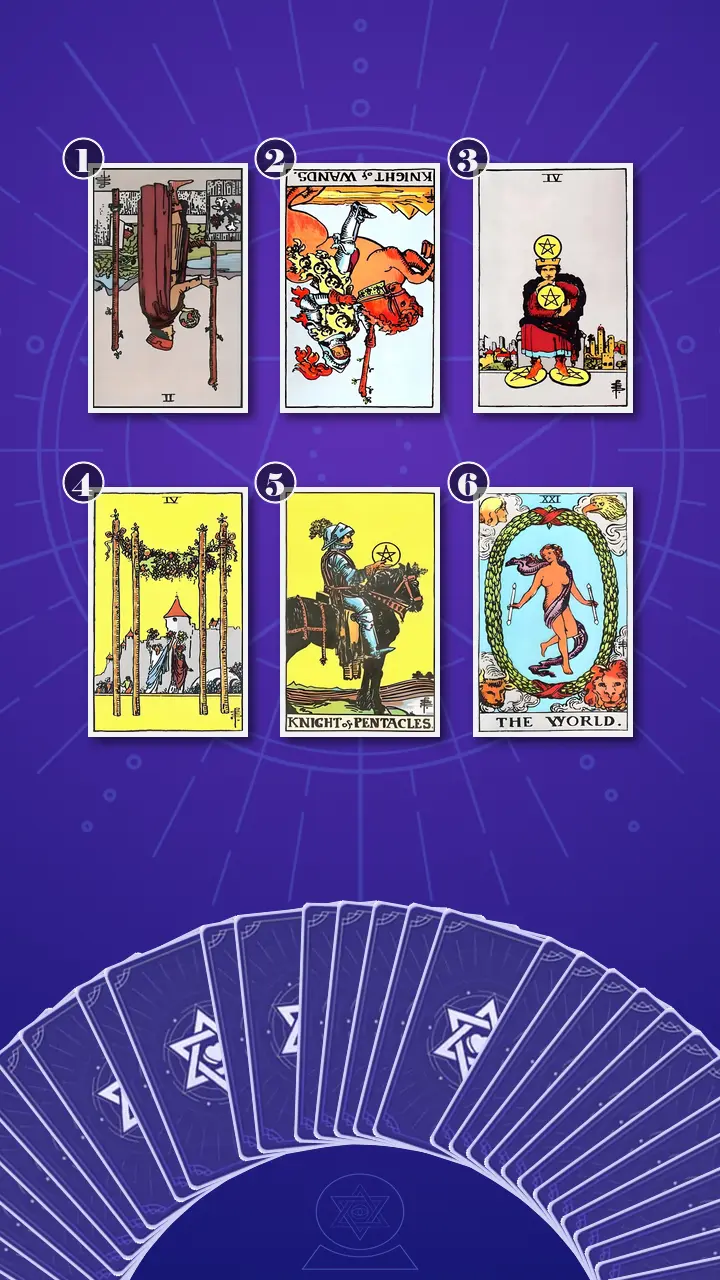
I chose the Transformation Path Grid (6) · Context Edition, a six-card tarot spread for digital nomad rootlessness and home-base indecision. A two-path spread would have encouraged another comparison between external destinations. Jordan did not need a prettier pros-and-cons list. They needed to see the system that made Toronto, Montreal, Lisbon, and Melbourne all produce the same cycle.
This is how tarot works in my practice: I use the cards as an objective reflective surface. Card meanings in context can make an invisible sequence visible, but they do not forecast a permanent home or remove responsibility from the person making the choice. The authority remains with Jordan.
I laid the cards in two rows of three. The top row would show the observable planning pattern, the novelty-driven blockage, and the fear of losing control beneath it. The lower row would reveal the transformation hinge, a practical action pathway, and an integrated relationship between mobility and belonging. Visually, I wanted the travel planner to become a floor plan.
The Globe That Never Became a Route
Position 1: The Planning Loop in Plain Sight
I first turned the card representing the presenting pattern: the visible behaviour through which Jordan kept planning the next move while postponing a rooted choice. It was The Two of Wands, in reversed position.
The figure traditionally stands above a landscape with a globe in hand, surveying possible futures while one wand remains fixed to the wall. For Jordan, that globe had become a Notion home-base matrix with columns for rent, weather, walkability, visas, time zones, coworking access, and community. At 8:42 p.m., Montreal, Lisbon, and Melbourne were being scored while the Toronto renewal email remained unanswered beneath Google Flights.
The card showed an Excess of comparative planning paired with a Deficiency of committed experimentation. Research looked productive, but no candidate received a start date, no local routine was renewed, and no city was allowed enough ordinary life to become informative. The internal bargain sounded reasonable: “If I compare one more option, then I will finally feel certain enough to choose.” Yet each extra option interrupted the very evidence that could have supported a choice.
“Planning can keep every life possible,” I said. “Participation makes one life knowable. What could one month lived deliberately in a place teach you that one more browser tab cannot?”
Jordan gave a short, bitter laugh. Their fingertips stopped tapping the table and curled around the edge instead. “That is so accurate it's almost rude,” they said. “I call it research, but I've been postponing the same email for three months.”
“Then we will treat the recognition as information, not as a charge against you,” I replied. “A coping strategy can be intelligent and still become outdated. Seeing the mechanism gives you more choices than blaming yourself ever could.”
When Familiarity Pulled the Fire Alarm
Position 2: The Novelty Spike That Resets the Search
I turned the card representing the active blockage: the force that converted novelty seeking into direction stagnation by repeatedly interrupting momentum. It was The Knight of Wands, in reversed position.
I pointed to the rearing horse and raised wand. The image carried plenty of heat and movement, but little evidence of a sustainable destination. In Jordan's life, this was the moment a cafe worker began to know their order, the commute stopped looking cinematic, or the first arrival high faded. An Instagram reel about remote work in Lisbon would appear, and Jordan could open Google Flights before reaching the next intersection. The recurring Toronto event that might have deepened the week was skipped in favour of planning another beginning.
The Knight's Fire was in Excess, while its directional force was Blocked. Jordan's personal recommendation algorithm had been trained almost entirely on novelty, so it interpreted familiarity as a command to scroll. Stimulation produced a quick release in the chest, but that release was not the same as guidance. It merely proved that imagining departure could interrupt discomfort.
“Ordinary is not the same as wrong,” I said. “Sometimes boredom reveals a genuine mismatch. Sometimes it is simply the end of the arrival high, when a place finally stops entertaining you and becomes available for relationship. You need enough time to tell those experiences apart.”
Jordan's calf tightened beneath the table. Their gaze moved from the rearing horse to the unread group-chat notification on their phone. “Last Thursday, someone asked if I was coming back to the community night,” they said. “I left it unread and watched a video about Melbourne instead.”
I asked what had happened in their body before they opened the video. Jordan pressed a palm to the centre of their chest. “It felt like being expected somewhere would make leaving harder.”
What the Clean Exit Was Costing
Position 3: The Protective Grip Beneath the Movement
I next turned the card for the underlying mechanism: the fear of losing control by choosing one place and allowing that choice to become consequential. It was The Four of Pentacles, upright.
The figure held one coin against the chest and secured two beneath the feet while a city remained in the background. I translated that guarded posture into Jordan's phone held over a banking app as a deposit deadline approached. They kept enough cash, light luggage, flexible contracts, and short-term housing available to leave quickly, while delaying a proper desk, a recurring membership, a local responsibility, or any object that made the room harder to abandon.
Security itself was not the problem. Jordan's income varied, rental conditions mattered, and no reflective exercise should ask someone to ignore finances, housing rights, immigration rules, health, or safety. In this position, however, the Pentacles energy had moved into Excess. Protecting optionality had become permanent provisionality. The clean exit remained available, but the present life never received enough contact to answer back.
“When you imagine renewing for three months, buying something for the room, or attending the same group four times, which loss appears first?” I asked. “Money, mobility, identity, time, or control?”
Jordan's hand closed around their phone, then loosened. Their eyes lowered as if a specific memory had surfaced. “Control,” they said. “I picked up a plant on Saturday and put it back because I pictured carrying it through an airport. The room feels empty, but apparently even a plant feels like evidence against my freedom.”
“The card is not asking you to buy the plant,” I said. “It is asking you to notice the rule underneath the decision: ‘If I pay, sign, buy, or become needed here, I lose my clean exit.’ Once the rule is visible, you can design boundaries that protect mobility without keeping your whole life in departure mode.”
When Four Wands Became an Open Door
Position 4: The Home That Was a Season, Not a Sentence
The radiator clicked off as I reached the lower row, and the room became unexpectedly still. A distant streetcar bell passed through the window glass while I turned the card representing the key transformation: the leverage point where endless movement could become time-bounded, participatory rooting. It was The Four of Wands, upright.
Four posts stood firmly in the ground, yet the garland suspended between them did not close the entrance. Welcoming figures gathered beyond it. Here, Fire had found Balance through structure: not a locked room, but an open threshold that gave work, pleasure, and connection somewhere to gather. In Jordan's life, that could mean naming one Toronto neighbourhood as a base for a defined season, setting a review date, returning to the same work table, and accepting one recurring invitation.
Before I went further, I named the bind I could see: on Sunday night, with the radiator ticking and three city tabs open, choosing Toronto for one season felt to Jordan like closing every other possible life before they knew which version of themselves might fit.
As I studied the four posts, I remembered thresholds uncovered on archaeological digs. A single footprint can show that someone passed through; a worn sill tells me that life accumulated there. Repetition creates context. Without context, even a beautiful artifact can become an isolated object that cannot explain how it was used.
I call this diagnostic lens Core Artifact Excavation. Instead of asking which skyline should win, I asked which durable values needed to survive the collapse of Jordan's old trajectory. Mobility was one. So were financial safety, queer community, focused work, reciprocal friendship, and the freedom to revise a decision. The new structure did not need to bury those values. It needed to hold them long enough to show which ones could coexist in an ordinary week.
“An open itinerary can preserve your options,” I said, “but only repeated participation can tell you which options are worth keeping.”
Stop treating an open itinerary as proof that you have control, and let a time-bounded home become a welcoming threshold where repeated participation can reveal what planning cannot.
Jordan's breath stopped for a beat. Their right hand, which had been closing and reopening around the phone, hovered above the table. Their pupils widened; then their gaze slipped past me toward the half-packed suitcase, as if several departures were replaying at once. Their jaw tightened. “But doesn't that mean I've been doing this wrong for years?”
I let the protest have room. “It means the strategy protected your freedom when you needed it. It also means you can update it. Protection becoming costly is information, not an indictment.” The anger thinned. Their eyes shone, one fist slowly opened, and both shoulders dropped on a shaking exhale. For a second they looked almost dizzy, the way solid ground can feel strange after years on moving walkways. “Oh,” they said, softer. “A season, not a sentence.”
“Now, with this new perspective, think back to last week,” I invited. “Was there a moment when this insight could have made you feel different?”
Jordan looked at the unread community message again. “Thursday. I could have replied, ‘Yes, I'll come next week,’ without secretly promising to live here forever.”
I named the shift plainly. This was the first movement from restless destination scanning and fear of choosing wrong toward grounded self-trust that could hold both mobility and belonging. A provisional home was becoming a container for evidence, not a verdict on identity.
The Still Horse on an Ordinary Tuesday
Position 5: Repetition as a Form of Research
I turned the card representing the action pathway: the small, observable practice that could carry the Four of Wands insight into daily life. It was The Knight of Pentacles, upright.
I placed it visually beneath the reversed Knight of Wands. One horse reared as though every impulse required immediate movement; this horse stood still before a cultivated field. The Knight held one pentacle with care. I saw no lack of ambition in that stillness. I saw attention directed long enough for a result to grow.
For Jordan, the modern-life scenario was deliberately unglamorous: two recurring work blocks at the same library or cafe, one local event attended more than once, and a brief note recording energy, focus, spending, and connection. Nothing in that practice declared Toronto permanent. Its value came from allowing the place to answer through lived patterns instead of first impressions.
The Knight's Earth energy was in Balance: reliable without becoming rigid, patient without becoming passive. It replaced the demand for hypothetical certainty with accumulated evidence. “I do not need a verdict today,” I offered as the new inner script. “I need enough repetitions to notice what changes.”
“You do not need a forever city,” I told Jordan. “You need enough Tuesdays to learn from one.”
Jordan unlocked their phone and opened the calendar. Their thumb hovered, not over Google Flights this time, but over the following Tuesday. “The library near me has day passes for the coworking floor,” they said. “I could book the same desk twice. Twice does not feel like a personality transplant.”
A Wreath Wide Enough for Roots and Roads
Position 6: Completing a Chapter Without Closing the World
I turned the final card for integration: the perspective that could reconcile mobility and belonging without forcing one to defeat the other. It was The World, upright.
The central figure moved freely inside a wreath, while four steady figures held the corners of the image. The boundary did not imprison the dancer; it gave the movement coherence. I read this as Integration, the balance that appears when experience is completed and carried forward rather than left as another open loop.
In Jordan's life, The World looked like a room containing both a packed bag and signs of use: groceries in the fridge, a mug beside the sink, a transit card on the table, completed work rhythms, a few recognizable faces, and a home-base review date on the calendar. At that review, Jordan might renew, revise the neighbourhood, or plan a move. Any of those outcomes could be valid if it emerged from a completed period rather than panic about a better life happening elsewhere.
“I can complete a chapter without making it my final chapter,” Jordan said, testing the sentence aloud.
“Exactly,” I replied. “The World is not predicting Toronto as your permanent destination. It is showing a coherent identity large enough to include the traveller, the worker, the neighbour, and the future planner. Freedom can include the ability to stay, learn, and leave from self-knowledge.”
Jordan leaned back. The suitcase still blocked the closet, and the lease email was still unanswered. Nothing external had magically resolved. Yet their leg had stopped bouncing, and their attention was no longer being pulled toward all three cities at once.
Turning a Travel Planner into a Floor Plan
I gathered the six cards into one causal story. The reversed Two of Wands showed planning being used as a substitute for lived choice. The reversed Knight of Wands showed the novelty spike that restarted the search whenever a place became familiar. The Four of Pentacles revealed why the loop felt protective: undefined commitments preserved control and kept every identity theoretically available. The Four of Wands introduced an open, time-bounded structure; the Knight of Pentacles translated it into repeated behaviour; and The World allowed one completed chapter to inform the next without becoming a permanent sentence.
The central blind spot was not a love of travel. It was mistaking the immediate relief produced by destination research for reliable directional evidence. Each new search loosened Jordan's chest for a moment, so the mind labelled departure as clarity. But the search also cancelled the routines, relationships, and ordinary-day observations needed to discover whether a place was genuinely unsuitable or simply no longer new.
I described the transformation as a change in research method. Jordan had been running an A/B test that kept generating new variants but never sent enough traffic to one version to produce useful results. The new direction was not “settle down.” It was: select one viable base, define the safety and financial boundaries, participate consistently, collect lived evidence, and review the experiment on a date chosen in advance.
I kept the next steps small because clarity grows more reliably from completed actions than from heroic promises. I also folded in my Stratigraphic Review, a weekend practice for separating the noisy surface layer of trends and comparison from the foundational values that should guide the next era.
The Provisional Home-Base Experiment
- Write the Eight-Minute Base Note Tonight at the table, set a timer and write: “I am treating Toronto as my provisional base from [start date] to [review date]. During that period, I will repeat [one work routine], [one local routine], and [one social routine].” Then send one no-obligation message asking the landlord for the exact renewal term, cost, deadline, and exit conditions. Keep it financially, legally, and physically safe. If a month feels loaded, write a seven-day version and add no new destinations during those seven days.
- Run the Two-Repeat Ordinary Tuesday Test Book the same two-hour work block at the same Toronto library, cafe, or coworking desk on two days this week. Attend one recurring local event for up to an hour. After each return, record three items in a phone note: energy before, energy after, and one new piece of evidence about the place. Treat repetition as longitudinal research, not a discipline test. Use public, affordable venues, protect rest, and leave any environment that feels unsafe or draining.
- Do the Twenty-Minute Stratigraphic Review On Saturday, divide a page into “Surface Layer” and “Core Artifacts.” Put reels, city rankings, friends' votes, and novelty spikes in the first column. In the second, record lived evidence under work, body, money, and connection, then schedule a fifteen-minute home-base review four weeks ahead. Use observations from ordinary days, not new destination content. Ask one trusted friend to question what you have learned rather than vote on where you should live.

Four Tuesdays Later: The Quiet Proof
Four Tuesdays later, I received a message from Jordan. At 9:05 that morning, they had placed the same scratched water bottle beside the same Toronto library window for the fourth time. The security guard had nodded hello. Jordan's breathing had settled before work began, and they had finished a difficult design task without losing an hour to rental listings.
They had also returned to the community night twice. Nobody had demanded a declaration of permanence. Someone had remembered their name, saved them a chair, and asked how the contract was going. It was a small form of belonging, light enough to leave room for choice and substantial enough to be felt.
Their final line held the honest edge of an unfinished transformation: “I slept through the night, but my first thought was, What if this is wrong? Then I remembered the review date and laughed.”
I did not read that message as proof that Toronto was the answer. I read it as proof that Jordan had changed the way they asked the question. They were moving from imagined futures to lived feedback, and from preserving every possible identity to trusting themselves with one revisable chapter.
Whenever I use this six-card Transformation Path Grid for digital nomad rootlessness, I am not asking tarot to appoint a city. I am using the cards to expose a loop, clarify actionable next steps, and return authorship to the person living the life. The cards provided the map; Jordan produced the evidence and retained the right to renew, revise, or leave.
I know how, when a lease email lands and the chest tightens, keeping every city possible can feel safer than choosing one ordinary life and risking the thought that the choice might be wrong. Yet noticing that reflex is already the first worn mark across a new threshold.
If staying did not have to mean forever, what small part of one ordinary Tuesday would you be curious to let become yours before your own review date?
This story is adapted from psychological research, written so that those in a similar struggle can see their own pattern in it — and find their next step clearly.These insights are not a substitute for professional psychological, medical, legal, or financial advice.
Learn more about our Journey to Clarity.
How did this insight land for you?
🫂 This Resonates Deeply
🌀 Living This Story
✨ Now I See Clearly
🌱 Seeing New Possibilities
🧰 Useful Framework
🔮 The Confirmation I Needed
💪 Feeling Empowered
🚀 Ready for My Next Step
Author Profile
 AI
AI“Having spent a lifetime at Cambridge and on archaeological digs, I’ve witnessed the rise and fall of countless civilizations. Please know that your current struggles are not a permanent fate, but merely a necessary fracture before rebuilding. I won't lecture you; instead, I invite you to sit with me in the ruins, using a patient, historical perspective to gently dust off the true, enduring value hidden beneath your temporary doubts.”
In this Direction Tarot Reading :
Core Expertise
- Historical Epoch Analogies: Comparing your current life transition to macro-historical shifts, contextualizing your profound loss of meaning.
- Core Artifact Excavation: Identifying the immutable principles and core values that must survive the collapse of your old trajectory to guide the new one.
Service Features
- The Stratigraphic Review: A structured weekend exercise separating passing societal trends from your foundational life values, establishing a robust anchor for your future.
Also specializes in :
Explore Related Patterns:
Commitment AvoidanceJordan left the community invitation unread because being expected somewhere felt as though it would make leaving harder. The same protective logic appeared in the unrenewed gym, the absent desk, the returned plant, and the reluctance to take on any local responsibility that might give the room or neighborhood weight. When you experience a small commitment as the beginning of an irreversible constraint, keeping the exit clean can feel safer than testing a bounded yes. Commitment Avoidance explains why the routines and relationships you want may repeatedly be interrupted by the strategy meant to protect your freedom. The pattern does not reject connection outright; it prevents connection from becoming consequential enough to complicate departure.
Control CopingJordan kept cash available, luggage light, contracts flexible, and housing short term so departure could remain quick. When asked what a three-month renewal, a room purchase, or recurring attendance threatened first, Jordan answered control and identified the rule that paying, signing, buying, or becoming needed could remove the clean exit. When you regulate uncertainty by minimizing anything that could limit immediate movement, optionality becomes a protective structure. Control Coping can be intelligent when finances, contracts, or safety genuinely require flexibility. It becomes costly when the protective rule expands far enough to prevent every revisable commitment, leaving freedom preserved in theory but unsupported by a life you have actually tested.
Potential HoardingChoosing a base felt to Jordan like deleting several possible versions of themselves. The half-unpacked suitcase, the returned plant, the unrenewed gym, and the unread community invitation kept those hypothetical identities available by preventing the present identity from becoming too substantial. When you protect every possible self from exclusion, potential can become something you store rather than something you test. Potential Hoarding preserves imaginative freedom, but it also keeps your identities theoretical. A lived self inevitably narrows some possibilities, and that narrowing is what allows experience, preference, and belonging to become knowable.
Analysis ParalysisJordan's three-city spreadsheet grew increasingly detailed while the Toronto lease email remained unanswered for three months. The comparison process looked active, but every added variable delayed the committed experiment that could have produced new information. Analysis therefore stopped serving the decision and became the place where the decision remained suspended. When you require the plan to eliminate uncertainty before you act, more research can deepen the freeze instead of resolving it. Analysis Paralysis captures that self-reinforcing mechanism: planning temporarily reduces the pressure of choosing, but the delay prevents you from gathering the lived evidence that would make a grounded choice possible.
Certainty SeekingJordan's internal bargain was explicit: one more comparison would finally create enough certainty to choose. Yet every additional city interrupted the routines and observations that could have reduced uncertainty through experience, leaving the lease email unresolved despite months of research. When you make certainty the entry requirement for action, you ask thought to provide evidence that only participation can generate. Certainty Seeking keeps the threshold moving because every new option introduces another unknown. The pattern is not a shortage of intelligence; it is a rule that says you may choose only after the normal risk of choosing has disappeared.
Fresh Start FantasyJordan said directly that the next city might make their direction obvious. Montreal, Lisbon, and Melbourne each lit up as a possible answer, but each imagined future was soon replaced by another before ordinary life could test its promise. When you assign a new place the job of revealing who you should become, the future gains clarity by remaining hypothetical. Fresh Start Fantasy concentrates hope in the beginning itself, where no disappointing routine or tradeoff has yet appeared. The fantasy is compelling because it offers transformation without requiring one current option to become consequential enough to challenge the projection.
Illusion of ControlJordan treated an open itinerary and a clean exit as evidence that control remained intact. Yet keeping commitments undefined meant no city accumulated enough ordinary experience to inform the next decision, so the strategy reduced the very knowledge needed for deliberate agency. When you equate having more options with having more control, it is easy to overlook whether those options are becoming usable. The Illusion of Control appears here because noncommitment feels self-directed while the novelty cycle increasingly dictates attention and behavior. Real choice grows when you can create boundaries, gather evidence, and revise deliberately, not merely when every door remains theoretically open.
IntellectualizationJordan could explain the rent, weather, time zones, queer scenes, and coworking options in three cities but could not decide whether to renew the gym down the street. Turning the choice into measurable variables created useful analytical distance, yet it also kept the harder questions about identity, consequence, and belonging outside the spreadsheet. When you translate an emotionally consequential choice entirely into data, analysis can function as a defense against what cannot be cleanly scored. Intellectualization does not make the research false or pointless. It explains how accurate information can still protect you from contacting the personal stakes that must eventually be felt, bounded, and chosen.
Uncertainty ToleranceJordan realized they could reply yes to next week's community event without secretly promising to live in Toronto forever. Four weeks later, the thought that the experiment might be wrong still appeared, but the scheduled review date allowed the routines and relationships to continue without demanding permanent certainty. When you can act while doubt remains present, uncertainty stops functioning as a veto. Uncertainty Tolerance does not require you to become indifferent to risk or permanence. It allows you to make a bounded choice, observe its effects, and retain the right to revise without treating every unresolved possibility as a reason to return to the planning loop.
Cognitive FlexibilityJordan moved from treating mobility and belonging as mutually exclusive to describing a home base as a season rather than a sentence. The later statement about completing a chapter without making it the final chapter allowed the traveller, worker, neighbor, and future planner to exist inside one coherent identity. When you stop framing a temporary commitment as the destruction of every alternative self, the decision gains more than two possible meanings. Cognitive Flexibility makes room for staying, learning, revising, and leaving to belong to the same process. The shift does not erase tradeoffs; it prevents a tradeoff from becoming an all-or-nothing verdict about who you are allowed to become.
Reality TestingJordan returned to the same Toronto library four times and to the community night twice, then observed changes in breathing, work focus, spending, and connection. Those repetitions generated concrete information that the city matrix could not supply, including the experience of being recognized without being pressured to stay permanently. When you compare a feared prediction with what repeatedly happens, assumptions become testable rather than authoritative. Reality Testing shifts the research method from imagined futures and momentary relief toward observable feedback. It does not predetermine whether you should stay or move; it gives your eventual decision a stronger evidence base than novelty, projection, or a single difficult evening can provide.
Explore Related Struggles:
Exit Readiness TrapJordan keeps the luggage light, the housing short term, the contracts flexible, and the room easy to abandon. Even a plant is returned to the shelf because carrying it through an airport would complicate the clean exit. When your present life is continually configured for departure, staying never receives enough material or relational investment to become a fair test. The empty room, skipped membership, and unread invitation preserve mobility, but they also prevent the current place from developing the qualities against which it is being judged. The trap is that permanent readiness to leave can feel like control while steadily reducing your access to rooted choice. Mobility becomes more genuinely available when it is protected by explicit boundaries and review points rather than by keeping the whole present in a state of non-arrival.
Freedom-Structure ConflictJordan keeps Montreal, Lisbon, and Melbourne open on the screen while the Toronto lease email remains unanswered and a half-unpacked suitcase blocks the closet. The same person who protects the ability to leave also wants recurring routines, recognizable faces, and relationships with enough time to deepen. You can genuinely value mobility and still need structure that gives your work and connections somewhere to accumulate. The friction appears because freedom is being measured by how little the present can hold you, while belonging requires allowing the present to become consequential. The struggle is not a simple choice between travel and settling down. It is the challenge of building a structure that can support attachment without turning a revisable decision into permanent confinement.
Permanence-Attachment BindJordan leaves the community message unread after noticing that being expected somewhere would make leaving harder. A three-month renewal, a recurring event, and even a plant begin to carry consequences far beyond their actual size. When a limited attachment feels equivalent to permanent settlement, you can want recognition and recoil from the ties through which recognition develops. The possibility of belonging remains attractive, but each concrete step toward it appears to reduce your future freedom. The bind forms because temporary participation is being asked to answer a forever question. Seeing the difference between a season and a sentence restores room for attachment to be real, bounded, and revisable at the same time.
Relief-Progress FusionAn Instagram reel about Lisbon can send Jordan to Google Flights before the next intersection, producing a quick release in the chest while a recurring Toronto invitation remains unanswered. The physical easing is real, but the search also interrupts the local experience needed to evaluate the present place. You can mistake the end of immediate discomfort for the beginning of meaningful direction. Once relief is treated as proof of progress, every difficult or ordinary moment appears to validate another departure even though the underlying decision remains untouched. The fusion keeps the loop closed by rewarding escape at the exact moment sustained participation might produce better information. Separating short-term release from directional evidence makes it possible to respect the sensation without allowing it to decide what the sensation cannot know.
Analysis ParalysisFor three months, Jordan has refined city comparisons while postponing the same lease email. Rent, weather, time zones, community, and coworking access are all available in the spreadsheet, yet no option receives a start date or enough ordinary life to become informative. You can look intensely active while the actual choice remains immobilized. Each additional comparison promises certainty, but it also postpones the experiment that could replace hypothetical certainty with lived evidence. The paralysis becomes self-sealing because analysis is both the attempted solution and the activity preventing resolution. The point of leverage is not finding a flawless metric; it is recognizing when more information no longer changes the decision and participation must become part of the evidence.
Explore Related Emotions:
Commitment ClaustrophobiaJordan leaves a recurring community invitation unread because being expected next Thursday feels as though it could make leaving Toronto harder. Even a plant is returned to the shelf after they imagine carrying it through an airport. A small local commitment expands internally until it seems capable of occupying the whole future. When you experience signing, buying, returning, or becoming known as a loss of your clean exit, ordinary participation can create an enclosing pressure far beyond its actual terms. Commitment Claustrophobia names the felt compression produced when a limited yes becomes indistinguishable from forever. Separating the real boundary of a commitment from the future it appears to consume restores your ability to choose duration, conditions, and review points for yourself.
Hollow FreedomJordan keeps cash available, luggage light, contracts flexible, and the room easy to abandon. The plant goes back on the shelf, the suitcase blocks the closet, and a recurring invitation stays unread. The exit remains clean, but the present contains few signs that Jordan has allowed themselves to use it. When you protect freedom mainly by preventing attachment, the option to leave can remain intact while losing the relationships, routines, and sensory texture that make freedom worth having. Hollow Freedom names the emptiness inside that arrangement: nothing is visibly trapping you, yet very little has been allowed to become yours. Seeing that cost does not require abandoning mobility; it lets you decide what degree of participation would make the present life feel inhabited.
Integration ReliefJordan tests the sentence, "I can complete a chapter without making it my final chapter," and their attention is no longer pulled toward all three cities at once. The same life can now contain recurring work, recognizable faces, a packed bag, and a review date. None of those elements has to erase the others. When you no longer force mobility and belonging to compete for your identity, the internal argument loses some of its grip. Integration Relief is the release of discovering that the traveller, worker, neighbour, and future planner can coexist within one revisable chapter. That coherence preserves agency because staying, learning, and leaving can all emerge from self-knowledge rather than from an automatic need to escape definition.
Choice Paralysis OverwhelmThree city tabs remain open above an unanswered Toronto lease email while Jordan can recite the rent, weather, time zones, and community options in each location. Every added comparison looks like progress, yet it increases the number of futures that must be protected and postpones the ordinary experience that could make one choice intelligible. When you can model nearly every possibility but cannot approach the nearest reversible decision, possibility stops feeling spacious and starts feeling too large to hold. Choice Paralysis Overwhelm names that subjective pressure: the mind is crowded with viable futures while the body cannot settle behind one experiment. Recognizing that extra comparison is amplifying the pressure makes room for a smaller choice that can produce evidence without becoming a lifetime verdict.
Identity GriefChoosing one base feels to Jordan like deleting several possible versions of themselves. Lisbon carries one imagined identity, Melbourne another, and Montreal another; renewing in Toronto appears to make those unlived selves recede before Jordan has discovered which one fits. The half-unpacked suitcase keeps those identities visually available, even as the room remains incomplete. When you attach a different self to every unchosen path, commitment can carry an ache that exceeds the practical decision in front of you. Identity Grief names the felt loss of the people you might have become, not proof that those possibilities were your only authentic lives. A time-bounded chapter allows you to acknowledge that ache while learning which values can travel with you and which identities existed mainly because no choice had yet tested them.
Wrong Choice PanicThe unanswered lease sits beneath the flight searches while Jordan's leg bounces, their calf tightens, and their hand closes around the phone. Choosing Toronto for a season feels less like selecting a workable base and more like deleting Montreal, Lisbon, Melbourne, and the selves attached to them. Four Tuesdays later, useful evidence has accumulated, but the first waking thought is still, "What if this is wrong?" When you experience a revisable choice as a test of whether you have protected the correct life, uncertainty can surge before evidence has a chance to speak. Wrong Choice Panic describes the sharp inner alarm that treats an imperfect decision as an irreversible loss of possibility. The review date does not have to erase that alarm; it gives you a concrete way to keep choosing while the feeling is present and to judge the chapter by lived feedback rather than by imagined catastrophe.
Cautious BelongingJordan returns to the community night twice. Someone remembers their name, saves a chair, and asks about the contract without requesting a declaration of permanence. The connection becomes real through repetition, but it stays light enough that Jordan's future remains their own. When you have treated being expected as a threat to mobility, being welcomed without being claimed can make closeness feel newly tolerable. Cautious Belonging describes the tentative warmth of letting recognition land while preserving a clear boundary around what you have and have not promised. You are not required to prove permanence before allowing one place, one group, or one ordinary week to matter.
Clarity Relief"A season, not a sentence" lands while Jordan's hand hovers above the table, one fist slowly opens, and both shoulders drop on a shaking exhale. The lease has not been answered and the suitcase has not moved, but the decision now has a duration, a review date, and an exit rather than the shape of a permanent identity verdict. When you can see the actual boundaries of a choice, pressure that was attached to an imagined forever has somewhere to go. Clarity Relief is the release that arrives when staying for now becomes distinguishable from staying forever. That clearer map does not make the decision for you; it returns the scale of the decision to something you can observe, evaluate, and revise.
Grounded Self-TrustFour Tuesdays later, Jordan places the same scratched water bottle beside the same library window, settles before work, and completes a difficult design task without losing an hour to rental listings. Their review date remains on the calendar, so repetition supplies information without removing the right to renew, revise, or leave. When you stop requiring certainty before participation, confidence can grow from your ability to notice what ordinary life is actually doing to your energy, work, spending, and connection. Grounded Self-Trust is the steady feeling of being able to make a bounded choice and remain capable of evaluating it. Its foundation is not a perfect city; it is your demonstrated capacity to gather evidence and respond to what you learn.
Explore Related Contexts:
Permanent Temporary ModeJordan keeps the suitcase half packed, delays a proper desk and recurring membership, and even returns a plant after imagining how it would move through an airport. Cash, flexible contracts, light luggage, and short-term housing are arranged to preserve a clean exit, so temporary logistics extend into the room, calendar, possessions, and local relationships. You are in Permanent Temporary Mode when exit readiness stops being a short transition and becomes the organizing rule of everyday life. This external setup preserves mobility, but it also prevents the present location from accumulating signs of use, reliable routines, and an occupied social role. A bounded home-base period can interrupt that structure without requiring a permanent settlement, because the right to review and leave remains explicit.
Algorithmic Reinvention LoopAn Instagram reel about remote work in Lisbon can send Jordan into Google Flights before they reach the next intersection, and a Melbourne video receives attention while a live Toronto community invitation remains unread. The recommendation feed repeatedly places vivid, optimized beginnings beside a current city that has already become ordinary. You enter an Algorithmic Reinvention Loop when platform-generated novelty keeps presenting a new location as a fresh route to clarity. The feed supplies rapid stimulation and endless alternatives, while the evidence required for a grounded decision develops slowly through repetition and reciprocal contact. Recognizing the platform as part of the decision environment lets you distinguish externally refreshed possibility from information produced by your own lived week.
Bounded Commitment TrialJordan reframes Toronto as a provisional base with a start date, a review date, repeated work and community routines, and explicit questions about lease cost, duration, deadline, and exit conditions. The commitment is structured as a season with observable boundaries, not as a declaration that every other city has been permanently rejected. You enter a Bounded Commitment Trial when a major life choice becomes testable without being stripped of consequence. The defined period gives one option enough continuity to generate real evidence, while financial limits, safety requirements, and a scheduled review protect your ability to revise. Commitment becomes a controlled participation window through which you can learn what staying actually changes.
Lease Renewal Decision ParalysisThe Toronto renewal email remains unanswered for three months while Jordan continues scoring other cities for rent, weather, visas, time zones, coworking access, and community. The lease is the point where a reversible spreadsheet exercise becomes a concrete decision involving money, duration, housing conditions, and an exit process. You face Lease Renewal Decision Paralysis when one administrative deadline carries the weight of several imagined futures at once. Additional comparison can postpone the immediate choice, but it cannot clarify what the current home would become under known terms and a defined review period. Separating the exact lease cost, deadline, duration, and exit conditions from the larger question of permanent identity restores a decision boundary that can actually be evaluated.